.jpg)

An intensive 100 hour YTT for beginners no experience can change your life completely. Discover if this course fits your personal wellness needs. Learn more.
Can you actually leap into an intensive yoga course without ever doing a headstand? A 100 hour YTT for beginners no experience might sound intimidating, but it is specifically designed to welcome anyone who wants to study yoga deeply. You do not need to be flexible, young, or have years of practice to begin this path.
Many people assume that teacher training is strictly reserved for advanced practitioners who can contort their bodies into complex shapes. That is a common misconception that keeps many passionate individuals away from the mat. In reality, a short foundational yoga teacher training acts as an accessible entry point for anyone curious about the deeper dimensions of wellness.
This comprehensive guide will walk you through exactly what to expect from a short course, how the curriculum adapts to novices, and why starting without prior background can can be an advantage. You will learn about daily schedules, foundational anatomy, and the unique benefits of immersing yourself completely in a traditional yogic environment. Let us unpack the reality of starting your journey from scratch.
Additionally, understanding the breakdown of daily life in an ashram will demystify the entire process. From morning chants to evening meditation, every hour is crafted to build your confidence and stamina. By the end of this article, you will see why a lack of experience is not a barrier but an asset.
Breaking Down the 100 Hour YTT for Beginners No Experience
A 100-hour yoga teacher training is essentially the first half of the standard 200-hour certification program. It typically spans over two weeks, offering a concentrated burst of learning that fits perfectly into a busy modern lifestyle. For those exploring a 100 hour YTT for beginners no experience, this format provides an ideal testing ground before committing to a full month of intensive study.
During these two weeks, the daily schedule is highly structured to help you adapt to a traditional yogic lifestyle. You will usually wake up early for morning cleansing rituals and pranayama, followed by a dynamic physical practice. The afternoons are dedicated to theoretical classes like philosophy and anatomy, concluding with a gentle evening practice or meditation.
This structural setup ensures that your body and mind are gradually introduced to the discipline without causing immediate burnout. The slow, step-by-step progression is why international bodies like the Yoga Alliance recognize the value of structured foundational courses. It allows you to build a steady routine from the ground up.
By breaking the massive world of yoga into digestible daily segments, you avoid the overwhelm that often comes with trying to learn everything at once from books or random online videos. Instead, you receive direct, real-time guidance from experienced teachers who understand how to guide raw beginners safely.
Ultimately, this short-term commitment allows you to experience the authentic depth of yoga without needing to quit your job or disrupt your life for a prolonged period. It serves as an educational holiday where the primary focus is your personal growth, health, and mental clarity.
Furthermore, the 100-hour structure allows you to absorb complex concepts at a sustainable pace. You will not feel pressured to master every teaching cue immediately. Instead, you are given the space to observe, practice, and integrate information naturally into your body.
Is It Safe to Start Yoga Teacher Training Without Prior Knowledge?
Safety is often the primary concern for anyone stepping onto a yoga mat for the first time, especially in an intensive environment. The short answer is yes, it is entirely safe, provided you choose a certified school that prioritizes alignment and individual anatomy. Training programs are built to deconstruct postures to their absolute basics, ensuring no student is left behind.
In a standard drop-in class, teachers rarely have the time to explain the precise mechanics of a posture. In a dedicated training program, however, every pose is broken down into its fundamental alignment principles. You will learn where your feet should press, how your pelvis should tilt, and how to activate your core to protect your spine.
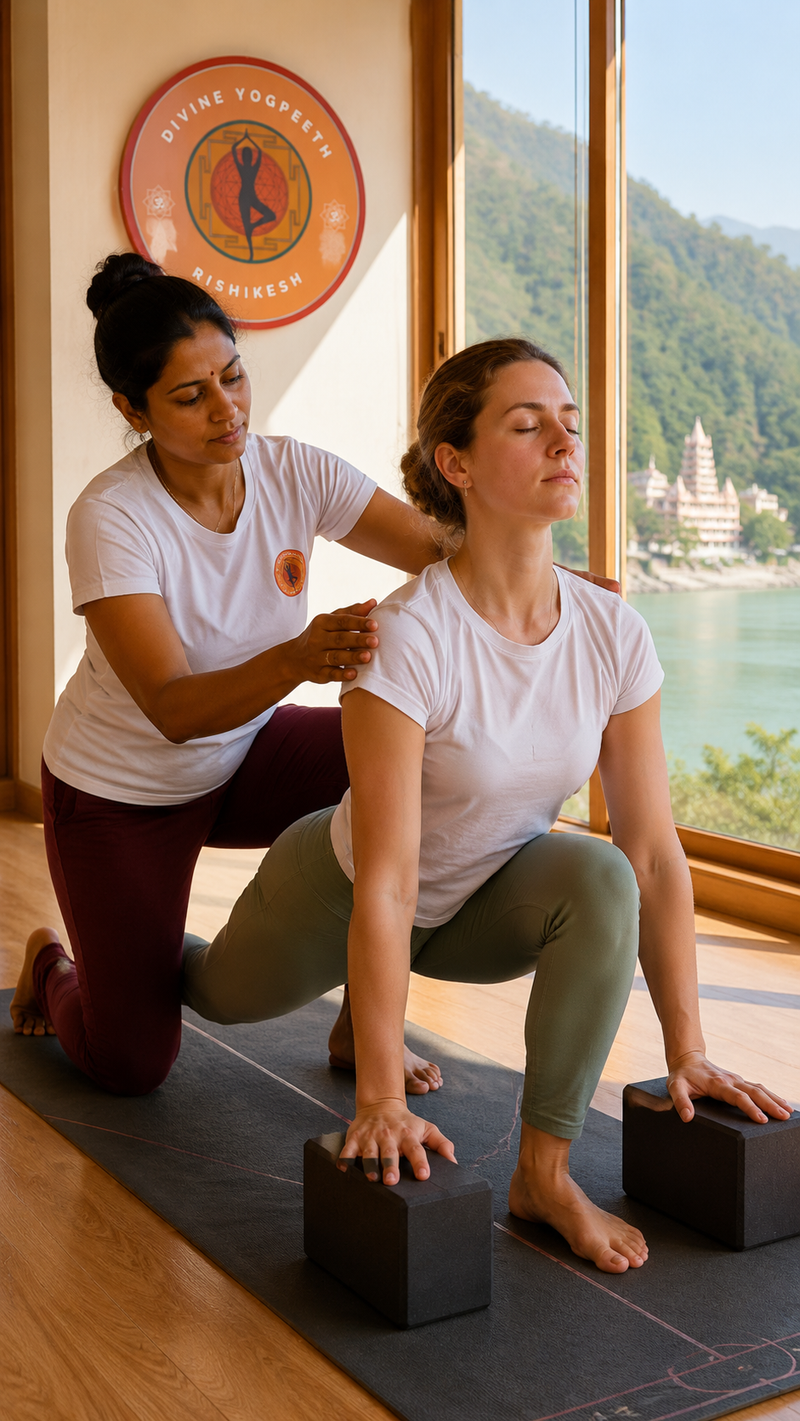
Instructors use specialized props such as wooden blocks, cotton straps, and bolsters to make difficult postures accessible to every body type. If your hamstrings are tight, a block brings the floor closer to you. If your shoulders are stiff, a strap bridges the gap, ensuring you experience the benefits of a pose without straining.
The Clean Slate Advantage
Coming into a training program with zero prior experience offers a massive hidden benefit: you have no bad habits to unlearn. Many self-taught practitioners arrive at advanced courses with deeply ingrained, incorrect alignment habits that put them at risk for chronic injuries. They must spend weeks rewiring their muscle memory.
As an absolute beginner, your muscle memory is a completely blank canvas. You will learn the correct way to perform foundational poses like Downward-Facing Dog (Adho Mukha Svanasana) or Cobra Pose (Bhujangasana) right from day one. This clean slate allows you to build a safe, sustainable, and lifelong personal practice from the very beginning.
This foundational safety also builds immense mental confidence. When you know exactly how to protect your joints, fear disappears from your practice. You begin to look forward to challenging poses because you possess the tools to approach them intelligently and mindfully.
What You Will Study During a Short Foundational Course
The curriculum of a beginner-friendly training is diverse, well-rounded, and goes far beyond the physical execution of postures. Yoga is an integrated science of living, and a quality course reflects this by balancing physical practice with deep theoretical wisdom. You will explore multiple subjects that feed both the body and the intellect.
The primary physical focus is usually Hatha yoga, which emphasizes slow, deliberate movements and holding poses to build physical strength and stamina. This is often paired with basic Ashtanga Vinyasa, which introduces dynamic movement synchronized with the breath. Together, these styles give you a comprehensive understanding of both static and fluid movement patterns.
Beyond the physical mat, a significant portion of your day is spent exploring traditional breathwork, known as pranayama, and various meditation techniques. You will discover how specific breathing patterns can instantly calm your nervous system, lower stress levels, and improve mental focus. According to guidelines supported by traditional health bodies like the Ministry of Ayush, these classical practices form the core of holistic well-being.
Anatomy and Alignment for Safe Practice
Understanding how your body moves is crucial when practicing yoga daily. Beginner anatomy classes do not require a medical background; instead, they focus on practical, functional anatomy. You will learn about major joint mechanisms, muscle groups, and how to prevent hyperextension or compression.
This knowledge empowers you to modify any posture according to your unique skeletal structure. You will begin to understand why certain poses feel natural while others require more time and patience, removing the frustration of comparison.
Philosophy and Yogic Lifestyle
You will also dive into ancient texts, such as Patanjali’s Yoga Sutras, to understand the ethical and philosophical foundations of the practice. This includes learning about the Yamas (social ethics) and Niyamas (personal disciplines), which provide a practical roadmap for living a balanced, peaceful life off the mat.
By studying philosophy, you realize that yoga is not just about what you do with your body, but how you treat yourself and others. It shifts the practice from a simple workout into a profound tool for mental clarity, emotional maturity, and self-discovery.
Shifting from Student to Practitioner: The Two-Week Evolution
The transition that takes place over a two-week immersive course is often remarkable. On the first day, sitting on the floor for an hour might feel uncomfortable, and your mind might race during meditation. However, as the days progress, your body adapts, your muscles strengthen, and your mental chatter begins to quiet down.
This evolution is driven by the power of consistency. Practicing every single day in a supportive environment accelerates your progress far faster than attending a weekly class at home. By the end of the first week, postures that felt impossible will begin to feel familiar and steady.
To experience a softer, less intensive approach before jumping into a full training schedule, some students choose to begin with a shorter wellness experience. Opting for a 3-day yoga retreat can be an excellent way to dip your toes into the yogic lifestyle without any academic pressure. It helps condition your body for the physical demands of a longer course.
As your body opens up, you will notice a parallel shift in your mental clarity and emotional resilience. The physical detoxification from clean food, daily movement, and regular sleep patterns works wonders for your overall vitality. You leave the course not just with a certificate, but with a deeply ingrained personal discipline.
This structural shift helps you build healthy habits that stick with you long after you return home. You will find yourself naturally waking up earlier, choosing cleaner foods, and handling stressful situations with greater calm. The training essentially rewires your relationship with your own well-being.
Why Rishikesh is the Ultimate Destination for Your First Yoga Training
Choosing where to study is just as important as choosing the course itself. Rishikesh, located in northern India, is globally recognized as the birthplace of yoga, drawing seekers from every corner of the earth for centuries. The energetic environment of this ancient town provides an unparalleled backdrop for an immersive learning experience.
The town is uniquely situated where the sacred Ganga River flows out of the towering Himalayan foothills. The combination of flowing water, mountain air, and centuries of spiritual practice creates a unique atmosphere that naturally supports introspection and focus. It is an environment where the distractions of modern technology easily fade away.
Living in a dedicated yogic community allows you to absorb the practice culturally and experientially, rather than just academically. You will hear temple bells in the morning, see classical practitioners along the riverbanks, and eat nutritious, freshly prepared vegetarian meals that fuel your practice.
Furthermore, studying here connects you with a diverse, global community of like-minded individuals. You will share classrooms, meals, and life stories with people from completely different backgrounds who share your exact passion for wellness. This sense of shared purpose creates lifelong friendships and a powerful global support network.
The sacred area of Laxman Jhula adds another layer of charm to your stay. Walking across the suspension bridge, exploring local organic cafes, and listening to the river creates a meditative rhythm that complements your classroom studies perfectly. It is truly a living classroom where yoga is felt in every breath.
Finding Your Footing on the Mat
If you are considering training in Rishikesh, Divine Yogpeeth offers a nurturing space with experienced teachers who specialize in guiding beginners from their very first steps on the mat. Our school blends traditional wisdom with modern teaching methodologies to ensure you build a safe, empowering foundation for your lifelong practice.
Our campus provides a peaceful sanctuary where you can focus entirely on your self-growth without external noise. We emphasize personalized attention, ensuring that our class sizes remain small enough for instructors to adjust your alignment carefully. From dietary needs to philosophical queries, our team supports you through every stage of your entry into the yogic lifestyle.

Frequently Asked Questions About Beginner Yoga Training
Can I take a 100-hour course if I am completely inflexible?
Absolutely. Inflexibility is the reason you practice yoga, not a barrier to entry. The training will teach you how to use props and modifications to safely increase your range of motion over time without forcing your body. You will quickly realize that true yoga is about the breath and awareness, not touching your toes.
Will I be certified to teach after a 100-hour program?
A 100-hour course provides a certificate of completion, but you generally need a full 200-hour certification to register as a teacher globally. Think of the 100-hour course as the perfect foundational building block that you can later upgrade to a full teaching credential. If you realize you want to complete your full professional path right away, you can seamlessly transition into our comprehensive 200-hour yoga teacher training to earn your international teaching credentials.
What should I pack for a short training in India?
Pack comfortable, breathable cotton clothing that allows for a full range of movement. You should also bring a reusable water bottle, a notebook for lectures, and an open mind. Most traditional schools will provide yoga mats and all necessary props, though you can bring a personal travel mat if preferred.
What if I cannot perform all the meditation techniques?
Meditation is a practice of observation, not perfection. As a beginner, it is entirely normal for your mind to drift or feel restless during silent sitting sessions. Your instructors will guide you through diverse techniques, from mantra chanting to breath awareness, helping you find the specific style that resonates with your mind.
Conclusion: Take Your First Step Today
Stepping into the world of yoga can feel like a major leap, but a dedicated 100 hour YTT for beginners no experience removes the pressure of perfectionism. It provides a structured, safe, and deeply enriching environment where you can explore your physical limits, calm your mind, and learn ancient wisdom at your own pace. You do not need a background in advanced postures; you only need a willingness to learn and an open heart.
Whether your goal is to eventually teach or simply to cultivate a powerful personal practice, this short intensive course is the ultimate catalyst for personal growth. If you feel ready to immerse yourself in this ancient tradition but prefer to start with a pure wellness focus before academic study, explore our relaxing 5 days retreat to experience the magic of Rishikesh firsthand.
Ready to begin your transformation? Explore our foundational 100-hour yoga teacher training and take the first step today.