.jpg)

Curious about a 100 hour YTT certificate international recognition? Discover the honest truth, teaching limits, and how to use it globally. Find out today!
100 Hour YTT Certificate International Recognition: Does It Hold Weight Globally?
You have finally decided to deepen your practice, but you are likely wondering about a 100 hour YTT certificate international recognition. Is this shorter program enough to let you teach anywhere in the world?
Many aspiring instructors feel overwhelmed by the time and financial commitment required for a full certification.
A shorter course seems like the perfect compromise, but clarity on its global validity is essential before you book your flight.
This guide breaks down exactly what a 100-hour certification means for your professional and personal journey.
You will learn about teaching limits, global studio standards, and whether this stepping stone aligns with your ultimate goals.
Let us clear the confusion so you can focus entirely on what truly matters: your practice.
What Exactly Is a 100 Hour YTT Certificate International Recognition?
When you complete a foundational training program, understanding its global standing becomes your first priority.
Securing a 100 hour YTT certificate international recognition depends entirely on the governing bodies involved.
Globally, the standard baseline for becoming a fully certified, independent instructor is 200 hours.
This means a 100-hour course serves primarily as an introductory module or a continuing education credit.
If you complete a program registered with bodies like Yoga Alliance, the hours often count toward continuing education.
However, this specific certificate alone does not grant you the highly sought-after Registered Yoga Teacher (RYT) status.
RYT status is the standard benchmark most commercial studios demand from their applicants worldwide.
Your 100-hour document proves you have undergone intensive, formal training under qualified lead instructors.
It shows you have studied methodology, anatomy, and philosophy for a significant, dedicated amount of time.
Many students use this certificate as the first half of a much larger educational journey.
They return later to complete another 100 hours to finalize their full 200-hour qualification.
Internationally, wellness centers recognize the dedication required to complete these intensive ashram hours.
Yet, they will likely view you as a practitioner in training rather than a fully qualified lead teacher.
How Does a 100 Hour Yoga Certification Value Compare to the 200-Hour Standard?
Comparing these two programs reveals distinct differences in depth, pacing, and professional outcomes.
The primary difference lies in the breadth of the curriculum and the practical teaching time provided.
Curriculum Depth and Focus
A standard 200-hour program covers every fundamental aspect needed to lead a safe, cohesive class.
It dives deeply into anatomy, philosophy, sequencing, and the business of yoga over several weeks.
A 100-hour program usually represents exactly half of this intensive curriculum.
You might focus heavily on personal alignment and basic philosophy while skimming over advanced sequencing.
If you are confused about which path to choose, understanding the 100 Hour vs 200 Hour Yoga Teacher Training: 5 Best Truths can provide clarity.
This helps align your current availability with your long-term educational aspirations.
Teaching Practicum Requirements
The most crucial component of any global certification is the hands-on teaching practicum.
In a full program, you spend hours leading your peers, receiving feedback, and refining your voice.
Shorter programs dedicate less time to this hands-on teaching experience due to schedule constraints.
You will practice adjusting and assisting, but perhaps not leading a full 60-minute sequence entirely alone.
This is by design, as the focus remains on building your personal foundation first.
Professional Recognition and Liability
Liability insurance is a mandatory requirement for teaching in most Western countries today.
Insurance providers typically require a 200-hour certification as the minimum standard for safe coverage.
Without liability insurance, hiring you becomes a legal risk for commercial gyms and studios.
This makes a standalone 100-hour certificate challenging to use for traditional, full-time employment.
For a comprehensive look at what a full program entails, you can review the detailed curriculum of a 200-Hour Yoga Teacher Training.
Where Can You Actually Teach with a 100h Yoga Certification Value?
Despite the limitations regarding major commercial studios, opportunities still exist for passionate individuals.
You must simply be strategic and creative about where and how you offer your services.
Understanding the legal and cultural landscape of your home country dictates your options.
Private Sessions and Mentorships
Many graduates begin by teaching friends, family members, or colleagues in informal, low-pressure settings.
This builds your confidence and helps you find your unique teaching voice without high-pressure environments.
Leading private sessions allows you to tailor the practice entirely to one person's specific bodily needs.
If you want more insight on navigating this early phase, read about Teaching Yoga After 100 Hour Certification: 5 Best Truths.
Private teaching is an excellent way to log hours and build a loyal client base from scratch.
Community Centers and Volunteer Work
Local community centers often have less stringent hiring requirements than dedicated, high-end yoga studios.
They prioritize enthusiasm, safety, and a willingness to serve the local neighborhood over elite credentials.
Offering free or donation-based classes in parks or community halls is an excellent starting point.
It allows you to log practical teaching hours while giving back meaningfully to your local community.
As you seek out these roles, remember that foundational knowledge is accessible globally; even Wikipedia outlines how modern yoga heavily relies on informal community sharing.
Assisting Senior Teachers
Another brilliant way to utilize your short training is by assisting highly experienced instructors.
You can offer to demonstrate poses or provide hands-on adjustments during their larger classes.
This real-world apprenticeship provides invaluable experience that a classroom setting simply cannot replicate.
Assisting bridges the crucial gap between your initial training and your eventual full certification.
It helps you learn room management and verbal cueing by observing a master at work.
Why Choose a Shorter Course If It Has Limitations?
If the end goal is a full certification, you might wonder why anyone starts with a shorter program.
The reality is that not everyone has the luxury of taking a full month away from their lives.
Time and Financial Flexibility
A 200-hour intensive requires three to four weeks of complete dedication, which is difficult for working professionals.
A 100-hour program usually spans 10 to 14 days, fitting perfectly into a standard annual leave allowance.
It also spreads the financial investment over a longer period, making it much more accessible.
Testing the Waters
Not every practitioner who takes a training course actually wants to become a full-time, professional instructor.
Many simply want to deepen their physical practice, correct their alignment, and understand the deep philosophy.
A shorter course acts as the perfect immersion without the heavy pressure of a career change.
If you realize teaching is your true calling, you already have a incredibly solid foundation to build upon.
If not, you walk away with a transformed body and a peacefully recalibrated mind.
Preparing for the Rigors of Training
Yoga training in India is physically, mentally, and emotionally demanding on every level.
Adapting to early mornings, intensive physical practice, and a strict sattvic diet takes time.
Understanding the 100 Hour YTT Daily Schedule: 5 Best Ways to Prepare helps you brace for the impact.
Starting with a shorter commitment allows your body and mind to adapt gradually to the rigorous ashram lifestyle.
This prevents burnout and ensures you actually enjoy the intensive learning process.
The Essential Skills You Gain in 100 Hours
Even without immediate global teaching credentials, the personal growth you experience is absolutely immense.
The curriculum packs an incredible amount of transformative knowledge into a very short timeframe.
You will walk away with skills that elevate your daily life, not just your time on the mat.
Precision in Alignment and Anatomy
You will break down traditional asanas to understand their biomechanics and subtle energetic benefits.
This prevents injuries in your own practice and teaches you exactly how to modify poses for different bodies.
You learn that a pose is not about how it looks, but how it functions anatomically and safely.
Foundational Breathing and Meditation
Physical postures are only a small, modern fraction of traditional yogic sciences and history.
You will dedicate significant time to mastering pranayama (breathwork) and deep meditation techniques.
These practices regulate the nervous system and build the mental resilience required for teaching.
Introduction to Yogic Philosophy
Understanding the ancient roots of the practice changes how you approach the physical postures entirely.
You will study foundational texts like the Yoga Sutras, exploring concepts that exist far beyond the mat.
This philosophical grounding ensures your future classes have real depth and meaning, rather than just fitness.
Structuring Your Education: The Split Program Strategy
Many reputable schools intentionally design their curriculum in two highly distinct halves.
This modular approach caters perfectly to international students with strict visa limits or time constraints.
You complete the first phase, return home to integrate the knowledge, and come back later.
The Integration Phase
Taking a break between your first and second hundred hours is incredibly beneficial for your personal growth.
It gives you time to establish a consistent self-practice based on correct, safe alignment principles.
You can start incorporating basic sequencing into your daily routine, discovering what feels authentic to you.
When you return for the final phase, you are vastly more prepared than a day-one beginner.
Your body has absorbed the initial shock, and your mind is ready for advanced pedagogical concepts.
Finding Consistency
To make this split strategy work, you must complete both modules with the exact same registered school.
Switching schools halfway through usually invalidates your initial hours due to vast curriculum differences.
Committing to a single institution ensures a seamless, logical continuation of your education.
This is why choosing the right school for your initial investment is absolutely critical to your success.
Do your research and select an ashram whose teaching methodology truly resonates with your spirit.
Navigating Yoga Alliance Continuing Education Requirements
If you are already a certified teacher, a 100-hour course serves a completely different, highly valuable purpose.
It acts as vital continuing education, which is required to maintain active standing with global registries.
Understanding how to log these hours is crucial for your ongoing professional development.
The YACEP Designation
Yoga Alliance requires all registered teachers to complete continuing education hours every three years.
Taking a specialized 100-hour course from a Yoga Alliance Continuing Education Provider (YACEP) fulfills this easily.
It proves to your students and employers that you are committed to lifelong learning and refinement.
Expanding Your Niche
Experienced teachers often use these shorter courses to dive into specialized niches like Yin, Ashtanga, or therapy.
Instead of relearning the basics, you add a powerful new tool to your professional teaching arsenal.
This makes you far more employable and allows you to reach entirely new demographics of students.
The Physical Demands of a Short Intensive Training
Do not let the shorter timeframe fool you; a 100-hour intensive is incredibly demanding on the physical body.
You will be practicing for several hours a day, pushing your muscles and joints to new limits.
Preparation is key to avoiding injury and maximizing your time in the classroom.
Muscle Fatigue and Recovery
Practicing asana twice a day, alongside alignment clinics, naturally leads to significant muscle fatigue.
You will discover muscles you never knew existed, and soreness is a guaranteed part of the journey.
Learning how to recover quickly through proper nutrition, hydration, and rest becomes your secondary education.
Mental Endurance
The physical fatigue often triggers mental resistance, testing your willpower and emotional stability.
Sitting for long lectures after a grueling morning practice requires immense focus and discipline.
This mental endurance is exactly what transforms you from a casual student into a dedicated yogi.
Transitioning from Student to Teacher Mentality
One of the most profound shifts during your training is the evolution of your internal mindset.
You must stop simply absorbing information and begin learning how to project it outward effectively.
This shift requires vulnerability, courage, and a willingness to make mistakes publicly.
Finding Your Voice
As a student, you follow instructions silently; as a teacher, your voice must command the room.
You will practice cueing loudly, clearly, and concisely, stripping away filler words and hesitation.
Finding an authentic teaching voice that does not sound robotic takes immense practice and patience.
Observing Instead of Doing
During practicum sessions, you must train your eyes to scan the room rather than focusing inward.
You learn to spot micro-misalignments in your peers' bodies and verbally correct them without disrupting flow.
This ability to hold space for others is the true hallmark of a confident, capable instructor.
Overcoming Imposter Syndrome as a New Practitioner
Leaving your training bubble and stepping back into the real world often triggers heavy imposter syndrome.
You might feel that your 100 hours are inadequate compared to teachers with decades of experience.
Overcoming this mental hurdle is essential for taking your first steps as a leader.
Embracing the Beginner's Mind
Acknowledge that you are at the beginning of a very long, very beautiful journey of mastery.
You do not need to know everything to teach effectively; you only need to share what you know safely.
Authenticity and humility resonate far more with students than a facade of absolute perfection.
Focus on Your Ideal Student
Remember that you are not trying to teach advanced yogis or senior instructors right now.
Your ideal student is someone who knows slightly less than you do, looking for basic guidance.
By focusing on serving beginners, your 100 hours of knowledge becomes an incredibly valuable, abundant resource.
Why Rishikesh? The Perfect Place to Start Your Journey
When deciding where to lay your educational foundation, location matters immensely to your spiritual growth.
Rishikesh is universally acknowledged as the undisputed yoga capital of the entire world.
Practicing on the banks of the sacred Ganga River offers an energetic resonance you simply cannot find elsewhere.
Authentic Lineage and Atmosphere
The town is steeped in centuries of deep spiritual history and traditional, unaltered wisdom.
You learn directly from Indian masters who have lived and breathed these practices since early childhood.
This pure environment strips away the commercialized aspects of modern wellness, returning you to the roots.
Discovering Yoga in Rishikesh: 7 Proven Reasons It Transforms You highlights why thousands travel here annually.
The energy of the Himalayas accelerates your learning and deepens your meditative states effortlessly.
A Global, Supportive Community
Despite its highly ancient roots, Rishikesh draws a vibrant, diverse, and passionate international crowd.
You will share your classroom with seekers from Europe, the Americas, Asia, and far beyond.
This creates a powerful, immediate support network that extends far beyond the short duration of your course.
The friendships forged during intensive training often become lifelong professional and personal connections.
If you want a small taste of this magic without a long commitment, a 5 Days Yoga Retreat offers a perfect introduction.
Take the Next Step with Divine Yogpeeth
Finding a registered school that honors traditional teachings while maintaining strict global standards is essential.
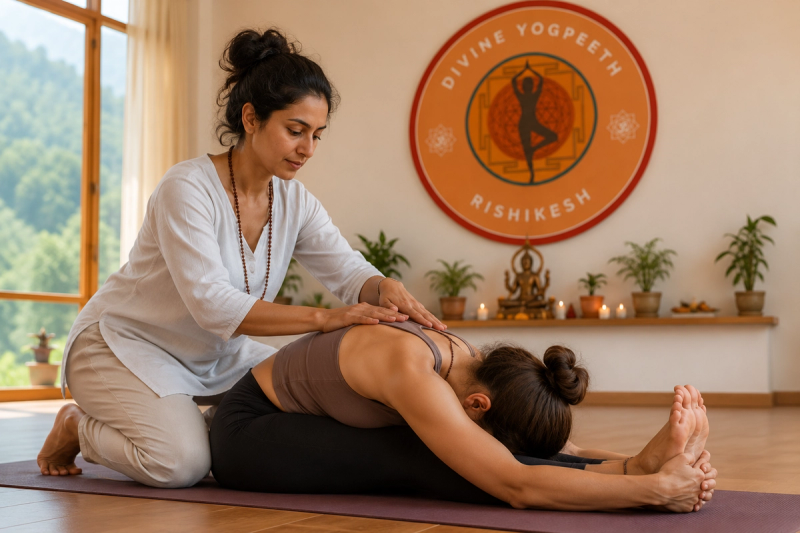
If you're considering training in Rishikesh, we at Divine Yogpeeth offer a supportive, highly experienced environment.
Our foundational programs are carefully designed to build your confidence and refine your physical practice safely.
You will learn from masters who guide you through every physical and emotional challenge with deep compassion.
Start your educational journey in a sacred space where true authenticity and student care are the highest priorities.
Frequently Asked Questions (FAQs)
Can I get insurance with a 100-hour certificate?
Generally, liability insurance providers require a strict minimum of 200 hours of formal, documented training.
A 100-hour document is usually insufficient for full liability coverage in standard Western markets.
Always check directly with local insurance brokers in your specific country for precise, up-to-date regulations.
Does this course count towards a 200-hour certification?
Yes, provided you complete the remaining hours at the exact same school within their specified timeframe.
Most ashrams design their 100-hour course as the first half of their standard 200-hour global curriculum.
Always confirm the exact time limit for completing the second half before enrolling in the initial program.
Is it worth doing if I do not want to teach?
Absolutely, this shorter immersion is the best possible way to deepen your personal practice safely.
You gain profound, lasting insights into your body, your mind, and the philosophical roots of the tradition.
It is a powerful, life-changing journey of self-discovery, entirely regardless of your future career aspirations.
Will international studios respect my 100-hour certificate?
Studios will deeply respect the dedication and foundational knowledge you have acquired by traveling to India.
However, they will almost certainly require you to complete a full 200-hour program before actively hiring you.
Your certificate proves you are on the right path, but it is not the final professional destination.
Conclusion
Your journey into teaching requires immense patience, steady dedication, and the right foundational steps.
While a 100 hour YTT certificate international recognition has specific limits regarding commercial employment, its true value is undeniable.
It serves as the perfect, manageable stepping stone, allowing you to test the waters without overwhelming your schedule.
You gain essential safety skills, deepen your self-practice, and build a sturdy base for future global certifications.
Every master was once a nervous beginner, and this initial immersion is a beautiful place to start.
Ready to begin your journey? Explore our 100-Hour Yoga Teacher Training program or visit our Home page to take the first step today.