.jpg)

100 hour YTT daily schedule explained with timings, yoga classes, pranayama, philosophy and practice in Rishikesh. Discover what to expect from each day there.
100 hour YTT daily schedule explained: What Happens Each Day in Detail
If you are researching a 100 hour YTT daily schedule explained in practical terms, you probably want more than a timetable. You want to know what you will actually do, how demanding the days feel, when you eat and rest, and whether the training gives you enough time to absorb what you learn.
A 100-hour teacher training is shorter than a 200-hour program, but the days can still be intensive. Your schedule may combine asana, pranayama, meditation, yoga philosophy, anatomy, teaching methodology, self-practice, and assessment. The rhythm matters because good training is not simply about accumulating hours; it is about connecting practice, understanding, and teaching.
In this guide, you will see how a typical training day can unfold in Rishikesh, what each session develops, how your energy changes through the day, and what you should check before choosing a school.
100 hour YTT daily schedule explained: How a Typical Day Begins
Most residential yoga teacher training days begin early. The exact timetable varies by school, season, teaching style, and curriculum, so treat any schedule you see online as a realistic framework rather than a universal rule.
A common day may start around 5:30 or 6:00 a.m. with personal preparation, followed by meditation, pranayama, cleansing practices, or an early asana session. Practicing before the heat becomes intense is especially practical in Rishikesh.
The morning block usually requires the most physical and mental focus. You may work on alignment, breath coordination, postures, transitions, or sequencing. If you are unsure how different yoga styles approach practice, learning the fundamentals of Hatha and Ashtanga yoga can give you useful context.
After practice, breakfast and a short break let your body recover and your mind process corrections from class. Later, theory may cover anatomy, physiology, philosophy, Sanskrit terminology, or teaching methodology.
For official context about yoga teacher training standards and credentials, you can review Yoga Alliance.
A useful way to judge a schedule is therefore not just by the number of practice hours. Look at how the school balances physical training, theory, teaching practice, meals, rest, and independent study.
What Does a 100-Hour YTT Daily Schedule Look Like in Practice?
A realistic residential day might look like this. Your school's exact timings can differ, but the sequence shows why the course can feel full without being chaotic.
- 5:30–6:00 a.m.: Wake up, preparation, hydration, and quiet time.
- 6:00–7:00 a.m.: Meditation, pranayama, or cleansing practices.
- 7:00–8:30 a.m.: Morning asana, alignment, or sequencing.
- 8:30–9:30 a.m.: Breakfast and recovery.
- 9:30–11:00 a.m.: Philosophy, anatomy, physiology, or teaching theory.
- 11:00–11:30 a.m.: Break.
- 11:30 a.m.–1:00 p.m.: Teaching skills, demonstrations, or partner work.
- 1:00–2:30 p.m.: Lunch and rest.
- 2:30–4:00 p.m.: Theory, workshops, self-study, or assignments.
- 4:00–5:00 p.m.: Personal time or self-practice.
- 5:00–6:30 p.m.: Evening yoga, meditation, restorative practice, or chanting.
- 6:30 p.m. onward: Dinner, revision, and sleep preparation.
The important detail is that not every hour is physically demanding. A good course uses different forms of learning so that you can stay attentive rather than simply exhausted.
Why the breaks matter
If you judge a course only by how many yoga classes it offers, you can miss a major quality signal. Several hours of demanding movement without meaningful recovery is not automatically better education than focused practice separated by theory and rest.
Meals matter too. If food and accommodation are included, ask about meal timings and what is provided during an intensive schedule. Your energy and concentration will depend on recovery as much as discipline.
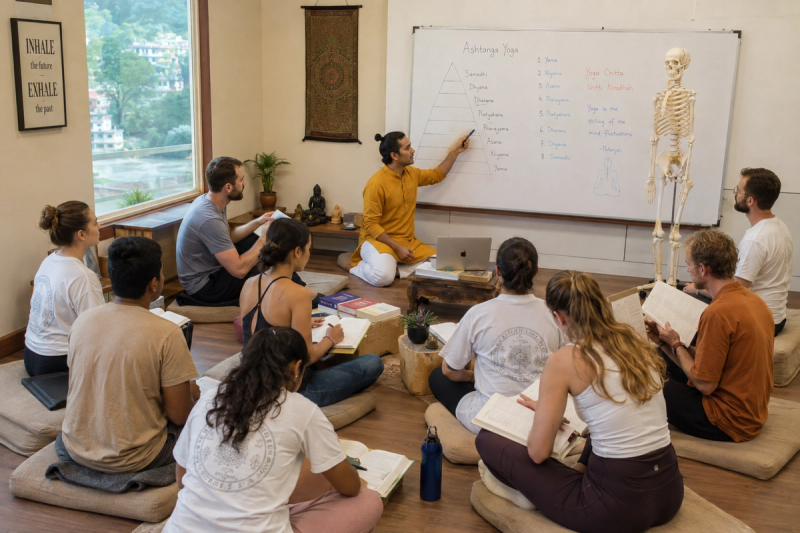
What You Actually Learn During Each Part of the Day
The biggest mistake is assuming a 100-hour course is simply a shorter version of a 200-hour course. A shorter program usually needs sharper priorities. You should leave knowing what you practiced, why you practiced it, and what you can responsibly explain to another person.
Morning asana and self-practice
Morning practice develops physical awareness and discipline. Depending on the curriculum, you may work on standing poses, seated poses, twists, backbends, inversions, transitions, or sequencing.
You should also learn to observe your limits. Teacher training is not a competition to achieve the deepest posture. If a movement causes sharp pain, numbness, or instability, forcing it to satisfy a demonstration is poor practice.
A strong class connects posture with breath and attention. You may repeat a sequence several times with different goals: first to experience it, then to observe alignment, and finally to understand how you would guide another person.
Pranayama, meditation, and subtle practices
Breathwork can involve breathing awareness, controlled techniques, ratios, preparation, and contraindications. Meditation may include breath observation, concentration, mantra, or guided practice.
The goal is not to become perfectly calm every morning. The goal is to understand a method well enough to practice it consistently and explain its basic purpose responsibly.
Philosophy and theory
Yoga philosophy gives context to physical practice. Depending on your curriculum, you may encounter the Yoga Sutras, Eight Limbs, yamas and niyamas, meditation, self-discipline, and ideas about the relationship between body, mind, and awareness.
If the theory feels abstract, connect it to daily behavior. Studying the Eight Limbs of Yoga and their practical meaning can help you treat philosophy as a framework for practice rather than a list of terms to memorize.
Teaching methodology and assessment
Teacher training becomes more useful when you stop being only a student. You may practice giving instructions, demonstrating postures, observing a partner, correcting common mistakes, creating short sequences, and managing the pace of a class.
You can also expect some form of assessment. Depending on the school, this may include written work, practical teaching, attendance requirements, demonstrations, or an examination. Understanding 100-hour YTT exam and evaluation before enrolling can help you prepare for the academic side.
The goal should be competence, not simply receiving a certificate.
For broader background on yoga as a traditional system and its historical development, Britannica's yoga resources can provide useful context.
How Intense Is a 100-Hour YTT Day?
A realistic answer is: it depends on your current fitness, previous yoga experience, sleep, nutrition, and the school's teaching style.
If you already practice regularly, the physical workload may feel manageable while theory and teaching practice become harder. If you are new to structured yoga, your body may need several days to adjust to early mornings, repeated movement, and long periods of sitting during theory sessions.
Do not assume that being flexible means you are ready for teacher training. Flexibility can help with certain postures, but teaching also requires observation, communication, body awareness, patience, and modification skills. The common misconception is explained in whether flexibility is required for yoga teacher training.
Intensity can also change across the course. Early days may feel demanding because you are adapting to the routine. Later, your sleep, breathing, movement patterns, and study habits may become more efficient.
Protect your recovery. Sleep consistently, drink enough water, eat properly, and avoid treating every optional practice as another endurance test. The purpose is learning, not exhaustion.
Why Rishikesh Makes This Daily Rhythm Different
Rishikesh is more than a backdrop for a yoga course. The environment can shape how you experience the schedule.
In Tapovan and the wider Rishikesh area, you are surrounded by yoga schools, practitioners, temples, the Ganga, and the Himalayan foothills. Early morning can be quiet enough for focused practice, while evenings can invite slower movement, walking, reflection, or meditation.
The setting can encourage you to spend less time treating the course like a classroom and more time noticing how practice fits into daily life. You may walk to class, discuss philosophy after sessions, or sit quietly near the river.
But location alone does not make a training good. Rishikesh has schools with different standards, teaching styles, accommodation arrangements, group sizes, and curricula. Compare the actual course structure rather than choosing based only on photographs or the phrase “yoga capital.”
If you want to experience the environment before committing to teacher training, our 3-day yoga retreat in Rishikesh can be a shorter introduction to a structured yoga routine.

What to Check Before You Enroll in a 100-Hour YTT
Before paying a deposit, ask for the detailed timetable. A course page that lists only “yoga, meditation, philosophy, anatomy” does not tell you how your day will actually work.
Check whether the schedule clearly explains:
- Daily start and finish times.
- Number and duration of asana sessions.
- Pranayama and meditation hours.
- Theory subjects and teaching methodology.
- Practical teaching or peer-teaching opportunities.
- Assessment and attendance requirements.
- Meal and accommodation arrangements, if included.
- Weekly days off or lighter periods.
- What happens if you miss a session.
- Certificate and eligibility details.
You should also ask how the school counts the 100 hours. A “100-hour” label can cover different structures depending on the provider, so compare actual instructional content rather than relying on the number alone.
If your main goal is to teach, compare teaching practice rather than only total class hours. You need opportunities to speak, demonstrate, observe, receive feedback, and improve.
If your goal is personal development, you may place more weight on meditation, philosophy, self-practice, and the residential environment.
For a focused program in Rishikesh, you can review our 100-Hour Yoga Teacher Training course and compare the curriculum with your goals.
A Typical Evening: What Happens After the Last Class?
The evening is where many students discover whether they have managed their energy well.
After the last session, you may have dinner, review notes, prepare for the next morning, talk with classmates, or simply rest. You do not need to turn every evening into another study session.
A useful habit is a 15-minute review. Write down one asana cue you learned, one philosophical idea you understood better, and one teaching mistake you want to avoid. That is often more useful than rereading pages of notes without a purpose.
You may also want quiet personal time. Residential training can be socially intense because you are learning and living around other practitioners. Protecting some solitude helps you notice how your body and mind are responding.
Your bedtime matters because an early morning schedule quickly exposes poor sleep habits. Staying up late and then struggling through dawn practice is usually a recovery problem, not a timetable problem.
The best daily rhythm is sustainable. You should finish the day ready to sleep well, not so depleted that you dread the next morning.
Why the 100-Hour Format Can Be the Right Starting Point
A 100-hour program can make sense when you want structured immersion but are not ready to commit to a longer 200-hour course.
It may suit you if you want to deepen your personal practice, explore teaching fundamentals, study philosophy, or build a foundation before deciding whether a longer certification is appropriate.
However, do not assume every 100-hour certificate has the same professional meaning. Check the school's curriculum, stated certification, assessment, and intended outcomes.
If your long-term plan is to teach more comprehensively, compare the program with our 200-Hour Yoga Teacher Training in Rishikesh. The additional hours can allow more time for anatomy, methodology, sequencing, supervised teaching, philosophy, and assessment.
The important question is not “Is 100 hours enough?” in isolation. Ask, “Enough for what?” Your answer should determine the program you choose.
A Soft Step Toward Training at Divine Yogpeeth
If you are considering training in Rishikesh, our 100-Hour Yoga Teacher Training in Rishikesh is a practical place to review the course structure, inclusions, and training details before you decide.
You can compare the information with your preferred pace, learning goals, and expectations for residential yoga education.
FAQs About a 100-Hour YTT Daily Schedule
What time does a typical 100-hour YTT day start?
Many residential programs begin around 5:30 or 6:00 a.m., especially when meditation, pranayama, or morning asana practice is scheduled early. The exact time depends on the school and season.
How many hours per day do you practice yoga?
You may have several hours of practical yoga across the morning and evening, but the full day also includes theory, anatomy, philosophy, teaching methodology, breaks, meals, and self-study. A longer day does not necessarily mean more physical practice.
Is a 100-hour YTT suitable for beginners?
It can be, depending on the school's entry requirements and teaching approach. You do not need advanced flexibility, but you should be prepared for early mornings, regular practice, study, and group learning.
Do you get free time during a 100-hour YTT?
Usually, yes, but free time is limited during intensive residential programs. Meals and scheduled breaks provide recovery, while evenings may offer additional personal time depending on the timetable.
Can you teach yoga after a 100-hour YTT?
That depends on the certificate, school, jurisdiction, and professional setting where you intend to teach. A 100-hour course can build useful foundations, but you should check whether its credential meets the requirements of the organizations, studios, or clients you want to work with.
Conclusion: Use the Schedule to Choose the Right Training
Understanding a 100 hour YTT daily schedule explained in detail gives you a better way to compare courses than simply looking at price or certificate wording.
Look for a timetable that balances practice with theory, teaching skills, recovery, meals, and reflection. You should know what happens in the morning, how much supervised practice you receive, what you study in theory sessions, and how assessment works before you commit.
Rishikesh can provide an inspiring setting, but the quality of your training still depends on the curriculum, teachers, schedule, and learning environment you choose.
If you are ready to explore a structured program, our 100-Hour Yoga Teacher Training in Rishikesh gives you a direct starting point. Review the details, compare them with your goals, and choose a schedule you can genuinely sustain—not one that simply looks impressive on a webpage.