
Explore sound healing instruments, from singing bowls to tuning forks, and learn how each supports relaxation and meditation in Rishikesh. Discover more today.
sound healing instruments complete guide: Explore 7 Powerful Tools Used in Sessions
Have you ever heard a singing bowl ring through a quiet room and noticed how its sound seems to linger long after the instrument stops? This sound healing instruments complete guide explores the tools that create these immersive listening experiences and explains how they are used in relaxation, meditation, and yoga sessions.
From traditional metal singing bowls to crystal bowls, gongs, tuning forks, and chimes, each instrument produces a different combination of pitch, resonance, and vibration. Understanding these differences helps you choose a session that suits your preferences, whether you are a yoga practitioner, a curious beginner, or someone exploring sound-based relaxation in Rishikesh, India.
You will discover how seven commonly used instruments work, what a practitioner may do with each one, and what to consider before booking a session or investing in your own equipment. You will also learn the difference between a calming experience and a scientifically established therapeutic outcome.
The aim is simple: help you approach sound healing with curiosity, realistic expectations, and enough practical knowledge to make an informed choice.
1. What Are Sound Healing Instruments, and How Do They Work?
Sound healing instruments are tools used to create tones, rhythms, and resonances during guided listening, meditation, and relaxation practices. A practitioner may play them around a participant, strike or rub them gently, or incorporate their sounds into a yoga or breathwork session.
The experience involves ordinary auditory perception: you hear changing pitches, overtones, rhythms, and differences in loudness. Some instruments also produce vibrations that can be felt when you are close to them or when an instrument is safely placed in contact with the body.
Your response depends on several factors, including sound intensity, musical preference, cultural associations, your surroundings, and your ability to relax. A slow, sustained tone may help you settle your attention, while a sudden loud strike may feel stimulating rather than calming.
Sound healing is used as a complementary wellness practice, not a replacement for medical care. Research into music-based interventions suggests potential benefits in certain settings, but that does not establish that every sound instrument treats illness or produces the same results for everyone.
For a useful starting point, explore the general principles of yoga through the Yoga Alliance website. A thoughtful approach combines practical experience with an understanding of what research does and does not support.
When choosing an instrument, consider three questions:
Sound: Do you prefer warm, deep tones or clear, high-pitched notes?
Experience: Are you seeking quiet meditation, a group sound bath, or hands-on learning?
Comfort: Can you adjust the volume, distance, and duration to suit your needs?
These considerations are more useful than choosing an instrument simply because it is marketed as having a particular healing frequency.
2. Seven Sound Healing Instruments Every Beginner Should Know
No single instrument is essential for every session. Practitioners select tools according to the atmosphere they want to create, their training, and the comfort of the participants.
Here are seven commonly encountered options.
1. Tibetan and Himalayan Singing Bowls
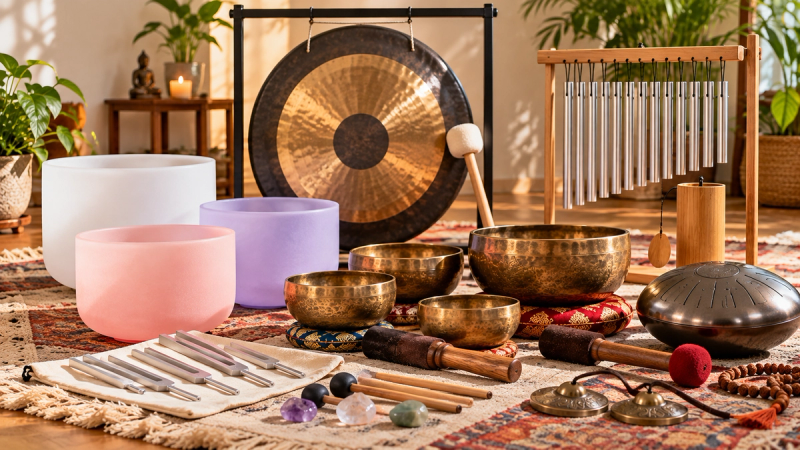
Metal singing bowls are among the most recognisable instruments used in sound meditation. Often associated with Himalayan and Tibetan Buddhist traditions, they produce a rich tone when struck with a mallet or played by moving a suitable striker around the rim.
Their sound can contain several overlapping frequencies, creating a layered, lingering resonance. A practitioner might play one bowl at a time or combine several bowls to create contrasting tones during a relaxation session.
Best suited for: Guided meditation, gentle sound baths, and focused listening.
If you are new to sound meditation, notice how a bowl's tone changes as it fades. You do not need to identify musical notes or follow a complicated technique. Simply listening can become an anchor for attention.
Metal bowls vary considerably in size, construction, and sound quality. Handmade appearance alone does not guarantee superior performance, so listen before purchasing whenever possible.
2. Crystal Singing Bowls
Crystal singing bowls are generally made from quartz-based material and produce clear, sustained tones. Compared with many metal bowls, they can sound brighter and more prominent, although the result depends on the bowl's size, construction, and playing technique.
A practitioner may use a single bowl for focused listening or combine several bowls in a longer session. Their sustained sound can help establish a consistent atmosphere for meditation.
Best suited for: Spacious sound baths, gentle relaxation, and practitioners who enjoy clear, ringing tones.
Crystal bowls can be loud at close range. Their sound may feel soothing to one person and uncomfortable to another, especially in a small room. A responsible practitioner should adjust the volume and allow participants to move farther away if needed.
Neither crystal nor metal bowls should be assumed to possess medically proven healing properties simply because a particular frequency is advertised.
3. Gongs
Gongs create a broad range of sounds, from low, soft washes to powerful, complex waves of resonance. Their character changes with the mallet, striking position, force, and instrument design.
During a gong bath, a practitioner may gradually introduce sound, build intensity, and then allow the tones to fade. The result can feel immersive, but it is not necessarily quiet or gentle throughout.
Best suited for: Group sound baths, immersive listening, and experienced participants comfortable with dynamic sound.
If you prefer predictable, low-volume environments, ask whether the practitioner offers a gentle session without dramatic crescendos. You can learn more about the format in this guide to gong bath meditation and its potential benefits.
4. Tuning Forks
Tuning forks are metal instruments that vibrate at a designed frequency when activated. Once struck gently, they produce a relatively clear tone that can be used for focused listening or incorporated into certain body-oriented practices.
Some practitioners hold tuning forks near the ears or body, while others use them as part of specialised methods. Techniques vary, so you should understand what a practitioner intends to do before agreeing to any physical contact.
Best suited for: Focused sound work, small-scale demonstrations, and practitioners interested in precise tonal tools.
A tuning fork's frequency is a physical property; claims that a specific frequency corrects organ function, removes disease, or balances energy centres should not be treated as established medical facts.
For practical technique ideas, see this guide to using tuning forks in sound healing.
5. Koshi-Style and Other Wind Chimes
Chimes produce delicate tones when their elements move against one another. Unlike a bowl that is deliberately struck, a chime can create intermittent sounds with small movements of the hand or air.
Practitioners may use chimes at the beginning or end of meditation, between exercises, or during a gradual transition out of a relaxation practice.
Best suited for: Gentle transitions, quiet meditation, and creating a light, spacious atmosphere.
Choose a chime whose volume and tonal character you enjoy. A bright, high-pitched instrument can be distracting in an otherwise quiet setting, so it is worth listening to a demonstration before buying one.
6. Drums and Frame Drums
Drums add rhythmic sound rather than relying primarily on long, sustained tones. A practitioner may play a steady, gentle pattern to support movement, group activities, or rhythmic meditation.
Frame drums and other hand-played drums vary in pitch and resonance according to their size, construction, and playing technique.
Best suited for: Rhythm-based practices, group participation, and sessions that combine movement with listening.
Rhythmic sound can encourage a sense of structure, but responses differ. If repetitive beats make you feel restless, a bowl-based or quieter session may be a better fit.
7. Voice, Mantra, and Singing
The human voice is an instrument in its own right. Humming, sustained vowels, devotional singing, and mantra recitation use breath and vocal resonance to create sound without requiring additional equipment.
You may encounter individual chanting, group singing, or a teacher guiding participants to hum softly. These approaches can connect listening with breathing, attention, and personal or cultural meaning.
Best suited for: Breath awareness, group participation, devotional practice, and meditation.
You do not need a trained singing voice to participate in a simple humming practice. Keep your voice comfortable, avoid straining, and remain free to listen silently if you prefer.
3. Choosing the Right Instrument for Your Goals
Knowing the names of instruments is only the beginning. The most suitable option depends on your goals, sensitivity to sound, budget, and the type of session you want to experience.
Instrument
Typical sound
Common use
Metal singing bowl
Warm, layered resonance
Meditation and relaxation
Crystal bowl
Clear, sustained tones
Sound baths
Gong
Broad, dynamic sound
Immersive group sessions
Tuning fork
Focused, defined tone
Targeted sound practices
Chimes
Light, intermittent notes
Transitions and gentle meditation
Drum
Rhythmic, pulsing sound
Movement and group practices
Voice or mantra
Flexible pitch and rhythm
Chanting and breath awareness
Match the tool to your preference
If you enjoy quiet, predictable sound, begin with a softly played singing bowl or gentle chimes. If you enjoy richer, more dynamic sound, consider a gong session after asking about its expected volume.
If you want to learn a skill, rather than simply attend a session, look for structured instruction that covers technique, instrument care, listening skills, and participant safety.
Before investing in expensive equipment, try a supervised session and compare a few instruments. The instrument that sounds impressive in a video may feel very different in a small room.
You can also read about the difference between binaural beats and singing bowls. This comparison can help you distinguish electronically generated audio from the acoustic sounds created by physical instruments.
What about frequency and chakras?
Some sound-healing traditions associate particular tones or instruments with the body's chakras. These associations can have personal or spiritual meaning within a practice, but there is no universally accepted scientific standard showing that a specific bowl or tuning fork frequency reliably activates a particular chakra.
If chakra symbolism interests you, approach it as a contemplative framework rather than a diagnostic system. You can explore chakra balancing practices while keeping medical questions separate from spiritual interpretation.
4. How to Use Sound Healing Instruments Responsibly
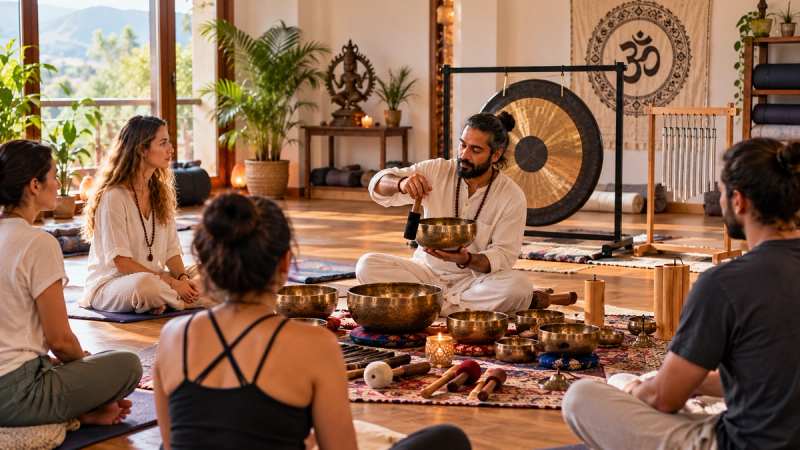
The quality of a session depends on more than the instrument. Room acoustics, volume, the practitioner's technique, and the participant's comfort all matter.
If you are attending a session for the first time, the following principles can help you make an informed choice.
Start at a comfortable volume. Sound that feels pleasant across a room can be overwhelming when played directly beside your head. Practitioners should be willing to reduce the intensity or increase the distance.
Ask before physical contact. Some approaches involve placing bowls on or near the body. You should receive a clear explanation first, and your consent should remain voluntary throughout the session.
Respect hearing sensitivity. Loud sound can cause discomfort and may pose a risk to hearing. If you have tinnitus, sound sensitivity, migraine triggers, or another relevant concern, discuss this with the practitioner and consider professional advice when appropriate.
Keep expectations realistic. A session may feel relaxing, emotionally meaningful, or simply enjoyable. It may also leave you neutral or uncomfortable. None of these responses proves that toxins have been removed, disease has been treated, or a particular energy centre has changed.
Maintain clean, suitable equipment. Instruments and any accessories that touch participants should be kept clean and handled appropriately. Practitioners should explain their methods and respect your boundaries.
If you are interested in research,
is a useful starting point for exploring studies on music, relaxation, stress, and sound-based interventions. Read the methods and limitations carefully: findings about music therapy or general relaxation cannot automatically be applied to every singing bowl or sound-healing technique.
Sound practices should complement, not replace, appropriate medical assessment and treatment.
5. Why Explore Sound Healing in Rishikesh, India?
Rishikesh offers a setting where yoga, meditation, chanting, and other contemplative practices are part of a wider learning environment. In areas such as Tapovan and Laxman Jhula, you can encounter yoga schools, retreat spaces, and practitioners with different approaches to sound-based relaxation.
The setting can add to your experience, but the location alone does not guarantee the quality of instruction. A good session depends on the practitioner's training, clear communication, appropriate sound levels, and respect for individual needs.
If you are travelling from abroad, consider the practical details before booking. Ask what the session includes, whether instruments are played near your body, how long the practice lasts, and whether you can participate without chanting or physical contact.
You may also want to combine a sound session with a broader yoga programme. A short retreat can give you time to explore meditation and mindful movement, while a longer course may offer more structured study.
A 3-day yoga retreat in Rishikesh can be a starting point if you have limited time.
A 5-day yoga retreat in Rishikesh may offer more time to establish a daily practice.
If your interest extends beyond attending sessions, investigate whether a structured training programme matches your learning goals.
Remember that you do not need to believe every traditional or spiritual explanation to benefit from mindful listening. You can appreciate the sound, explore your own response, and make informed decisions based on your experience.
6. Explore Sound Healing Training with Divine Yogpeeth
If sound healing has become more than a passing curiosity, learning in a structured environment can help you understand instruments, practice techniques, and develop a more responsible approach to guiding others.
At Divine Yogpeeth, located in Laxman Jhula, Tapovan, Rishikesh, we invite you to explore our sound healing training course if you want to investigate this practice more deeply.
Before enrolling in any programme, ask about the curriculum, hands-on practice, instructor experience, instrument coverage, assessment methods, and the scope of any certificate awarded. These details matter more than broad promises of healing or guaranteed professional outcomes.
If you are still building your yoga foundation, our 100-hour yoga teacher training may also be relevant to your wider learning interests.
A useful learning experience should allow you to practise listening, compare instruments, adjust sound intensity, and understand when a technique may not be appropriate. It should also make room for questions and acknowledge the limits of current scientific evidence.
Whether your aim is personal exploration or developing complementary skills for wellness settings, choose training that emphasises consent, practical competence, and realistic claims.
7. Frequently Asked Questions About Sound Healing Instruments
Which sound healing instrument is best for beginners?
A metal singing bowl is often a practical starting point because you can learn basic striking and listening techniques with relatively little equipment. However, the best choice depends on the sound you enjoy and how sensitive you are to volume and pitch.
Are crystal singing bowls better than Tibetan singing bowls?
Neither type is universally better. Metal bowls often produce layered, complex tones, while crystal bowls can create clear, sustained sounds. Try both before choosing an instrument for personal use or a professional setting.
How many instruments do you need for a sound healing session?
You can conduct a simple listening practice with one instrument. A larger collection can provide more tonal variety, but additional equipment does not automatically make a session more effective. Technique, volume, pacing, and participant comfort remain important.
Can sound healing cure anxiety, pain, or other medical conditions?
Sound-based relaxation may help some people feel calmer, but evidence varies by intervention and outcome. It should not be presented as a proven cure for anxiety, chronic pain, or other medical conditions. Seek qualified healthcare support for persistent symptoms.
Can you learn sound healing in Rishikesh?
You can explore courses and workshops offered by local yoga and wellness schools. Review the curriculum, teaching experience, practical components, fees, and certificate details before enrolling. A course certificate should not be assumed to grant a medical or psychotherapy qualification.
8. Conclusion: Choose Your Sound Healing Instruments with Confidence
The right sound healing instruments can make meditation more engaging, provide a focus for mindful listening, and help you explore different ways of experiencing sound. From Himalayan singing bowls and crystal bowls to gongs, tuning forks, chimes, drums, and the human voice, every tool offers a distinct listening experience.
Start with your preferences rather than claims about miracle frequencies. Pay attention to sound intensity, choose a practitioner who respects consent, and keep your expectations realistic. If you want to develop your skills beyond attending a session, structured instruction can help you understand the instruments and use them responsibly.
Ready to explore sound healing in Rishikesh? Discover our sound healing training course at Divine Yogpeeth to learn more about the programme and take the next step towards a deeper understanding of sound-based practices..