.jpg)

Create a sound healing space home setup with practical tips for room choice, acoustics, instruments, lighting, and mindful practice. Discover what works.
Sound healing space home setup: How to Create a Calm, Effective Practice Room
A sound healing space home setup does not need a spare studio, expensive instruments, or perfect silence. What matters more is creating an environment where sound can travel clearly and you can settle into your practice without constant distractions.
Think about the last time you heard a singing bowl in a quiet room. The sound may have seemed to linger long after the initial strike. Now imagine trying to create that same sense of spaciousness beside a noisy television, cluttered desk, or rattling fan.
Your room influences your practice more than you might expect.
In this guide, you will learn how to choose the right location, improve acoustics without expensive renovations, arrange singing bowls and other instruments, use lighting and natural elements thoughtfully, and build a simple routine around your space.
You will also learn why Rishikesh remains such an interesting place to deepen your understanding of sound-based practices, especially when you want to move beyond simply playing an instrument and start developing proper technique.
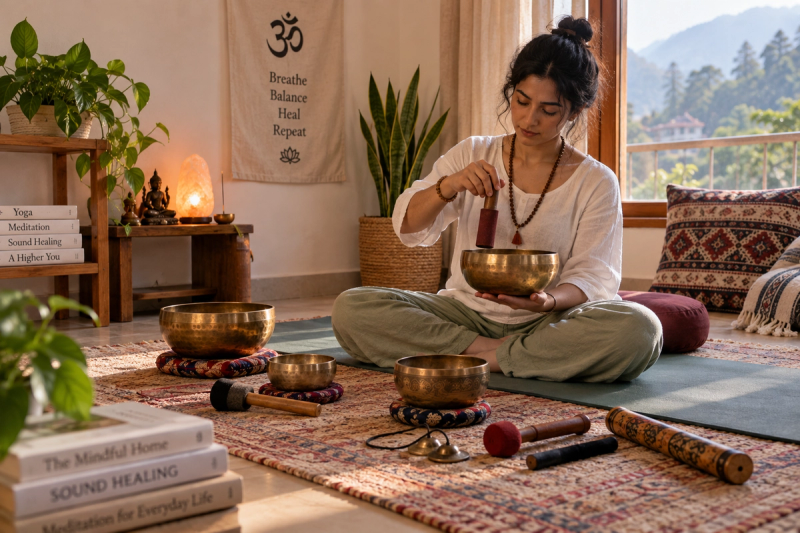
1. Choose the Right Room for Your Sound Healing Space Home Setup
Before buying anything, look at the room you already have. The best space is not necessarily the biggest one. A smaller room can actually work beautifully if it is relatively quiet and allows you to sit or lie down comfortably.
Start by observing the room at different times of day.
Listen for traffic, construction, appliances, conversations, footsteps, and sounds from neighboring rooms. A space that seems peaceful at 10 a.m. may become surprisingly noisy at 7 p.m.
Natural acoustics matter too. Rooms with completely bare walls and hard floors can create strong reflections. That may make certain instruments sound harsh or muddy rather than warm and clear.
You do not need professional acoustic treatment. Begin with simple changes.
A rug can soften reflections from a hard floor. Curtains can reduce some high-frequency reflections from windows. Cushions, blankets, bookshelves, and upholstered furniture can also help break up excessive reverberation.
Keep enough open space around your main practice area so you can comfortably sit, meditate, or lie down.
Think about sound before decoration
A common mistake is designing the room visually first and acoustically second.
Instead, sit in the intended practice position and make a sound. Clap once or strike a bowl gently. Listen to how quickly the sound changes.
You are looking for a room where the sound feels controlled rather than excessively echoing.
You can also learn more about yoga's broader traditional context through Yoga Alliance, particularly if your interest in sound healing is connected to a developing yoga-teaching practice.
Once you have chosen your room, remove unnecessary clutter. You do not need a minimalist showroom, but visual disorder can make it harder to settle into meditation.
A simple mat, comfortable cushion, small instrument table, and a few meaningful objects are usually enough.
2. Build a Practical Home Sound Healing Room Setup
Once the room is selected, decide what you actually need. This is where many beginners overspend.
You do not need ten singing bowls because you saw a beautifully arranged studio online. One well-understood instrument can be more useful than a collection you do not know how to play.
For a basic setup, consider:
- A comfortable yoga or meditation mat
- One or two singing bowls
- A suitable mallet or striker
- A meditation cushion or folded blanket
- A small, stable surface for instruments
- Soft lighting
- A timer or clock kept outside your immediate visual focus
- A water bottle if your practice lasts longer
Place your primary instrument where you can reach it without twisting your body or interrupting your concentration.
If you use multiple bowls, organize them according to how frequently you use them rather than simply displaying them.
Your most-used bowl should be easiest to access.
Give every instrument enough space
Singing bowls need room to resonate. Avoid placing a bowl directly against a wall or on a cluttered shelf where other objects can vibrate against it.
A soft mat or dedicated bowl cushion can provide stability. At the same time, avoid covering the instrument in thick fabric while playing because this can alter its resonance.
You should also protect your hearing and avoid striking instruments aggressively. Sound healing is not about producing the loudest possible sound.
The quality of the tone, your technique, the timing between sounds, and your ability to listen are much more important.
If you are interested in understanding the difference between sound-based approaches, our guide comparing binaural beats and singing bowls can help you think more clearly about what each practice actually involves.
A good home space should also make it easy to stop. Keep the room accessible and uncomplicated so beginning a 10-minute session does not require 20 minutes of preparation.
3. Improve Acoustics Without Turning Your Home Into a Studio
You do not need to renovate your house to create a better acoustic environment.
The goal is balance. You want enough resonance for the sound to feel spacious, but not so much reflection that individual tones become confused.
Start with the floor.
If you have tile, stone, or another hard surface, place a rug beneath your main practice area. This can reduce some unwanted reflections and also make floor-based meditation more comfortable.
Next, consider the windows.
Heavy curtains can soften reflections from large glass surfaces. You can close them during your practice if outside noise or visual distractions are significant.
Walls can be treated simply as well. Bookshelves, fabric wall hangings, cushions, and other irregular surfaces can break up reflections.
You do not necessarily want to make the room completely acoustically dead. Excessive absorption can remove some of the natural character that makes bowls, gongs, chimes, or vocal practices enjoyable.
Test before you buy acoustic products
Try the free solutions first.
Sit where you normally practice. Play your instrument softly. Then add one change at a time.
For example, place a rug under you and listen again. Close the curtains and compare the result. Move a large reflective object away from the instrument.
This simple process tells you much more than buying acoustic panels based on appearance.
You should also think about external noise. If traffic is unavoidable, choose the quietest time of day instead of trying to eliminate every sound.
For many practitioners, learning to remain attentive despite occasional environmental noise is more realistic than expecting complete silence.
If you want to explore structured sound-healing practice rather than only improving your home environment, our sound healing training course offers a more systematic path for learning techniques and applications.
A useful home setup supports practice. It should not become another project that prevents you from practicing.
4. Use Lighting, Natural Elements, and Visual Simplicity Intentionally
Sound is the primary focus, but your other senses influence how easily you settle.
Lighting is one of the simplest things to change.
Bright overhead lighting can feel unnecessarily stimulating during a meditation or sound session. If possible, use softer ambient lighting or natural light during daytime practice.
You can keep the room visually simple without making it sterile.
A plant, a wooden object, a small textile, or a meaningful spiritual item can give the space character. The key is restraint. Every additional object competes slightly for your attention.
Scent requires similar consideration.
If you use incense, essential oils, or candles, keep the amount subtle and make sure ventilation is adequate. Strong fragrances can become distracting, particularly during longer sessions.
Safety matters more than atmosphere. Never leave a burning candle unattended, and be cautious with smoke around children, pets, or anyone sensitive to fragrances.
Create a consistent sensory environment
You do not need the room to look identical every time, but consistency can help establish a practice cue.
For example, you might dim the lights, place your mat in the same location, sit quietly for two minutes, and then begin with three gentle sounds from your bowl.
Over time, these repeated actions can signal that your practice is beginning.
You can also combine sound work with meditation or gentle yoga. If your practice includes chakra-focused meditation, you may find our beginner's guide to chakra meditation useful for understanding how meditation can complement a broader sound-based routine.
The important point is not to create a theatrical environment. Create one that helps you pay attention.

Why Rishikesh? Why This Matters for Sound Healing
Rishikesh offers something that a perfectly decorated home room cannot: immersion in a living yoga environment.
The location itself can influence how you approach practice. Along the Ganga, around the ashrams and yoga schools of Tapovan and Laxman Jhula, you encounter people studying meditation, yoga, Ayurveda, chanting, breathwork, and related contemplative disciplines.
That does not automatically make every practice authentic or effective. You still need to evaluate teachers, training methods, course structure, and your own goals carefully.
For someone interested in sound healing, the advantage of studying in a dedicated environment is that you can receive direct feedback.
A teacher can observe how you hold a mallet, how much force you use, how you allow a bowl to resonate, how you transition between sounds, and how you structure a session.
Those details are difficult to learn reliably from watching random videos online.
Rishikesh is also useful because sound practices often sit alongside other disciplines rather than existing in isolation.
You may encounter chanting, meditation, pranayama, yoga philosophy, and traditional approaches to wellbeing within the same learning environment.
If you are planning a broader yoga experience in the city, you can also explore practical considerations in this guide for foreigners attending a yoga retreat in Rishikesh.
The objective is not to copy a Rishikesh studio inside your house.
It is to bring home the qualities that make practice sustainable: simplicity, consistency, attentive listening, and respect for the method.
A Simple Routine for Your Home Sound Healing Space
Once your room is ready, keep your first sessions surprisingly simple.
You might begin with 10 to 15 minutes rather than attempting a one-hour sound bath immediately.
Start by sitting comfortably and noticing your natural breathing. Give yourself a minute or two before introducing sound.
Strike your bowl gently and listen until the sound naturally fades.
Do not rush to produce another tone.
The silence between sounds is part of the experience. It gives you an opportunity to notice changes in attention, breathing, and bodily sensation.
After several minutes, you can experiment with different striking positions or gentle circular techniques if your instrument is suitable for them.
Avoid assuming that every technique works with every bowl. The instrument, striker, material, and playing method all affect the result.
At the end, sit quietly for a few minutes.
This final pause is easy to skip, but it helps prevent the session from becoming nothing more than repeated sounds.
If you eventually guide other people, preparation becomes even more important. You need to consider volume, positioning, consent, comfort, accessibility, and the individual needs of participants.
A home practice space is therefore a good laboratory for developing listening skills before you attempt to facilitate sessions for others.
If you want a deeper retreat-based experience alongside your practice, you can explore our 3-day yoga retreat in Rishikesh as one way to experience structured practice away from your usual environment.
When Your Home Setup Is Not Enough
A home sound healing space is excellent for regular personal practice, but there is a point where self-study has limitations.
You may reach that point when you want to:
- Facilitate sessions for other people
- Understand different sound healing instruments
- Develop structured session sequences
- Improve your playing technique
- Combine sound practices with yoga and meditation
- Learn how to work responsibly with participants
At that stage, simply purchasing another instrument will not solve the problem.
Training becomes more valuable.
A structured program can give you supervised practice, feedback, demonstrations, and a framework for understanding how different techniques fit together.
Your home space can then become the place where you continue practicing what you learned rather than the place where you try to figure everything out alone.
If you are developing a broader yoga career, our 100-Hour Yoga Teacher Training in Rishikesh can also be relevant when you want to strengthen your foundational teaching knowledge.
The best setup is ultimately the one you will actually use.
A beautiful room that remains untouched is less valuable than a modest corner where you practice consistently.
FAQs
1. How much space do you need for a sound healing space at home?
You need enough room to sit or lie down comfortably and place your primary instruments within easy reach. For personal practice, a dedicated corner of a bedroom, meditation room, or yoga area can be sufficient.
2. Do you need expensive singing bowls?
No. You can begin with one suitable, good-quality bowl and learn how it responds to your technique. Buying multiple instruments before understanding one properly is usually unnecessary.
3. Should a sound healing room be completely silent?
Not necessarily. Lower background noise is helpful, but complete silence is difficult to achieve at home. Choose quieter practice times and reduce avoidable distractions rather than trying to eliminate every environmental sound.
4. Can you combine sound healing with yoga?
Yes, many practitioners combine sound with meditation, gentle yoga, breath awareness, or relaxation. The exact sequence should match your purpose and level of training rather than following a rigid formula.
5. Can you learn sound healing at home?
You can develop personal familiarity with instruments at home, but learning to facilitate sound healing sessions responsibly requires more than buying instruments or watching videos. Structured instruction and supervised practice can be valuable when you intend to work with others.
Conclusion: Make Your Sound Healing Space Simple Enough to Use
A successful sound healing space home setup is not defined by expensive décor, a large collection of instruments, or a picture-perfect meditation room.
It is defined by whether the space helps you listen.
Choose a relatively quiet room, soften harsh acoustics, keep your instruments organized, use comfortable lighting, remove unnecessary distractions, and establish a short routine you can repeat consistently.
Start small. One bowl, one mat, and 10 minutes of attentive practice can teach you more than an elaborate setup that you rarely use.
And if you want to move from personal experimentation toward structured sound-healing knowledge, we invite you to explore our Sound Healing Training Course in Rishikesh and deepen your understanding through guided learning.
The room is only the beginning. The real practice starts when you become willing to listen carefully.