
Standing yoga poses benefits, techniques and common mistakes explained with practical alignment tips. Build strength and balance safely. Discover more.
Standing Yoga Poses Benefits, Technique and Common Mistakes: A Complete Guide
Standing yoga poses benefits technique is a useful topic to explore if you want stronger legs, better balance, improved mobility, and greater awareness of your posture. Yet simply holding a pose for longer does not guarantee better results. The way you distribute your weight, position your joints, and coordinate your breathing matters just as much.
Think about the last time you held Warrior II or tried to balance in Tree Pose. Did you feel stable and grounded, or were your feet shifting and your shoulders tightening? Small adjustments can change how a posture feels and how effectively you practise it.
Standing asanas can form the foundation of a balanced yoga routine. They teach you to work with gravity, coordinate different muscle groups, and maintain awareness while moving or staying still.
In this guide, you will learn the practical benefits of standing postures, step-by-step techniques for seven useful poses, common alignment mistakes, and ways to build a safer routine. You will also discover how practising yoga in Rishikesh can deepen your understanding of these fundamentals.
1. Standing Yoga Poses Benefits: Why These Asanas Matter
Standing poses ask your feet, ankles, legs, hips, trunk, and upper body to work together. Depending on the posture, you may be building strength, practising balance, improving mobility, or developing greater control over your movements.
Here are the main benefits you can work towards through consistent practice.
Improved balance and body awareness
Poses such as Tree Pose and Warrior III challenge your ability to maintain a stable position. You learn to notice small shifts in weight and make controlled corrections rather than relying entirely on momentum.
This awareness can be useful during everyday activities such as climbing stairs, walking on uneven ground, and changing direction.
Stronger legs and supporting muscles
Chair Pose, Warrior I, and Warrior II recruit the quadriceps, gluteal muscles, and other muscles around the hips and legs. Holding these postures with sound alignment can develop muscular endurance.
The intensity depends on your stance, depth, duration, and current fitness. You do not need to force a deep squat or an extremely wide stance to benefit.
Greater hip and ankle mobility
Some standing asanas involve controlled hip rotation, ankle movement, and changes in leg position. Regular practice may help you explore your available range of motion more comfortably.
Mobility gains are gradual. Stretching sensations should remain manageable rather than sharp or painful.
Better postural control
Mountain Pose looks simple, but it encourages you to notice how your feet support you and how your pelvis, rib cage, shoulders, and head relate to one another.
The goal is not to hold an artificially rigid posture. It is to develop comfortable, adaptable alignment.
Focus and stress management
Maintaining a pose while breathing steadily gives your attention a clear task. This can make practice feel grounding and help you notice tension before it becomes excessive.
Yoga may support general well-being, but standing poses alone should not be treated as a guaranteed treatment for anxiety, chronic pain, or other medical conditions.
For broader background on yoga's history and traditions, explore
.
2. Seven Standing Yoga Poses: Technique and Alignment
You do not need to practise every standing posture in one session. Start with a few foundational asanas and learn how each position feels before adding more challenging variations.
1. Tadasana (Mountain Pose)
How to practise:
Stand with your feet together or hip-width apart, whichever feels more stable.
Spread your toes comfortably and distribute your weight across the heels and balls of your feet.
Keep your knees relaxed rather than forcefully locked.
Let your pelvis rest in a comfortable neutral position and lengthen through your spine.
Relax your shoulders, keep your chin level, and breathe naturally.
Common mistake: Pushing your chest forward, exaggerating the lower-back arch, or gripping your toes to maintain balance.
Correction: Imagine your head rising gently while your feet remain grounded. Make small adjustments instead of forcing your body into a rigid line.
2. Vrikshasana (Tree Pose)
How to practise:
- Begin in Mountain Pose.
- Shift your weight onto one foot without leaning your entire torso sideways.
- Place the other foot against your inner ankle or calf, avoiding direct pressure on the knee joint.
- Bring your hands together at your chest or raise them if your balance permits.
- Look at a stationary point and breathe evenly.
- Release slowly and repeat on the opposite side.
- Common mistake: Pressing the raised foot against the knee or allowing the standing hip to drift excessively outward.
- Correction: Use a wall or chair for support. A lower foot position is a valid variation, not a lesser achievement.
3. Virabhadrasana I (Warrior I)
How to practise:
- Step your feet apart and turn the front foot forward.
- Angle the back foot outward to a comfortable degree.
- Bend the front knee while keeping it aligned generally in the direction of the toes.
- Keep the back leg active and adjust your stance so you can balance comfortably.
- Raise your arms only as far as your shoulders and upper back allow.
- Breathe steadily, then change sides.
- Common mistake: Forcing the hips to face completely forward despite discomfort in the back leg or pelvis.
- Correction: Allow a natural hip angle, shorten your stance if necessary, and prioritise stability over depth.
4. Virabhadrasana II (Warrior II)
How to practise:
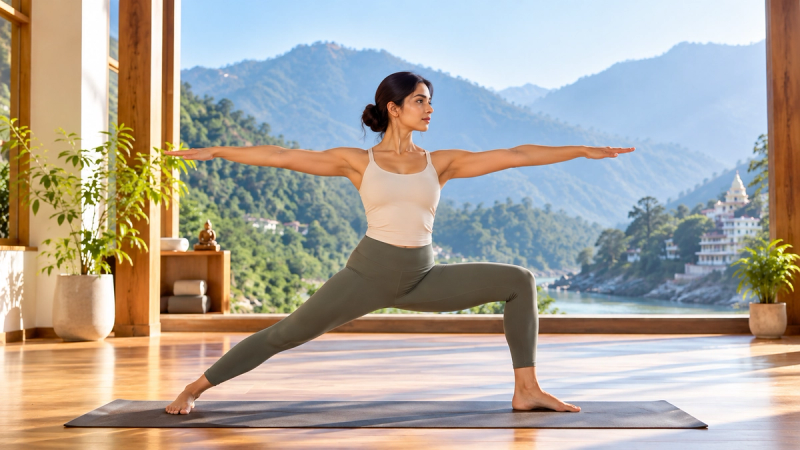
Take a wide stance and turn your front foot outward.
Keep your back foot angled slightly inward.
Bend the front knee while tracking it in the direction of the toes.
Extend your arms at approximately shoulder height without shrugging.
Keep your torso upright and look over your front hand if comfortable.
Repeat on the other side.
Common mistake: Letting the front knee collapse inward or leaning your torso heavily over the front thigh.
Correction: Reduce the depth of the bend and adjust the distance between your feet until you can maintain control.
5. Utthita Trikonasana (Extended Triangle Pose)
How to practise:
Stand with your feet wide apart and turn one foot outward.
Extend your arms to the sides.
Move your torso towards the front leg while lengthening both sides of your waist.
Rest your lower hand on your shin, a yoga block, or another suitable support.
Extend the upper arm towards the ceiling if this feels comfortable.
Keep breathing and repeat on the opposite side.
Common mistake: Reaching the hand towards the floor by collapsing the torso or forcing the chest to rotate upward.
Correction: Raise your supporting hand. A longer spine and comfortable breathing are more useful than touching the floor.
6. Utkatasana (Chair Pose)
How to practise:
Begin in Mountain Pose with your feet comfortably positioned.
Bend your knees and move your hips backward as if approaching a chair.
Keep your weight distributed across your feet.
Raise your arms forward or overhead, depending on shoulder mobility.
Keep your torso long and your knees tracking in the direction of your toes.
Hold briefly before straightening your legs.
Common mistake: Forcing a deep squat, lifting the heels, or allowing the lower back to overarch.
Correction: Reduce the depth and keep your breathing smooth. Your range should match your current strength and mobility.
7. Virabhadrasana III (Warrior III)
How to practise:
Begin standing with your feet grounded.
Shift your weight onto one foot and soften the standing knee.
Hinge forward at the hips while extending the other leg behind you.
Keep your torso and lifted leg moving towards a comfortable level.
Place your hands on your hips, extend them forward, or reach them backward.
Return to standing with control and switch sides.
Common mistake: Rotating the pelvis open, lifting the back leg too high, or holding your breath.
Correction: Keep the lifted leg lower, use a wall for support, and focus on a stable pelvis rather than achieving a perfectly horizontal position.
For more detail about safe movement and body mechanics, explore our related guide to yoga anatomy, muscles, and joint alignment.
3. Standing Yoga Poses Benefits for Flexibility, Strength and Stability
Each standing posture places different demands on your body. Understanding those differences helps you select poses according to your goals rather than choosing the most difficult-looking asana.
Build strength without sacrificing alignment
Warrior I, Warrior II, and Chair Pose are useful when you want to challenge the muscles that support your legs and hips. Start with short, controlled holds and increase the duration gradually.
If your knees begin to shake excessively, your breathing becomes strained, or your alignment deteriorates, come out of the pose and rest. Fatigue is a reason to adjust your practice, not to push through every repetition.
Develop flexibility gradually
Triangle Pose explores the movement of the hips and trunk, while Warrior variations challenge your ability to maintain a stable stance with different leg positions.
Warm up before practising deeper movements. Avoid bouncing into stretches or pulling yourself farther into a posture with your hands.
Practise stability with appropriate support
Tree Pose and Warrior III challenge single-leg balance. You can practise near a wall, keep one hand on a chair, or lower the lifted leg until you feel secure.
These modifications allow you to practise the intended movement without making falling part of the exercise.
Research on yoga examines a range of outcomes, including mobility, balance, physical function, and well-being. Results vary according to the population, intervention, and study design. You can explore published research through
, the biomedical literature database.
The practical lesson is straightforward: consistent practice with suitable difficulty is more useful than forcing advanced shapes. Your body should remain responsive, and your breathing should not become a struggle.
4. Common Standing Yoga Mistakes and How to Correct Them
Even familiar poses can become uncomfortable when you focus only on their appearance. Small changes in stance, joint position, and breathing can improve the quality of your practice.
1. Locking your knees
Standing with your knees forcefully pushed backward can feel rigid. Keep the joints responsive and avoid forcing them into hyperextension.
2. Distributing weight unevenly
If most of your weight shifts to the outer edges of your feet or your toes grip the floor, your balance may become less comfortable. Notice the contact between your feet and the ground and make small adjustments.
3. Chasing depth instead of control
A deeper Warrior Pose is not automatically better. Bending farther than your current mobility allows may make it harder to maintain knee alignment and a stable torso.
4. Holding your breath
Beginners sometimes concentrate so intensely that breathing becomes shallow or stops briefly. Ease out of the posture if you cannot breathe comfortably.
5. Comparing your body with a demonstration
Different hip structures, proportions, mobility levels, and injury histories influence how a pose looks. Your version does not need to match an instructor's photograph.
6. Ignoring pain signals
Muscular effort and a manageable stretch can be normal. Sharp pain, joint pain, numbness, dizziness, or a sudden loss of balance are reasons to stop and reassess.
7. Skipping the warm-up
Moving directly into a deep lunge or challenging balance can feel uncomfortable when your body is not prepared. Begin with gentle walking, ankle movements, shoulder rolls, and a few comfortable standing transitions.
For more practical guidance, explore our article on yoga injury prevention and safe practice.
If you have persistent joint pain, a recent injury, or a medical condition that affects balance or movement, seek appropriate professional advice before starting a demanding routine.
5. Why Practise Standing Yoga Poses in Rishikesh?
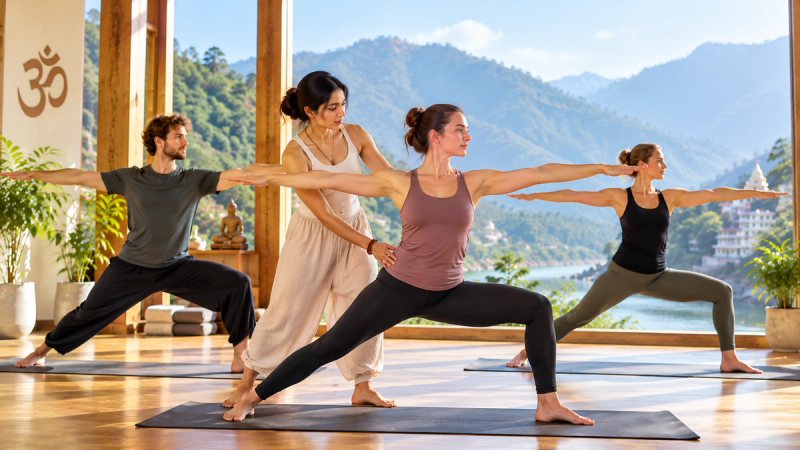
Rishikesh offers a setting where you can explore yoga beyond a sequence of physical postures. The town's yoga schools, traditional teachings, and Himalayan surroundings attract practitioners who want to develop a more consistent practice.
However, the location alone does not guarantee good instruction. The quality of your learning depends on the teacher, class structure, individual feedback, and attention to safety.
Learn through observation and feedback
When you practise standing asanas with a qualified instructor, you can receive guidance on foot placement, knee tracking, hip position, and breathing.
An instructor may also suggest blocks, a wall, or a modified stance. These adjustments help you understand the purpose of a pose instead of simply copying its external shape.
Develop a more consistent routine
Practising in a structured environment can help you establish regular habits. You can learn how to warm up, sequence poses, balance effort with rest, and adapt movements to different ability levels.
If you are visiting from abroad, it is also worth planning your accommodation, travel, and class schedule in advance. Our guide to yoga retreats in Rishikesh for international visitors can help you consider practical details before booking.
Connect physical practice with yoga philosophy
Yoga includes more than physical alignment. Breath awareness, concentration, self-observation, and ethical principles can all inform the way you practise.
For a closer look at the local setting, explore yoga practice in Tapovan, Rishikesh.
A meaningful practice does not require you to perform the most advanced asanas. It requires patience, consistent attention, and an understanding of when to modify or rest.
6. Explore Structured Yoga Learning with Divine Yogpeeth
If you want to develop your understanding of alignment, sequencing, and yoga practice in Rishikesh, choosing a structured learning environment may help you build a stronger foundation.
At Divine Yogpeeth, located in the Tapovan and Laxman Jhula area of Rishikesh, you can explore yoga learning opportunities according to your interests and available time. Our 100-hour yoga teacher training course is one option to investigate if you want a shorter structured training experience.
Before enrolling in any programme, review the curriculum, daily schedule, teaching approach, accommodation arrangements, fees, and certification details. A teacher-training course also involves learning how to observe students and communicate modifications; it is not simply an opportunity to practise challenging poses.
If you are considering a longer course, you can also explore our 200-hour yoga teacher training in Rishikesh and assess whether its curriculum fits your experience and goals.
The right programme should support your learning without promising instant flexibility, perfect balance, or guaranteed health outcomes.
7. FAQs About Standing Yoga Poses
Which standing yoga pose is best for beginners?
Mountain Pose is a practical starting point because it teaches foot placement, comfortable alignment, and body awareness. You can then add supported Tree Pose and gentle Warrior variations as your confidence improves.
How long should you hold a standing yoga pose?
Start with approximately 15–30 seconds if that feels comfortable, then adjust according to the posture and your ability. You do not need to hold every pose for the same duration. Stop sooner if you experience pain, dizziness, or difficulty breathing.
Can standing yoga poses improve balance?
They can help you practise balance and postural control, particularly when you work with poses such as Tree Pose and Warrior III. Results depend on consistency, the difficulty of your practice, and your individual circumstances.
Can you practise standing asanas every day?
Many people can practise gentle standing poses daily, provided the intensity suits their fitness and recovery needs. Alternate challenging sessions with lighter practice when needed, and avoid movements that aggravate an injury.
Are standing yoga poses suitable for older adults?
Some standing poses can be adapted for older adults, including versions performed beside a wall or sturdy chair. Choose modifications according to mobility and balance, and seek professional guidance when medical conditions or fall risks are present.
8. Conclusion: Build Strength and Balance One Pose at a Time
Standing yoga poses benefits technique become easier to understand when you stop treating each posture as a shape to achieve and start treating it as a skill to practise. Stable feet, comfortable joint positions, steady breathing, and gradual progression form the foundation of a useful routine.
Begin with Mountain Pose, add a supported balance posture, and gradually explore the Warrior poses, Triangle Pose, and <aChair Pose. Pay attention to your body's signals and remember that a modification can be the most effective version for you.
Ready to develop a stronger yoga foundation? Explore Divine Yogpeeth's 200-hour yoga teacher training in Rishikesh to review the programme and decide whether structured yoga study suits your goals.