.jpg)

Student life 200 hour YTT week schedule: see a realistic week in Rishikesh, from sunrise practice and study to teaching practice, rest, and free time. Discover
Student Life 200 Hour YTT Week Schedule: A Real Week in Rishikesh
Student life during a 200 hour YTT week schedule can look demanding on paper: early meditation, asana practice, anatomy, philosophy, teaching practice, meals, assignments, and quiet evenings. But what does a real week actually feel like when you are living and studying in Rishikesh?
A typical week is less about rushing from one class to another and more about learning a steady rhythm. You wake before the city becomes busy, move your body, study with focused attention, eat simple nourishing meals, and gradually become more comfortable teaching in front of others. By the end of the week, you may notice that your idea of “practice” has changed.
This guide gives you a realistic picture of a week in a 200-hour Yoga Teacher Training course in Rishikesh. You will see how mornings, classes, meals, self-study, teaching practice, rest, and free time can fit together. You will also learn what makes the schedule challenging, how to prepare, and what to expect from student life beyond the classroom.
Student Life During a 200-Hour YTT: What Your Week Really Looks Like
A 200-hour YTT week schedule follows a structured routine because teacher training requires more than daily yoga classes. You are developing physical practice, communication, anatomy, philosophy, and teaching discipline.
Your exact timetable can vary by school, season, teacher, and course design. Still, a typical day begins around sunrise and continues through the afternoon, with evenings for study, reflection, practice, or rest.
A representative day might look like this:
- 5:30–6:00 AM: Wake up and prepare
- 6:00–7:00 AM: Meditation, pranayama, or cleansing practices
- 7:00–9:00 AM: Asana and practical yoga class
- 9:00–10:00 AM: Breakfast and personal time
- 10:00 AM–12:00 PM: Anatomy, philosophy, methodology, or related theory
- 12:00–1:00 PM: Lunch and rest
- 1:00–3:00 PM: Teaching methodology, alignment, or practice teaching
- 3:00 PM onward: Self-study, assignments, exploration, or recovery
Do not treat this as a promise of identical hours at every school. The useful point is the rhythm: practice first, study deeply, then apply what you have learned.
If you want to understand the formal framework behind yoga teacher credentials, you can also review Yoga Alliance.
The first few days may feel intense. You are not only using your body; you are asking your attention to remain steady for several hours. Sleep, hydration, and sensible pacing matter as much as flexibility.
A 200-Hour YTT Week Schedule: From Sunrise Practice to Evening Study
The biggest adjustment is often the morning. If you are used to waking at 8 or 9 AM, a sunrise schedule can feel brutal. Give your body time to adapt instead of proving you can function on little sleep.
Morning: Build the foundation
Your morning may begin with meditation, breathwork, or a quiet preparation period. Pranayama can feel very different when you practice it consistently rather than occasionally.
The asana session usually becomes the physical anchor of the day. Depending on the curriculum, you may work with alignment, sequencing, traditional forms, Vinyasa, Hatha, or other approaches. You are learning not just how to perform a posture, but how to observe it, explain it, modify it, and eventually teach it.
Breakfast matters more than you might expect. A heavy meal immediately before movement is uncomfortable, while skipping food entirely can leave you distracted later. A simple, balanced breakfast and enough water can make the difference between feeling present and feeling depleted.
Midday: Learn the theory behind the practice
After morning practice, classes often shift toward anatomy, yoga philosophy, teaching methodology, Sanskrit terminology, or other theoretical subjects.
This is where your notebook becomes valuable. Concepts that seem obvious in class can disappear later. Write down definitions, questions, teaching cues, and examples rather than copying every word.
Lunch is part of your training rhythm too. Give yourself a few quiet minutes after eating instead of immediately starting another task.
Afternoon and evening: Turn knowledge into skill
Teaching practice is where the course starts feeling real. You may first teach one posture, then a short sequence, and gradually guide longer portions of a class.
You will make mistakes: speaking too quickly, forgetting a cue, losing your sequence, or discovering that a clear instruction in your head sounds confusing aloud. That is normal.
Evenings are usually less structured than mornings, but that does not mean they are automatically free. You may review notes, prepare a short sequence, complete an assignment, practice meditation, walk near the Ganga, or simply sleep early.
That balance matters. You are training to teach yoga, not competing to see who can exhaust themselves first.
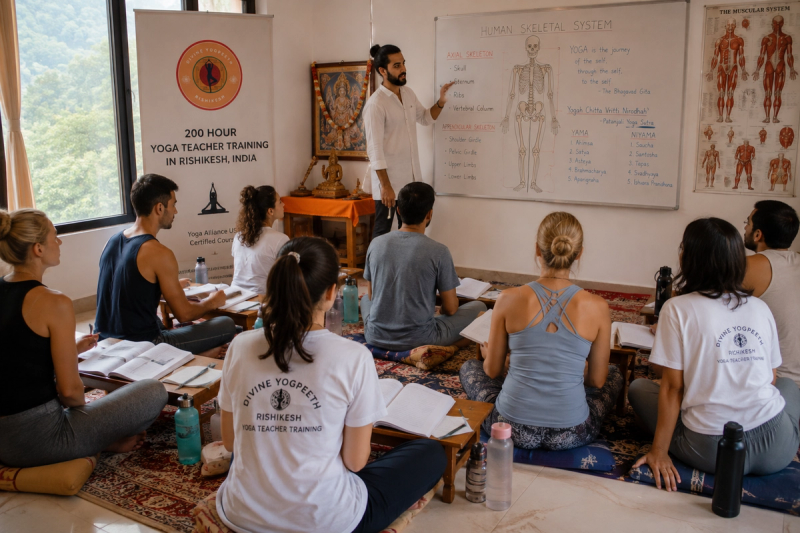
What You Study Beyond the Yoga Mat
A common misconception about 200-hour training is that most of your time will be spent doing advanced poses. In reality, serious teacher training asks you to understand what you are teaching and why.
Anatomy and safe movement
You may study major muscle groups, joints, movement patterns, common alignment concerns, and basic principles of safe instruction. The goal is not to turn you into a medical professional. Instead, you learn to observe movement more intelligently and avoid treating every body as if it has identical proportions, mobility, or limitations.
For broader scientific literature on health and human movement, you can also explore PubMed.
Philosophy and self-observation
Yoga philosophy can challenge the assumption that teacher training is simply a professional qualification. You may discuss ethics, discipline, attention, attachment, self-study, and the purpose of practice.
The important part is connecting ideas with your daily behavior. For example, a discussion about consistency becomes more meaningful when you have to get up for practice even when you would rather stay in bed.
You can explore this side further through our article on why yoga philosophy still matters in modern practice.
Teaching methodology and communication
This is where knowledge becomes instruction. You learn how to demonstrate, cue, observe, offer modifications, organize a sequence, manage time, and communicate with different learners.
You may also practice concise language. Saying less can teach more. Instead of giving five instructions at once, you learn to prioritize the cue that actually helps the student.
That skill matters during practice teaching, when classmates give you direct feedback. If nerves show up, our guide to teaching your first yoga class with confidence offers practical ideas.
Why Rishikesh Changes the Feel of Your Training Week
Rishikesh adds a distinctive environment to student life. You are not training in isolation from the place around you.
In Tapovan and the Laxman Jhula area, you can move between quiet practice spaces, cafés, local streets, temples, markets, and viewpoints around the Ganga. The Himalayan setting can make an ordinary walk after class feel like part of the retreat.
But Rishikesh is not a permanent meditation bubble. It can be noisy, busy, hot, rainy, crowded, or unpredictable. Learning to stay grounded despite those conditions is useful practice.
You also have opportunities to observe how yoga exists beyond a classroom. You may see people practicing by the river, hear Sanskrit chanting, visit traditional spaces, or simply notice how different communities approach spirituality and daily life.
For international students, cultural adjustment can be as significant as the physical schedule. Food, climate, traffic, communication styles, and routines may differ from home.
That is why preparation matters. A helpful guide to practical considerations is our guide for foreigners attending a yoga retreat in Rishikesh.
How to Handle the Hardest Parts of a 200-Hour YTT Week
The hardest part may not be a difficult posture. It may be maintaining attention and energy for an entire week.
You can make the schedule more manageable by protecting a few basics.
Sleep first. If class begins early, late-night socializing will eventually catch up with you. You do not need to experience every café, conversation, or evening event during one week.
Hydrate consistently. Rishikesh weather can make dehydration easier to overlook, especially when you are practicing regularly.
Keep your practice honest. If your body is tired, do not turn every session into a performance. Teacher training should improve your awareness, not encourage you to ignore signals from your body.
Review notes daily. Ten to twenty minutes of review can be more effective than trying to memorize an entire week's material on the final night.
Leave some empty time. Your brain needs recovery. A walk, quiet tea, journaling, or an early bedtime can support learning better than another hour of studying.
Expect emotional ups and downs. You may feel confident one day and question yourself the next, especially when teaching practice exposes habits you did not notice before. That fluctuation is normal.
If you are comparing course lengths, our 100-hour Yoga Teacher Training can also help you understand how a shorter training format differs from a full 200-hour immersion.
A Typical Weekly Rhythm: How the Days Can Feel Different
A useful way to imagine student life is to think about the week as a progression rather than seven identical days.
Monday can feel fresh. You are learning names, routines, and expectations. Your body may still be adjusting to early mornings.
Tuesday often feels more physical. You begin recognizing the pace of the course, but soreness or fatigue may appear.
Wednesday can be mentally demanding. Theory, anatomy, philosophy, and teaching methodology start connecting, which requires concentration.
Thursday often brings more application. You may spend more time practicing how to teach, observe, sequence, and communicate.
Friday can feel like a turning point. You may realize that small changes in your teaching voice or awareness have started to stick.
Saturday may bring consolidation. Depending on the program, you could review material, practice teaching, complete assignments, or have a little more personal time.
Sunday, if it is a rest day, is not wasted time. It gives your body and mind room to recover, explore Rishikesh, wash clothes, journal, call home, or simply do nothing.
Your actual course may follow a different weekly structure, but this progression captures something important: learning often becomes easier once your body accepts the routine.
What Your Free Time in Rishikesh Can Look Like
One of the biggest mistakes is assuming that free time should be packed with sightseeing.
During a 200-hour course, you will probably enjoy Rishikesh more if you resist that temptation. A short walk can be enough. Sitting beside the Ganga for twenty minutes may feel more restorative than organizing a full afternoon trip.
You can use free time to:
- Explore Tapovan and Laxman Jhula.
- Journal about what you are learning.
- Practice a sequence you are preparing to teach.
- Call family or friends.
- Do laundry and reset your room.
- Read about yoga philosophy.
- Take a quiet walk near the river.
- Rest without guilt.
If you want additional wellness experiences, you may also consider a short retreat after training rather than trying to squeeze everything into your course week. Divine Yogpeeth offers options such as a 3-day yoga retreat and a 5-day yoga retreat for a more concentrated retreat format.
A Practical Packing and Preparation Checklist
You do not need a suitcase full of specialized yoga equipment. A practical setup is better.
Bring comfortable clothing that allows movement, a reusable water bottle, personal toiletries, basic medications you normally use, a notebook, pens, and suitable footwear for walking.
For study, consider bringing a small folder or digital system where you can organize anatomy notes, philosophy concepts, class sequences, and teacher feedback.
Mentally, prepare for repetition. You may practice the same fundamental movement several times because teaching requires familiarity. Do not confuse repetition with lack of progress.
Prepare to receive feedback. A good teacher-training environment should challenge you without humiliating you. If a cue is unclear, treat the feedback as useful information.
Most importantly, arrive with realistic expectations. You do not need to become an expert in four weeks. A 200-hour course gives you a foundation; continued practice develops your teaching over time.

Why a Structured YTT Week Matters for Your Future Teaching
The schedule is not simply there to keep you busy. Repetition creates familiarity, and familiarity gives you more confidence when you eventually teach.
When you repeatedly practice meditation, pranayama, asana, anatomy, sequencing, philosophy, and teaching skills, you begin seeing connections between subjects. Anatomy changes how you cue. Philosophy influences how you approach teaching. Personal practice affects how you observe students.
That integration is one of the most valuable outcomes of a well-structured 200-hour course.
If you are considering training with us in Rishikesh, our 200-Hour Yoga Teacher Training in Rishikesh is designed around structured study, practice, and teaching development.
FAQs About Student Life During a 200-Hour YTT
Is a 200-hour YTT schedule difficult for beginners?
It can be demanding, especially if you are not used to early mornings or several hours of focused study. You do not need advanced flexibility, but you do need consistency, willingness to learn, and enough recovery time.
How many hours a day do you study during YTT?
The exact number varies by school and curriculum. Expect a combination of practical sessions, theory classes, breaks, meals, assignments, and self-study. The full day can feel structured even when not every hour is a formal class.
Do you get free time during a 200-hour YTT?
Usually, yes, but it is limited compared with a vacation. You may have evenings or rest days for exploring Rishikesh, calling home, practicing independently, or recovering.
Can you explore Rishikesh while doing teacher training?
Yes, but plan modestly. Short local outings are generally easier to fit around a demanding course than full-day excursions. Protect your sleep and class attendance first.
What should you expect emotionally?
You may experience confidence, frustration, excitement, homesickness, fatigue, and renewed motivation at different points. Teaching practice can expose weaknesses, but that is part of learning how to improve.
Conclusion: Is This Weekly Rhythm Right for You?
Student life during a 200-hour YTT week schedule is not a holiday routine. It asks you to wake early, practice consistently, study seriously, accept feedback, and manage your energy while living in a very different environment.
The reward is not simply completing a timetable. You begin to understand how practice, theory, observation, communication, and self-discipline fit together.
If that kind of structured immersion sounds right for you, explore our 200-Hour Yoga Teacher Training in Rishikesh and see whether the course fits your goals. Your next step does not need to be perfect; it needs to be informed.