
Svadhyaya self study yoga teacher training reveals how reflection, yoga philosophy and mindful practice deepen your growth. Discover its meaning and benefits.
Svadhyaya Self Study Yoga Teacher Training: The Practice of Self-Study That Transforms You
Have you ever completed a challenging yoga practice but realised that you understood very little about your own reactions, thoughts or habits? Svadhyaya self study yoga teacher training addresses precisely this gap by teaching you to look beyond physical postures and observe what happens within you.
In yoga philosophy, Svadhyaya means self-study. It involves understanding your thoughts, recognising behavioural patterns, studying meaningful philosophical teachings and developing awareness through consistent reflection.
During yoga teacher training, this practice becomes particularly important. You are not simply learning how to demonstrate asanas or guide a class. You are learning to understand your own practice before helping someone else develop theirs.
Whether you are an experienced practitioner or preparing for your first teacher training programme, Svadhyaya offers a practical way to deepen your relationship with yoga.
You will discover its philosophical meaning, its connection with Patanjali's Yoga Sutras, practical self-study techniques and why an immersive learning environment in Rishikesh can help you develop this discipline.
1. What Is Svadhyaya in Yoga Philosophy?
Svadhyaya is a Sanskrit term formed from two elements: Sva, meaning self, and Adhyaya, meaning study or investigation.
Together, they describe the practice of studying yourself and developing a deeper understanding of your thoughts, behaviour, beliefs and inner experiences.
However, Svadhyaya is not limited to personal introspection. Traditional yoga philosophy also associates it with the study of sacred texts and teachings that help you understand the nature of existence.
This combination makes the practice particularly meaningful. You examine your personal experiences while using philosophical knowledge to question assumptions and develop greater awareness.
Svadhyaya as One of the Five Niyamas
In Patanjali's eight-limbed system of yoga, Svadhyaya is the fourth Niyama.
The five Niyamas describe personal disciplines that support ethical living and spiritual development.
They are:
- Saucha: Purity and cleanliness of body and mind.
- Santosha: Contentment and acceptance.
- Tapas: Discipline and dedicated effort.
- Svadhyaya: Self-study and the study of philosophical teachings.
- Ishvara Pranidhana: Surrender or devotion to a higher principle.
These practices complement one another. For example, Tapas helps you maintain consistency, while Svadhyaya helps you understand why you struggle with consistency in the first place.
You can explore the broader relationship between these principles through our guide to yoga philosophy and its importance in modern practice.
What Does Patanjali Say About Svadhyaya?
Patanjali discusses Svadhyaya in Yoga Sutra 2.44:
Svadhyayad Ishta Devata Samprayogah.
This sutra traditionally describes a connection with one's chosen deity or spiritual ideal through self-study.
Its interpretation depends on the philosophical tradition. However, its central message highlights the spiritual depth of consistent study and reflection.
For a teacher in training, the lesson is straightforward: understanding yoga requires more than memorising techniques. You must also examine the principles behind your practice.
You can explore the broader context of the Yoga Sutras of Patanjali in teacher training.
2. Why Svadhyaya Self-Study Matters During Yoga Teacher Training
Yoga teacher training places you in a learning environment where physical practice, philosophy, anatomy, breathing techniques and teaching skills develop together.
It can be physically demanding and mentally challenging. You may discover limitations that you never noticed during casual practice.
This is where self-study becomes valuable.
Instead of judging yourself when something feels difficult, you learn to investigate the experience.
For example, imagine that you struggle to maintain balance in a standing posture. Your first reaction might be frustration.
Svadhyaya encourages you to ask different questions:
- Am I holding unnecessary tension?
- Is my breathing becoming irregular?
- Am I comparing my progress with other students?
- Am I approaching the posture with patience?
- What can this experience teach me?
These questions change the purpose of your practice. You stop treating every posture as a performance and start treating it as an opportunity for awareness.
Developing Awareness Beyond Physical Asanas
During training, you might become more aware of how your body responds to different movements, how your attention changes during meditation and how your breathing reacts to stress.
You also begin noticing patterns outside the yoga hall.
Perhaps you become impatient when receiving corrections, hesitate when practising in front of others or struggle to maintain discipline without external supervision.
These observations are valuable because teaching requires patience, communication and emotional awareness.
A teacher who understands personal limitations is generally better prepared to respect the different abilities and experiences of students.
Understanding Your Strengths and Limitations
Self-study does not mean searching endlessly for personal weaknesses.
It also means recognising your strengths without developing unnecessary pride.
You might discover that you communicate philosophical concepts clearly but need more practice with anatomical explanations.
Alternatively, your asana practice may be strong while your confidence in leading group sessions needs improvement.
Recognising these differences allows you to work on specific areas instead of following an unrealistic idea of perfection.
21 Day Yoga, Breathwork, Meditation & Ayurveda Retreat In India • BookRetreats.combookretreats.com
3. Practical Svadhyaya Techniques You Can Develop During Training
Understanding the philosophy is only the beginning. Svadhyaya becomes meaningful when you bring it into your everyday routine.
You do not need complicated rituals or hours of additional practice. A few consistent habits can help you observe your development more clearly.
1. Maintain a Daily Yoga Journal
Journaling is one of the simplest ways to practise self-reflection.
After your morning asana session or meditation, spend five to ten minutes writing about your experience.
Consider recording:
- Which practices felt comfortable or challenging?
- What thoughts repeatedly distracted you?
- Did you notice changes in your breathing?
- How did you respond to corrections?
- What would you like to improve tomorrow?
- Avoid writing only about physical performance.
Your emotional responses, attention and consistency are equally important subjects for reflection.
Over several weeks, your journal may reveal patterns that are difficult to recognise during individual sessions.
For a more structured approach, explore these yoga journaling and self-reflection practices.
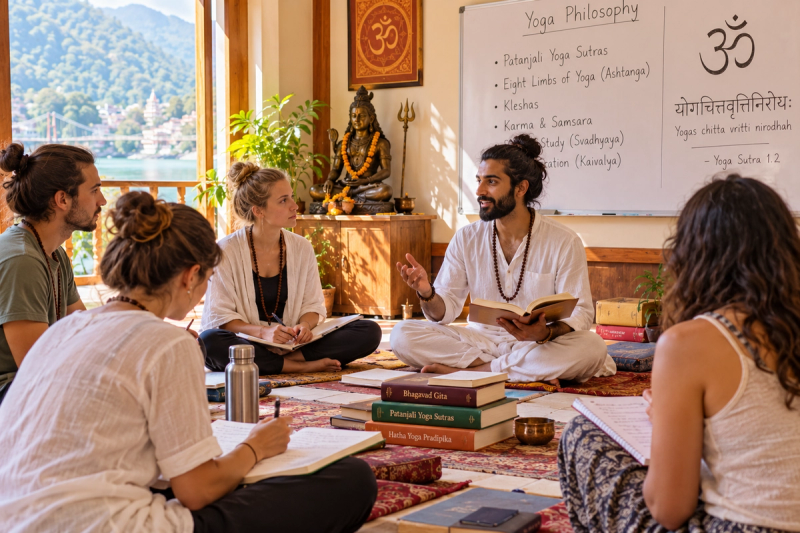
2. Study Yoga Philosophy Consistently
Reading philosophical texts is another traditional component of Svadhyaya.
You can begin with selected teachings from the Yoga Sutras of Patanjali and gradually explore other relevant texts.
Rather than attempting to memorise every Sanskrit verse, focus on understanding its meaning and practical application.
For instance, when studying Ahimsa, examine how non-violence applies to your language, relationships and approach to physical practice.
When studying Santosha, consider whether your desire to improve is creating unnecessary dissatisfaction.
This approach connects philosophical knowledge with everyday behaviour.
3. Practise Mindful Observation During Asanas
Your regular asana practice can become a form of self-study.
Choose a familiar posture and observe what happens while entering, maintaining and leaving it.
Notice your breathing, muscular engagement, alignment and mental reactions.
Do not force yourself into a deeper posture simply to achieve an external result.
The purpose is to understand the relationship between movement, breath and awareness while respecting your body's current capacity.
4. Observe Your Reactions During Meditation
Meditation provides an opportunity to notice how your mind behaves when you become quiet.
You may encounter repetitive thoughts, restlessness, expectations or discomfort.
Instead of immediately trying to suppress these experiences, observe them without automatically following every thought.
This does not mean every meditation session will feel peaceful.
Some sessions may reveal how distracted or impatient you have become.
Recognising that honestly is part of the learning process.
5. Review Your Progress Weekly
Daily reflection helps you understand individual experiences. Weekly reflection helps you identify broader patterns.
At the end of each week, review your journal and identify three things:
- One improvement you have noticed.
- One recurring difficulty that needs attention.
- One practical intention for the coming week.
- Keep your goals realistic.
For example, improving your breathing awareness during practice is more useful than expecting to eliminate every distracting thought within seven days.
4. How Self-Study Changes Your Approach to Teaching Yoga
Becoming a yoga teacher involves more than developing a personal practice.
You eventually become responsible for guiding people with different physical abilities, expectations, learning styles and levels of experience.
Svadhyaya helps you recognise that your personal experience is not automatically the experience of every student.
Developing Empathy and Patience
Imagine a student who cannot comfortably perform a posture that you find relatively easy.
Without self-awareness, you might unintentionally assume that the student lacks discipline or effort.
However, your own experience of limitations can help you respond more thoughtfully.
You become more willing to offer modifications, explain movements differently and recognise that progress varies between individuals.
Becoming More Comfortable with Feedback
Teacher training involves receiving corrections from instructors and sometimes feedback from fellow students.
This can be uncomfortable, particularly when you have invested significant effort into developing a particular skill.
Svadhyaya encourages you to examine your response before becoming defensive.
Ask yourself whether the feedback identifies a genuine area for improvement.
You do not need to accept every opinion without question, but you should be willing to evaluate constructive criticism objectively.
Developing Teaching Ethics
Self-study also supports responsible teaching.
You become more aware of personal biases, limitations and the influence you may have over students.
For example, you learn to distinguish between guiding a student and imposing your own preferences.
This is important when discussing physical adjustments, personal boundaries and different levels of experience.
Explore the principles of yoga teacher ethics and professional responsibility.
For further information about yoga education and traditional wellness initiatives in India, you can visit the official
.
Building Confidence Without Ego
Confidence is important when leading a yoga class.
However, confidence should come from preparation, knowledge and experience rather than the belief that you know everything.
Svadhyaya helps you recognise what you understand and where you need further learning.
This creates a healthier relationship with teaching.
You become more comfortable saying that you need to check a philosophical interpretation or consult a qualified professional about an anatomical question.
That honesty is a strength, not a weakness.
5. Why Rishikesh Is a Meaningful Place to Practise Svadhyaya
Book 3 Day Hatha Yoga Retreat in Rishikesh - Check Costwellness.yatradham.org
Your surroundings can influence how consistently you practise self-reflection.
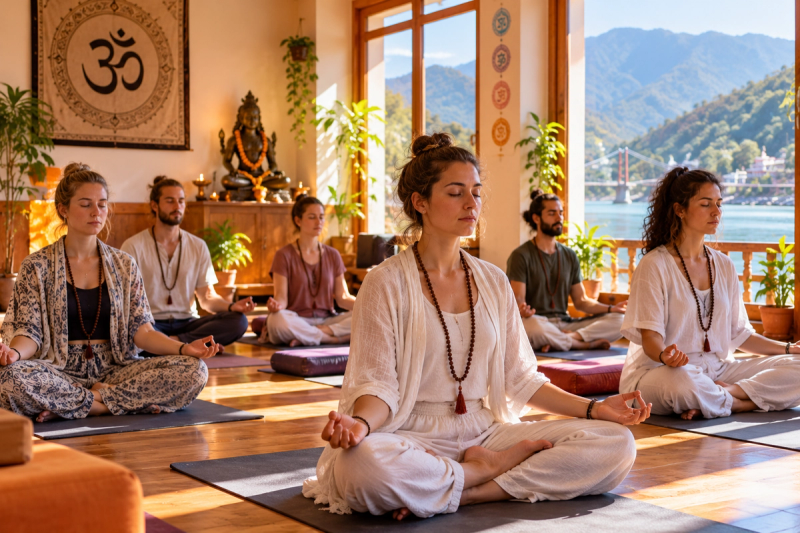
Rishikesh offers an environment where yoga philosophy, traditional learning, meditation and contemporary yoga education are part of everyday life.
Located in Uttarakhand, this Himalayan town attracts practitioners and yoga students from India and different parts of the world.
The presence of the Ganga, nearby hills and established yoga communities can provide opportunities to step away from familiar routines and give more attention to your practice.
Learning in Tapovan and Laxman Jhula
Tapovan and the Laxman Jhula area are well-known locations for yoga schools, meditation spaces and spiritual learning.
You can attend classes, study philosophical concepts and develop a consistent daily routine.
The environment also brings together people with different cultural backgrounds.
Interacting with international students can expose you to different perspectives on yoga, teaching and personal development.
However, the location alone does not guarantee meaningful learning. Your experience depends on the quality of instruction, your willingness to participate and the discipline you maintain.
Creating Space for Reflection
A structured training schedule can help you reduce everyday distractions.
Time between classes can be used for reading, journaling, quiet walks or reviewing the day's lessons.
Even a short period of reflection beside the Ganga can help you organise your thoughts after an intensive learning session.
You can also explore Tapovan Rishikesh yoga and its learning environment to understand the area's appeal to yoga practitioners.
Learning Alongside Different Practitioners
A residential yoga programme brings students together for daily practice and shared learning.
You may encounter people who have practised yoga for years, complete beginners and individuals interested in becoming professional teachers.
These interactions can challenge your assumptions.
You learn that people approach yoga for different reasons, and the same philosophical teaching may influence individuals in different ways.
This diversity makes self-reflection particularly valuable.
6. How to Integrate Svadhyaya Into Your Daily Yoga Teacher Training Routine
Self-study becomes effective when it is part of your routine rather than an activity you perform occasionally.
A structured teacher training schedule provides several opportunities to practise it without adding unnecessary pressure.
Here is an example of how you can integrate reflection into a typical training day.
Time or activity
Svadhyaya practice
Early morning
Observe your mental state before practice
Asana session
Notice alignment, breathing and reactions
Pranayama
Observe changes in attention and breath
Philosophy class
Reflect on the practical meaning of teachings
Practice teaching
Review communication and confidence
Evening meditation
Observe thoughts without judgement
Before sleep
Write a short journal entry
Your actual schedule will depend on the school's timetable.
The important point is to connect self-study with activities you are already performing.
Use Questions Instead of Judging Yourself
A useful self-study habit is replacing negative self-talk with specific questions.
For example:
Instead of saying, "I am not good at meditation," ask, "What makes it difficult for me to maintain attention?"
Instead of saying, "I am a weak yoga practitioner," ask, "Which aspects of my practice need more time and guidance?"
Instead of saying, "I cannot teach confidently," ask, "Which teaching skills should I practise before leading another session?"
This distinction matters.
Self-study should develop awareness, not become another way to criticise yourself.
Maintain Consistency Without Expecting Perfection
You will not always feel motivated to journal or study philosophy.
Some days will be physically exhausting, while others may be mentally demanding.
A five-minute reflection is better than abandoning the practice because you cannot dedicate an entire hour.
The purpose is consistency and honest observation.
You should also remember that self-study does not replace guidance from qualified teachers, particularly when you need feedback about alignment, injuries or teaching methods.
7. Choosing a Yoga Teacher Training Programme That Supports Self-Study
Not every yoga teacher training programme gives equal attention to philosophy and personal reflection.
If Svadhyaya is important to your learning goals, examine the curriculum before selecting a school.
A programme should ideally combine practical training with opportunities to understand yoga beyond physical postures.
Consider these factors:
- Yoga philosophy: Does the curriculum include Patanjali's Yoga Sutras and the Niyamas?
- Experienced instructors: Can teachers explain philosophical concepts with practical examples?
- Practice teaching: Will you receive constructive feedback?
- Meditation and pranayama: Are these taught consistently rather than treated as optional activities?
- Learning environment: Is there enough time for discussion, questions and reflection?
- Student support: Can you approach instructors when you need clarification?
100-Hour or 200-Hour Training: Which Should You Choose?
Your choice should depend on your previous experience and future objectives.
A 100-hour programme may suit practitioners who want a shorter, structured introduction to yoga education or an opportunity to deepen selected aspects of their existing practice.
A 200-hour programme is generally the more comprehensive foundation for those pursuing an initial yoga teacher training qualification.
It typically involves a broader curriculum covering asana, pranayama, meditation, anatomy, philosophy and teaching methodology.
You should also check the programme's certification arrangements and whether its qualification meets your intended professional requirements.
If you are considering a structured programme, compare our 100-Hour Yoga Teacher Training in Rishikesh and 200-Hour Yoga Teacher Training in Rishikesh.
8. Begin Your Self-Study Practice at Divine Yogpeeth, Rishikesh
24 Day 200-Hour Multi-Style Yoga and Ayurveda Teacher Training in Rishikesh, India - BookYogaRetreats.combookyogaretreats.com
Choosing the right learning environment can make a difference when you want to understand yoga philosophy alongside practical teaching skills.
At Divine Yogpeeth, located in Laxman Jhula, Tapovan, Rishikesh, we bring together traditional yoga teachings and structured teacher training.
Our programmes provide opportunities to study different dimensions of yoga, including asana, pranayama, meditation and philosophy.
For students interested in Svadhyaya, the value of training goes beyond completing a syllabus.
It involves developing a consistent practice, asking meaningful questions and learning how philosophical principles can influence your everyday decisions.
Our yoga teacher training programmes in Rishikesh offer a starting point for exploring the available learning options.
Before enrolling, review the curriculum, schedule, accommodation details and certification information to determine whether the programme matches your expectations.
9. Frequently Asked Questions About Svadhyaya in Yoga
What does Svadhyaya mean in yoga?
Svadhyaya means self-study. It involves observing your thoughts, behaviour and experiences while studying philosophical teachings that support deeper understanding. It is one of the five Niyamas in Patanjali's eight-limbed yoga system.
Why is Svadhyaya important in yoga teacher training?
It helps you develop self-awareness, recognise personal limitations, understand philosophical teachings and respond more thoughtfully to feedback. These qualities can improve your preparation for responsible yoga teaching.
How can beginners practise Svadhyaya?
Beginners can start with a simple daily journal, mindful observation during asanas, meditation and regular reading of introductory yoga philosophy. Even five to ten minutes of reflection can establish a useful habit.
Is Svadhyaya only about reading spiritual books?
No. Studying philosophical texts is one aspect, but Svadhyaya also involves examining your own thoughts, actions and experiences. Both intellectual study and personal observation contribute to the practice.
Can Svadhyaya improve your teaching skills?
It can support teaching development by improving self-awareness, patience and your ability to receive feedback. It also helps you recognise your limitations and understand that different students require different approaches.
10. Conclusion: Make Self-Study a Part of Your Yoga Practice
Svadhyaya self study yoga teacher training teaches you that developing as a yoga practitioner requires more than physical flexibility or the ability to demonstrate challenging postures.
It asks you to observe your thoughts, understand your behaviour, study philosophical teachings and approach your limitations with honesty.
As you develop this discipline, you may become more patient during practice, more receptive to feedback and more thoughtful when guiding others.
The most meaningful progress often comes from the questions you ask yourself consistently.
If you are ready to deepen your understanding of yoga philosophy while building a strong foundation in teaching, explore our 200-Hour Yoga Teacher Training in Rishikesh.
Begin your training with curiosity, practise with discipline and allow self-study to become an essential part of the way you live and teach yoga.