.jpg)

Master vinyasa fundamentals 100 hour YTT in Rishikesh. Build a strong foundation, align your breath, and grow your practice. Discover your true path today.
Vinyasa Fundamentals 100 Hour YTT: What You Will Master
Stepping onto the mat for a vinyasa fundamentals 100 hour YTT is the exact moment your practice transitions from merely following motions to truly embodying the essence of yoga.
You have probably felt that disconnect before—moving through a fast-paced class, wondering if your hips are squared, if your shoulders are safe, or if you are even breathing correctly.
This foundational training strips away the confusion and replaces it with clarity, precision, and unshakeable confidence.
Whether you are aiming to teach eventually or simply want to bulletproof your own daily practice, mastering these mechanics changes everything.
You stop guessing. You stop forcing. You learn to listen to your body and move with intelligent intention.
In this guide, you will discover exactly what you can expect to master during this immersive journey in Rishikesh.
We will break down the anatomy of flow, the science of breath, and the structural integrity that keeps your joints healthy for decades.
You will uncover why practicing in the foothills of the Himalayas amplifies your growth and how this knowledge translates into real-world stability.
Let’s explore the profound shift that happens when you finally understand the "why" behind every movement you make on the mat.
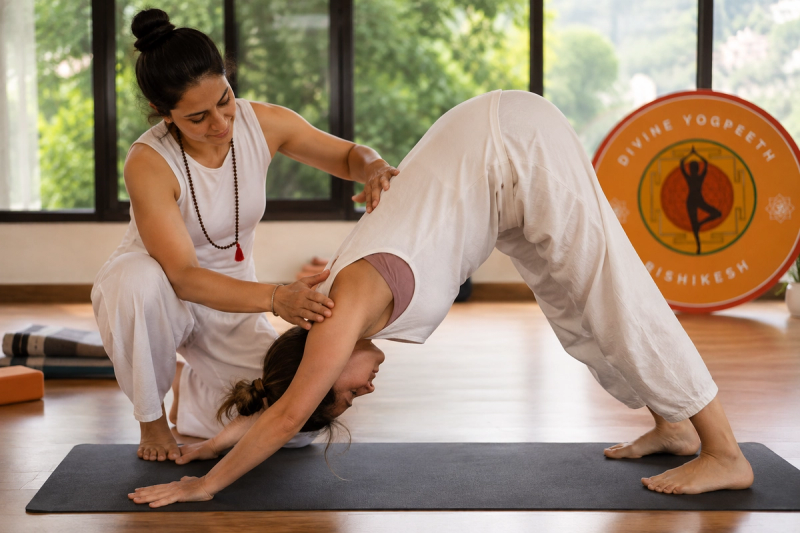
1. Core Vinyasa Fundamentals 100 Hour YTT
When you dive into the core of your vinyasa fundamentals 100 hour YTT, you are doing much more than memorizing poses. You are deconstructing the entire architecture of movement.
Vinyasa translates to "arranging something in a special way," and that is exactly what you learn to do with your physical and energetic body.
Instead of rushing from upward dog to downward dog, you start examining the micro-movements that make the transition safe and effective.
A Yoga Alliance recognized curriculum ensures you are getting a structured, globally respected standard of education.
You break down the primary series, analyzing the skeletal alignment required for every single shape. You begin to understand that an asana is never a static, locked position.
It is a living, breathing expression of your current physical state. During this training, you will spend hours dissecting the physical mechanics of the body.
You learn how to properly engage your core to support your lower back during deep backbends.
You discover the secret to distributing weight in your hands so you never experience wrist pain during chaturanga again.
This knowledge is not just for future teachers—it is mandatory for anyone who wants a sustainable, lifelong practice.
By mastering these foundational elements, you prevent the chronic wear and tear that plagues so many modern practitioners. You learn to practice smarter, not harder.
2. Mastering Vinyasa Flow Basics
Mastering vinyasa flow basics is about learning to ride the invisible current of your breath. It is the crucial difference between a clunky, disjointed sequence and a seamless, liquid flow.
In this phase of your training, you focus heavily on the spaces between the postures. Most injuries happen during transitions, not in the peak poses themselves.
You will learn how to navigate these transitions with grace, control, and immense core stability. You discover the power of the bandhas, or energetic locks.
Engaging your Mula Bandha (root lock) and Uddiyana Bandha (navel lock) transforms you from feeling heavy and gravity-bound to feeling light and buoyant.
Suddenly, jumping to the top of your mat is no longer a loud, thudding effort. It becomes a controlled, floating movement.
You realize that strength in yoga comes from the deep intrinsic muscles, not just the superficial muscles you see in the mirror.
You will also explore how to modify the flow for different body types and energy levels. Not every day requires a fiery, intense sequence.
You learn how to dial back the intensity while maintaining the structural integrity of the flow. This adaptability is the hallmark of a mature yogi.
You start recognizing when your body needs an advanced variation and when it desperately needs the support of blocks and straps.
This deep listening is what keeps you returning to your mat year after year, avoiding burnout and cultivating a truly nourishing daily habit.
3. The Science of Breath (Pranayama) in Vinyasa
If movement is the vehicle of vinyasa, the breath is the absolute engine. During your training, you will stop breathing on autopilot and start utilizing your breath as a precise, therapeutic tool.
The synchronization of breath and movement is what separates yoga from mere calisthenics.
You will dive deeply into Ujjayi Pranayama, the victorious breath, learning how to create that audible, oceanic sound at the back of your throat.
This specific breathing technique is not just for ambiance. It directly stimulates the vagus nerve.
According to research available on PubMed, slow, controlled yogic breathing has a profound impact on down-regulating the autonomic nervous system.
You shift from a state of fight-or-flight into a state of rest-and-digest, even while holding a challenging warrior pose. You learn that if you lose your breath, you have lost the yoga.
Your teachers will show you how the inhale naturally creates expansion, upward lifting, and opening in the body.
Conversely, you will feel how the exhale promotes grounding, folding, and surrendering. By mapping these physiological responses to specific asanas, your practice becomes infinitely more intuitive.
Furthermore, you will explore the subtle energy channels known as Nadis. By directing your breath with focused intention, you clear blockages within these pathways, allowing Prana to flow freely.
You learn the mechanics of alternate nostril breathing to balance the left and right hemispheres of the brain, creating a profound sense of equilibrium before you attempt a physical posture.
Mastering this breathwork is the true secret to unlocking advanced physical poses without strain.
4. Understanding Anatomy and Alignment
You cannot safely push your limits until you intimately understand your own biology. The anatomy modules in your training strip away the mystery of the human body.
You will learn the difference between tension (muscle tightness you can stretch) and compression (bone hitting bone, which you can never stretch).
This single realization will completely change how you approach flexibility. You start analyzing the major joints: the shoulders, the hips, the knees, and the spine.
You learn why forcing a lotus pose on tight hips translates directly into meniscus tears in the knees.
By studying biomechanics, you realize that every body is structurally different. The way a pose looks in a textbook might not be how it looks on your unique skeleton, and that is perfectly fine.
This knowledge gives you permission to modify. To understand how these principles fit into a larger educational journey, exploring a detailed 100 Hour Yoga Teacher Training guide provides excellent context.
You learn the precise anatomical cues that prevent dumping weight into your lower back.
You discover how external rotation in the shoulders creates space in the neck during downward dog.
By understanding the intricate pulley system of your muscles and fascia, you become your own best physical therapist, catching bad habits long before they manifest as chronic pain or joint instability.
5. The Art of Intelligent Sequencing
A great yoga class never happens by accident. It is the result of highly intelligent, intentional sequencing.
In this portion of your learning, you move from being a student who follows a sequence to a practitioner who understands the recipe.
You learn the concept of Vinyasa Krama, which means placing steps in a specific, logical order to reach a desired goal.
You will discover how to prepare the body for a peak pose. If your goal is a deep backbend like Wheel Pose, you cannot simply drop into it.
You must systematically open the hip flexors, stretch the chest, and ignite the core and hamstrings first. You learn how to map out this journey safely.
If you are considering sharing this journey with others eventually, starting with a foundational 100-hour yoga teacher training equips you with this exact blueprint.
Equally important is the art of counter-posing. You learn how to neutralize the spine after deep extensions or intense spinal twists.
You understand why an intense hip opener sequence must be followed by stabilizing postures before settling into Savasana.
You will also dive into the psychological arc of a class. A skilled sequence manages the energy of the room, taking practitioners from a state of distraction into a moving meditation.
You learn how to use pacing, tone of voice, and strategic silence to guide this journey, elevating a standard fitness routine into a transformative yogic experience.
6. Why Rishikesh? / Why This Matters
Location is never just a backdrop; it is an active participant in your education. Rishikesh is universally recognized as the yoga capital of the world for a reason.
Situated on the banks of the sacred Ganges River and sheltered by the towering Himalayas, the energetic resonance of this city is palpable.
When you practice here, you are plugging into a current of spiritual dedication that has flowed continuously for thousands of years.
You are not just learning physical shapes in a sterile gym. You are absorbing the authentic essence of the practice right at its source.
As detailed in resources exploring Yoga in Rishikesh: 7 Proven Reasons It Transforms You, the environment itself acts as a master teacher.
The daily rhythm of the ashrams, the sound of temple bells, and the sight of sadhus meditating by the river all strip away your daily anxieties.
The weather in Rishikesh also plays a role in your practice. The warmth of the Indian sun helps your muscles remain supple, allowing for safer, deeper stretching.
The clean, crisp air rolling down from the mountains makes your pranayama practice incredibly potent. Beyond the physical, the cultural immersion is profound.
You will witness ancient fire ceremonies at sunset, chanting ancient mantras as the sky turns orange. This is an experience that simply cannot be replicated in a western studio setting.
It grounds your physical practice in a rich, vibrant spiritual context, fostering rapid, exponential growth.
7. Teaching Methodology and Confidence
Even if you never plan to teach a single public class, the teaching methodology modules will radically transform your own practice.
You learn how to find your voice. Standing in front of a room and guiding others requires a level of grounded confidence that spills over into every aspect of your life.
You learn to speak with clarity, precision, and authentic authority.
You will practice giving clear, concise cues rather than drowning students in wordy explanations. This sharpens your own internal dialogue when you practice alone.
Gaining this kind of New yoga teacher confidence after training is often the most surprising benefit for students.
You learn the art of hands-on adjustments, discovering how a gentle, informed touch can help someone safely find incredible depth in a posture.
This process requires deep observation. You learn to read bodies, recognizing when someone is holding tension in their jaw, or when they are hyperextending a joint.
By learning to look at others with this analytical yet compassionate eye, you become far more aware of your own blind spots.
You start recognizing your own habitual patterns of tension and avoidance.
You learn how to hold space for others to struggle, to breathe, and to breakthrough, which ultimately teaches you how to hold that same patient space for yourself.
8. Beyond the Physical: Yoga Philosophy
Asana is only a tiny fraction of the yogic path. To truly master the fundamentals, you must dive into the ancient texts that birthed this practice.
You will study Patanjali’s Yoga Sutras and explore the ethical guidelines that form the bedrock of a yogic lifestyle.
You discover that the way you treat yourself on the mat directly mirrors how you navigate conflicts in the real world.
You will dive deep into the Eight Limbs of Yoga Philosophy, learning that physical postures are simply a preparation tool to sit comfortably in meditation.
You explore the Yamas and Niyamas, realizing that concepts like Ahimsa (non-violence) apply not just to your diet, but to the aggressive way you might be forcing your knees into a lotus pose.
You learn Santosha (contentment), discovering how to be perfectly at peace with your tight hamstrings rather than constantly fighting them.
This philosophical grounding changes why you show up to your mat. It is no longer about achieving a physical aesthetic or conquering a complicated arm balance.
It becomes a dedicated ritual of self-study (Svadhyaya). You learn to observe your mind's reactions to discomfort, using the physical practice as a laboratory for mental resilience.
This is the profound wisdom that sustains a practitioner for a lifetime, long after the physical body inevitably ages and changes.
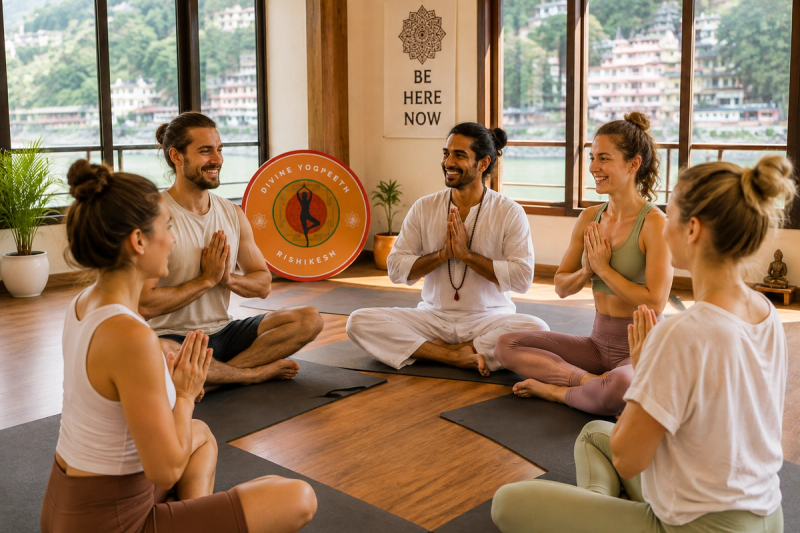
9. Your Next Step: The Divine Yogpeeth Experience
At this stage of your journey, choosing the right environment and guides is the most important decision you will make.
You need a space that honors the ancient traditions while delivering the curriculum in a way that makes sense for the modern practitioner.
If you're considering training in Rishikesh, Divine Yogpeeth offers exactly that balanced, deeply authentic environment.
We provide a sanctuary where you can step away from the noise and focus entirely on your inner evolution.
Our curriculum is meticulously designed to build you up from the foundation. We strip away the intimidating jargon and replace it with practical, usable knowledge.
You are guided by teachers who have dedicated their entire lives to this path, yet remain incredibly approachable and invested in your personal growth.
For those ready to fully immerse themselves and perhaps step into the role of a teacher, exploring our comprehensive 200-hour yoga teacher training provides the ultimate container for transformation.
You will find a supportive community, nourishing sattvic food, and a daily rhythm that heals your nervous system while challenging your physical limits.
10. FAQs
What is the daily schedule like?
Your day typically begins before sunrise with pranayama and meditation, followed by a dynamic physical practice.
After a nourishing breakfast, you dive into philosophy and anatomy lectures. The afternoon brings teaching methodology and a softer evening practice before dinner.
Do I need to be advanced to join?
Absolutely not. This foundational training is designed specifically for students who want to learn the correct mechanics from the ground up.
Beginners are welcomed and often excel because they do not have to unlearn years of bad habits.
Will I be able to teach after this?
This 100-hour module is the first half of a full 200-hour certification.
While it vastly improves your knowledge, you will need to complete the full 200 hours to register as an international teacher. It serves as the perfect stepping stone.
Is the food provided suitable for a sensitive stomach?
Yes. Ashram meals are traditionally Sattvic—meaning they are vegetarian, mild, organic, and specifically prepared to support deep physical practice.
They promote mental clarity without causing sluggishness, keeping your digestive fire balanced and healthy.
Conclusion: Start Your Journey Today
Committing to your vinyasa fundamentals 100 hour YTT is one of the most profound investments you can make in your own well-being.
You are not just learning how to stretch; you are learning how to breathe, how to move with integrity, and how to quiet the relentless chatter of the mind.
This foundation will carry you through every future class, every personal challenge, and every phase of your life with newfound grace.
The physical strength you gain is merely a byproduct of the mental resilience you will forge on the banks of the sacred Ganges River.
Ready to begin? Explore our deeply restorative 5 days retreat to dip your toes in, or take a shorter immersion with our 3 days retreat to take the first step toward lasting peace today.