

Yoga injury prevention teacher training teaches you safer alignment, smart sequencing, and mindful adjustments. Build teaching confidence in Rishikesh. Discover more.
Yoga Injury Prevention Teacher Training: What Every New Teacher Must Learn
Introduction
Yoga injury prevention teacher training is essential if you want to teach with confidence while helping students practise safely. One poorly timed adjustment, an unsuitable pose variation, or a sequence that ignores a student's limitations can turn a beneficial class into an uncomfortable or potentially harmful experience.
As a new yoga teacher, you may feel pressure to demonstrate advanced asanas, correct every student's alignment, and keep a class flowing smoothly. But effective teaching is not about pushing everyone towards the deepest expression of a pose. It is about understanding movement, recognising individual differences, and helping students make informed choices.
Whether you are preparing to teach your first class in India or hoping to build an international teaching career, injury prevention deserves a central place in your education. You need to understand basic anatomy, recognise warning signs, offer accessible modifications, and know when a student should seek professional medical advice.
This guide explains the practical skills that help you create safer yoga classes, avoid common teaching mistakes, and develop a more responsible approach to instruction. You will also discover why studying in Rishikesh can provide a valuable setting for developing your teaching foundations.
1. Why Yoga Injury Prevention Teacher Training Starts with Understanding Risk
Yoga can support mobility, balance, strength, and body awareness. However, no physical practice is entirely risk-free. Repeated loading, excessive stretching, poor technique, unsuitable progression, and ignoring pain can contribute to injuries.
As a teacher, your first responsibility is to understand that students arrive with different bodies, movement histories, fitness levels, and expectations. Two students performing the same asana may need entirely different instructions.
A beginner who spends hours sitting at a desk may have limited hip mobility or difficulty bearing weight through the wrists. Another student may be naturally flexible but lack the strength to control a joint through its available range. Neither student should be judged by how closely they resemble a demonstration.
Recognise the difference between effort and pain
Muscular effort, mild stretching sensations, and the challenge of maintaining balance can occur during practice. Sharp pain, sudden joint pain, numbness, tingling, dizziness, and sensations of instability require a different response.
Teach students to leave a pose or reduce its intensity when something feels wrong. Never encourage them to push through sharp pain or treat discomfort as proof that a pose is working.
You should also understand the limits of your role. A yoga teacher can observe movement, suggest reasonable modifications, and encourage appropriate support. You should not diagnose injuries, prescribe rehabilitation, or promise that yoga will cure a medical condition.
The central principle is straightforward: your student's safety matters more than the appearance of the pose.
For further professional context, consult
and review the standards and scope relevant to your training and teaching practice.
For additional professional context, visit Yoga Alliance to learn more about yoga teacher education and professional standards. Understanding your role and responsibilities is an important step towards teaching safer, more informed yoga classes.
2. Anatomy and Alignment: The Foundation of Safer Yoga Teaching
A working understanding of anatomy helps you explain poses more clearly and recognise when a movement may not suit a particular student. You do not need to become a medical professional, but you should understand how joints move, how muscles contribute to stability, and why individual ranges of motion differ.
Understand joints, muscles, and individual variation
The shoulders, wrists, hips, knees, and spine deserve particular attention because many familiar yoga poses place meaningful demands on these areas.
For example, Downward-Facing Dog requires the shoulders to support body weight while the wrists bear pressure. If a student experiences wrist discomfort, you might reduce the duration, suggest a suitable forearm variation where appropriate, or choose another pose that avoids aggravating symptoms.
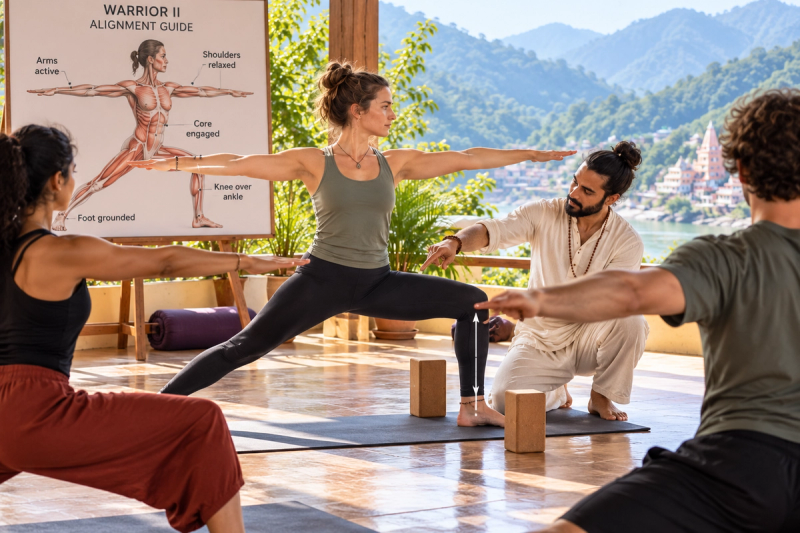
In Warrior II, the front knee generally tracks in the direction of the toes, but your instruction should account for the student's stance, comfort, balance, and available range of motion. Forcing an identical stance on every student is not good alignment teaching.
Teach movement rather than rigid shapes
Good alignment is not about making every body look the same. It is about helping students move with control, distribute effort appropriately, and avoid forcing themselves into positions they cannot comfortably manage.
Useful teaching habits include:
Offering a stable base before adding movement or complexity.
Explaining where students should feel muscular effort and where pain is a reason to stop.
Using blocks, straps, folded blankets, or chairs when they improve accessibility.
Providing a simpler variation before demonstrating a more demanding expression.
Allowing students to rest without embarrassment or pressure.
If you want to study these concepts in greater depth, explore our related guide to yoga anatomy, muscles, joints, and safe alignment.
Anatomy becomes useful when you can translate it into simple, actionable cues. Rather than telling a student to achieve a perfect pose, explain how to establish a comfortable stance, maintain control, and adjust the movement to suit their body.
3. Safe Yoga Sequencing: How to Prepare a Class That Protects Students
A well-designed yoga sequence prepares students for the movements they will perform. It does not simply arrange attractive poses in a particular order. When you understand progression, fatigue, and recovery, you can create classes that feel purposeful without demanding more than students can manage.
Build intensity gradually
Start by considering the physical demands of your planned class. If you intend to teach standing balances, challenging backbends, or weight-bearing arm poses, prepare the relevant movement patterns first.
A beginner-friendly class might follow this structure:
Arrival and observation: Begin with comfortable breathing and gentle movements. Give students time to notice how they feel.
Warm-up: Introduce easy spinal movements, shoulder mobility, hip movements, and gentle weight-bearing preparation where appropriate.
Progressive standing work: Move from simple standing postures towards more demanding variations, allowing time to develop stability.
Peak activity: Introduce the main physical challenge only after suitable preparation. Offer alternatives and avoid excessive repetition.
Cool-down: Gradually reduce intensity through comfortable movements and supported resting positions.
Relaxation: Finish with an opportunity to settle the breath and recover.
The precise sequence should depend on the class objective, student experience, available time, and individual needs. A restorative class, for example, does not require the same preparation as a vigorous Vinyasa session.
Manage repetition, intensity, and fatigue
A pose may feel manageable once but become uncomfortable after repeated loading. This matters particularly in classes that include numerous chaturangas, long wrist-bearing sequences, deep hip stretches, or repeated end-range spinal movements.
Watch how students respond as the class progresses. Shaking, loss of coordination, collapsing alignment, or difficulty following simple instructions may indicate that the exercise needs to be reduced or paused.
Avoid assuming that sweating, exhaustion, or muscle soreness proves a class was effective. Better measures include controlled movement, appropriate challenge, and the student's ability to recover comfortably.
For further guidance on building a class, see our practical yoga class plan template for new teachers.
4. Modifications, Props, and Hands-On Adjustments
One of the most important skills you can develop as a new teacher is the ability to offer an alternative without making a student feel that they have failed.
Students may need modifications because of limited mobility, fatigue, pregnancy, previous injuries, chronic conditions, or simply their current comfort level. You should not assume that someone with a particular limitation can or cannot perform a pose without considering their individual circumstances.
Make modifications part of the original instruction
Instead of demonstrating one demanding version and waiting for students to struggle, introduce choices from the beginning.
For example:
Forward folds: Suggest bending the knees and using blocks to reduce the need to reach the floor.
Lunges: Offer a shorter stance or support from a wall or chair when balance is difficult.
Wrist-bearing poses: Consider reducing loading or choosing a different movement if the wrists are uncomfortable.
Seated positions: Use a folded blanket or suitable cushion to make the position more comfortable.
Deep backbends: Offer a gentler, controlled alternative rather than encouraging students to force their spines into greater extension.
These are general teaching options, not universal solutions. A modification is appropriate only when it suits the student's needs and does not aggravate symptoms.
Use physical adjustments responsibly
Hands-on adjustments require particular care. A student may have an injury, a medical condition, a history of trauma, or a personal boundary that you cannot see.
Ask permission before touching a student, explain what you intend to do, and respect a refusal immediately. Consent should be freely given and may be withdrawn at any time. Do not assume that attending a class implies consent to physical contact.
Whenever possible, use clear verbal cues, demonstrations, and props before attempting hands-on corrections. Never use body weight or force to push someone deeper into a pose.
The same principle applies when teaching international students. Cultural expectations, communication styles, and comfort with physical contact can vary. Clear explanations and respectful choices help create a class where everyone can participate without pressure.
You can also consult the Indian government's
website for broader information about India's yoga and traditional health systems. Professional yoga instruction should remain clear about the distinction between general wellness education and medical treatment.
For broader information about India's approach to yoga and traditional health systems, explore the Ministry of AYUSH website. Remember that general yoga instruction is not a substitute for medical assessment or treatment when a student experiences an injury.

5. Why Rishikesh Matters for Learning Safer Yoga Teaching
Rishikesh offers a distinctive setting for yoga education, with established yoga communities, opportunities for sustained practice, and access to teachers with different approaches to asana, philosophy, breathing, and meditation.
For an aspiring teacher, studying in Rishikesh can provide an opportunity to move beyond learning poses from videos. You can practise giving instructions, observe how other students respond, ask questions, and develop a better understanding of the difference between performing yoga and teaching it.
The setting alone, however, does not guarantee high-quality instruction. A school in a well-known yoga destination still needs a suitable curriculum, capable instructors, meaningful practice-teaching opportunities, and responsible safety procedures.
What should you look for in a teacher training programme?
Before enrolling, ask whether the curriculum covers:
Basic functional anatomy and joint movement.
Common reasons students struggle with particular asanas.
Safe sequencing, warm-ups, and progression.
Variations and prop use for different ability levels.
Verbal cueing, demonstration, and observation skills.
Consent, professional boundaries, and teaching ethics.
Practice teaching with constructive feedback.
Appropriate responses when a student reports pain or becomes unwell.
You should also ask how much time is devoted to supervised teaching. Understanding an alignment principle in theory is different from recognising when a student needs an alternative in a live class.
If you are an international student, review the course language, daily schedule, accommodation arrangements, and any prerequisites before travelling. Indian practitioners should also check whether the course fits their existing knowledge, budget, and intended teaching goals.
For a broader understanding of how the local setting shapes practice, explore yoga in Tapovan, Rishikesh.
Ultimately, choose a programme for the quality of its education and practical supervision, not simply because its location is famous.
6. Building Confidence Through Observation, Communication, and Teaching Ethics
Injury prevention is not limited to anatomy or the physical arrangement of poses. Your ability to observe, communicate, and respond appropriately can be just as important.
A new teacher may become so focused on delivering the planned sequence that they overlook what is happening in front of them. You might notice a student holding their breath, repeatedly shifting away from one side, struggling to balance, or appearing unusually uncomfortable.
These observations do not establish a diagnosis. They are reasons to pause, check in respectfully, and offer a less demanding option.
Learn to ask useful questions
Simple questions can help students communicate their needs:
Is this position comfortable for you?
Would you prefer a supported variation?
Are you experiencing pain, or is this a manageable stretching sensation?
Would you like to rest or leave this movement out today?
Give students time to answer. Avoid interpreting silence as agreement or assuming that a student wants to keep up with the rest of the group.
Your language matters, too. Replace commands such as "push further" or "ignore the discomfort" with instructions that encourage control and choice. Explain that resting is a legitimate part of practice, not a sign of weakness.
Know when to stop and refer
If a student experiences sudden severe pain, fainting, chest pain, significant breathing difficulty, or another potentially serious symptom, stop the practice and follow appropriate emergency procedures.
Persistent or worsening pain, numbness, weakness, swelling, and recurring joint symptoms may warrant assessment by a qualified healthcare professional. Do not attempt to manage a suspected injury through increasingly elaborate yoga modifications.
You should also maintain appropriate professional boundaries. Avoid promising injury prevention as a guarantee, diagnosing conditions, or presenting a yoga teaching qualification as equivalent to clinical training.
If you want to explore the responsibilities involved in beginning your teaching career, our guide to teaching your first yoga class with confidence offers a useful companion perspective.
A responsible teacher understands that knowing when not to teach a pose is a professional skill.
7. How to Turn Injury Prevention into a Daily Teaching Habit
Safety becomes more consistent when you build it into your preparation rather than treating it as a separate checklist. Before every class, take a few minutes to review the demands of your sequence and the needs of the students attending.
A practical pre-class routine can help:
Review the sequence: Identify demanding movements, repeated loading, balance challenges, and positions that may need alternatives.
Prepare variations: Decide in advance which props, simpler movements, or rest options you can offer.
Check the environment: Make sure mats are stable, pathways are clear, and students have enough room to move.
Explain student choice: Tell the class that modifications and rest are welcome throughout the session.
Observe continuously: Adapt your teaching when the class needs a slower pace or a different movement.
Reflect afterwards: Note which instructions worked, where students struggled, and what you should change next time.
You can keep a simple teaching journal with three questions: What went well? Where did students need more support? What will I change in the next class?
Over time, this habit helps you identify recurring problems in your cueing and sequencing. You may discover that a transition needs more explanation, a particular pose requires an earlier modification, or the class becomes fatigued before reaching its intended peak.
Avoid treating a written sequence as a contract. Your plan should guide the session, not prevent you from responding to the people in the room.
For additional professional development, explore the 100-hour yoga teacher training programme as one possible starting point for further study. Before enrolling, confirm the programme's current syllabus, eligibility requirements, and whether its scope matches your learning goals.
8. Learn to Teach with Greater Awareness at Divine Yogpeeth
If you are considering yoga teacher training in Rishikesh, Divine Yogpeeth offers 200-hour yoga teacher training for those exploring a more structured path into yoga instruction.
When comparing programmes, ask how anatomy, alignment, modifications, teaching ethics, and supervised practice are covered. Confirm the actual curriculum with the school rather than assuming every training course provides the same depth of injury-prevention education.
A strong learning environment should help you develop the ability to explain poses clearly, recognise when students need alternatives, and approach teaching with appropriate humility. Your aim should be to graduate with more than a collection of asanas: you should be able to plan a class, communicate responsibly, and understand the limits of your expertise.
9. FAQs About Yoga Injury Prevention Teacher Training
What is yoga injury prevention teacher training?
It refers to learning the knowledge and practical teaching skills that can help reduce avoidable risks during yoga classes. Relevant subjects include basic anatomy, alignment, progressive sequencing, modifications, consent, and recognising when a student needs medical assessment.
Can beginners learn to teach yoga safely?
Yes, beginners can start developing responsible teaching habits through structured education, practice, and supervision. However, completing a course does not make anyone an expert in every student's needs. Continued learning and recognising the limits of your competence remain essential.
Which yoga poses are most likely to cause injuries?
There is no single list of poses that will injure everyone. Risk depends on factors such as loading, technique, repetition, individual mobility, previous injuries, and the demands of the practice. Challenging inversions, deep backbends, and repeated weight-bearing movements may require particular care, especially for inexperienced practitioners.
How can a yoga teacher help students with previous injuries?
Ask about their current comfort and any relevant guidance they have received from a healthcare professional. Offer alternatives that do not aggravate symptoms, avoid diagnosing the injury, and encourage appropriate clinical advice when needed. Do not assume that a pose is safe simply because a student has performed it before.
Is Rishikesh a good place to study yoga teaching?
Rishikesh can be a useful destination for immersive yoga education, but location should not be your only selection criterion. Compare course content, instructor experience, practice-teaching hours, safety procedures, student support, and the training's suitability for your goals.
10. Conclusion: Make Safe Teaching Your Priority from Day One
Yoga injury prevention teacher training is about developing sound judgement, not memorising a list of forbidden poses. As a new teacher, you need to understand basic anatomy, sequence classes progressively, offer useful modifications, respect consent, and respond appropriately when students report pain or discomfort.
The most effective teachers do not try to make every student perform the same shape. They help students practise with greater awareness while respecting individual needs and recognising when professional medical support is necessary.
Whether you plan to teach in India or internationally, make these skills part of your education from the beginning. Choose training that values practical teaching, responsible instruction, and continuous learning alongside asana practice.
Ready to build your foundation as a yoga teacher? Explore Divine Yogpeeth's 200-hour yoga teacher training in Rishikesh, review the curriculum, and ask how the programme addresses anatomy, alignment, modifications, and supervised teaching before you enrol.
Your future students deserve a teacher who values their wellbeing as much as their progress.