.jpg)

100 hour YTT vs weekend yoga workshop comparison: see differences in depth, teaching practice, time, cost, and Rishikesh fit before you choose. Discover today
100 hour YTT vs Weekend Yoga Workshop: A Straightforward Comparison
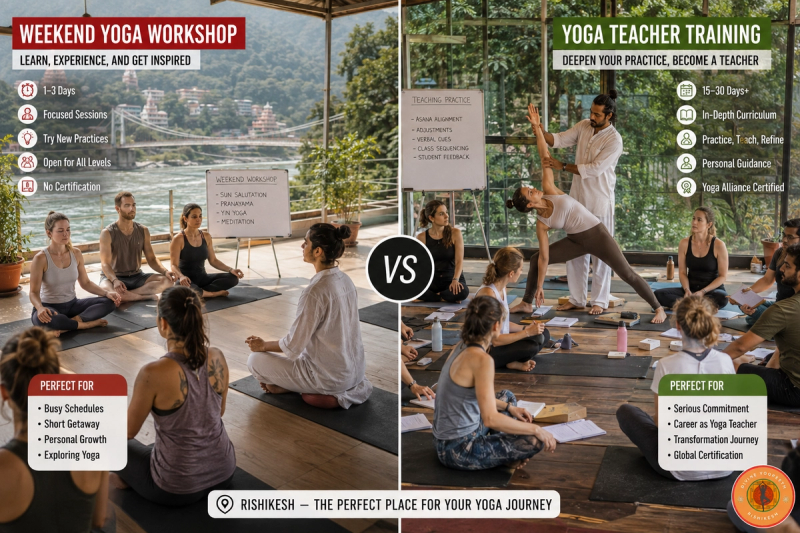
A 100 hour YTT vs weekend yoga workshop comparison can save you from choosing a course simply because it fits your calendar. If you have only a few free days, a weekend workshop can be useful—but if you want structured teacher training, the difference in depth is substantial.
The real question is not which option is “better.” It is what you want to walk away with. A short workshop can introduce you to a technique, theme, or practice without asking you to reorganize your life. A 100-hour YTT asks for more time, consistency, study, practice teaching, and self-reflection.
In this guide, you will compare the two formats by depth, schedule, teaching preparation, practice, certification expectations, cost, and suitability. You will also see why Rishikesh can make a longer training feel more immersive and how to decide whether a 100-hour course or a weekend format makes sense for your current goals.
100 hour YTT vs Weekend Yoga Workshop: What Is the Real Difference?
At the simplest level, the difference is depth. A weekend yoga workshop is usually designed around a focused subject or experience. A 100-hour yoga teacher training is a structured educational program with enough time to revisit concepts, practice them, receive feedback, and connect separate parts of yoga study.
A weekend format may cover topics such as alignment, meditation, pranayama, sequencing, restorative yoga, or a particular style. You can learn something valuable in two or three days, especially when the instructor keeps the scope realistic.
A 100-hour program gives you a wider learning arc. Instead of attending a session and moving on, you normally have repeated contact with theory and practical work. You have more opportunities to ask questions, notice weaknesses, and improve your technique.
That distinction matters if you are considering teaching. A workshop can sharpen an existing skill, but it should not automatically be treated as equivalent to comprehensive teacher education.
For background on professional yoga teacher credentials, you can review the official Yoga Alliance (nofollow) site and compare its current standards with the specific training you are considering.
If your goal is a substantial foundation in asana, pranayama, meditation, anatomy, philosophy, teaching methodology, and related practices, a longer course generally gives you more room to build those foundations.
When a Weekend Workshop Makes More Sense
A weekend workshop is a sensible choice when you want a targeted learning experience. You might already teach yoga and want to deepen one area, or you may be curious about a practice before committing to a longer program.
It also works well when your schedule is tight. A two- or three-day workshop can let you explore yoga education without taking weeks away from work, university, family, or other responsibilities.
The limitation is equally clear: short duration restricts repetition and feedback. If you are exploring wellness practices alongside yoga, the comparison of binaural beats and singing bowls is another example of why a focused workshop can serve a different purpose from a broad teacher-training curriculum.
You may understand an idea during the session but have little time to test whether you can apply it confidently on your own.
100-Hour Yoga Teacher Training vs Weekend Workshop: Depth, Practice, and Feedback
Think about learning to teach yoga as a skill rather than a collection of facts. Knowing what a posture is called is one thing. Observing a student, explaining the movement clearly, adapting it appropriately, and maintaining a coherent class are different skills.
A 100-hour YTT can create more space for that progression. You can move from explanation to demonstration, from guided practice to independent practice, and from theory to teaching exercises. The exact curriculum varies by school, so you should always check what hours and subjects are actually included.
A weekend workshop normally has a narrower objective. That is not a weakness if the objective is narrow by design. A focused workshop may be excellent for learning one method without the commitment of a full training.
The difference becomes especially important when you learn teaching methodology.
With more time, you can work on:
- Giving concise verbal instructions.
- Demonstrating safely and clearly.
- Building a logical sequence.
- Managing transitions and class pace.
- Offering appropriate variations.
- Observing students instead of simply performing alongside them.
- Receiving instructor feedback and applying it in another practice.
A useful comparison is depth versus convenience. The workshop wins on convenience. The 100-hour course generally wins on continuity.
You should also consider what happens between classes. Longer training gives you more chances to practice outside formal sessions, review notes, and identify questions that only appear after you try something yourself.
What You Actually Learn in Each Format
Course titles can be misleading, so compare the curriculum rather than the number printed on the brochure. Two workshops can have completely different outcomes, just as two 100-hour trainings can differ in quality and emphasis.
Typical Weekend Workshop Scope
A weekend workshop usually works best when it promises a specific outcome. You might leave with a better understanding of a technique, a new meditation method, or practical tools for a particular style of yoga.
You should expect focused teaching rather than a complete teacher-training curriculum. If a short workshop claims to make you fully prepared to teach every type of student, approach that claim cautiously.
Typical 100-Hour YTT Scope
A 100-hour YTT can cover several interconnected areas. Depending on the school, these may include asana practice, pranayama, meditation, yoga philosophy, anatomy, teaching methodology, sequencing, adjustment principles, and practice teaching.
The benefit is not simply having more subjects. It is having time to connect them.
For example, anatomy can influence how you think about alignment. Philosophy can influence how you approach teaching and student relationships. Pranayama and meditation can broaden your understanding of practices beyond physical postures.
If you are particularly interested in breathwork, look for a curriculum that gives pranayama more than a passing mention. You can also explore a dedicated resource on the importance of pranayama teacher training before choosing your program.
For a deeper specialization after foundational study, additional education may make more sense than trying to squeeze every subject into one short workshop. For broader context on India’s official approach to traditional systems and wellness, you can also consult the Ministry of AYUSH (nofollow).
If you are also weighing a short immersion, a guide to a weekend yoga retreat in Rishikesh for beginners can help you distinguish retreat time from formal teacher training.
Time Commitment, Cost, and What You Are Really Paying For
A weekend workshop is easier to fit into your life. You may only need to block a few days, arrange local transport, and return to your normal routine quickly.
A 100-hour YTT requires a larger commitment. Depending on the school's schedule, you may spend several weeks in training or complete an intensive format with substantial daily practice and study.
That makes price comparisons tricky. Looking only at the total fee can lead you to the wrong conclusion.
Instead, compare what the fee includes:
- Number of instructional hours.
- Accommodation and meals, if included.
- Daily yoga and meditation sessions.
- Teaching practice.
- Course materials.
- Assessment or feedback.
- Certificate or completion documentation.
- Location and learning environment.
- Access to teachers outside scheduled sessions.
A cheaper workshop is not automatically better value, and a more expensive YTT is not automatically better quality.
You should also calculate the opportunity cost. If a longer course requires unpaid leave or travel, that matters. At the same time, if your goal is to become more confident teaching, spending money on several disconnected workshops may eventually cost more than choosing one well-structured foundational training.
For a shorter introduction to yoga in Rishikesh, a 3-day yoga retreat option can be a different proposition from teacher training: it is better viewed as an immersion or reset than as a substitute for comprehensive education.

Why Rishikesh Matters When You Choose a Longer Training
Rishikesh changes the equation because your learning does not have to end when the classroom session ends. You can practice in the morning, study during the day, walk beside the Ganga, and continue reflecting on what you learned.
The setting does not magically make a course good. A beautiful location cannot compensate for weak teaching, poor organization, or an unclear curriculum. That is why you should evaluate the school first and the scenery second.
Still, an immersive environment can help you build a consistent routine. When your accommodation, practice space, and training are close together, there are fewer distractions between sessions.
Tapovan and the Laxman Jhula area also give you a strong yoga-centered environment, with practitioners from India and around the world. If you want to understand the local context more closely, you can explore how Tapovan Rishikesh yoga fits into a broader practice experience.
A longer stay can also help you decide whether yoga teaching is genuinely something you want to pursue. A weekend can feel inspiring because everything is new. Several weeks give you a more realistic test of discipline, early mornings, repeated practice, study, and teaching.
That is an important distinction. You are not only choosing a course; you are testing whether the lifestyle and responsibilities associated with deeper yoga study suit you.
Which Option Is Right for You?
There is no universal winner. Your decision should follow your intended outcome.
Choose a weekend workshop if:
- You want to explore a specific yoga topic.
- You already have a foundation and want specialization.
- Your schedule cannot accommodate longer training.
- You want to test a teacher or school before committing.
- You are attending mainly for personal practice.
Consider a 100-hour YTT if:
- You want structured, foundational teacher education.
- You want repeated practice and instructor feedback.
- You are considering teaching yoga more seriously.
- You want to study several connected areas rather than one topic.
- You can commit to a consistent training schedule.
- You want an immersive learning period in Rishikesh.
There is also a middle path. You can attend a retreat or workshop first, then decide whether a teacher training is appropriate. A short experience can help you evaluate the teaching style, environment, daily rhythm, and your own motivation before making a larger commitment.
Do not choose a 100-hour YTT simply because the number sounds more impressive. If you cannot attend consistently or engage with the coursework, the extra hours will not automatically create better learning.
Likewise, do not choose a weekend workshop just because it is easier. If you already know that you want a serious foundation for teaching, delaying structured training may only postpone the work you eventually need to do.
A Practical Checklist Before You Book
Before paying a deposit, ask the school direct questions. This is one of the easiest ways to separate a thoughtfully designed program from a course that relies mainly on attractive marketing.
Ask:
- What subjects are included, and how many hours are devoted to each?
- How much of the training involves practice teaching?
- Will instructors give individual feedback?
- What are the daily start and finish times?
- What exactly does the certificate represent?
- Are accommodation and meals included?
- What happens if you miss a session?
- What experience and qualifications do the teachers have?
- Is the program suitable for your current yoga experience?
- What should you realistically be able to do after completing it?
Also check whether the course is designed for personal development, continuing education, or preparation to teach. Those goals overlap, but they are not identical.
If you are comparing a 100-hour program with a weekend workshop, put both curricula side by side. Compare actual hours, practice opportunities, assessment, teacher access, and outcomes. Do not compare only the headline price.
If You Want a 100-Hour YTT in Rishikesh
If you have decided that you want more than a short introduction, our 100-Hour Yoga Teacher Training in Rishikesh is one option to explore as you compare schools, schedules, and course structures.
The key is to choose a program that matches your current level and intended outcome rather than chasing a certificate for its own sake.
You can also compare it with our 200-Hour Yoga Teacher Training if you already know that you want a more extensive foundation and can make the larger time commitment.
FAQs
Is a 100-hour YTT better than a weekend yoga workshop?
Not automatically. A 100-hour YTT is generally more comprehensive, while a weekend workshop is better for focused learning with less time commitment. The right option depends on your goal.
Can a weekend yoga workshop prepare you to teach?
It can help you develop a specific skill, but a short workshop should not automatically be treated as equivalent to comprehensive teacher training. Check the curriculum, practice-teaching component, and stated outcomes carefully.
Is 100-hour YTT enough to become a yoga teacher?
That depends on the training provider, your intended teaching context, and the credential or registration pathway you are pursuing. Review the current requirements of any organization or employer you intend to work with rather than assuming that every 100-hour course has the same status.
Should you take a retreat before a 100-hour YTT?
A retreat can be useful if you are new to immersive yoga practice or want to experience a school environment first. It is not mandatory, but it can help you understand whether you enjoy the daily rhythm of practice and study.
Why choose Rishikesh for yoga teacher training?
Rishikesh offers a strong yoga-focused environment and the opportunity to combine formal study with personal practice. However, location should not replace careful evaluation of curriculum, teachers, schedule, student support, and course standards.
Conclusion: Choose the Depth That Matches Your Goal
The 100 hour YTT vs weekend yoga workshop comparison becomes much simpler when you start with your end goal. If you want a short, focused learning experience, a weekend workshop may be exactly right. If you want structured study, repeated practice, teaching preparation, and time to develop your understanding, a 100-hour YTT is the more appropriate format.
You do not need to choose the longest course simply to prove that you are serious. You need to choose the format you can genuinely commit to and use well.
If you are ready to study yoga more deeply in Rishikesh, explore our 100-Hour Yoga Teacher Training in Rishikesh and compare the curriculum, schedule, and learning experience before you book. The right training is not the one with the biggest promise—it is the one that gives you the right depth for the teacher and practitioner you want to become.