.jpg)

Binaural beats vs singing bowls healing explained with evidence, practical uses, and Rishikesh sound practices. Find the best fit for you.
Binaural Beats vs Singing Bowls Healing: Which Works Better?
What happens when you put binaural beats vs singing bowls healing side by side? You quickly discover that both use sound to influence your experience, but they do it in very different ways. One relies on carefully separated tones delivered to each ear; the other creates a rich, physical sound through a vibrating metal bowl.
If you have ever finished yoga practice feeling mentally busy despite being physically relaxed, sound may offer another way to settle your attention. But you do not need to believe every claim about “healing frequencies” to benefit from a thoughtful sound practice.
In this guide, you will learn how binaural beats work, how singing bowls work, what current research actually suggests, and which option may suit meditation, relaxation, sleep preparation, or a deeper yoga practice. You will also see why the atmosphere of Rishikesh can make sound-based practices feel particularly natural.
The key point is simple: there is no scientifically established single frequency that is universally “better.” The useful choice depends on your goal, your sensitivity to sound, and the kind of practice you want to build.
Binaural Beats vs Singing Bowls Healing: How the Two Approaches Differ
The biggest difference is how the sound is produced and experienced.
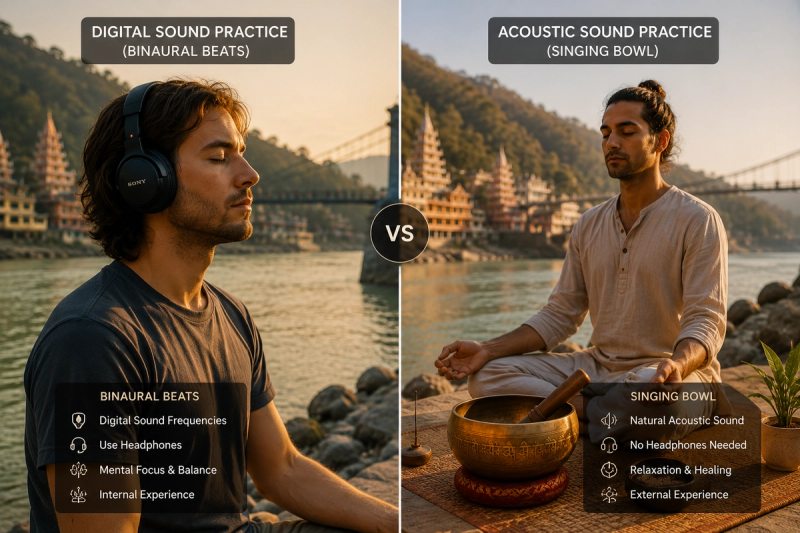
Binaural beats are an auditory illusion. You hear one tone in one ear and a slightly different tone in the other, normally through headphones. Your brain perceives a rhythmic beat corresponding to the frequency difference between the two tones.
For example, if one ear receives a 200 Hz tone and the other receives a 206 Hz tone, you may perceive a 6 Hz beat. This perceived difference is not simply another physical tone coming from a speaker. It is created by the interaction of the two auditory signals.
Singing bowls work differently. A struck or rubbed bowl produces a complex mixture of tones and harmonics. The sound gradually changes as the vibration decays, giving you a moving auditory experience rather than a precisely engineered beat.
That distinction matters when you compare the two.
With binaural beats, you are usually working with a controlled audio stimulus. With a singing bowl, you are experiencing sound, resonance, vibration, silence, and the environment around you as one event.
Research on binaural beats has reported possible effects on anxiety, cognition, pain perception, and other outcomes, although study methods and results vary. A meta-analysis of 22 studies found an overall medium effect across several cognitive and psychological outcomes, while newer reviews continue to describe promising but heterogeneous evidence.
For singing bowls, the research base is smaller but growing. A 2025 systematic review identified 19 clinical studies and reported potential benefits involving anxiety, depression, sleep, cognitive function, and physiological outcomes, while also emphasizing the need for stronger research.
You can therefore think of binaural beats as precision-oriented auditory stimulation, while singing bowls are better understood as a rich sound-and-vibration meditation practice.
For broader context around traditional Indian wellness approaches, you can also explore the official AYUSH resource.
Which Healing Frequency Is Better for Meditation and Relaxation?
If your main goal is meditation, the “better” option depends less on a magic number and more on how easily the sound helps you remain present.
Binaural beats can be useful when you want a consistent auditory environment. Once your headphones are on, the sound can remain relatively stable for the entire session. This can help you create a predictable ritual before meditation, study, relaxation, or sleep preparation.
Some people prefer low-frequency beat ranges because they associate them with slower, quieter states. However, you should be careful with claims that a specific frequency automatically produces a particular brain state or guarantees healing.
Your response is individual.
Singing bowls provide a different experience. Instead of asking you to focus on a constant electronic tone, the changing resonance naturally gives your attention something to follow. The sound rises, expands, fades, and eventually disappears.
That fading quality can be particularly useful in meditation because silence becomes part of the practice.
Why the Physical Sound Matters
A singing bowl is not only something you hear. Depending on how close you are and how the bowl is played, you may also notice subtle vibrations and changes in the acoustic environment.
This is one reason a live sound healing session can feel very different from listening to a digital recording.
Recent research is interesting here. A small experimental study involving 17 participants examined whether the beating sound of a singing bowl could synchronize with brainwave activity. The researchers observed increased activity around the bowl's beat frequency, but the study was small, so it should not be treated as proof of a universal therapeutic effect.
The more sensible takeaway is that sound can influence attention and physiological experience without requiring you to accept exaggerated claims about “frequency healing.”
If your mind responds well to structure, binaural beats may be easier to use consistently. If you respond strongly to acoustic texture, resonance, and silence, singing bowls may feel more natural.
You can also combine either practice with slow breathing, meditation, or gentle yoga rather than treating sound as a replacement for those practices.
Binaural Beat Therapy vs Singing Bowl Sound Healing: What Does Research Say?
This is where you should separate promising evidence from marketing.
Neither binaural beats nor singing bowls should be presented as cures for medical conditions. The research is still developing, and many studies involve small samples, different protocols, different outcomes, or short intervention periods.
For binaural beats, research has investigated anxiety, pain, cognition, sleep, and emotional regulation. A recent systematic review of music and binaural-beat interventions in young adults found that many included studies reported improvements in at least one area, including anxiety, sleep, mood, or cognition. However, the authors also highlighted heterogeneity and small sample sizes.
Another 2026 systematic review and meta-analysis specifically examined theta binaural beats in adults and included randomized controlled trials involving pain, cognition, and anxiety. The evidence is encouraging, but the appropriate interpretation is still that binaural beats are a potentially useful complementary tool rather than a guaranteed therapy.
Singing bowls have a similar evidence story.
A 2020 systematic review found reports of improvements in distress, anxiety, mood, tension, and several physiological measures, but concluded that the small number of studies and methodological limitations prevented firm recommendations.
More recent evidence is somewhat more encouraging. A 2025 systematic review of Tibetan singing bowl interventions found that most included studies reported improvements in areas such as anxiety, depressive symptoms, well-being, heart-rate variability, and heart rate. However, the review also noted substantial variation between studies and did not perform a meta-analysis.
That distinction is important.
If you see a claim that a particular singing bowl frequency “repairs your cells” or that a particular binaural beat “guarantees deep healing,” treat it skeptically. Current evidence does not justify that level of certainty.
A more defensible approach is to view both practices as tools that may support relaxation, attention, meditation, and subjective well-being.
For a deeper look at the evidence around sound practices, you can read our guide to sound healing and chronic pain research.
Binaural Beats vs Singing Bowls Healing: Which Should You Choose?
Instead of asking which one wins, start with what you actually want from your practice.
Choose binaural beats if you want:
- A consistent sound environment.
- A practice you can use privately with headphones.
- A structured meditation or relaxation routine.
- An easy digital option while travelling.
- A predictable auditory stimulus without needing a practitioner.
Choose singing bowls if you want:
- A live, immersive sound experience.
- Resonance and changing harmonics.
- A practice that naturally moves between sound and silence.
- A group meditation or sound bath environment.
- A more traditional-feeling setting connected with contemplative practices.
There is also a practical consideration: headphones.
Binaural beats generally require separate signals reaching each ear, so headphones are commonly used. Singing bowls do not require anything on your ears. You simply sit, listen, breathe, and allow the sound to decay naturally.
Your environment matters too.
A binaural beat can work in a quiet bedroom, hotel room, office, or meditation corner. A singing bowl session can become much more powerful experientially when you are physically present in a calm room with a skilled facilitator.
If you are already practising yoga, you can experiment without making the practice complicated.
Try five to ten minutes of quiet sitting after asana practice. On one day, use binaural beats. On another, use a singing bowl. Keep your breathing similar and observe what actually happens to your attention, tension, and ability to remain still.
That personal comparison is more useful than blindly choosing a frequency because somebody online calls it “the best.”
For those interested in a structured approach to sound, our Nada Yoga and sound spiritual practice guide explores the relationship between sound, attention, and yogic practice.
Why Rishikesh Makes Sound Healing Worth Exploring
Rishikesh offers something that an audio app cannot reproduce: context.
When you practise sound meditation in Rishikesh, the experience can happen alongside yoga, breathwork, meditation, quiet reflection, and the natural rhythm of the Ganga. The surrounding environment becomes part of your attention.
You may hear a singing bowl fade into silence and then notice distant river sounds, birds, footsteps, or temple bells. Instead of trying to eliminate every sound, you learn to observe sound without automatically chasing it.
That is an important meditative skill.
For international visitors, this can also make sound healing easier to explore within a broader yoga experience. You are not required to treat sound as a mysterious technology. You can approach it as another method of training attention.
If you are staying longer, you can build sound practice into your daily routine rather than treating it as a one-time novelty. A short session after asana, pranayama, or meditation may be enough to understand whether you genuinely enjoy it.
Rishikesh also gives you opportunities to explore different forms of practice. You might begin with a retreat, attend a sound session, and later decide that you want formal training.
If you are considering a shorter immersion, our 5-day yoga retreat in Rishikesh can be a practical starting point for combining yoga, reflection, and wellness practices.
Explore Sound Healing Training in Rishikesh
If sound keeps appearing in your personal practice and you want to understand it beyond simply listening to recordings, formal training may make more sense than collecting random frequency playlists.
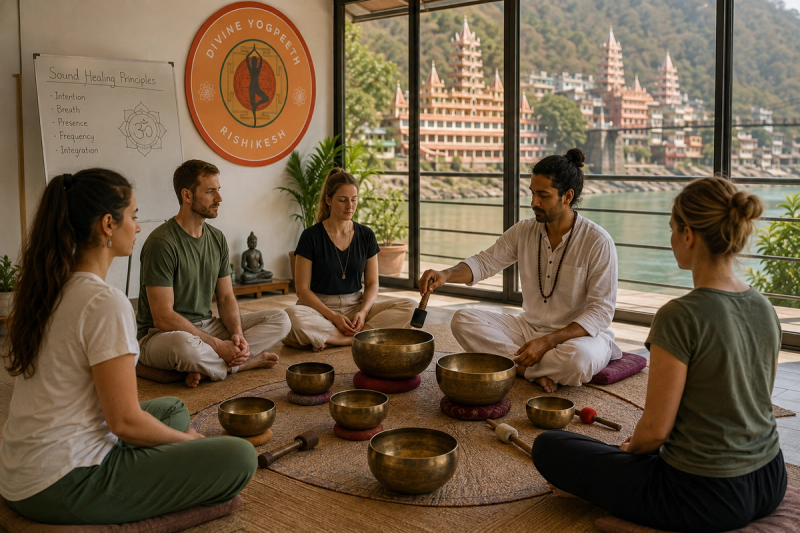
At Divine Yogpeeth, we offer a dedicated Sound Healing Training Course for people who want to explore sound practices in a structured yoga environment.
The goal should not be to memorize impressive-sounding frequency claims.
Instead, you want to understand how to create a safe, intentional session, work with sound attentively, and integrate it appropriately with meditation and yogic practices.
If you are considering becoming a yoga teacher as well, sound can complement a broader foundation in yoga teaching rather than replacing it. Our 200-hour Yoga Teacher Training in Rishikesh is another route if you want a more comprehensive teacher-training experience.
The important question is what you want to do with the practice afterward.
If you simply want relaxation, a personal meditation routine may be enough. If you want to facilitate sessions for others, structured education becomes much more important.
FAQs
Are binaural beats more powerful than singing bowls?
There is no strong evidence showing that one is universally more powerful. Binaural beats offer a controlled auditory stimulus, while singing bowls provide complex tones, resonance, and a live sound experience. Your response and your purpose matter.
Do singing bowls have a specific healing frequency?
Singing bowls produce multiple tones and harmonics rather than one universally proven healing frequency. Some research has explored beat frequencies and brainwave responses, but that does not establish that a particular bowl frequency can cure a particular condition.
Do you need headphones for binaural beats?
Headphones are generally used because binaural beats depend on presenting different tones separately to the two ears. Without channel separation, the intended binaural effect may not occur in the same way.
Can you combine singing bowls with yoga and meditation?
Yes. Singing bowls can be used before meditation to help you settle, during a relaxation practice, or after yoga as a transition into stillness. The sound should support your practice rather than become a distraction.
Is sound healing scientifically proven?
Research suggests that sound-based interventions may support relaxation, anxiety reduction, mood, sleep, and other outcomes, but the evidence varies considerably by technique and study quality. It is more accurate to describe sound healing as a complementary practice than as a proven cure for disease.
Conclusion: Binaural Beats vs Singing Bowls Healing Comes Down to Your Practice
The real answer to binaural beats vs singing bowls healing is not that one frequency wins.
Binaural beats may suit you if you prefer consistency, headphones, and a controlled auditory environment. Singing bowls may suit you if you prefer live resonance, changing harmonics, vibration, and the natural transition from sound into silence.
Neither needs exaggerated promises to be useful.
Start with your goal. If you want to settle your mind after yoga, test both. If you want a personal meditation tool, compare how you feel after several sessions rather than judging after one recording. If you want to facilitate sound-based practices for others, invest in proper training instead of relying on social-media frequency charts.
And if you want to experience sound healing within a dedicated yoga environment in Rishikesh, we invite you to explore our Sound Healing Training Course and take the next step toward a more informed practice.