.jpg)

Nada yoga sound spiritual practice is your key to deep healing. Discover how ancient frequencies calm your mind, restore balance, and awaken you. Learn more.
Nada Yoga Sound Spiritual Practice: The Ultimate Guide to Inner Peace
Have you ever noticed how a specific melody can instantly shift your mood, bringing you to tears or filling you with immense joy? Nada yoga sound spiritual practice is the ancient science of harnessing this exact phenomenon to achieve profound inner stillness.
For thousands of years, sages recognized that the universe is fundamentally composed of vibration. When your mind is scattered and your body feels tense, you are simply out of tune with your natural frequency. This practice offers a direct pathway to recalibrate your internal state.
By directing your awareness toward specific internal and external frequencies, you bypass the analytical mind entirely. You do not need to wrestle with your thoughts or force yourself into difficult postures. Instead, you allow the vibration to wash over you, naturally dissolving energetic blockages.
This guide will walk you through the mechanics of this deeply restorative path. You will discover how working with frequencies can quiet your nervous system, elevate your awareness, and bring you back to your true self.
Understanding Nada Yoga Sound Spiritual Practice
To grasp the depth of this system, you must first understand how ancient yogis viewed the cosmos. They believed that everything in existence, from the densest physical matter to the most subtle thought, is vibrating energy.
In this tradition, sound is divided into two primary categories: Ahata and Anahata. Ahata refers to struck sound, which is any noise created by two objects coming into contact. This includes music, voices, and the rustling of leaves.
Anahata refers to unstruck sound. This is the subtle, internal vibration that exists without any physical friction. The ultimate goal of this path is to move your awareness from the gross, external noises of the world to the delicate, internal hum of your own consciousness.
Organizations like Yoga Alliance recognize the profound impact of these traditional methodologies when integrated into comprehensive teacher training programs. Exploring these subtle realms requires patience, but the rewards are immediate.
When you begin tuning into these frequencies, you may notice a significant shift in your daily life. You might find that you react less aggressively to stress or sleep more deeply. For a broader look at how these vibrations affect your daily life, explore these 7 ultimate ways it transforms you.
The Four Stages of Sound in Yogic Philosophy
Your journey into nada yoga sound spiritual practice involves moving through four distinct layers of awareness. You begin with what is obvious and gradually refine your attention until you reach the source of vibration itself.
Vaikhari (The Audible Sound)
Vaikhari is the sound you can hear with your physical ears. It is spoken language, chanted mantras, and the tones of musical instruments. When you first begin your practice, you rely heavily on Vaikhari to anchor your wandering mind.
By chanting out loud or listening to a specific tone, you give your brain a single point of focus. This external anchor prevents your thoughts from spiraling into anxiety or future planning. It is a highly accessible starting point for any practitioner.
Madhyama (The Mental Sound)
As your concentration deepens, you move into Madhyama, the mental sound. This is the stage where you chant a mantra silently in your head. The physical lips are still, but the vibration echoes powerfully within your mind.
This internal repetition requires more focus than audible chanting. It begins to untangle the deeper layers of subconscious chatter, preparing you for the more subtle stages of awareness. To understand the mechanics of this internal repetition, discover the science of mantra chanting.
Pashyanti (The Visual Sound)
Pashyanti translates to "that which can be seen." At this advanced stage, sound is no longer processed as a sequence of words or tones. Instead, it is experienced as a sudden flash of insight, an intuitive knowing, or a visual geometry.
You sense the vibration as an energetic presence rather than hearing it. Your awareness becomes deeply refined, allowing you to perceive the subtle currents of energy moving through your subtle body.
Para (The Transcendent Sound)
Para is the ultimate, unmanifested sound. It is the silent source from which all vibrations arise and to which they all return. This is the state of pure consciousness, completely free from the fluctuations of the mind.
Reaching this state is the pinnacle of the practice. Here, you experience complete unity with the universe, resting in profound stillness and boundless peace.
How Sound Frequencies Heal the Nervous System
Your body is an intricate biological instrument that responds dramatically to its acoustic environment. When you immerse yourself in intentional vibrations, you trigger profound physiological shifts that promote deep healing.
Research published on platforms like PubMed increasingly demonstrates how specific frequencies can lower cortisol levels, reduce heart rate, and stabilize blood pressure. You are essentially using acoustic medicine to biohack your nervous system.
When you listen to steady, rhythmic tones, your brainwaves begin to synchronize with the frequency. This process, known as entrainment, shifts your brain from the fast-paced Beta state (associated with active thinking and stress) to the slower Alpha and Theta states.
These slower brainwave states are where cellular repair and emotional processing occur. By regularly guiding your brain into these restorative frequencies, you train your nervous system to become more resilient to everyday stressors.
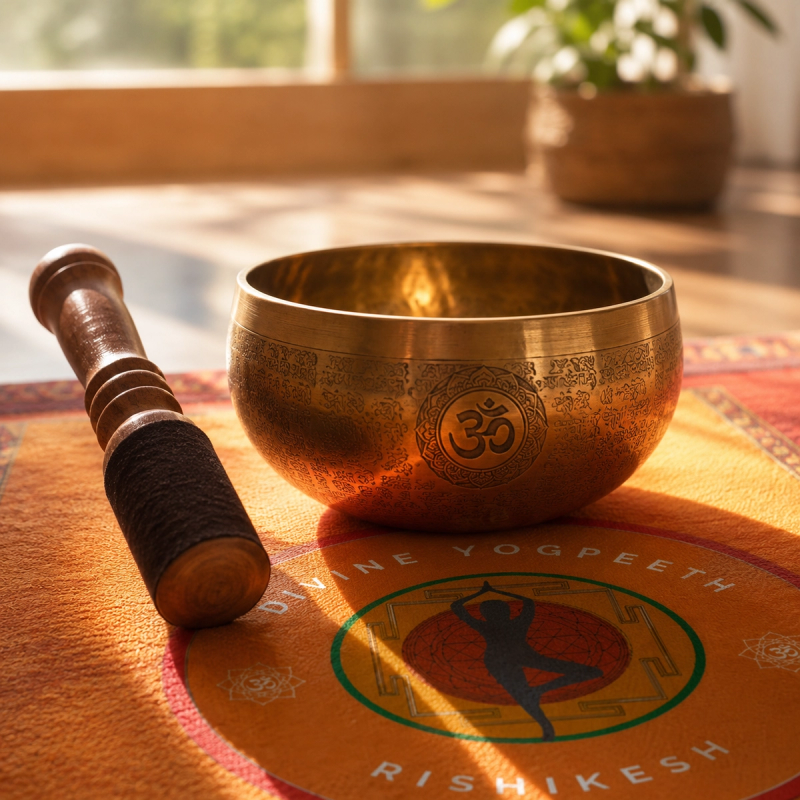
Different instruments create different therapeutic effects. Tibetan singing bowls, for example, produce rich overtones that penetrate deep into your tissues. To see how these specific instruments work, explore how singing bowl sound healing restores you.
Essential Techniques for Your Daily Practice
Integrating this practice into your routine does not require complex equipment or hours of free time. You only need a quiet space and a willingness to listen deeply.
Start with Bhramari Pranayama, also known as humming bee breath. Close your eyes, plug your ears with your thumbs, and inhale deeply. As you exhale, make a steady, low-pitched humming sound, focusing entirely on the vibration in your skull.
This simple technique immediately soothes the vagus nerve and quiets mental chatter. Practice this for just five minutes a day, and you will notice a drastic reduction in your baseline anxiety levels.
Another powerful technique is guided sound meditation. You can attend a live session or use high-quality recordings of gongs or crystal bowls. The key is to let go of active listening and allow the waves of sound to physically wash over you.
If you are new to this type of immersive acoustic experience, knowing what to expect can ease any apprehension. Learn more about the ultimate benefits of a first gong bath session to prepare yourself.
The Connection Between Sound and the Chakras
Your energetic body consists of seven primary energy centers known as chakras. Each of these centers governs specific physical, emotional, and spiritual functions. Furthermore, each chakra vibrates at a distinct frequency.
When a chakra becomes blocked due to trauma, stress, or poor lifestyle habits, its natural frequency becomes distorted. Nada yoga sound spiritual practice uses specific seed mantras (Bija mantras) to tune these energy centers back to their optimal state.
For example, chanting the Bija mantra "LAM" focuses vibration into the Root Chakra, cultivating a sense of safety and grounding. Chanting "YAM" directs energy to the Heart Chakra, opening you to compassion and emotional release.
By systematically chanting these seed sounds, you perform an internal energetic massage. You clear stagnant energy, allowing prana (life force) to flow freely through your central channel.
If you want to master these techniques and learn how to facilitate this healing for others, structured education is vital. Exploring a dedicated sound healing training course can elevate your understanding from a personal practice to a professional skill.
Why Rishikesh is the Global Capital of Sound Practice
There is a reason thousands of seekers travel to a small town in the foothills of the Himalayas every year. Rishikesh is not just a location; it is an energetic vortex that amplifies spiritual practices exponentially.
The city sits on the banks of the sacred Ganges River, a constant source of powerful, natural white noise. The continuous flow of the water provides a perfect acoustic backdrop for internal meditation, naturally drawing the mind inward.
Furthermore, the atmosphere in Rishikesh is saturated with the vibrations of centuries of uninterrupted spiritual practice. When you chant a mantra here, you are joining a continuous acoustic lineage that dates back millennia.
The environment strips away the distractions of modern life. You are surrounded by towering mountains, ancient temples, and a community of like-minded practitioners, all of which support your inward journey.
Stepping out of your normal environment and immersing yourself in this sacred space accelerates your growth. Taking time for a dedicated 5-day yoga retreat allows you to fully absorb the transformative frequencies of the Himalayas.
Soft CTA Section: Your Sanctuary in Rishikesh
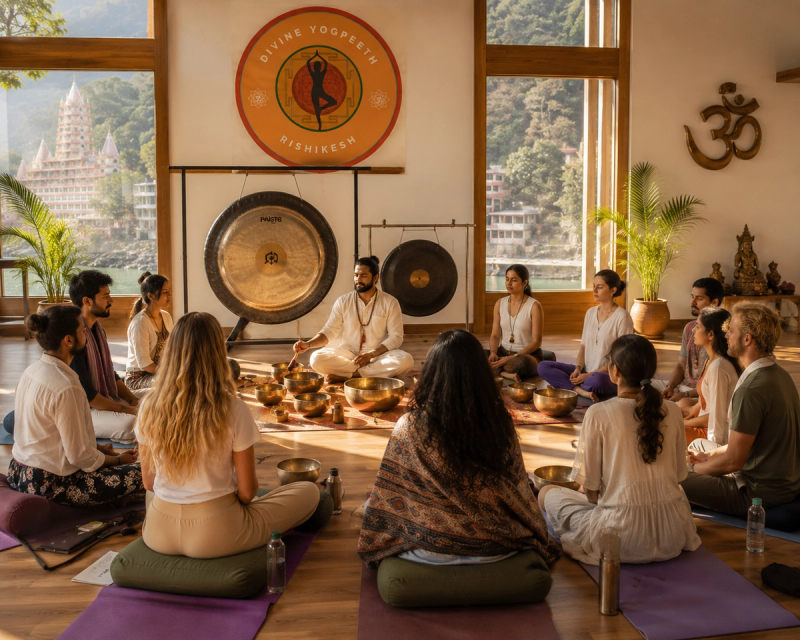
If you are considering training in Rishikesh, we offer a deeply supportive environment to explore these ancient sciences. Located right on the banks of the Ganga in Tapovan, our campus provides the perfect acoustic and energetic setting for your evolution.
Our teachers carry decades of traditional knowledge, ensuring you learn these subtle practices safely and effectively. You can discover more about our philosophy and approach on the Divine Yogpeeth home page.
Frequently Asked Questions
Do I need musical talent to practice nada yoga?
Absolutely not. This practice is about internal vibration and focused awareness, not musical performance. Your ability to carry a tune is completely irrelevant to the healing benefits you will receive.
How long does it take to feel the benefits?
Many practitioners feel an immediate sense of calm and clarity after just one session of humming or chanting. However, profound shifts in your nervous system and energetic body require consistent, daily practice over several weeks.
Can sound healing replace traditional medicine?
Sound therapy is a powerful complementary practice, but it should not replace professional medical treatment. It excels at regulating the nervous system and promoting an environment where the body can heal itself more effectively.
What is the best time of day to practice?
Early morning (Brahmamuhurta) or late evening are ideal times. During these hours, the external environment is naturally quieter, making it much easier to tune into your subtle internal frequencies.
Conclusion: Awaken Your Inner Silence
Nada yoga sound spiritual practice offers a beautiful paradox: you use sound to discover absolute silence. In a world that constantly demands your attention with relentless noise, this ancient science provides a reliable sanctuary.
By learning to listen deeply—first to the sounds around you, then to the sounds within you—you unlock a profound source of peace that remains accessible no matter what chaos surrounds you.
The journey from the external noise to the internal stillness is the ultimate spiritual adventure. It requires dedication, but the resulting clarity and emotional freedom are worth every moment of practice.
Ready to begin? Explore our 200-Hour Yoga Teacher Training in Rishikesh and take the first step toward mastering your internal frequency today.