.jpg)

Binaural beats vs singing bowls healing: compare the science, meditation benefits, practical uses, and Rishikesh training options. Discover what suits you.
binaural beats vs singing bowls healing: Which Healing Frequency Works Better?
Have you ever put on headphones for meditation and felt your attention settle almost instantly? Or have you sat near a singing bowl and noticed the sound seems to fill the room and your body at the same time? The question behind these experiences is often binaural beats vs singing bowls healing—and which approach is actually better for you.
The answer is less about finding a magical frequency and more about understanding how each method creates a listening experience. Binaural beats use two slightly different tones delivered separately to each ear, while singing bowls create rich acoustic tones, overtones, and physical resonance in the room.
If you want to choose wisely, you need to separate what is scientifically plausible from claims that go far beyond the evidence. You also need to consider your goal: meditation, relaxation, sleep preparation, focused breathing, or learning sound-healing skills.
This guide compares both methods, explains what you can realistically expect, and shows how Rishikesh can offer a practical setting for exploring sound alongside yoga.
Binaural Beats vs Singing Bowls Healing: How the Two Methods Work
Binaural beats and singing bowls both use sound, but they produce very different sensory experiences.
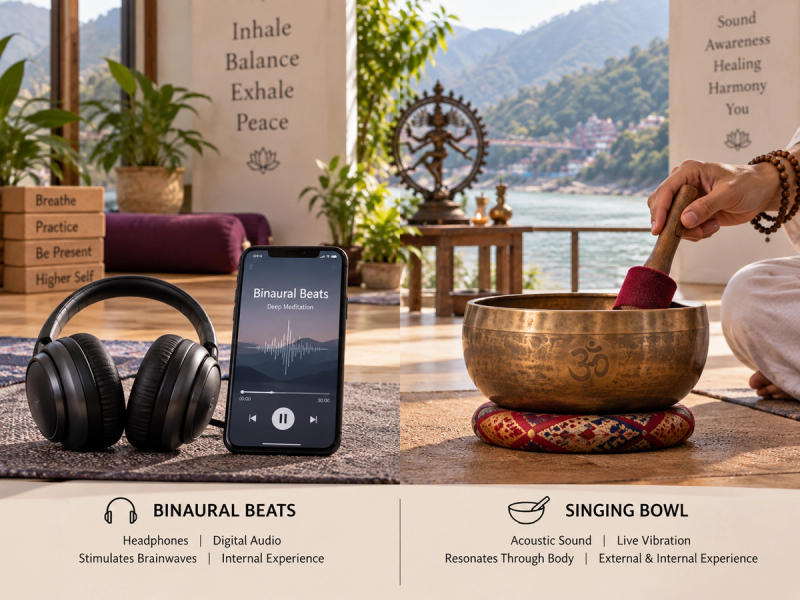
With binaural beats, you hear one steady tone in one ear and a slightly different tone in the other through headphones. Your brain perceives a third rhythmic sensation based on the difference between those tones. For example, tones of 200 Hz and 210 Hz can create a perceived 10 Hz beat.
That perceived beat is not a physical sound wave traveling through the room. It is an auditory phenomenon created by the interaction of the two tones in your hearing system. This is why headphones are normally essential.
Singing bowls work differently. A bowl is struck or rubbed around its rim, producing a complex collection of frequencies and overtones. You hear the sound directly in the environment, and you may also notice subtle vibrations through the air, nearby surfaces, or your own body.
Neither method should be treated as a guaranteed treatment for a medical condition. Sound can support relaxation and meditation, but that is different from proving that a particular frequency cures illness.
For a broader perspective on yoga, wellbeing, and traditional practices, you can also explore information from AYUSH while keeping modern evidence and personal experience in their proper places.
Binaural Beats vs Singing Bowls Healing for Meditation and Relaxation
If your main goal is to become quieter, both approaches can be useful—but they may suit different personalities.
Binaural beats can be convenient when you meditate alone. You can choose a track, put on comfortable headphones, close your eyes, and create a consistent sound environment almost anywhere. That predictability can help you build a routine, especially when outside noise makes silent meditation difficult.
Singing bowls offer a more physical and spatial experience. Instead of a sound coming only through headphones, you hear an acoustic instrument in the room. The gradual decay of the tone can give you a natural object for attention: listen to the strike, notice the strongest resonance, and follow the sound as it fades.
Your response also depends on context. If headphones feel isolating, a bowl may feel more grounding. If you become distracted by other people or environmental sounds, binaural audio may provide a more controlled setting.
What does “healing frequency” actually mean?
The phrase sounds precise, but it often is not. Online, you will find claims that certain frequencies have universal healing powers. Those claims should make you cautious.
A sound can influence mood, attention, breathing patterns, and perceived relaxation without having a unique biological power that applies equally to everyone. Your expectations, environment, volume, duration, and state of mind can all change your experience.
So instead of asking, “Which frequency heals me?” a better question is, “Which sound helps me enter the mental state I want to practice?”
That shift keeps your practice grounded. You can still appreciate traditional sound practices and modern audio technology without turning either into a miracle cure.
If you want to explore the wider relationship between sound and contemplative practice, our sound healing training course in Rishikesh offers a more structured way to study sound rather than simply consuming random frequency tracks.
Singing Bowls vs Binaural Beats: What Does the Evidence Suggest?
The evidence around these methods is more nuanced than social media often suggests.
Research on binaural beats has investigated possible effects on anxiety, attention, pain perception, sleep, and mood. Some studies report promising effects, while results vary according to study design, frequency, duration, participant characteristics, and comparison group. That means you should treat binaural beats as a possible relaxation or attention aid—not a clinically proven cure.
Singing bowls and related sound meditation practices have also been studied, with some research suggesting improvements in perceived relaxation, mood, or anxiety. Again, the evidence does not justify saying that a specific bowl frequency repairs a particular organ, balances every person’s energy in the same measurable way, or replaces medical care.
You can learn more about the broader research culture surrounding yoga and related practices through PubMed, where you can search peer-reviewed biomedical literature rather than relying on frequency charts circulating online.
What matters more than the exact frequency?
For your personal practice, several factors may matter more than chasing a number:
- Volume: A sound that is too loud can create tension instead of relaxation.
- Duration: A manageable 10–20 minute practice is often easier to sustain than an ambitious session you abandon.
- Environment: Quiet surroundings make subtle sound easier to follow.
- Attention: Listening deliberately can make the practice more useful than playing audio in the background.
- Consistency: Repeated practice gives you a better basis for judging whether a method helps.
- Expectation: Believing something will relax you can influence your experience, so notice the effect without assuming a specific mechanism.
This is why a fair comparison is not simply “10 Hz versus 432 Hz.” Those numbers describe different things, and they do not automatically tell you which practice will work better for your nervous system or meditation habit.
Which Sound Practice Should You Choose for Your Goal?
Your goal should guide your choice.
Choose binaural beats if you want portability. They work well for solo practice when you have headphones, a phone, and a quiet place. They can be useful when you want a repeatable audio routine during travel or before sleep.
Choose singing bowls if you prefer an acoustic, embodied experience. The changing overtones and natural decay give you something dynamic to listen to. In a group setting, the shared sound can also create a clear beginning and ending to a meditation session.
Try both if you are training as a yoga teacher. You may discover that different students respond differently. One person may enjoy headphone-based meditation, while another may find the physical presence of a bowl much more engaging.
You can also combine sound with established yoga practices rather than treating sound as a standalone solution. Slow breathing, comfortable posture, and a clear intention can make a short session more coherent.
If you are already exploring energetic practices, our guide to chakra meditation for beginners can help you place sound-based practices within a broader meditation routine.
Why Rishikesh Makes Sound Healing Especially Interesting
Rishikesh gives you something that an online audio track cannot: a real practice environment.
When you practice near the Ganga, you are surrounded by changing acoustic conditions. Water, bells, voices, birds, temple sounds, and human activity all become part of your listening environment. That does not make one frequency scientifically superior, but it can make you more attentive to how sound affects your concentration.
Tapovan is also a practical place to encounter yoga, meditation, breathwork, and teacher training in the same area. Instead of consuming isolated wellness content online, you can experience how sound fits into a broader practice.
If you are planning a stay specifically around yoga and retreat work, our Rishikesh retreat guide for international visitors can help you think through the practical side of preparing for a retreat.
The important point is to arrive with curiosity rather than a promise to “activate” a particular frequency. Listen carefully. Notice your breathing. Observe whether your attention becomes steadier. Then judge the practice by your actual experience, while keeping health claims grounded in evidence.
A Practical 15-Minute Sound Meditation You Can Try
You do not need expensive equipment to compare the two approaches.
Start with five minutes of comfortable seated breathing. Keep your spine relaxed rather than forcing a rigid posture. Let your exhalation become easy and unhurried.
For the next five minutes, use a low-volume binaural-beat track through headphones. Do not multitask. Simply notice the tones and your response. If you become uncomfortable, remove the headphones and stop.
On another day, replace the track with a singing bowl recording or, ideally, an in-person bowl session. Listen to the beginning, middle, and fading end of each tone. Notice whether the changing overtones hold your attention differently.
After each session, ask yourself:
- Did your breathing become slower or easier?
- Did your attention settle or become more distracted?
- Did you feel relaxed, sleepy, alert, grounded, or neutral?
- Did the sound feel pleasant at its chosen volume?
- Would you voluntarily practice this method again?
Do not score the session according to what a video promised. Score it according to what you actually noticed.
If you experience persistent distress, significant sleep problems, pain, or another health concern, sound meditation should not become a substitute for appropriate professional care.

Learn Sound Healing in a Real Yoga Environment
If you want to move beyond trying random audio tracks, structured training can teach you how to use sound more responsibly.
At Divine Yogpeeth, we offer our sound healing training course for learners who want to explore sound within a yoga and wellness setting in Rishikesh.
If your interest is broader than sound alone, you can also explore our 100-Hour Yoga Teacher Training as a way to deepen your understanding of practical yoga teaching and related techniques.
The value of in-person learning is not simply receiving a list of “healing frequencies.” You get the opportunity to practice listening, understand session structure, observe how sound is introduced, and develop better judgment about what you can responsibly tell another person.
That distinction matters. A good sound-healing practice should leave room for curiosity, consent, comfort, and individual differences.
FAQs
Are binaural beats better than singing bowls?
Not universally. Binaural beats are more portable and controlled, while singing bowls provide a live acoustic and more spatial listening experience. Your goal and personal response matter more than declaring one universally superior.
Can singing bowls really heal the body?
Singing bowls can support relaxation and meditation, and some people find them deeply calming. However, strong claims that specific bowl frequencies directly cure diseases are not established by good evidence. Use sound as a complementary practice, not a replacement for medical treatment.
Do binaural beats work without headphones?
The defining binaural-beat effect requires different tones to reach the two ears separately, so headphones or separate left/right channels are normally needed. Ordinary ambient music may still be relaxing, but that is not the same mechanism.
What frequency should you use for meditation?
There is no single frequency that is proven to be best for every person. Rather than chasing a specific number, choose comfortable audio at a safe volume and evaluate whether it helps you maintain relaxed, focused attention.
Can you combine singing bowls with yoga?
Yes. A bowl can be used before meditation, during a relaxation practice, or at the end of a yoga session. The key is to use sound in a way that supports the session's intention instead of distracting from it.
Conclusion: Binaural Beats vs Singing Bowls Healing Is About the Practice, Not a Magic Number
When you compare binaural beats vs singing bowls healing, the most useful answer is not that one frequency wins. Binaural beats give you a controlled, portable listening experience; singing bowls give you rich acoustic sound that you can experience in a shared physical space.
Both can become valuable parts of a meditation routine when you use them with realistic expectations. Pay attention to comfort, volume, consistency, your environment, and your actual response rather than trusting exaggerated claims about a single “perfect” frequency.
If you are ready to study sound more deeply in Rishikesh, explore our sound healing training course in Rishikesh and take the next step toward a more informed practice with us. You can also explore our yoga programs and retreats to build sound practice into a wider yoga experience.