.jpg)

Frequency healing Hz sound therapy explained clearly: learn what Hz means, what research says, and how sound practices fit into yoga in Rishikesh. Discover
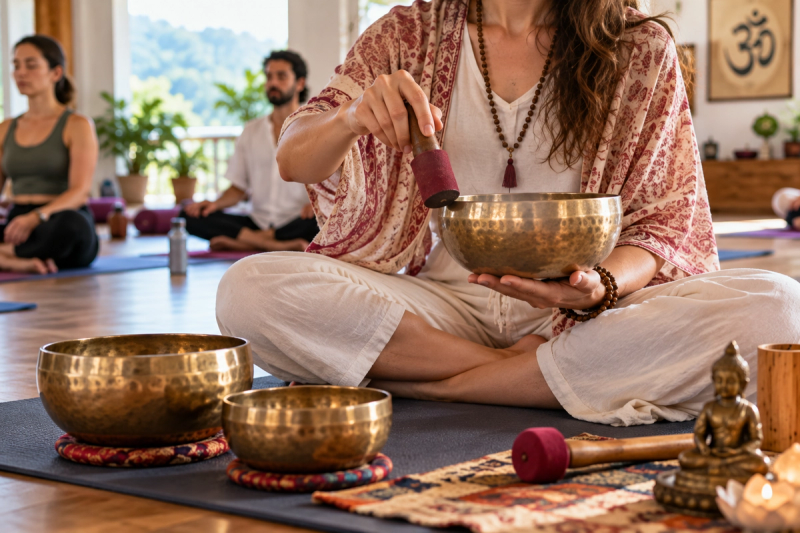
Frequency Healing Hz Sound Therapy: Understanding Hz Frequencies and Their Effects
Imagine sitting quietly while a singing bowl rings beside you and the sound seems to fill the room long after the visible vibration has disappeared. Frequency healing Hz sound therapy is often described in similar terms: specific tones or sound frequencies are said to influence relaxation, meditation, energy, or wellbeing. But what does “Hz” actually mean, and what can sound realistically do for you?
Hertz (Hz) is simply a unit used to describe frequency—the number of cycles of a repeating wave per second. In sound, frequency is closely related to perceived pitch: lower frequencies generally sound deeper, while higher frequencies generally sound higher. The important distinction is that a frequency having a precise number does not automatically make it medically healing.
If you are exploring sound baths, singing bowls, chanting, tuning forks, or sound-based meditation, understanding this difference helps you approach the practice with curiosity rather than exaggerated promises. You will learn how sound frequency works, what research says about sound and relaxation, why popular numbers such as 432 Hz and 528 Hz receive attention, and how you can explore sound practices safely in Rishikesh.
Frequency Healing Hz Sound Therapy: What Does Hz Actually Mean?
Hz stands for hertz, the standard unit for frequency. One hertz means one cycle per second. When you hear a musical note, the frequency of the sound wave contributes strongly to its pitch, although the experience of sound also depends on loudness, harmonics, the instrument, acoustics, and your hearing.
This is why a sound bowl, a human voice, and an electronic tone can all involve frequencies while producing very different experiences. A singing bowl creates a complex mixture of fundamental and harmonic frequencies rather than one perfectly isolated number.
When people discuss frequency healing, they often move quickly from a measurable physical property—frequency—to a much broader claim about the body. That leap needs care. Hearing a 100 Hz tone does not mean that every cell in your body is being “tuned” to 100 Hz, and there is no universal frequency that has been established as a cure for a particular disease.
That does not make sound practices meaningless. Sound can influence attention, emotion, breathing patterns, and the atmosphere of a meditation session. Research on music-based interventions has found reductions in anxiety and stress in several settings, although interventions vary considerably and the evidence does not establish that one special frequency is responsible for the effect. A 2025 systematic review and meta-analysis of 51 studies found an overall medium effect of music therapy on anxiety outcomes, while physiological effects were smaller and not statistically significant.
For a deeper scientific starting point, you can explore research on music-based interventions through PubMed.
How Different Sound Frequencies May Affect Your Experience
Your experience of sound is not determined by frequency alone. Duration, volume, rhythm, repetition, musical context, your expectations, and the environment can all change how a sound feels.
Lower-pitched sounds can feel deep, grounded, or physically noticeable, particularly when played at sufficient volume. Higher-pitched sounds may feel bright, clear, or more stimulating. But these descriptions are subjective rather than fixed biological rules.
432 Hz, 528 Hz, and Other Popular Frequencies
Two numbers appear frequently in online sound-healing discussions: 432 Hz and 528 Hz.
You may see 432 Hz described as a frequency associated with calmness or natural harmony. You may also encounter 528 Hz marketed as a “love frequency” or as a special frequency for cellular repair or DNA-related effects. These claims are popular in wellness content, but they should not be presented as established medical facts.
A better way to approach these tones is to treat them as sound choices used within a relaxation or meditation practice. If listening to a particular tone helps you slow down, breathe steadily, or maintain attention, that subjective response can be useful without requiring a claim that the number itself has a unique healing power.
You can also compare sound-based approaches. For example, binaural beats use two slightly different tones presented separately to each ear, while singing bowls create acoustic tones and harmonics. If you want to understand that distinction, see our guide to binaural beats vs singing bowls healing.
The practical question is not “Which number is magical?” but “Which sound helps you create the mental and physical conditions you want for your practice?”
What Does Sound Healing Research Actually Say?
The strongest evidence is broader than the online claims about individual “healing frequencies.” Research has investigated music and sound interventions for outcomes such as anxiety, stress, pain perception, and emotional wellbeing.
A 2021 meta-analysis of 32 randomized controlled trials involving 1,924 participants found that music therapy significantly reduced anxiety immediately after treatment, although the evidence for effects at follow-up was less certain.
A separate systematic review and meta-analysis published in 2022 examined 47 studies and 2,747 participants and reported beneficial effects of music therapy on stress-related outcomes. The authors also highlighted differences between interventions and the need for further research.
This distinction matters. “Sound can support relaxation” is a reasonable evidence-informed statement. “528 Hz repairs DNA” is a much stronger biological claim that requires specific evidence and should not be treated as established simply because the claim is repeated online.
If you practice sound meditation, you can therefore focus on outcomes you can actually observe: whether your breathing becomes slower, whether your attention settles, whether your body feels less tense, and whether the practice helps you create a consistent meditation routine.
For a broader exploration of traditional and wellness-oriented practices, India’s official AYUSH system is another useful reference point: Ministry of AYUSH.
How Singing Bowls, Mantra, and Sound Meditation Work in Practice
A sound session can involve singing bowls, gongs, chanting, mantra repetition, tuning forks, or recorded tones. The method matters because you are not simply “receiving a frequency”; you are participating in an environment that directs your attention toward sound and away from competing distractions.
A typical session may begin with comfortable positioning and a few minutes of quiet breathing. Sounds are then introduced gradually. You might focus on the beginning, middle, and fading of each tone rather than trying to force a particular sensation.
This can make sound a useful bridge into meditation. Instead of struggling to hold your attention on an abstract object, you have a changing auditory object to follow.
The environment also matters. A quiet room, moderate volume, comfortable temperature, and an experienced facilitator can make it easier to relax. If you are sensitive to loud or sudden sounds, you should communicate that before a session begins.
If you are preparing for your first experience, our sound healing session preparation tips can help you think through clothing, expectations, hydration, timing, and personal comfort.
You may also notice that a sound session feels different from ordinary music listening. The goal is often not entertainment. It is sustained attention, relaxation, reflection, or meditative awareness.
Why Rishikesh Is a Natural Place to Explore Sound Practices
Rishikesh offers an unusual combination of yoga education, meditation spaces, traditional chanting, retreat culture, and quiet places for reflection. If you come here to study yoga, sound practices can complement the broader experience without needing to become a substitute for yoga itself.
The setting can also influence your attention. A session near the Ganga, a quiet classroom, or a simple meditation space can create fewer distractions than your normal daily environment.
If you are interested in the relationship between sound, energy-focused practices, and meditation, you may also find our guide to chakra balancing therapy useful. Approach chakra language as part of a traditional or contemplative framework rather than assuming every associated physiological claim has been scientifically established.
Rishikesh is also practical for people who want structured learning rather than a single sound bath. You can combine yoga, meditation, pranayama, philosophy, and sound practices within a longer retreat or teacher-training schedule.
For a shorter introduction to retreat life, you can explore our 5-day yoga retreat in Rishikesh.
How to Explore Frequency-Based Sound Practices Safely
Sound meditation is generally simple to try, but “natural” does not automatically mean risk-free. Your comfort should come before chasing a particular frequency or intensity.
Start with moderate volume. You do not need a loud gong or powerful speaker to make a session meaningful. Excessive sound exposure can be uncomfortable and can pose risks to hearing, particularly when you are close to a loud source for a prolonged period.
Give yourself permission to change position, step outside, or stop the session if you feel dizzy, overwhelmed, anxious, or physically uncomfortable. If you have a medical condition affected by sound, are recovering from a procedure, or have significant hearing sensitivity, ask an appropriate healthcare professional about whether a particular practice is suitable for you.
Also be careful with therapeutic language. Sound sessions may support relaxation or complement a wellness routine, but they should not replace diagnosis, medication, psychotherapy, or other medical care when those are needed.
A useful mindset is simple: use sound as a practice, not as a promise.
A Simple 10-Minute Sound Meditation You Can Try
You do not need expensive equipment to experiment with sound meditation. Choose a quiet place and use a gentle sound source such as a singing bowl, soft bell, or calm recording.
Start by sitting or lying in a comfortable position. Take several natural breaths without trying to control them. Then allow your attention to rest on the sound.
Notice three things: how the sound begins, how its texture changes, and how it disappears. When your mind wanders, return to the next sound without judging yourself.
After several minutes, shift your attention to your breathing. Notice whether your breath feels slower or more comfortable than when you started.
Finish with a minute of silence. This final pause is important because it lets you notice the contrast between sound and stillness.
Do not worry about reaching a special state. The value of the exercise is learning how your attention responds to sound and whether the practice helps you become calmer or more present.
You can repeat this practice several times a week and keep a simple note of how you feel before and after. Over time, that personal observation is more useful than assuming a frequency must work because a social-media post says it does.
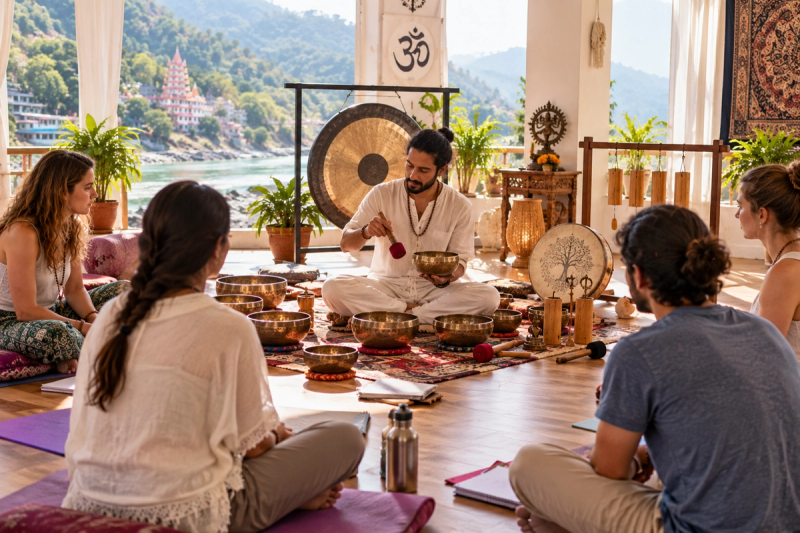
Learn Sound Healing in a Structured Yoga Environment
If you want to move beyond casual listening, structured training can give you a clearer understanding of instruments, session design, meditation, and responsible facilitation. It also gives you an opportunity to practice with other people and receive feedback instead of trying to copy techniques from short videos.
At Divine Yogpeeth, our Sound Healing Training Course is designed for people who want to explore sound practices in a yoga-learning environment in Rishikesh.
You can also use a broader yoga program to place sound practices within meditation, pranayama, teaching methodology, and yoga philosophy. Our 100-hour Yoga Teacher Training in Rishikesh is one option if you want a shorter structured training format.
The key is to learn the practice with realistic expectations. A good facilitator should be able to explain what is traditional, what is experiential, and what is supported by scientific evidence.
FAQs About Frequency Healing and Hz Sound Therapy
Is frequency healing scientifically proven?
Sound and music interventions have research support for some outcomes, particularly relaxation, anxiety, and stress-related measures. However, that evidence does not prove that every specific frequency has a unique healing effect. Claims about precise frequencies curing diseases or repairing cells require much stronger evidence.
What is the best Hz frequency for meditation?
There is no scientifically established single “best” frequency for everyone. A comfortable tone at a safe volume can work as an attention anchor. Your response may depend on the sound, setting, duration, expectations, and personal preference.
Is 528 Hz really a healing frequency?
528 Hz is widely promoted online as a special healing or “love” frequency. You can certainly use a 528 Hz tone during relaxation or meditation if you enjoy it, but claims that it has uniquely proven healing properties should be treated cautiously because they go beyond the evidence currently available.
Can singing bowls heal the body?
Singing bowls can be used in relaxation, meditation, and sound-based wellness sessions. Research on music and sound interventions suggests potential benefits for stress and anxiety, but that should not be confused with proof that singing bowls can directly cure a medical condition.
Should you choose sound therapy or yoga?
You do not necessarily have to choose one. Sound practices can complement yoga, meditation, breathwork, or a retreat. If you have a specific health concern, use appropriate medical care first and treat sound practice as a complementary wellness activity.
Conclusion: Use Sound With Curiosity, Not Hype
Frequency healing Hz sound therapy becomes much more useful when you separate the measurable science of sound from exaggerated promises about special numbers. Hz tells you about frequency; it does not, by itself, tell you that a tone can cure a disease.
What you can explore for yourself is how sound affects your attention, breathing, mood, and meditation experience. Research on music-based interventions provides evidence for benefits in areas such as anxiety and stress, while the evidence for specific “healing frequencies” remains much less established.
If you want to experience sound practices in a structured Rishikesh setting, we invite you to explore our Sound Healing Training Course and learn how sound can be integrated thoughtfully with yoga and meditation.
The goal is not to chase a magical number. It is to develop a practice you understand, experience, and can approach responsibly.