.jpg)

Discover how kirtan bhajan devotional music healing can calm your mind, deepen meditation, and support inner wellbeing through sacred sound. Discover
kirtan bhajan devotional music healing: How Devotional Music Heals from Within
Have you ever noticed how a simple chant can quiet your thoughts before you even realize it? Kirtan bhajan devotional music healing brings together rhythm, repetition, voice, breath, and devotion in a practice that can influence how you feel from the inside out.
You do not need to be a trained singer or deeply experienced meditator to participate. You can simply listen, sing along, breathe, and allow the repetition to create a steady rhythm.
In yoga traditions, sound is not treated merely as entertainment. Chanting and devotional singing can become practices of concentration, emotional expression, and contemplation.
But what exactly happens when you participate in kirtan or bhajan? Why can a room full of people singing the same words feel so different from simply listening to a song through headphones?
This guide explores the difference between kirtan and bhajan, the potential effects of devotional music on your mind and body, how sound fits into yoga practice, and why Rishikesh offers a particularly meaningful environment for experiencing it.
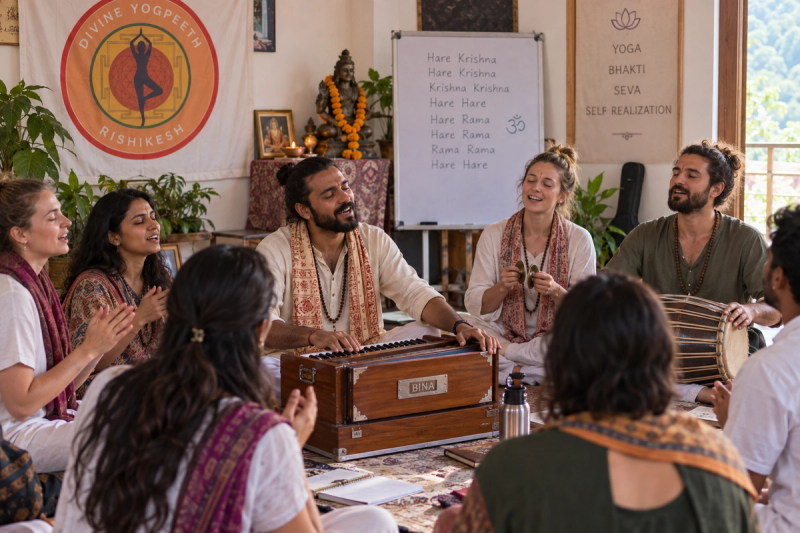
Kirtan Bhajan Devotional Music Healing: What Do Kirtan and Bhajan Mean?
Although the words are often used interchangeably, kirtan and bhajan have distinct traditional contexts. Both involve devotional singing, but the structure, setting, and style can differ considerably.
Kirtan is commonly associated with call-and-response chanting. A lead singer or musician may introduce a phrase, while everyone else repeats it. The repetition makes participation easy, even when you do not know Sanskrit or the melody beforehand.
Bhajan generally refers to devotional songs expressing love, surrender, remembrance, or praise. A bhajan can be performed individually or collectively and may have a more song-like structure.
The distinction is not rigid. In contemporary yoga spaces, the terms frequently overlap.
What matters for your experience is less the label and more what the practice invites you to do: focus your attention, regulate your breathing, listen carefully, participate with your voice, and temporarily step away from ordinary mental chatter.
If you want to explore yoga traditions beyond physical postures, learning about yoga philosophy and its importance in modern practice can give you useful context.
You may also encounter Sanskrit mantras during kirtan. Their repeated sounds can provide an anchor for attention, particularly when your mind tends to wander during silent meditation.
For a broader introduction to yoga's traditional terminology and modern teaching context, Yoga Alliance is a useful reference point.
The important point is that you should not approach devotional music as a performance test. Your pronunciation does not have to be perfect, and your voice does not have to be beautiful. Participation itself can become the practice.
How Does Devotional Music Support Inner Healing?
The word “healing” deserves some care. Kirtan and bhajan should not be presented as a guaranteed treatment for medical or psychological conditions.
Instead, you can think of devotional music as a practice that may support relaxation, emotional processing, attention, social connection, and a sense of meaning.
1. Repetition Gives Your Mind an Anchor
When a phrase is repeated again and again, you have fewer decisions to make. You do not need to invent what comes next.
That simplicity can make it easier to concentrate on the present moment.
The experience has something in common with mantra meditation: repetition gives wandering attention a clear object to return to.
2. Singing Connects Breath and Attention
Singing naturally involves controlled breathing. You inhale, produce sound, pause, and repeat.
When an entire group follows a similar rhythm, you may begin to experience a sense of collective pacing. That can make the practice feel grounding, especially when your attention has been scattered.
3. Emotion Gets a Safe Outlet
Devotional singing can bring up many emotions. You may feel peaceful, joyful, nostalgic, vulnerable, or even unexpectedly emotional.
You do not necessarily have to analyze every feeling as it appears.
Sometimes simply giving an emotion space—without judging it—can be more useful than trying to suppress it.
This is one reason people sometimes describe kirtan as emotionally releasing. The experience is subjective, and it will not feel identical for everyone.
4. Group Singing Can Reduce Isolation
A kirtan is often collective. You are not expected to carry the entire experience yourself.
You hear other voices around you, contribute your own voice, and follow a shared rhythm. That social dimension can be particularly meaningful if you spend much of your day working, studying, or practicing alone.
Research into music and wellbeing more broadly suggests that musical engagement can influence mood, social bonding, and emotional experience. It is therefore reasonable to see devotional music as one possible wellbeing practice rather than a magical cure.
Kirtan and Bhajan Benefits for Meditation and Yoga Practice
You may already use breathwork, asana, or silent meditation. So where does devotional music fit?
It can act as a bridge between active and quiet practices.
A typical yoga session asks you to move from external activity toward internal awareness. Kirtan can support a similar shift through sound rather than physical movement.
Sound Can Make Concentration More Accessible
Silent meditation can be difficult when your mind is busy. You sit down intending to focus, only to discover that your brain has produced a long list of unfinished tasks.
With kirtan, sound gives your attention something immediate to follow.
Instead of fighting every thought, you repeatedly return to the melody, mantra, rhythm, and breath.
Devotional Music Can Complement Breathwork
You can become more aware of your breathing when you sing slowly and deliberately.
Longer phrases encourage you to notice when you inhale and when you release the breath through the voice. This does not replace formal pranayama instruction, but it can make you more conscious of the connection between breath and attention.
It Can Add Emotional Depth to Yoga
Physical yoga can become overly mechanical if you focus only on alignment and flexibility.
Devotional practices remind you that yoga also has dimensions involving attention, self-reflection, discipline, and connection.
If you are curious about how sound-based practices compare with other approaches, you can explore the differences between group and private sound healing sessions.
You may also find that devotional music prepares you for stillness. After several minutes of rhythmic chanting, silence can feel noticeably different—not because silence has changed, but because your attention has.
For some practitioners, that transition becomes one of the most valuable parts of the practice.
Healing Through Sacred Sound: What You May Actually Experience
It is easy to make exaggerated claims about “healing frequencies” or suggest that particular sounds automatically repair the body.
You should be skeptical of such promises.
Your experience of kirtan can be meaningful without requiring extraordinary scientific claims. Music affects perception, emotion, attention, memory, and social interaction. Repetitive chanting also gives you a structured activity that combines sound, breath, movement, and participation.
You may notice several practical effects during or after a session:
- Your thoughts feel less scattered.
- Your breathing becomes more noticeable.
- You feel emotionally lighter.
- You become more aware of your voice.
- You feel connected to the people around you.
- Meditation becomes easier immediately afterward.
- You experience a temporary sense of quiet or spaciousness.
These effects are not guaranteed, and they can vary depending on your mood, expectations, environment, and familiarity with chanting.
The cultural and spiritual context also matters. A devotional song may carry meanings connected with particular deities, teachers, stories, or philosophical traditions.
If you are unfamiliar with those traditions, you can participate respectfully without pretending to understand everything immediately.
You can listen first. Ask questions. Learn the meaning of the words. Notice how the practice feels rather than forcing yourself to have a particular spiritual experience.
India's Ministry of Ayush provides broader information about traditional Indian systems of health and wellbeing through the Ministry of Ayush.
That distinction—between meaningful traditional practice and unsupported medical promises—is important. You can value kirtan deeply while still keeping realistic expectations.
Why Rishikesh Makes Kirtan and Bhajan Especially Meaningful
Rishikesh is not simply a destination where yoga classes happen. It has a long-standing relationship with spiritual practice, pilgrimage, meditation, Sanskrit learning, and devotional traditions.
The presence of the Ganga adds another dimension to the experience. Along the river, you may encounter temple bells, chants, devotional singing, evening ceremonies, and quiet moments of reflection within the same day.
That environment can make sound feel less like an isolated activity and more like part of the surrounding culture.
If you are visiting from outside India, it is useful to approach these practices with curiosity rather than treating them as a cultural spectacle.
You may not understand every Sanskrit word. That is completely fine.
Start by listening. Observe when people begin and end. Notice whether the setting is devotional, educational, meditative, or part of a larger ceremony.
Rishikesh can also give you the opportunity to combine devotional music with other forms of practice. You might attend a yoga class in the morning, spend time beside the Ganga, practice meditation later, and experience chanting in the evening.
If you are specifically interested in spending dedicated time in the city, our 5-day yoga retreat in Rishikesh can provide a structured setting for deeper practice.
You can also explore what Tapovan yoga in Rishikesh can offer if you want to understand the area's broader yoga environment before planning your stay.
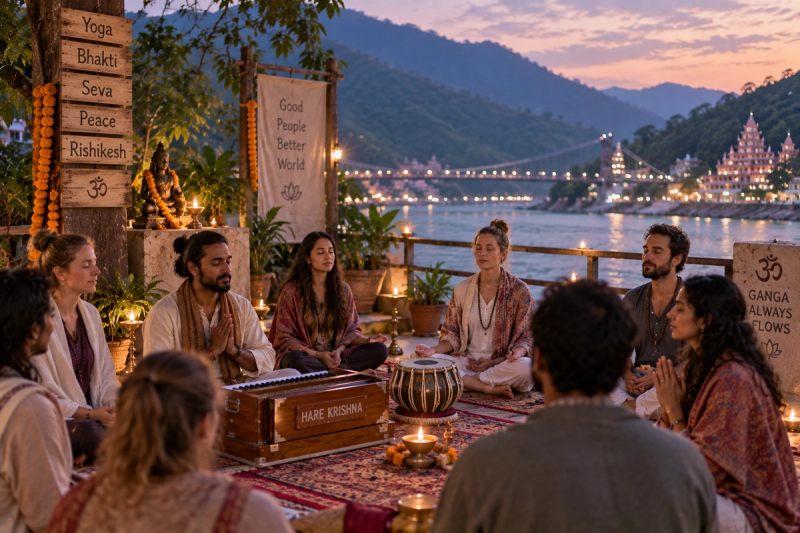
How to Begin a Kirtan Practice Without Feeling Awkward
Your first kirtan can feel strange.
You might wonder whether you are singing too loudly, pronouncing the words incorrectly, or participating in the “right” way.
Usually, the simplest approach is the best.
Listen Before You Lead
During your first few minutes, listen to the rhythm and melody.
When you understand the repeating pattern, join when you feel comfortable.
Do Not Worry About Your Singing Voice
Kirtan is not an audition.
The purpose is participation and attention, not musical perfection. If you prefer, begin quietly and gradually become more involved.
Learn the Meaning
If a mantra or devotional phrase is repeated, ask what it means.
Understanding the words can change your relationship with the practice. Instead of repeating unfamiliar sounds mechanically, you begin to understand the intention behind them.
Let Silence Be Part of the Practice
You do not need continuous stimulation.
After chanting, sit quietly for a few minutes. Notice your breath, body, and mental state.
That quiet period can help you recognize whether the practice actually made a difference for you.
Explore Sound, Yoga and Devotional Practice in Rishikesh
If you want to go beyond occasional chanting, structured learning can help you understand how sound fits into a broader yoga practice.
At Divine Yogpeeth, we offer yoga education and sound-based learning in Rishikesh, with opportunities to experience practices in a setting connected to the city's yoga culture.
If you are exploring sound more systematically, our Sound Healing Training Course is a natural place to investigate the subject further.
For a shorter immersion, you can also consider our 3-day yoga retreat and use the time to explore yoga, meditation, sound, and the atmosphere of Rishikesh without committing to a longer training.
The right choice depends on your intention.
If you mainly want personal exploration, a retreat may be enough. If you want a more structured understanding of yoga and related practices, teacher training can offer greater depth.
Your goal should determine the format—not the other way around.
FAQs About Kirtan Bhajan Devotional Music Healing
Is kirtan the same as bhajan?
Not exactly. Both are forms of devotional music, but kirtan is often associated with repetitive call-and-response chanting, while bhajan generally refers to devotional songs. In modern settings, the terms can overlap.
Do I need to know Sanskrit to participate in kirtan?
No. You can participate by listening first and gradually repeating the sounds you hear. Learning the meaning and pronunciation can deepen your understanding, but prior Sanskrit knowledge is not required.
Can devotional music replace meditation?
Not necessarily. Kirtan can function as a meditative practice for some people, particularly because repetition gives the mind an anchor. However, it does not have to replace silent meditation, and different practices suit different people.
Is sound healing scientifically proven to cure illness?
You should be cautious about claims that sound or kirtan can cure medical conditions. Music and chanting may support relaxation, mood, attention, and social connection, but devotional music should not be treated as a substitute for appropriate medical care.
What should you expect from your first kirtan?
Expect something simple rather than dramatic. You may spend time listening, repeating a phrase, following a rhythm, and sitting quietly afterward. You might feel peaceful, energized, emotional, or simply neutral. Any of these responses can be normal.
Conclusion: Let Sound Become Part of Your Practice
Kirtan bhajan devotional music healing is best understood as an experiential practice rather than a promise of instant healing. Through repetition, breath, voice, devotion, and community, you can create a different quality of attention and give yourself space to reconnect with what is happening within you.
You do not need a perfect voice, extensive yoga experience, or advanced meditation skills.
You only need the willingness to listen and participate.
And if you want to experience these practices in a deeper yoga environment, Rishikesh gives you a setting where yoga, meditation, sacred sound, and devotional traditions can naturally meet.
Ready to explore yoga and sound more deeply? We invite you to discover our Sound Healing Training Course in Rishikesh and take the next step in your practice.