

Explore practice teaching internship 200 hour YTT in Rishikesh, from teaching practice and feedback to class planning. Discover what to expect and learn more.
Practice teaching internship 200 hour YTT: What to Expect from Your First Teaching Experience
Introduction
The practice teaching internship 200 hour YTT experience can reveal something surprising: knowing how to perform a yoga pose is very different from knowing how to teach it to someone else. You might feel confident on your mat, but guiding a room full of students requires communication, observation, patience, and thoughtful preparation.
A 200-hour yoga teacher training (YTT) program helps you develop these skills through structured learning and practical teaching opportunities. Instead of simply memorising asanas, you begin learning how to build a class, give understandable instructions, recognise different student needs, and respond calmly when something does not go according to plan.
For international yoga seekers and Indian practitioners alike, training in Rishikesh offers an opportunity to explore yoga in a setting where daily practice, philosophy, and traditional learning are closely connected.
But what actually happens during practice teaching? Will you teach fellow trainees? How much feedback should you expect? And will completing a 200-hour course automatically make you ready to teach independently?
This guide explains what a practical teaching internship can involve, which skills you can develop, how to prepare for your first class, and what to check before choosing a yoga school in Rishikesh.
1. What Does a Practice Teaching Internship in a 200-Hour YTT Involve?
A practice teaching internship is a structured opportunity to apply what you learn during yoga teacher training. Depending on the school's curriculum, it may include teaching fellow trainees, preparing short sequences, practising verbal instructions, and receiving feedback from instructors.
The word internship can mean different things at different schools. Some programs include supervised classroom teaching within the training itself, while others use practice teaching or practicum sessions rather than a separate placement at an external studio.
Before enrolling, check precisely what the school offers. Do not assume that every 200-hour program includes a paid internship, an external studio placement, or guaranteed teaching work.
From Practising Yoga to Teaching Yoga
As a student, you can follow the instructor's demonstration and concentrate on your own alignment. As a teacher, your attention must extend beyond your personal practice.
You need to consider:
- Whether students understand your instructions.
- Whether the sequence progresses at an appropriate pace.
- Whether the room can follow the transitions safely.
- Whether you have offered suitable alternatives for different abilities.
- Whether students have enough time to breathe, adjust, and rest.
For example, demonstrating a standing posture is only one part of teaching it. You must also explain how students can enter and leave the pose, identify common alignment concerns, and provide an accessible variation when needed.
A good practical component helps you practise these responsibilities before you lead a class independently.
For background on recognised yoga teaching credentials, consult the official <a href="https://yogaalliance.org" rel="nofollow">Yoga Alliance website</a>. Remember that a school's registration status and the exact recognition of its program should be verified directly rather than assumed from marketing language.
2. How Practice Teaching Sessions Usually Work
Your first teaching session may feel unfamiliar, even if you have practised yoga for years. That is normal. Teaching introduces a different set of responsibilities, and confidence generally develops through repetition rather than observation alone.
The precise schedule varies by school, but a well-structured practicum may include the following stages.
Step 1: Observation and Preparation
Initially, you observe experienced teachers and examine how they structure a class. Pay attention to their opening instructions, breathing cues, transitions, pacing, and use of modifications.
You may then prepare a short sequence using poses already covered in your course. A simple, well-organised class is usually more useful for beginners than an ambitious sequence containing advanced postures.
Step 2: Short Teaching Assignments
You might begin by leading a warm-up, explaining a few postures, or guiding a short breathing exercise. These smaller assignments allow you to practise speaking clearly without having to manage an entire session immediately.
Your instructor may ask you to teach without demonstrating every movement. This helps you learn to communicate through words and observe whether students can follow your cues.
Step 3: Teaching Fellow Trainees
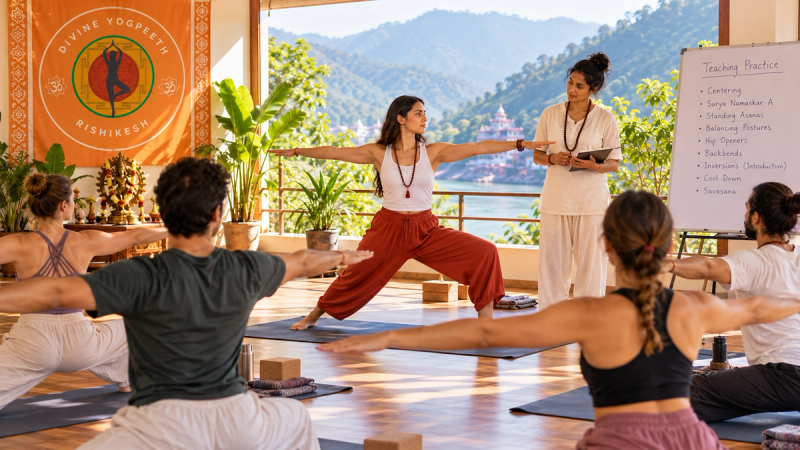
Peer teaching gives you a realistic opportunity to manage a small group. Your fellow students may follow your sequence, ask questions, or provide feedback on your instructions.
You can practise maintaining a steady pace, adapting your language, and managing moments of silence. You also learn that different students may interpret the same instruction differently.
Step 4: Instructor Feedback and Reflection
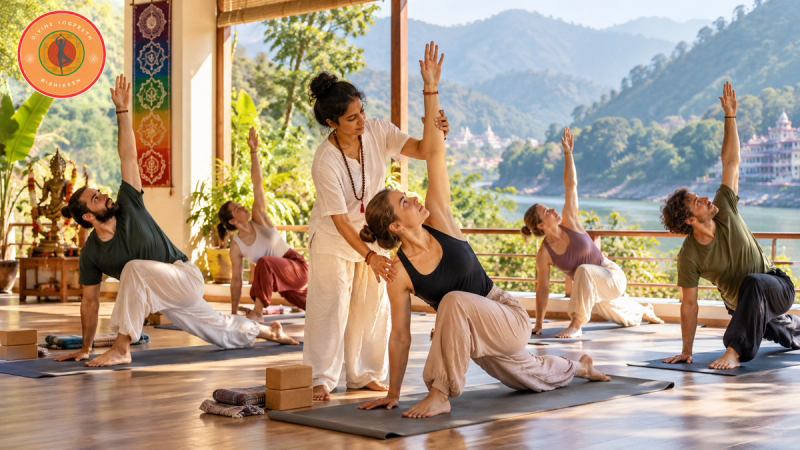
After a session, your instructor may identify strengths and areas for improvement. Feedback could cover voice projection, sequencing, alignment cues, timing, class organisation, or student safety.
You should leave with specific actions to practise, not merely a general statement that your class was good or bad.
Step 5: Repeat and Improve
The real value appears when you teach again using the feedback you received. You might simplify a transition, improve a cue, or allocate more time for relaxation.
Ask the school how many practical teaching sessions are included, whether instructors observe each session, and how your progress is assessed. These details provide a clearer picture of the training than the course duration alone.
3. The Essential Skills You Develop Through Teaching Practice
A 200-hour training program covers more than physical postures. Its practical teaching component should help you connect theoretical knowledge with the decisions you make while guiding a class.
Class Planning and Sequencing
You learn to create a logical progression rather than selecting poses randomly. A class may move from centring and gentle movement into warm-ups, standing postures, appropriate peak work, cool-downs, and relaxation.
The sequence should have a clear purpose and suit the students you are teaching. A beginner-friendly class, for example, may need more preparation and simpler transitions than a class for experienced practitioners.
Clear Verbal Communication
Effective instructions are concise, specific, and easy to understand. Instead of giving five directions at once, you can introduce one or two important actions and allow students time to respond.
You also learn to avoid relying exclusively on Sanskrit terminology. Traditional terms can enrich a class, but unfamiliar words should be explained when necessary.
Observation and Safe Modifications
You cannot assume every student has the same mobility, balance, strength, or comfort level. Teaching practice encourages you to offer variations and avoid pressuring students into positions that do not suit them.
Learn to distinguish between general teaching guidance and individual medical advice. If a student reports an injury or health concern beyond your competence, an appropriate response may be to suggest professional assessment rather than attempting to diagnose the problem.
For further context on yoga, health, and research, the <a href="https://pubmed.ncbi.nlm.nih.gov" rel="nofollow">PubMed research database</a> is a useful starting point. Research findings should be interpreted carefully, and individual outcomes can vary.
Time Management and Class Presence
A class can become rushed when you spend too long explaining one posture. You learn to estimate how much time each section needs and adjust your plan without losing the overall structure.
Your voice, pace, and ability to remain composed also matter. Silence is not automatically a mistake; it can give students time to notice their breathing and experience a posture.
Professional Boundaries
Teaching practice should also develop your understanding of consent, respectful communication, and appropriate boundaries. Physical adjustments should never be treated as compulsory.
A responsible teacher explains options, respects a student's decision, and recognises when a question falls outside their training.
4. How to Prepare for Your First Practice Teaching Class
Preparation does not mean memorising every word. It means knowing the purpose of your class, understanding its structure, and having a plan for common challenges.
Start with a manageable teaching objective. For example, you might prepare a 20-minute beginner session focused on comfortable standing postures and basic breath awareness.
Write a simple class plan that includes the opening, warm-up, main sequence, cool-down, and final relaxation. Note approximate timings and the most important safety cues for each section.
Practise Your Instructions Aloud
Instructions that look clear on paper can become confusing when spoken. Rehearse your sequence aloud and notice where your sentences become too long or where you use technical language without explanation.
You can practise with a fellow trainee, but do not rely entirely on teaching an imaginary student. Real feedback helps you recognise whether your cues make sense to someone else.
Prepare Modifications
Think about how a student could make a posture easier or choose a suitable alternative. Keep props available where appropriate, and avoid presenting one body shape as the only correct expression of a pose.
Learn to Recover from Mistakes
You may forget a transition, misjudge the time, or lose your place. Pause, breathe, and return to the next clear instruction.
A brief pause is usually better than rushing into an unfamiliar sequence. Students need a teacher who can make thoughtful decisions, not someone who appears flawless at every moment.
A useful pre-class checklist includes:
- A clear class objective and sequence.
- A suitable opening and closing.
- Essential alignment and safety cues.
- Accessible alternatives where appropriate.
- A realistic time plan.
- Space for questions and feedback.
After teaching, record three things: what worked, what felt difficult, and what you will change next time. This turns each practice session into a practical learning cycle.
5. Why Rishikesh Matters for Your Yoga Teaching Development
Rishikesh attracts yoga practitioners from India and around the world because of its yoga schools, spiritual traditions, teacher-training programs, and Himalayan setting. For many students, learning here also means stepping away from familiar routines and giving their practice more sustained attention.
In areas such as Tapovan and Laxman Jhula, you may encounter different teaching approaches and practitioners with varied backgrounds. This can broaden your perspective, especially if you are preparing to teach students whose experience, language, or expectations differ from your own.
The setting, however, does not automatically make a training program better. A beautiful location cannot replace qualified instruction, supervised practice, clear assessment, or responsible teaching standards.
Look Beyond the Destination
Before choosing a course, consider the daily schedule, teaching faculty, class size, practical teaching hours, curriculum, accommodation arrangements, and total cost.
Ask whether the program includes anatomy, teaching methodology, yoga philosophy, pranayama, meditation, and supervised practical work. Confirm how much time is allocated to each subject rather than relying on broad descriptions.
You should also check the course's current certification and registration arrangements, along with any requirements relevant to your intended teaching market. A training certificate does not automatically grant professional licensing in every country or guarantee employment.
For international students, practical considerations matter too. Confirm travel documents, visa requirements, insurance, arrival arrangements, and the school's policies before booking.
For additional destination context, explore this guide to yoga in Tapovan, Rishikesh. The local environment can support focused learning, but your daily participation and the quality of your instruction will shape what you take away.
6. Explore 200-Hour Yoga Teacher Training at Divine Yogpeeth
If you are considering teacher training in Rishikesh, Divine Yogpeeth offers a 200-hour yoga teacher training program in the Laxman Jhula and Tapovan area. Our course page is a useful starting point for exploring the program and checking its current details.
Visit our 200-Hour Yoga Teacher Training page to review the course information and determine whether the training aligns with your goals.
Before enrolling, ask our team to clarify the practical teaching schedule, how instructors provide feedback, what assessment involves, and whether any separate internship or external placement is included. Confirm the current fees, accommodation arrangements, course dates, and certificate details directly.
This is particularly important if your goal is to begin teaching professionally after graduation. You need to understand not just what you will study, but also what you will be able to demonstrate by the end of the course.
If you are still deciding between an intensive training program and a shorter introduction to yoga, compare the course structure, time commitment, and learning objectives before making a decision.
7. Common Challenges During Practice Teaching—and How to Handle Them
Even a prepared trainee can experience difficulties when leading a class. Recognising common challenges early makes them easier to address.
Feeling Nervous in Front of a Group
Nervousness often comes from trying to remember everything while worrying about how others perceive you. Reduce the pressure by preparing a simple sequence, rehearsing the opening, and focusing on the students rather than your performance.
You do not need to eliminate every sign of nervousness before you can teach effectively. You need a plan that helps you continue when nerves appear.
Giving Too Many Instructions
New teachers sometimes explain every possible detail of a posture at once. Students can struggle to process several cues while maintaining balance and breathing.
Choose the most important instructions first. Add details gradually, and observe whether students have enough time to respond.
Losing Track of the Sequence
If you forget a pose, resist the urge to improvise something unfamiliar. Return to a familiar posture or move to the next planned section safely.
A well-designed class plan gives you a structure to return to when your attention slips.
Comparing Yourself with Experienced Teachers
Your first practice session should not look like the work of someone who has taught for years. Experienced teachers have developed their timing, observation, and communication through repeated teaching.
Measure your progress against your earlier attempts. Are your instructions clearer? Are transitions smoother? Are you better at adapting when a student needs an alternative?
For more help with confidence and classroom communication, see these practical tips for teaching your first yoga class.
8. How to Know Whether Your Teaching Practice Is Effective
The number of sessions you complete is only one measure of progress. The quality of your learning matters just as much.
After each class, assess your performance using a few consistent questions:
- Could students understand and follow your instructions?
- Did your sequence have a clear beginning, middle, and end?
- Were your transitions appropriate for the group?
- Did you offer modifications without making students feel inadequate?
- Did you manage time without rushing the final relaxation?
- Could you identify and apply the feedback you received?
Ask your instructor for one or two specific improvements to focus on during the next session. Trying to fix everything at once can make progress difficult to measure.
You can also maintain a teaching journal. Record your class objective, the sequence you used, the feedback received, and the changes you plan to make. Over time, this creates a useful record of your development.
Remember that a 200-hour certificate marks a foundation, not the end of your education. You may need additional supervised experience, mentoring, continuing education, or specialist training depending on your goals and the students you intend to teach.
The strongest outcome is not simply being able to say that you completed a training course. It is being able to explain your teaching decisions, recognise your limitations, and continue improving responsibly.
FAQs
1. Is Practice Teaching Included in Every 200-Hour YTT?
Practical teaching is a common component of yoga teacher training, but its format and depth vary. Some schools include supervised peer teaching and assessment, while others may offer additional teaching opportunities separately. Confirm the number of sessions, supervision arrangements, and assessment requirements before enrolling.
2. Do You Need Previous Teaching Experience to Join a 200-Hour YTT?
You generally do not need professional teaching experience to begin a foundational teacher-training program. However, schools can have different entry expectations, and you should check the specific course requirements. Regular personal practice and a willingness to receive feedback can help you prepare.
3. Will a 200-Hour YTT Guarantee a Yoga Teaching Job?
No. Completing a training program does not guarantee employment, clients, income, or permission to teach in every jurisdiction. Your opportunities depend on your skills, local requirements, professional network, experience, and ability to build trust with students.
4. What Should You Look for in Supervised Teaching Practice?
Look for a clear teaching schedule, qualified feedback, opportunities to repeat sessions, transparent assessment criteria, and attention to safe modifications and professional boundaries. Ask whether practical sessions are observed and whether feedback is individual or only given to the group.
5. Is Rishikesh a Good Place to Complete Your 200-Hour YTT?
Rishikesh can be a suitable choice if you want an immersive yoga-learning environment and find a school whose curriculum, faculty, schedule, and budget meet your needs. Compare specific programs carefully rather than choosing solely because of the destination.
Conclusion: Take Your First Step Towards Teaching Yoga
The practice teaching internship 200 hour YTT experience helps you move from practising yoga for yourself to guiding others with greater clarity and responsibility. Through preparation, supervised teaching, constructive feedback, and repeated practice, you can develop the foundations of effective class planning, communication, sequencing, and student awareness.
Your first class may feel uncomfortable. You may forget a cue or discover that an explanation that made sense in your head does not work for a group. These moments are part of learning to teach, provided you reflect on them and make meaningful improvements.
The key is to choose a training program that gives you clear expectations, useful practical experience, and honest feedback—not simply a certificate.
Ready to take the next step? Explore our 200-Hour Yoga Teacher Training in Rishikesh, review the course details, and contact our team to ask about the practical teaching component before enrolling. Start with the right questions and build your teaching foundation with purpose.