.jpg)

Teaching first yoga class tips nervousness holding you back? Discover proven strategies to calm your mind, sequence smartly, and lead students with confidence.
Teaching First Yoga Class Tips Nervousness: How to Overcome Fear and Lead with Confidence
Teaching first yoga class tips nervousness is something every single instructor faces, regardless of how deep their personal practice goes. You unroll your mat at the front of the room, look out at the expectant faces, and suddenly, your mind goes entirely blank. Your palms sweat, your heart races, and you wonder why you ever decided to stand in front of a room full of people.
This reaction is completely normal and rooted in biology. Your brain perceives public speaking and leadership as vulnerable states. The pressure to deliver a flawless sequence, offer perfect cues, and hold space for others can feel overwhelming.
You are not alone in this fear. Even the most seasoned instructors once stood exactly where you are right now, battling self-doubt. The good news is that this anxiety is highly manageable.
By applying the right preparation strategies and mindset shifts, you can channel that nervous energy into genuine passion. You will discover how to stop worrying about being perfect and start focusing on serving your students. Here is exactly how to navigate those overwhelming feelings and step into your role as a capable, grounded guide.
Understanding Teaching First Yoga Class Tips Nervousness
Teaching first yoga class tips nervousness usually stems from a phenomenon known as imposter syndrome. You might secretly believe you do not know enough to lead others. You worry a student will ask an anatomy question you cannot answer, or you will mix up your left and right sides during a crucial vinyasa transition.
Acknowledge these thoughts without letting them define your reality. Recognize that certification means you have put in the work. You understand alignment, breath, and safety. Your students are not expecting a flawless performance; they are looking for a safe, welcoming space to practice.
Shift your focus from internal validation to external service. When you concentrate entirely on how you look or sound, anxiety spikes. When you focus on how your students feel, the pressure melts away. Watch their bodies. Observe their breath. Make the class about their experience, not your performance.
Remember that vulnerability is a powerful teaching tool. If you stumble over a word, smile and correct yourself. Students connect deeply with authentic, human teachers. They do not want a robot reciting Sanskrit; they want a real person guiding them through physical and mental release.
To build a strong foundation, ensure your education supports your goals. Standards set by Yoga Alliance provide a framework that guarantees you have the necessary hours of anatomy, philosophy, and practicum to lead safely. Trust the training you received.
Essential Preparation Strategies to Calm Your Mind
The best antidote to anxiety is thorough, unshakeable preparation. You cannot control who walks into your studio or how they behave, but you can entirely control how well you know your material.
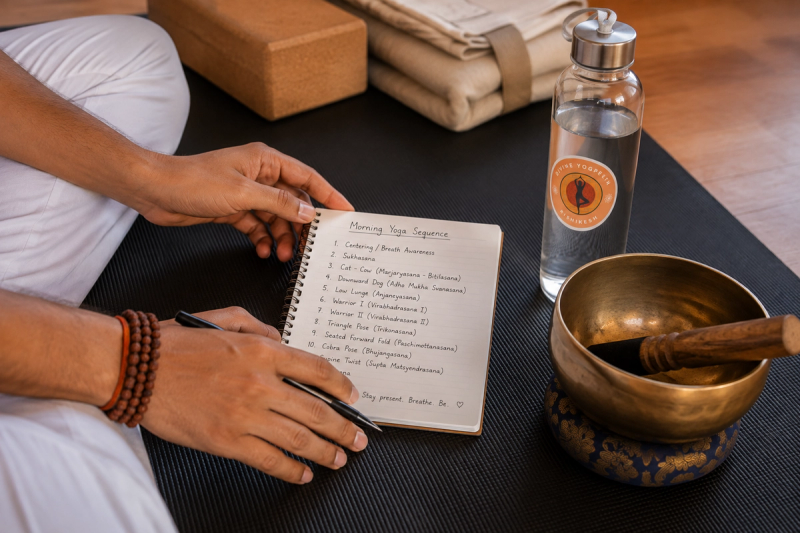
Do not rely on winging it. Write your entire sequence down. Practice teaching it out loud to an empty room, a mirror, or a patient friend. Speak your cues clearly and concisely. Notice where your phrasing gets tangled and simplify those moments.
Focus heavily on transitions. Teachers rarely forget the peak pose; they forget how to get students from Warrior II to Half Moon seamlessly.
Master Your Sequence Safely
Keep your first sequence incredibly simple. This is not the time to introduce complex arm balances or intricate peak poses that require ten preparatory steps. Stick to foundational asanas that you know in your bones.
A straightforward, well-paced Hatha or Vinyasa flow allows you to focus on the students rather than struggling to remember your own choreography. If you need help structuring your flow, brushing up on Yoga Class Sequencing Principles Teacher Training can provide clarity and remove the guesswork.
Always have a physical copy of your sequence nearby. Place it next to your water bottle. Just knowing it is there serves as a powerful psychological safety net, even if you never actually look at it.
Arrive Early and Claim the Space
Rush hour traffic and running late are guaranteed to spike your cortisol. Arrive at the studio at least thirty minutes before your students. Unroll your mat. Adjust the lighting. Test the music system to ensure your playlist works smoothly.
Sit in the center of the room and breathe. Visualize the room filling with students. Picture yourself speaking calmly and confidently. Claiming the physical space before anyone else arrives establishes your energetic authority in the room.
Greet your students as they walk in. Ask about any injuries. Learning their names and chatting briefly transforms them from an intimidating audience into friendly acquaintances. This simple act drastically lowers the barrier of fear.
Grounding Techniques to Use Right Before Class
Ten minutes before the class begins, the adrenaline rush will hit its peak. Your chest might feel tight. Your breath might become shallow. This is the precise moment to employ active grounding techniques to regulate your nervous system.
Do not try to force yourself to calm down. Instead, give your body physical signals that it is safe. Stand in Tadasana (Mountain Pose) near the back of the room. Press the four corners of your feet firmly into the floor. Feel the solid earth supporting your weight.
Lengthen your spine and drop your shoulders away from your ears. Consciously unclench your jaw.
Regulate Your Breathing
Anxiety lives in short, rapid chest breaths. Shift your breathing into your belly. Inhale deeply through your nose for a count of four, and exhale slowly for a count of six. Extending the exhale activates the parasympathetic nervous system, effectively hitting the brakes on your body's fight-or-flight response.
Science supports this approach. According to studies indexed on PubMed, slow, controlled breathing practices significantly reduce heart rate and anxiety markers in high-stress situations. You teach pranayama to your students; now is the time to use it for yourself.
Use a Grounding Mantra
Find a short, silent phrase to repeat in your mind. "I am grounded." "I am here to serve." "I am prepared." Choose a mantra that resonates with your specific fears and silently recite it synced with your breath.
Remind yourself that the physical symptoms of nervousness (sweating, racing heart) are identical to the symptoms of excitement. Reframe the narrative in your mind. Tell yourself, "I am not terrified; I am excited to share this practice."
What to Do When Things Go Wrong
Every yoga teacher, no matter how experienced, makes mistakes. You will mix up left and right. You will blank on a pose. You will cue an inhale when it should be an exhale. Teaching first yoga class tips nervousness spikes precisely because we fear these exact scenarios.
The secret is knowing how to handle the slip-ups gracefully. When you make a mistake, do not panic. Do not launch into a long, defensive apology.
If you say "right leg" instead of "left leg," simply laugh lightly and correct it. "Excuse me, let's take that on the left side." Your students will appreciate your humanity. They are focused on their own bodies, not grading your performance.
Handling the Memory Blank
If your mind goes completely blank, do not freeze. Guide your students into Downward Facing Dog or Child's Pose. Tell them to take five deep, intentional breaths.
This gives you thirty seconds of complete silence to look at your notes, collect your thoughts, and find your place in the sequence. To your students, it feels like a deliberate, restful pause. To you, it is a lifeline.
Learning to structure a class properly prevents these blanks from happening often. If you need actionable strategies for building reliable flows, reading up on how to Create Yoga Sequence After Teacher Training offers excellent frameworks that are easy to memorize.
Managing Different Skill Levels
You might plan a beginner class, but an advanced practitioner walks in. Alternatively, you might plan a dynamic flow, but someone with a shoulder injury arrives.
Do not throw your entire sequence away. Stick to your plan but offer modifications. Remind the room that Child's Pose is always available. Offer the foundational pose first, then layer on advanced options for those who want them. You are the guide, but they are in charge of their own practice.
Post-Class Reflection: Growing Past the Nerves
When you cue that final "Namaste," the wave of relief will be immense. You did it. You survived. Take a moment to genuinely celebrate that accomplishment, no matter how messy it might have felt internally.
After the students leave, sit down and reflect. Do not focus solely on what went wrong. Write down three things that went beautifully. Did you nail a specific transition? Did a student thank you for a helpful cue? Document the wins to build your confidence reservoir.
Next, gently note one or two areas for improvement. Perhaps your music was slightly too loud, or you spoke too quickly during the warm-up. These are not failures; they are data points for your next class.
Building a sustainable career requires continuous learning. The confidence to lead rooms gracefully comes with time and repetition. If you are looking to turn this passion into a profession, exploring Yoga Business Skills After TTC can help you navigate the practical side of being a studio instructor or independent teacher.
Keep showing up. The first class is always the hardest. The second is slightly easier. By your tenth class, the terror will be replaced by comfortable anticipation. You will start to find your unique voice, your preferred pacing, and your authentic teaching persona.
Why Rishikesh is the Perfect Place to Master Your Teaching Skills
Location plays a massive role in how you absorb and process yoga education. Rishikesh, nestled in the foothills of the Himalayas along the banks of the sacred Ganga, is universally recognized as the yoga capital of the world.
Studying here offers a profound advantage for nervous teachers. The environment strips away the superficial, performative aspects of modern studio culture. You are immersed in the ancient, authentic roots of the practice.
The energy in Rishikesh encourages introspection and spiritual grounding. When you learn to teach here, you learn to teach from a place of deep inner peace rather than ego. The daily exposure to authentic ashram life, traditional philosophy, and dedicated masters builds a resilience that modern city studios simply cannot replicate.
Graduating from a program in this sacred city gives you a deep well of traditional knowledge to draw upon. When you step in front of your first class, you carry the weight and wisdom of the Himalayas with you. This unspoken authority naturally calms your nerves and commands respect from your students.
Take the Next Step in Your Teaching Journey
If you are considering taking the leap into teaching, or want to deepen your existing practice in an authentic environment, choosing the right school is critical. If you're considering training in Rishikesh, Divine Yogpeeth offers an incredibly supportive environment to overcome your fears and find your unique teaching voice. Our traditional approach ensures you leave not just with a certificate, but with genuine, unshakeable confidence.
Frequently Asked Questions
Is it normal to shake during my first yoga class?
Yes, minor physical tremors are a standard physiological response to adrenaline. Focus on grounding your feet, breathing deeply into your belly, and moving slowly. The shaking usually subsides after the first ten minutes as you settle into your flow.
Should I tell my students it is my first time teaching?
There are divided opinions on this, but generally, it is best to keep it to yourself. Announcing your inexperience can sometimes make students nervous about their safety. Step into the role with quiet authority. If you feel compelled to share, do so individually after class, not during your opening speech.
How do I stop talking too fast when nervous?
Nerves naturally speed up our cadence. Counteract this by consciously syncing your speech with your own physical breath. Deliver one cue per exhale. If you feel yourself rushing, deliberately insert a three-second pause between sentences. Silence is highly effective in a yoga room.
What if I cannot answer a student's anatomy question?
Honesty is always the best policy. Never guess an answer regarding anatomy or injuries. Simply say, "That is a great question. I want to give you the most accurate information, so let me research that and get back to you next week." This builds trust and shows professional integrity.
Building up your knowledge base constantly is key to avoiding these panic moments. For insights on developing your authority and presence, reading up on New yoga teacher confidence after training: 7 Best Tips is highly recommended.
Conclusion
Overcoming teaching first yoga class tips nervousness is a rite of passage. It proves that you care deeply about the practice and the well-being of your students. Remember that perfection is an illusion. Your students are seeking connection, safe guidance, and a moment of peace in their busy lives. Prepare diligently, breathe deeply, and allow your authentic self to shine through the anxiety. You have the knowledge; now you simply need the experience.
Ready to begin your journey or upgrade your existing skills? Explore our 200-Hour YTT or our foundational 100-hour yoga teacher training in Rishikesh and take the first step toward confident, fearless teaching today.