.jpg)

Restorative yoga 200 hour TTC curriculum: learn why rest belongs in teacher training, what to expect, and how to choose a course in Rishikesh. Find out more.
Restorative yoga 200 hour TTC curriculum: Why Rest Is Part of the Training
Restorative yoga 200 hour TTC curriculum can sound gentle until you realize how much skill it takes to teach someone how to truly rest. What if the ability to slow down, support the body, and observe the breath were not an optional break from serious yoga training, but part of becoming a better teacher?
A well-rounded 200-hour teacher training should give you more than physically demanding asana practice. You also need to understand recovery, nervous-system regulation, sequencing, breath awareness, props, and how different bodies respond to practice. Restorative methods can help you develop that wider teaching perspective.
In this guide, you will learn what restorative yoga can look like within a 200-hour TTC, which skills you can develop, how it differs from simply lying down, and why studying it in Rishikesh can add useful context to your training. You will also see what to look for when comparing 200-hour programs and how to decide whether a curriculum gives rest enough attention.
What the restorative yoga 200 hour TTC curriculum should teach you
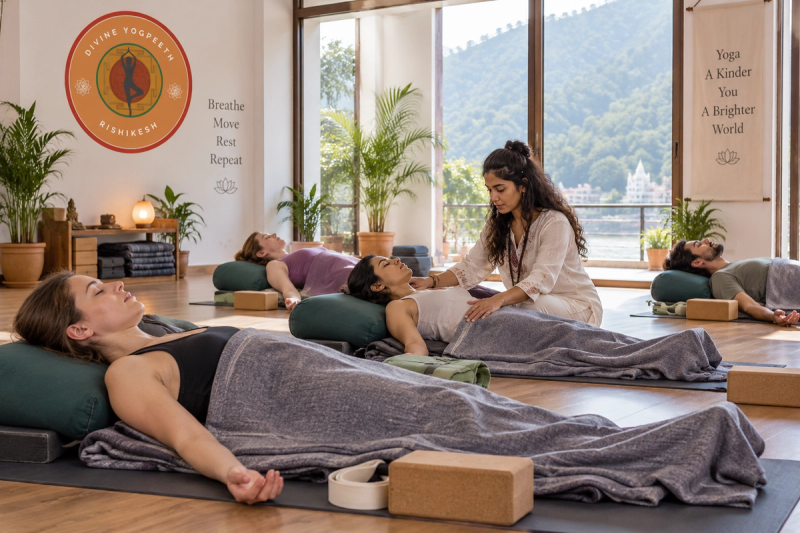
Restorative yoga is built around supported, comfortable positions held long enough for you to reduce unnecessary effort and pay attention to breathing and sensation. The goal is not to force flexibility or create an impressive shape. The teacher's job is to make the setup purposeful, safe, and responsive.
Within a 200-hour TTC, restorative work can introduce you to a different side of teaching. You learn that a pose can be effective without being intense, and that the quality of support can matter as much as the pose itself.
A useful curriculum may cover:
- The purpose and principles of restorative practice.
- Prop selection and intelligent placement using bolsters, blankets, blocks, straps, or cushions.
- Entry and exit from supported postures.
- Breath observation without forcing a particular breathing pattern.
- Basic sequencing from active work toward quieter practice.
- Verbal cues that encourage awareness rather than performance.
- Modifications for comfort, mobility, and different body proportions.
- The difference between restorative practice, relaxation, Yin-style practices, and Yoga Nidra.
You should also learn how to recognize when a student needs a modification. A posture that looks peaceful from across the room may still create pressure, numbness, strain, or anxiety for the person practicing it.
For broader context about yoga education and teacher credentials, you can review the information available from Yoga Alliance. A credential or registration, however, does not automatically tell you how much restorative practice a particular school teaches, so the actual curriculum still deserves your attention.
Restorative yoga in a 200-hour TTC: skills beyond the pose
One of the biggest mistakes you can make as a trainee is measuring progress only by how difficult your personal practice becomes. Teaching requires a different skill set. You need to observe, communicate, adapt, and understand why a particular practice is appropriate.
Learning to teach with props
Props are not shortcuts. In restorative practice, they are tools for creating a stable relationship between the body and the floor or another support.
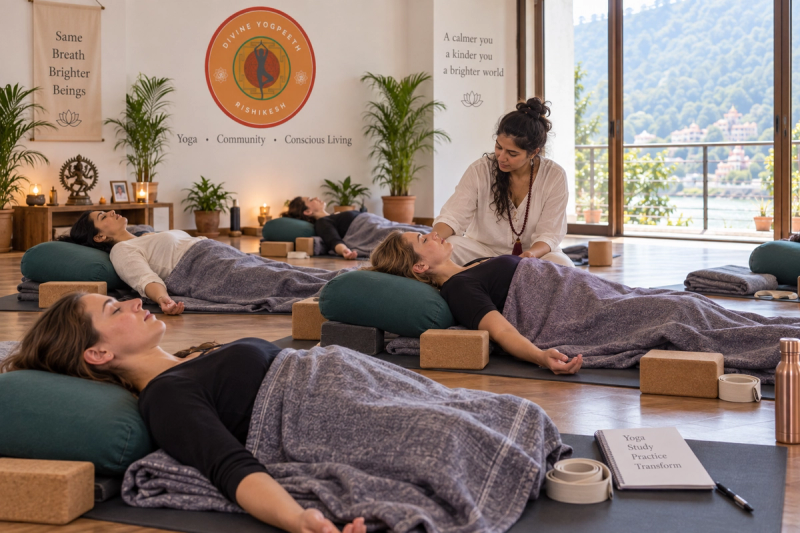
You may learn to adjust the height of a bolster, add a folded blanket beneath the head, support the knees, or change the angle of the torso. Small adjustments can make a substantial difference in comfort.
This is also where anatomy becomes practical. Instead of memorizing muscles simply for an exam, you start asking useful questions: Where is the student's weight? Is the neck comfortable? Can the breath move freely? Is the student holding tension to stay in position?
Learning to sequence energy
A class can have a deliberate arc. You might begin with movement, gradually reduce muscular demand, introduce supported shapes, and finish with quiet breathing or relaxation.
That sequencing skill matters because restorative practice is rarely just a collection of relaxing poses. The transition from stimulation to stillness is part of the teaching.
If you want to strengthen the anatomy side of your training, a related resource on Yoga Anatomy Muscles Joints and Safe Alignment Tips can help you connect alignment concepts with practical teaching.
Why rest belongs in serious yoga teacher training
Rest is easy to misunderstand. You may assume that a serious TTC should be physically demanding every day, with long asana sessions proving how committed you are. That approach can leave out an important teaching lesson: intensity is only one variable.
Students arrive with different goals and capacities. One person may want stronger movement and another may need a slower class because they are tired, older, new to yoga, or simply seeking a quieter practice.
Restorative training teaches you to work with that range rather than expecting everyone to practice in the same way.
Rest can improve your teaching awareness
When you are not busy trying to achieve a pose, you have more opportunity to notice subtle details. You can observe breathing patterns, facial tension, fidgeting, discomfort, and changes in posture.
That observation can make your cues more precise. Instead of telling everyone to “relax,” you can give a concrete instruction such as softening the jaw, adjusting the head support, or allowing the hands to rest somewhere comfortable.
A useful teacher does not confuse stillness with passivity. You are still making decisions: choosing support, managing timing, explaining the purpose of the practice, and watching for signs that a student needs to change position.
Rest can balance an active curriculum
Many 200-hour programs include dynamic styles such as Hatha or Vinyasa. Those practices can build strength, coordination, mobility, and sequencing skills. Restorative work gives you a complementary teaching tool.
The point is not to decide that active yoga is better or worse than restorative yoga. The useful question is whether you can teach appropriately across different contexts.
A strong teacher should be able to recognize when a class needs activation and when it needs downshifting. That flexibility is especially valuable when you eventually teach mixed-level groups.
How restorative practice can fit into your 200-hour training
The exact structure varies from school to school, so you should read the curriculum rather than assuming every 200-hour TTC offers the same depth.
Restorative material may appear as a dedicated class, a portion of asana sessions, a sequencing workshop, relaxation practice, or integration with anatomy and teaching methodology.
You can look for evidence that the subject is taught rather than merely mentioned. A curriculum becomes more meaningful when you get opportunities to practice the method yourself, observe demonstrations, discuss modifications, and teach supported sequences under supervision.
A useful checklist is:
- Are restorative principles explicitly named in the syllabus?
- Are props and modifications taught practically?
- Do you practice teaching, not only practicing?
- Is relaxation integrated with sequencing and class planning?
- Does the course explain how restorative methods differ from other slow practices?
- Can you ask teachers about how they adapt poses for different students?
You should also consider how much time the school allocates to anatomy, philosophy, pranayama, meditation, teaching methodology, and supervised practice. Restorative yoga should complement these areas, not replace the broader foundation expected from a 200-hour program.
If you are comparing course formats, 200 Hour YTT Fees in India and What Is Included can help you think beyond the headline price and examine what a program actually includes.
Why Rishikesh matters when you study restorative yoga
Rishikesh can give your training a distinct environment because yoga practice happens alongside a strong culture of study, meditation, retreat, and spiritual practice. Your surroundings do not automatically make a course better, but they can influence how you experience the quieter parts of training.
For restorative work, the value of place can be practical. A demanding training schedule followed by quieter sessions may encourage you to notice how environment, routine, sleep, movement, and attention affect your practice.
You can also use your time in Rishikesh to explore what kind of yoga environment actually suits you. Tapovan is a common base for yoga schools, cafés, wellness spaces, and visiting practitioners, making it easier to experience different approaches while staying focused on your course.
If you are interested in the local setting, Tapovan Rishikesh Yoga and 7 Ways It Can Change Your Practice offers additional context about practicing in the area.
What to look for in a restorative yoga teacher training curriculum
When you compare schools, do not choose a program simply because “restorative yoga” appears somewhere on the website. Look at how the topic is taught and how it connects with the rest of the course.
Start by examining the curriculum structure. You want to see a coherent relationship between asana, anatomy, pranayama, meditation, philosophy, sequencing, and teaching practice.
Then ask about the practical details. How many sessions involve restorative methods? Are props available? Do trainees receive feedback while teaching? Are modifications discussed for different mobility levels? Are quiet practices treated as genuine learning sessions or simply used as downtime?
Teacher experience also matters. A trainer who can explain why a support is placed in a particular position gives you more useful knowledge than a class that simply tells you to copy a shape.
The learning environment matters as well. A teacher-training group can be physically demanding and emotionally busy. You should have opportunities to ask questions without feeling that every question indicates weakness.
The goal of your course search should be more than finding a certificate; you can also explore Divine Yogpeeth to understand our training environment. Look for a curriculum that gives you space to build practical teaching skills, understand your own practice, and work with different levels of intensity.
Ask these questions before enrolling
Before paying a deposit, ask the school for the current syllabus and clarify what “restorative” means in practice.
You can ask:
- How many hours are dedicated to restorative or supported yoga?
- Is restorative sequencing part of teaching practice?
- Which props are provided?
- How are modifications taught?
- Will instructors give individual feedback?
- How is restorative work connected to anatomy and teaching methodology?
Clear answers help you compare programs based on substance rather than marketing language.
A balanced 200-hour curriculum: active practice and real recovery
A good 200-hour training does not need to turn every session into either an intense workout or a long relaxation period. Balance is more useful.
You may have mornings focused on asana, sessions on anatomy or philosophy, teaching-practice assignments, pranayama, meditation, and quieter evening practices. The exact schedule will vary, but the principle remains: different methods train different teaching abilities.
Restorative yoga can teach you patience. You may discover that holding a supported position without constantly adjusting requires more attention than expected. You may also notice how quickly your mind starts searching for stimulation when the body becomes still.
That is valuable information for a future teacher. If you struggle to stay present during stillness, you can better understand why students may find quiet practices challenging.
Rest also has a place in class planning. Suppose you teach a physically demanding sequence. Ending abruptly can feel disconnected. A gradual reduction in intensity, followed by supported postures and relaxation, can create a more coherent class arc.
The same principle applies outside the studio. Your personal practice does not have to be identical every day. Some days may call for strength and movement; others may call for recovery, breath awareness, or meditation.
For deeper study of quieter practices, Yoga Nidra Benefits and How to Practice can help you distinguish guided yogic sleep practices from restorative asana.
Start your training in Rishikesh with a curriculum that includes the whole practice
If you are considering a 200-hour TTC in Rishikesh, Divine Yogpeeth offers our 200-Hour Yoga Teacher Training in Rishikesh, where you can explore yoga education in a focused residential setting in Laxman Jhula, Tapovan.
The goal of your course search should be more than finding a certificate. Look for a curriculum that gives you space to build practical teaching skills, understand your own practice, and work with different levels of intensity.
If you are not ready for a full 200-hour commitment, you can also compare our 100-Hour Yoga Teacher Training as a shorter training pathway.
FAQs
Is restorative yoga included in every 200-hour TTC?
No. Course structures differ, and the depth of restorative yoga can vary considerably. Check the current syllabus and ask how many hours are devoted to restorative practice, props, sequencing, and teaching methodology.
Is restorative yoga too easy for a serious yoga teacher?
No. Physical intensity and teaching difficulty are not the same thing. Restorative practice can require careful observation, precise support, timing, communication, and sensitivity to student comfort.
Do you need special equipment to teach restorative yoga?
You can adapt many practices with common household supports, but teacher-training environments often use bolsters, blankets, blocks, straps, and cushions. Learning how to use props effectively is part of the skill.
Can beginners study restorative yoga during a 200-hour TTC?
Yes, depending on the school's entry requirements and teaching approach. You do not need to arrive already knowing restorative sequencing. The important part is being willing to learn, observe, practice, and receive feedback.
Is restorative yoga the same as Yoga Nidra?
No. They can both involve stillness and relaxation, but they are different practices. Restorative yoga generally uses supported physical postures, while Yoga Nidra is a guided practice of conscious relaxation and awareness.
Conclusion: restorative yoga 200 hour TTC curriculum is part of becoming a complete teacher
A restorative yoga 200 hour TTC curriculum should remind you that yoga teaching is not a competition to make every class harder. Your responsibility grows when you learn how to choose an appropriate practice, support different bodies, communicate clearly, and recognize when less effort is the wiser option.
As you compare teacher-training programs, examine the actual curriculum, teaching hours, anatomy content, prop work, supervised practice, and teacher feedback. Restorative methods are most useful when they are integrated into a broader education rather than treated as a decorative syllabus item.
If you are ready to study in Rishikesh, explore our 200-Hour Yoga Teacher Training in Rishikesh and take the next step toward building a more adaptable, thoughtful teaching practice..