.jpg)

Yoga anatomy muscles joints alignment explained with practical teaching insights for safer, stronger yoga practice in Rishikesh. Learn more.
Introduction
Yoga anatomy muscles joints alignment teachers need to understand is far more practical than memorizing the names of every bone and muscle in the body.
Have you ever watched a student struggle with Downward-Facing Dog even though their posture looks technically correct? Or noticed that one student can comfortably enter a deep hip-opening pose while another feels restricted almost immediately?
That difference is where anatomy becomes essential.
When you understand how muscles create movement, how joints allow or limit motion, and how individual body structures affect alignment, you can teach with greater awareness. Instead of forcing every student toward the same visual shape, you can help each person find a stable and functional version of the pose.
This guide explores the major muscle groups, important joints, movement patterns, and practical alignment principles you can apply while teaching. You will also learn why "perfect alignment" does not look identical in every body and how an anatomy-based approach can make your teaching safer and more intelligent.
Yoga Anatomy Muscles, Joints and Alignment: Why Teachers Need the Basics
A yoga teacher does not need to become a medical professional. You do, however, need enough functional anatomy to understand what your students are asking their bodies to do.
Every asana involves some combination of joint movement, muscular contraction, balance, breathing, and load management. When you can recognize these elements, your instructions become much more useful.
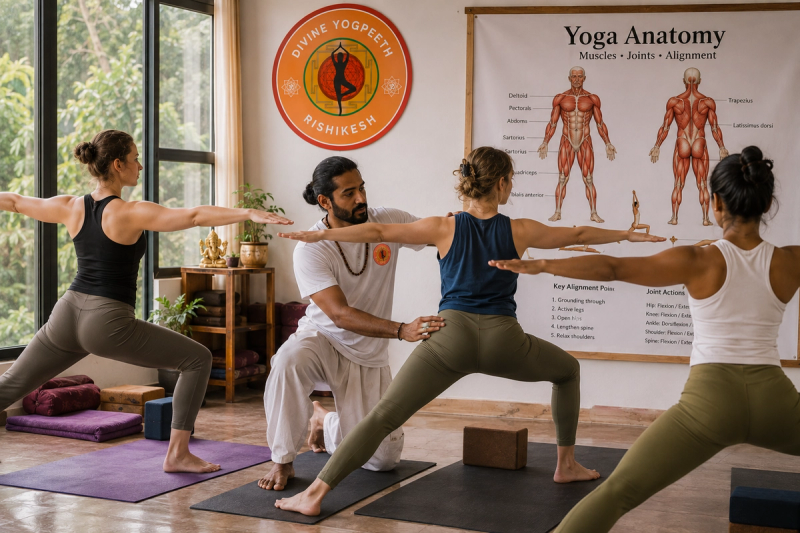
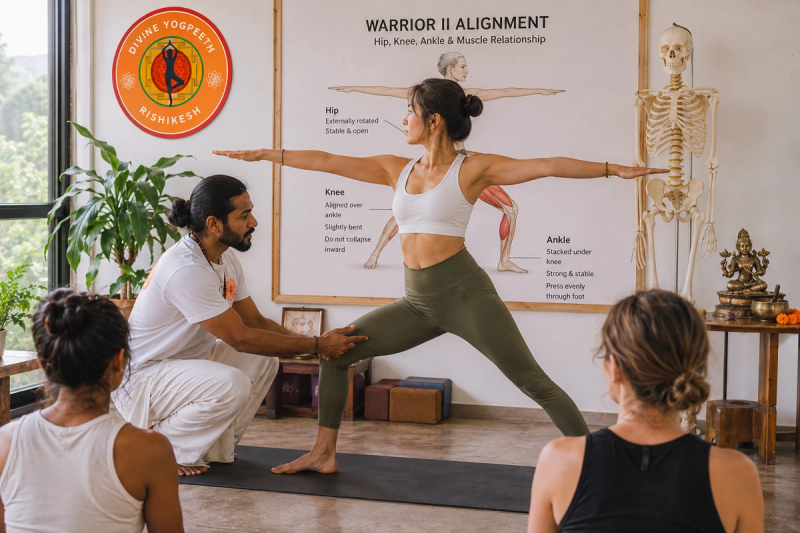
For example, consider Warrior II. Your student's front hip is externally rotated while the knee bends and tracks generally toward the direction of the toes. The back leg remains relatively extended, and the pelvis and trunk need to organize themselves over the legs.
You do not need to give a five-minute anatomy lecture during the pose. You simply need to understand what is happening well enough to offer an appropriate cue.
Useful anatomical questions include:
- Which joints are moving?
- What range of motion does the pose require?
- Which muscles are producing or controlling the movement?
- Where is the student's body bearing load?
- Is the limitation muscular, structural, balance-related, or simply unfamiliarity?
- Does the student have pain, or are they experiencing normal muscular effort?
A strong foundation in anatomy also helps you avoid one of the biggest teaching mistakes: assuming that every student should look exactly like the teacher.
Your role is not to manufacture identical shapes. Your role is to help students develop controlled, comfortable, functional movement.
For a broader professional foundation, you can also explore Yoga Alliance as one reference point when considering yoga teacher education and professional standards.
Understanding Major Muscles Used in Yoga
You do not need to memorize every muscle in the human body to become a better yoga teacher. Start with the major muscle groups that repeatedly influence common asanas.
Core Muscles
The core is more than the abdominal muscles.
The abdominal wall, diaphragm, pelvic floor, spinal muscles, and deeper stabilizing structures all contribute to trunk control. In yoga, this system helps you maintain posture and transfer force between the upper and lower body.
Plank, Boat Pose, balancing postures, and many transitions require effective trunk stabilization.
Rather than constantly telling students to "tighten your abs," you can use functional cues such as maintaining a stable ribcage, controlling the pelvis, or lengthening through the spine.
Glutes and Hip Muscles
The gluteal muscles contribute to hip extension, rotation, and stabilization.
You use them in movements such as standing from a squat, stabilizing the pelvis, and controlling transitions. The deeper hip rotators also influence how the femur moves within the hip joint.
This matters particularly in standing poses and hip-opening postures.
A student who cannot comfortably move into a deep hip position may not simply need more stretching. Their available movement can be influenced by muscle strength, mobility, previous activity, joint structure, and individual anatomy.
Quadriceps and Hamstrings
The quadriceps extend the knee and play an important role in many standing postures.
The hamstrings cross both the hip and knee, meaning they influence movements at two joints. Their length and strength can affect how comfortably a student folds forward or performs movements involving hip flexion.
When teaching forward folds, avoid treating the hamstrings as the only explanation for limited movement. Pelvic position, spinal movement, hip structure, and technique also matter.
Shoulders and Upper Back
The shoulder complex is particularly important in Downward-Facing Dog, Plank, Chaturanga, arm balances, and inversions.
The shoulder blade needs to move as part of the larger shoulder complex. Simply telling students to "pull the shoulders down" in every posture can sometimes interfere with natural movement.
Teaching should therefore focus on controlled movement rather than forcing the shoulders into one rigid position.
Joints and Functional Range of Motion in Yoga
Understanding joints can completely change how you interpret a student's posture.
A joint is not simply a hinge that moves in one predetermined direction. Different joints have different structures and ranges of motion, and individual bodies vary significantly.
The Hip Joint
The hip is a ball-and-socket joint capable of flexion, extension, abduction, adduction, and rotation.
This wide range of movement explains why hip mobility appears in so many yoga postures.
But mobility is not automatically better.
If you constantly push a student toward a deeper range without adequate control, strength, or awareness, you may create unnecessary stress. A functional range is one that the student can access and control appropriately.
This is particularly important in deep external-rotation postures.
Instead of asking, "How deep can you go?" ask, "Can you access this position comfortably and maintain control?"
The Knee Joint
The knee primarily performs flexion and extension, with smaller amounts of rotation available depending on its position.
Because the knee is located between the hip and ankle, its position can be influenced by what happens above and below it.
In standing poses, observe the relationship between the hip, knee, and foot rather than looking at the knee in isolation.
A useful teaching principle is simple: avoid forcing a student's knee into a position merely because it resembles a textbook image.
The Shoulder Complex
The shoulder has remarkable mobility, but that mobility also means it requires effective muscular control.
In weight-bearing poses, your students are asking the shoulders, arms, wrists, and hands to manage load.
Small adjustments to hand placement, shoulder position, scapular movement, or the amount of weight being transferred can make a major difference.
This is one reason why yoga adjustments should be based on observation rather than automatic routines.
For teachers interested in developing practical adjustment skills, our yoga adjustments and assists training resources can complement your broader teaching education.
Safe Alignment: Why One Shape Does Not Fit Every Body
Safe yoga alignment is often misunderstood as finding one perfect position and reproducing it with every student.
Human anatomy does not work that way.
Two students can perform the same asana with noticeably different external shapes while both maintaining good control. Differences in bone structure, limb proportions, mobility, strength, previous movement experience, and training background can all affect appearance.
Alignment Should Serve Function
Think about alignment as a tool rather than a visual target.
A useful alignment cue should help a student:
- create stability,
- distribute load appropriately,
- understand the intended movement,
- breathe comfortably,
- control the position,
- or reduce unnecessary strain.
For example, telling a student to "keep your spine straight" can be less useful than explaining how to lengthen the spine while maintaining comfortable breathing and controlled movement.
Watch for Compensation
Compensation occurs when the body changes one movement to achieve another.
A student with limited ankle mobility might alter their squat. A student with restricted shoulder movement might compensate through the spine. A student with limited hip mobility might change pelvic or spinal mechanics during a forward fold.
This is where observation matters.
Do not immediately assume the compensation is dangerous. Instead, identify what is happening, understand the student's comfort level, and decide whether modifying the pose would improve control or comfort.
If pain is present, especially sharp, persistent, or worsening pain, the appropriate response is not to push harder. The student may need to stop the movement and seek appropriate professional assessment.
Applying Anatomy to Common Yoga Poses
Anatomy becomes genuinely useful when you can apply it to actual teaching.
Downward-Facing Dog
Downward-Facing Dog combines shoulder movement, spinal positioning, hip flexion, knee extension, and ankle movement.
A common beginner mistake is trying to force the heels toward the floor.
That is rarely the most important goal.
Instead, encourage students to create a stable relationship between the hands, shoulders, spine, hips, and legs. Bent knees can be perfectly appropriate if they allow the student to maintain a more functional spinal position.
Warrior II
Warrior II requires coordination between the feet, ankles, knees, hips, pelvis, trunk, and shoulders.
Rather than demanding that the front thigh reach a specific depth, focus on controlled knee flexion and a stable base.
Your student's stance width and leg proportions may also affect the appearance of the posture.
Chaturanga
Chaturanga is a particularly useful example of why strength matters alongside mobility.
The pose places significant demand on the upper body. If a student lacks sufficient strength or control, repeatedly lowering through a poorly controlled position is not automatically productive.
Knees-down variations, reduced range, or alternative transitions can help students develop the necessary capacity progressively.
Forward Folds
Forward folds involve hip flexion, spinal movement, and posterior-chain lengthening.
A student who cannot place their hands on the floor is not necessarily doing something wrong.
Blocks can bring the floor closer. Bent knees can reduce unnecessary tension. The goal is to create a controlled movement pattern rather than win a flexibility competition.
Why Rishikesh Matters for Anatomy-Based Yoga Teaching
Rishikesh offers a particularly interesting environment for anyone who wants to deepen their yoga education.
You are surrounded by a large international yoga community, traditional practices, modern teacher-training approaches, and students with very different physical backgrounds.
That diversity can make anatomy more than a classroom subject.
When you teach or practice alongside people from different countries and movement backgrounds, you quickly see that the same cue does not produce the same result for everyone.
Rishikesh also encourages you to connect physical practice with broader aspects of yoga education. Anatomy can support asana teaching without replacing the philosophical, breathing, meditation, and traditional dimensions of yoga.
For additional context on yoga's historical and cultural development, resources such as Britannica can provide broader background beyond practical anatomy.
Take Your Anatomy Knowledge Into Your Yoga Teacher Training
If you are considering formal teacher training in Rishikesh, anatomy should be one of the areas you take seriously rather than treating it as a subject to memorize for an exam.
At Divine Yogpeeth, we approach teacher education as an opportunity to connect theory with actual teaching practice. If you want a structured introduction to teacher training, explore our 100-Hour Yoga Teacher Training program.
For a more comprehensive foundation, our 200-Hour Yoga Teacher Training in Rishikesh is the more relevant option for building your teaching knowledge, sequencing skills, practical understanding, and confidence.
The goal should not be to turn you into an anatomy textbook.
It should help you become a teacher who can look at a student, understand the movement in front of you, and give a useful cue at the right moment.
FAQs
Why is anatomy important for yoga teachers?
Anatomy helps you understand how muscles, joints, and movement patterns contribute to asana practice. This makes it easier to give appropriate cues, identify movement limitations, modify poses, and teach with greater awareness.
Do yoga teachers need to memorize every muscle?
No. You should understand the major muscles, joints, movement patterns, and basic biomechanics relevant to the postures you teach. Functional understanding is more useful than memorizing long lists of anatomical terminology.
Is deeper alignment always better in yoga?
No. A deeper position is not automatically a better position. A student's anatomy, mobility, strength, control, and comfort all influence what range is appropriate for them.
Can yoga anatomy prevent injuries?
Anatomical knowledge can help you recognize potentially problematic movement patterns and make sensible modifications, but it cannot guarantee injury prevention. Teachers should stay within their scope of practice and refer students to qualified healthcare professionals when appropriate.
Should beginners study yoga anatomy?
Yes. Even a basic understanding of anatomy can improve how beginners understand their own movement. For aspiring teachers, anatomy becomes even more valuable because it supports better cueing and modification.
Conclusion: Build Better Teachers Through Better Anatomy
Yoga anatomy muscles joints alignment teachers study is not about making every posture look identical.
It is about understanding movement well enough to teach intelligently.
When you understand how major muscles contribute to movement, how joints create available ranges of motion, and why bodies naturally differ, you can stop chasing rigid alignment rules. You can start teaching students according to function, control, awareness, and individual needs.
That shift matters.
Whether you are beginning your teaching journey or already leading classes, keep studying anatomy alongside your practical teaching experience. Observe more carefully. Cue more precisely. Modify when necessary. And never confuse a visually impressive pose with a functional one.
Ready to build a stronger foundation as a yoga teacher? Explore our 200-Hour Yoga Teacher Training in Rishikesh and take the next step toward teaching with greater anatomical awareness and confidence.