.jpg)

Mastering Sanskrit yoga teacher training essential terms is crucial for your practice. Discover the core vocabulary to elevate your teaching. Find out more.
Sanskrit Yoga Teacher Training Essential Terms You Must Know
Have you ever felt completely lost when an instructor calls out "Adho Mukha Svanasana" during a fast-paced vinyasa flow? Mastering Sanskrit yoga teacher training essential terms is the crucial bridge between simply copying physical movements and truly understanding the ancient science of yoga. When you step onto the mat as a future guide for others, this traditional vocabulary becomes your most powerful and reliable tool.
It connects you directly to thousands of years of rich history while ensuring you communicate with absolute precision. Knowing these ancient words elevates your confidence and helps you command a room with authentic authority. We will walk through the exact phrases and concepts you need to build a rock-solid foundation for your future classes.
You do not need to become a perfect linguistic scholar to teach an incredible and moving yoga session. You simply need a working knowledge of the core concepts that define this practice across the globe. By the end of this guide, you will feel prepared to speak the universal language of yoga with clarity and grace.
The Foundation of Sanskrit Yoga Teacher Training Essential Terms
Sanskrit is often referred to as the language of the gods, carrying a vibrational frequency that goes far beyond basic human communication. When you learn these ancient syllables, you are tuning into the original frequency of the yogic tradition. This is why memorizing Sanskrit yoga teacher training essential terms is highly recommended by international bodies like Yoga Alliance for maintaining the integrity of the practice.
Using Sanskrit in your classes creates a beautiful, universal environment where practitioners from any country can follow your lead. If you teach a class in Europe, Asia, or the Americas, "Tadasana" means the exact same thing to every single student in the room. This eliminates the confusion that often arises from varied regional translations or slang terms for poses.
Understanding the root words also helps you decode complex pose names instantly. Once you know that "Eka" means one and "Pada" means foot, any pose starting with "Eka Pada" immediately makes physical sense. To explore how we integrate this into our daily curriculum, you can read our guide on the 100 Hour YTT Language of Instruction India: Honest Guide.

Core Asana Vocabulary for Your Sequences
The physical postures, or "Asanas," form the bulk of what you will cue during a standard modern yoga class. To teach safely and effectively, you must understand the components that make up these Sanskrit names.
Let us break down the most common root words you will encounter every single day on the mat:
- Asana: This translates directly to "seat" or "posture," and it forms the suffix of almost every physical pose you will ever teach.
- Adho: Meaning "downward."
- Urdhva: Meaning "upward."
- Mukha: Meaning "face."
- Svana: Meaning "dog."
When you piece these together, "Adho Mukha Svanasana" translates beautifully into Downward-Facing Dog.
Other foundational terms include "Chaturanga Dandasana," which translates to Four-Limbed Staff Pose. "Chatur" means four, "Anga" means limb, and "Danda" means staff. Knowing this helps you cue your students to keep their bodies as rigid and straight as a staff while lowering to the ground.
"Savasana," or Corpse Pose, is perhaps the most important term you will use. "Sava" translates to corpse, reminding practitioners that this pose is about complete physical stillness and the death of the ego. Providing this deeper context transforms your classes from a mere workout into a deeply spiritual experience. You can see how this depth is applied across our entire philosophy by exploring our holistic approach to yoga.
Breath and Energy: Pranayama and Chakras
Yoga is deeply rooted in the manipulation and mastery of unseen energy within the physical body. To guide your students through these subtle practices, you must be comfortable with the vocabulary of breath and vital force.
Pranayama is the expansion and control of life force energy. "Prana" means vital life energy, while "Yama" means control or extension. When you teach breathing exercises, you are not just asking students to inhale and exhale; you are teaching them to regulate their vital life force. For a deep dive into historical definitions and roots, you can always reference resources like Wikipedia to see how these terms have evolved over centuries.
Ujjayi is the victorious breath, often called the ocean breath due to the sound it creates in the back of the throat. Cueing Ujjayi breath correctly helps your students build internal heat and maintain strict focus during challenging flows.
Chakras are the spinning wheels of energy located along the central channel of the body. From the Muladhara (Root) to the Sahasrara (Crown), knowing the Sanskrit names of these seven energy centers allows you to theme your classes around specific energetic healing.
Bandhas are energetic locks used to contain and direct Prana within the body. Mula Bandha (Root Lock), Uddiyana Bandha (Abdominal Lock), and Jalandhara Bandha (Throat Lock) are essential concepts for advanced physical practices and breathwork.
Key Philosophical Terms Every Teacher Needs
To truly embody the role of a yoga guide, you must understand the philosophy that dictates the lifestyle off the mat. The Yoga Sutras of Patanjali provide the framework for this, primarily through the Ashtanga, or eight-limbed path.
Yamas and Niyamas are the first two limbs, representing ethical restraints and positive observances. Terms like "Ahimsa" (non-violence) and "Satya" (truthfulness) should be woven into your dharma talks and class themes. Understanding these concepts prevents the practice from becoming purely physical and shallow. For a comprehensive look at how these principles shape your mindset, review our article on the Eight Limbs of Yoga Philosophy: 8 Ultimate Steps to Peace.
Samadhi is the final limb, representing complete integration or bliss. While you may not reach Samadhi during a standard sixty-minute vinyasa class, keeping this ultimate goal in mind grounds your teaching in true tradition.
Guru is a term often used but rarely fully understood in Western contexts. "Gu" means darkness, and "Ru" means the dispeller. A true Guru is not just a teacher, but someone who removes the darkness of ignorance from your path. When you teach, you aim to ignite the inner Guru within each of your students.
Om (Aum) is the primordial sound of the universe. Chanting this sacred syllable at the beginning or end of your class unites the energy of the room and honors the deep roots of the tradition you are passing on.
Why Rishikesh Matters for Your Learning
Learning these ancient terms from a textbook or an online video is entirely different from hearing them spoken in the birthplace of yoga. Rishikesh carries a unique vibrational energy that makes absorbing these concepts feel entirely natural.
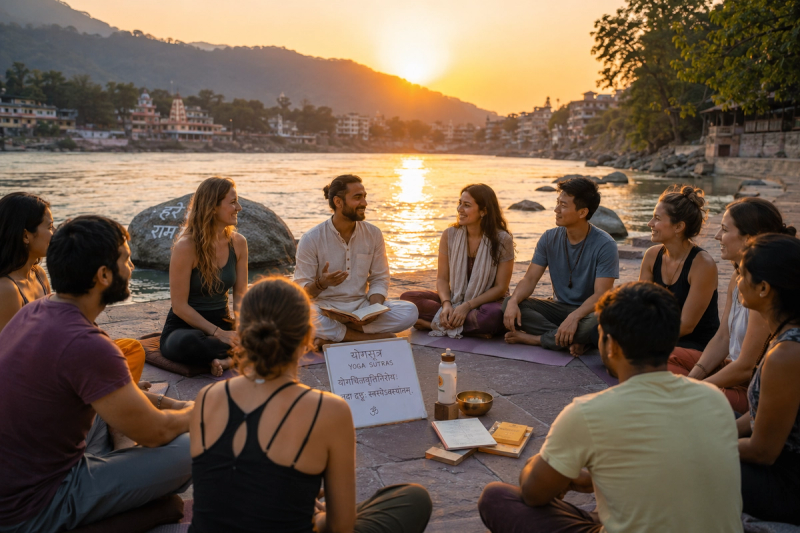
When you sit on the banks of the sacred Ganga River, the Sanskrit language feels alive. The chants echoing from the local ashrams and the daily aarti ceremonies immerse you in the vocabulary until it becomes second nature. You are not just memorizing words for an exam; you are living the language every single day.
Studying here also gives you direct access to traditional Indian masters who grew up speaking and chanting these exact syllables. Their pronunciation, cadence, and deep understanding of the etymology will elevate your own teaching immensely. To understand how this authentic environment impacts your global standing, read about the Yoga Alliance RYT 200 Certification: 7 Best Real Truths.
Soft CTA: Experiencing Authentic Teachings
If you are considering training in Rishikesh, Divine Yogpeeth offers an incredibly supportive environment to master these ancient terms without feeling overwhelmed. Our experienced teachers break down complex Sanskrit vocabulary into easily digestible lessons, ensuring you feel totally prepared. You can explore how we integrate this into our foundational 100-Hour Yoga Teacher Training to start your journey with confidence.
Frequently Asked Questions About Sanskrit in Yoga
Do I need to be completely fluent in Sanskrit to teach yoga?
Absolutely not. You do not need to conversational fluency in the language. You only need to memorize and understand the specific Sanskrit yoga teacher training essential terms relevant to the physical poses, breathing techniques, and core philosophical concepts.
How can I memorize all these complex terms quickly?
The secret is consistent, daily repetition. Break the words down into their root meanings rather than trying to memorize them as random sounds. Once you know what "Adho" and "Mukha" mean, half the work is done. Using flashcards and practicing your vocal cueing out loud while alone will speed up the process. For more actionable advice on building your voice, check out our tips on gaining new yoga teacher confidence after training.
Should I use Sanskrit or English when I teach my public classes?
This largely depends on your target audience and the studio where you teach. A best practice is to use a dual-cueing method. State the Sanskrit term followed immediately by the English translation. For example, "Find your way into Balasana, Child's Pose." This educates your students while ensuring absolute beginners never feel lost or intimidated.
Will I be tested on these terms during my certification?
Yes, any reputable Yoga Alliance certified program will require you to demonstrate a working knowledge of these core terms. You will need to use them correctly during your practical teaching exams and likely identify them on a written test. Do not stress, as the immersion process makes learning them highly intuitive.
Conclusion and Next Steps
Committing the Sanskrit yoga teacher training essential terms to memory is one of the most rewarding parts of your educational journey. It transforms you from a fitness instructor into a true keeper of ancient wisdom. By respecting the original language of the practice, you honor the lineage of teachers who came before you and ensure the authentic teachings survive for future generations.
Do not let the fear of mispronunciation hold you back. Every master was once a beginner, and stumbling over a few syllables is simply part of the beautiful learning process. Your future students will deeply appreciate the depth, history, and authenticity you bring to the mat.
Ready to begin your transformative journey and find your authentic teaching voice? Explore our comprehensive 200-Hour Yoga Teacher Training and take the first step toward mastering the art and science of yoga today.