.jpg)

Sound healing for children benefits safety explained with practical tips, risks, and gentle session ideas for Rishikesh practitioners. Discover more.
Sound Healing for Children Benefits and Safety: What You Need to Know
Imagine a child becoming noticeably calmer after a few minutes of gentle sound. Sound healing for children benefits safety is a topic worth understanding carefully, because a relaxing sound session is not automatically suitable for every child or every setting. The right approach depends on age, hearing sensitivity, volume, duration, the instruments used, and the child’s ability to communicate discomfort.
If you are a parent, teacher, yoga practitioner, or aspiring sound healing facilitator, you may wonder whether singing bowls, chimes, gongs, or calming music can support children without overwhelming them. You may also want to separate realistic benefits from exaggerated wellness claims.
This guide explains what you should know before introducing sound-based relaxation to a child. You will learn possible benefits, practical safety rules, situations that require extra caution, how to create a child-friendly session, why Rishikesh can be relevant to your learning journey, and how professional training can help you work more responsibly.
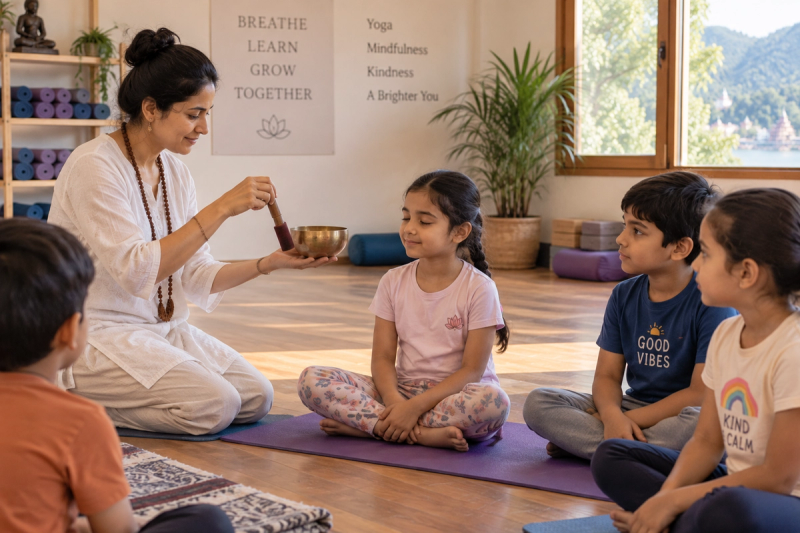
Sound Healing for Children: What Does It Actually Mean?
Sound healing for children generally refers to using gentle, intentional sound as part of relaxation, mindfulness, yoga, breath awareness, or a calming environment. The term can cover many different practices, from soft singing and humming to simple percussion, chimes, recorded music, and singing bowls.
You should not treat the phrase “sound healing” as proof that sound can diagnose or cure a medical condition. For children especially, it is more responsible to describe the practice as a complementary relaxation or wellness activity unless a qualified healthcare professional has advised otherwise.
A child’s response to sound can also be very different from an adult’s. One child may find a soft bowl tone soothing, while another may find the same sound distracting, irritating, or frightening. That difference is not a failure. It is useful information about the child’s sensory needs.
A good session therefore starts with observation rather than assumptions. Notice whether the child looks comfortable, remains engaged, covers their ears, becomes restless, asks for the sound to stop, or moves away from the instrument. Their response should guide what you do next.
For background on yoga education and professional standards, you can explore Yoga Alliance. If you are learning to facilitate sound practices, understanding your scope and training is just as important as knowing how to use an instrument.
The goal is simple: create a predictable, gentle environment in which a child can choose to participate without pressure.
What Are the Potential Benefits of Sound Healing for Children?
When sound is used gently and appropriately, it may support relaxation, focused attention, body awareness, and a calmer transition between activities. You should frame these as possible wellness benefits rather than guaranteed therapeutic outcomes.
1. A calmer transition
A short period of soft sound can help mark the transition from active play to quiet time. For example, a teacher might use a few gentle chime sounds before a breathing exercise. The predictable cue can tell children that the activity is changing.
2. Attention and listening
Listening carefully to a fading tone can encourage a child to notice subtle changes in sound. This can become a simple mindfulness exercise: listen, notice when the sound becomes quieter, and then notice the silence that follows.
3. Relaxation
Slow breathing and quiet sound may create a peaceful environment. If a child enjoys the experience, it can become part of a bedtime, classroom, yoga, or relaxation routine. The benefit may come from the overall calming context rather than from a special property of one instrument.
4. Body awareness
A facilitator can invite children to notice how they feel before and after a brief sound exercise. You might ask, “Do your shoulders feel the same or different?” or “Do you feel more awake or more relaxed?” This encourages self-awareness without telling the child what they are supposed to feel.
5. Creative engagement
Sound can also be playful. Children can explore rhythm, humming, simple vocal sounds, or gentle instruments under supervision. That makes sound-based activities useful in settings where relaxation and creativity are combined.
If you want to explore related practices, our guide to gong bath meditation for a first session can help you understand how sound-based relaxation is approached in adult wellness settings. For children, however, you should scale the intensity down considerably.
Is Sound Healing Safe for Children?
For many healthy children, gentle sound activities can be used as a low-intensity relaxation practice, but “safe” depends on how the session is designed. The biggest practical concern is excessive sound exposure.
Traditional or wellness instruments can still be uncomfortable or excessively loud when played close to a child’s ears. Keep the instrument at a reasonable distance, avoid forceful strikes, and let the child move away or ask you to stop.
You should also consider the child’s sensory profile. Some children are particularly sensitive to unexpected or complex sounds. Others may become anxious when a sound suddenly changes in volume or pitch.
Extra caution is appropriate if a child has known hearing problems, significant sound sensitivity, neurological or developmental concerns, or another condition for which a healthcare professional has given specific sensory recommendations. In those situations, ask the relevant professional or caregiver for guidance before introducing unfamiliar sound practices.
For general information about traditional systems and wellness practices in India, you can also visit the Ministry of AYUSH. It is still important to distinguish traditional wellness education from individualized medical advice.
A responsible facilitator does not promise that sound will treat anxiety, ADHD, autism, trauma, sleep disorders, pain, or any other medical or developmental condition. If a child needs healthcare, sound practices should not replace qualified assessment or treatment.
How Can You Create a Child-Friendly Sound Session?
The safest session is usually simpler than an adult sound bath. You do not need a long sequence of instruments or dramatic volume changes.
Start with a quiet room and explain what will happen before you make any sound. Give the child a clear choice to participate. If possible, let them see the instrument first and hear one very gentle sample.
Keep the first exposure brief. A few seconds of sound followed by silence may be enough. Watch the child’s response before deciding whether to continue.
Use distance and volume carefully
Do not place a singing bowl beside a child’s head or strike an instrument close to their ears. Start softly and increase neither volume nor intensity simply to create a stronger “experience.”
Prefer predictable sounds
Soft chimes, humming, gentle vocal toning, or quiet recorded music may be easier for some children than sudden gong strikes. Predictability matters because a child can prepare for a sound instead of being startled by it.
Build in silence
Silence is part of the exercise. After a gentle sound, give the child time to notice it fading. You can invite them to breathe naturally rather than forcing a particular breathing pattern.
Let the child lead
If the child says “stop,” stops participating, looks distressed, or moves away, respect that immediately. Do not interpret resistance as emotional “release” or insist that the child needs to continue.
Keep the purpose modest
A child-friendly sound session can simply be a quiet listening exercise. You do not need to claim that it is balancing chakras, removing trauma, or fixing a health problem.
If you want to understand how different sound environments can be structured, our guide to preparing for a sound healing session offers useful context. For work with children, simplify the environment and prioritize consent, comfort, and supervision.
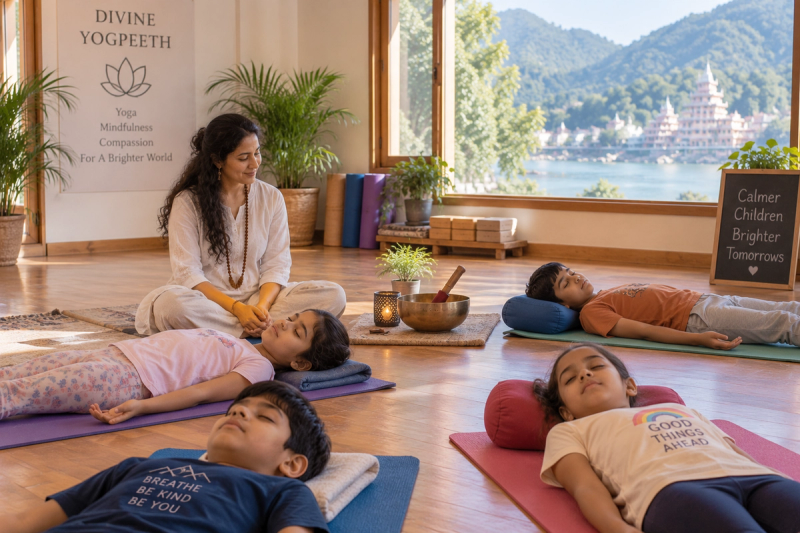
Why Rishikesh Matters When You Want to Learn Sound Healing Responsibly
Rishikesh attracts yoga practitioners from India and around the world because it brings together yoga education, meditation, traditional wellness practices, and teacher-training communities. That makes it a useful place to explore sound-based practices in a structured learning environment.
But the location itself does not make a technique safe. Your training matters more than the setting.
If you plan to use sound practices with children, look for education that teaches more than instrument technique. You should understand basic session design, contraindications, communication, boundaries, observation, and when to refer someone to a qualified healthcare professional.
You may also benefit from learning how sound practices fit alongside yoga, meditation, and relaxation rather than treating them as isolated techniques. For example, a facilitator could use a short sound exercise as the closing part of a gentle children's yoga class instead of conducting a long, intense sound bath.
Rishikesh can also expose you to different approaches to sound, including singing bowls, mantra, chanting, and other contemplative practices. Your responsibility is to learn how to adapt those practices to the age, needs, and comfort of the people in front of you.
If you are comparing formats, our group vs private sound healing session guide explains practical differences in session environments. Those considerations become even more important when you are working with children, because group noise and individual sensory preferences can vary widely.
A Practical Safety Checklist Before You Use Sound With a Child
Before beginning, take a few minutes to check the environment and your plan. A simple checklist can prevent avoidable problems.
- Ask the parent, guardian, or responsible adult whether there are known hearing or sensory concerns.
- Explain the activity in child-friendly language.
- Let the child choose whether to participate.
- Keep instruments away from the ears.
- Start at low volume and short duration.
- Avoid sudden, forceful gong or drum strikes.
- Watch for signs of discomfort or overstimulation.
- Stop immediately if the child asks you to stop or appears distressed.
- Never claim that sound can cure a medical or developmental condition.
- Do not use sound practice as a replacement for medical, psychological, or developmental care.
- Keep children supervised throughout the activity.
- Clean and maintain shared instruments appropriately.
A small room with reflective walls can make sound feel much stronger than expected. If several children participate, one child's reaction can influence another child's comfort.
When unsure whether a sound is comfortable, make it quieter, move the instrument farther away, or stop.
How Can Sound Healing Fit Into Children's Yoga and Relaxation?
Sound does not have to be a separate “healing session.” You can integrate a short, gentle sound element into a broader practice.
For example, a children's yoga class might finish with two or three soft chime tones. Children can sit or lie comfortably, listen to the sound fade, and then return their attention to the room.
Another option is humming. A child can hum softly for a few breaths if they enjoy it. This can combine breath awareness, vibration, and playful participation without requiring complex equipment.
You can also use a simple listening game. Ask children to identify whether a sound is getting louder or softer, or invite them to raise a hand when they can no longer hear a fading tone. This turns sound into an observation activity rather than a claim-based therapy.
If you are interested in broader relaxation practices, you can also explore yoga nidra benefits and how to practice. The same principle applies: the practice should be adapted to the participant rather than forcing the participant to fit a fixed routine.
For parents, the most important question is not “Did the sound heal my child?” A better question is “Did my child feel comfortable, engaged, and appropriately supported?”
That shift keeps the practice realistic and child-centered.
Learn Sound Healing in Rishikesh With a Responsible Approach
If you want to move beyond personal practice and learn how sound sessions are structured, our Sound Healing Training Course in Rishikesh can be a natural place to explore the subject more systematically.
We focus on learning the practice in a structured yoga environment, so you can develop a clearer understanding of sound-based techniques before deciding how they fit into your own teaching or wellness work.
If your wider goal is to build a stronger foundation in yoga teaching, you can also explore our 100-Hour Yoga Teacher Training in Rishikesh. Choose training based on the skills you actually need, especially if you intend to work with different age groups.
FAQs About Sound Healing for Children
Is sound healing safe for toddlers?
You should use extra caution with toddlers because they may have difficulty explaining exactly what feels uncomfortable. Keep sounds very soft, sessions very short, and supervision constant. Never place instruments close to a toddler’s ears. If there are hearing, developmental, or sensory concerns, discuss the activity with the child’s healthcare professional or responsible caregiver.
Can singing bowls be used with children?
They can be used as part of a gentle listening or relaxation activity when handled carefully. Keep the bowl at a safe distance, use light strikes, and observe the child's response. Avoid placing a vibrating bowl directly on a child's body unless you have appropriate training and a clear reason to use that technique.
Can sound healing help children with anxiety or sleep problems?
A calm sound activity may help some children relax, but you should not promise treatment for anxiety or sleep disorders. If a child has persistent anxiety, significant sleep problems, or another health concern, qualified medical or mental-health guidance should come first.
How long should a children's sound session last?
There is no single evidence-based duration that is right for every child. A short introduction is generally easier to monitor than a long session. Start briefly, observe the child, and stop if they show discomfort. The goal should be comfort and participation, not maximizing session length.
Can I learn sound healing and then work with children?
You can learn sound practices, but working responsibly with children requires more than learning how to play an instrument. You should understand child safeguarding, communication, sensory differences, session boundaries, and the limits of wellness practices. If you plan to work professionally with children, obtain appropriate training for the setting and follow relevant local requirements.
Conclusion: Keep Sound Gentle, Simple, and Child-Centered
Sound healing for children benefits safety when the practice is approached realistically: gentle sound, low intensity, short exposure, informed supervision, and respect for the child’s choice.
The most useful benefits are practical ones you can observe without making exaggerated claims. A child may enjoy focused listening, a calmer transition, quiet relaxation, body awareness, or creative sound exploration. Another child may dislike the same activity, and that response deserves equal respect.
If you want to develop your skills in Rishikesh, we invite you to explore our Sound Healing Training Course and learn how sound-based practices can be incorporated thoughtfully into a wider yoga and wellness approach.
Ready to deepen your understanding? Explore our 200-Hour Yoga Teacher Training in Rishikesh and build a broader foundation for responsible yoga teaching.