.jpg)

Yoga adjustments assists teacher training builds your confidence. Discover how to safely guide students, deepen practices, and master alignment. Find out now!
Yoga Adjustments Assists Teacher Training: What You Must Know
Mastering yoga adjustments assists teacher training completely shifts how you guide students on the mat. You move beyond simply calling out poses and start deeply understanding body mechanics.
Have you ever felt unsure about correcting a student's alignment during a live class? It happens to almost every new instructor who steps into a studio. Touching a student requires unshakeable confidence, clear intention, and profound anatomical awareness.
When you learn how to physically guide someone into a safer shape, you unlock a completely new level of teaching expertise. This guide breaks down exactly what you will uncover about hands-on corrections during your certification journey. You will explore the vital concepts of consent, biomechanics, and the subtle art of reading bodies.
The Core of Yoga Adjustments Assists Teacher Training
What does it actually mean to step into a student's personal space during an intense asana practice? Physical corrections are never about forcing a body into a perfect, symmetrical geometric shape. They exist purely to create safety and internal awareness.
During your studies, you quickly realize that every human skeleton is completely unique. A downward dog that looks technically misaligned might actually be the safest expression for that specific student's joints. Global organizations like Yoga Alliance emphasize that careful observation must always precede any physical intervention.
You learn to distinguish between a functional physical limitation and a simple technical misunderstanding. This distinction forms the absolute foundation of all safe corrections in the studio. If a student lacks flexibility, pushing them deeper will undoubtedly cause injury. If they simply misunderstand the muscular engagement, a gentle touch changes everything.
Adjusting vs. Assisting
These two terms often get grouped together in casual conversation, but they serve entirely different purposes on the mat. An adjustment actively corrects a dangerous misalignment that might eventually lead to pain or chronic injury. It brings the practitioner back to a safe anatomical baseline.
An assist, however, helps a student comfortably access a deeper variation of a pose they already hold safely. You provide an external prop—your hands—so they can experience a fuller extension or a much more grounded foundation.
You practice both of these techniques extensively during your coursework. You partner with fellow trainees, receiving critical feedback on the weight of your hands, the direction of your force, and your overall physical presence.
Building Confidence Through Proper Technique
Fear often holds new instructors back from utilizing their hands during a sequence. You worry endlessly about injuring someone or accidentally overstepping personal boundaries. Proper education entirely dismantles this fear through repetitive, highly supervised practice sessions.
You start by establishing a firm, unshakeable grounding in your own physical body. You absolutely cannot support another person if you are standing off-balance yourself. Your stance, your core engagement, and your breath set the tone for the entire interaction.
When you learn how to build new yoga teacher confidence after training, mastering physical corrections plays a massive role in your success. The hesitancy completely fades when you understand exactly where to place your palms.
The Critical Importance of Consent
Before you even step off your own mat to help, you must establish crystal clear communication with the room. Consent is not a one-time question asked at the start; it is an ongoing, active dialogue. You learn how to use consent cards and verbal check-ins seamlessly without disrupting the flow.
Some days, a highly experienced student might deeply crave strong, grounding assists. Other days, that exact same student might want a completely hands-off experience due to mental stress or physical sensitivity. Respecting these fluctuating boundaries builds profound, lasting trust between you and your class.
The Anatomy of a Safe Correction
You simply cannot physically adjust what you do not anatomically understand. Deep anatomy lessons tie directly into how you approach any physical intervention on the mat. You rigorously study joint mobility, skeletal variation, and complex muscular engagement.
Research documented on platforms like PubMed highlights the crucial importance of anatomical knowledge in preventing yoga-related injuries. You must know exactly which joints are meant to be stable and which are designed for high mobility.
For example, the human knee hinge should absolutely never be twisted or torqued. If a student violently struggles in a hip opener like Pigeon Pose, the adjustment focuses entirely on the pelvis, never the delicate knee. You learn to trace the visible pain point backward to its true source.
The Direction of Energy
Every single pose has invisible lines of energy extending outward and rooting heavily downward. When you place your hands on a student, you must strictly follow these natural energetic lines. You never compress the spine; you always aim to create vast internal space.
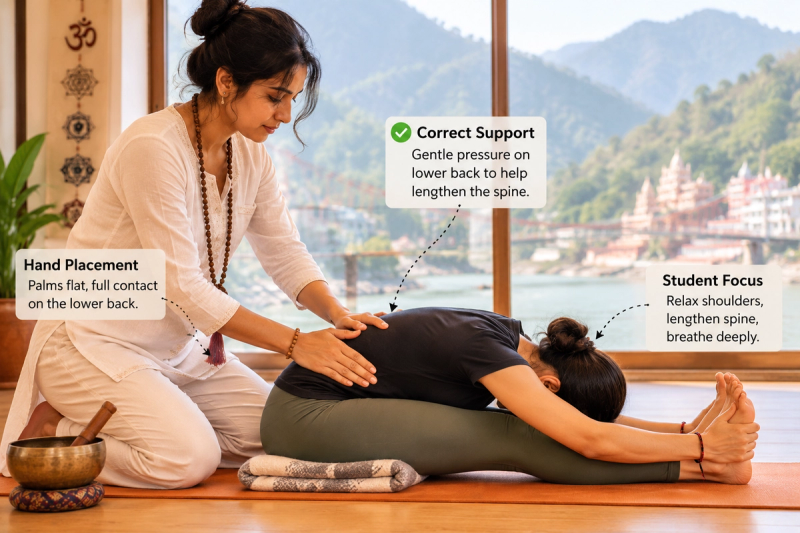
If you are assisting a seated forward fold, your hands gently guide the hips back while encouraging the spine to lengthen forward. You learn to smartly use your own body weight rather than your arm strength to apply steady pressure.
Mastering Specific Asana Interventions
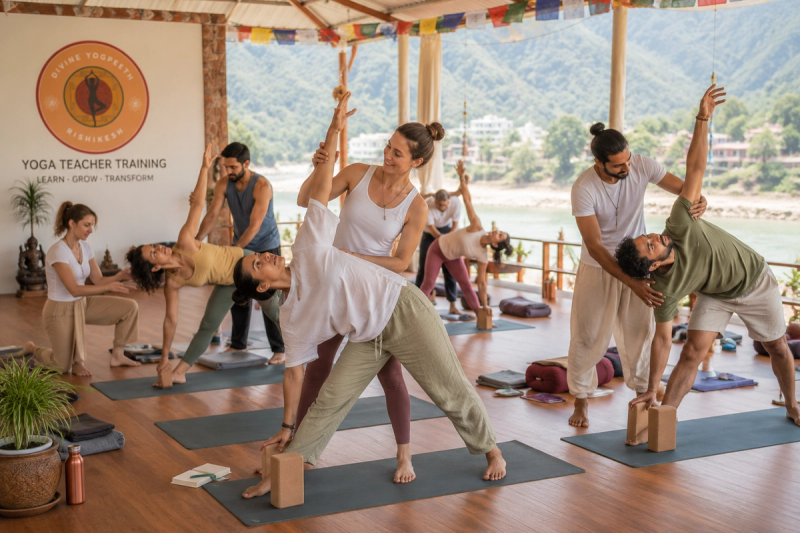
Your training time is heavily spent breaking down the most common poses encountered in a standard vinyasa or hatha sequence. You physically practice interventions for Downward Facing Dog, Chaturanga, and Triangle Pose repeatedly until they become muscle memory.
In Downward Dog, you might learn the highly effective "hip traction" assist. You stand securely behind the student, firmly gripping the hip creases, and pull back and upward. This instantly relieves heavy pressure on the wrists and beautifully lengthens the lumbar spine.
In Chaturanga, verbal cues frequently fail because the student is desperately fighting gravity and fatigue. A physical block placed under the sternum, or a hand guiding the shoulders back, creates instant, vital muscle memory. You learn these critical interventions to vigorously protect your students' rotator cuffs.
The Strategic Role of Props
Sometimes, the absolute best adjustment involves using no hands at all. You study how to utilize blocks, straps, and bolsters as powerful extensions of your physical guidance. A strap can stabilize a wandering elbow in Pincha Mayurasana far better than your hands ever could.
Deeply understanding props allows you to assist multiple students simultaneously across the room. While you physically guide one person, you slide a block under the hand of another. This high efficiency makes your classes feel incredibly attentive and professional.
Verbal Cues vs. Physical Touch
A hands-on approach should absolutely never replace exceptionally clear communication. Your words remain your absolute primary tool for safely guiding a room full of moving bodies. Physical touch acts as a powerful supplement only when verbal instructions do not quite land.
You practice meticulously matching your physical touch to your spoken voice. If you verbally say "lengthen the spine," your hands should gently trace the line of the spine upwards at that exact moment. The physical sensation reinforces the auditory cue, creating a truly holistic learning experience.
If you are deeply curious about yoga class sequencing principles, you will find that pacing matters immensely. You simply cannot adjust everyone in every single pose. You learn how to quickly scan a room and accurately identify who needs your help the most.
Developing Your Observation Skills
Before you ever reach out to correct a posture, you must learn how to truly see what is happening. Observation is a highly active skill that requires immense mental focus and clarity. You scan the room not just for glaring mistakes, but for subtle, hidden imbalances.
Are a student’s shoulders nervously creeping up towards their ears? Is their breathing shallow and panicked? Are their toes aggressively gripping the mat out of sheer fear? These tiny physical details tell a massive story about their internal nervous system state.
You train your eyes to trace the architectural lines of the body. You always start at the foundation—the feet and hands—and slowly work your way up the kinetic chain. If the foundation is unstable, absolutely everything built above it will be heavily compromised.
When you dedicate serious time to observing, you realize that most misalignments start entirely at the ground level. A collapsed arch in the right foot can cause radiating pain all the way up into the lower back.
By completely mastering observation, you save yourself and your students highly unnecessary physical interventions. You learn exactly what specific verbal cue will instantly fix the root of the problem. Your physical touches become incredibly rare, highly potent, and deeply effective rather than constant and annoying.
The Ethics of Touch in the Studio
Navigating the complex ethics of physical contact is absolutely paramount for any modern, professional instructor. The studio is a highly vulnerable space where people drop their daily armor. People come to their mats to heal, to sweat profusely, and sometimes to cry.
You inherently hold a position of significant power at the front of the room. Recognizing this exact power dynamic dictates how you must approach every single student. An adjustment should never feel dominant, aggressive, or possessive.
It must always feel deeply supportive, collaborative, and entirely optional for the receiver. You learn the highly specific areas of the body that are appropriate to touch and those that are strictly off-limits. You always use a flat, firm, reassuring palm rather than poking with individual fingers, which can feel deeply invasive.
Furthermore, you understand that a student's strict boundaries can change rapidly mid-class. Just because they happily allowed a deep assist in Warrior II does not mean they want one during Savasana.
This continuous ethical training ensures you successfully create a genuinely safe container for everyone. When students explicitly know their autonomy is respected above all else, they can finally relax deeply into their personal practice.
Why Rishikesh? / Why This Matters
Learning these profound skills in India offers an unparalleled depth of complete immersion. The raw atmosphere here effectively strips away daily western distractions. You absorb ancient knowledge in the exact place where these sacred traditions originated centuries ago.
Practicing yoga in Rishikesh allows you to study directly under masters who view adjustments as a powerful energy exchange. It is not just western biomechanics; it is the transfer of prana (vital life force).
You learn to confidently approach a student with calm, deeply grounded energy. If you are frantic, your touch will undeniably feel frantic and unsettling. The spiritual environment of the Himalayas naturally cultivates the centered presence required for truly profound teaching.
Taking the Next Step in Your Journey
Mastering these complex physical techniques takes dedicated time, patience, and expert guidance. If you genuinely want to elevate your teaching, immersing yourself in a highly structured program is absolutely essential.
When you explore Divine Yogpeeth, you find comprehensive options designed to support this exact growth. Our 200-Hour Yoga Teacher Training covers these crucial alignment principles extensively, giving you the vast practical hours needed to touch with total confidence.
Whether you want to deeply refine your personal practice or build a thriving career, direct feedback from highly experienced instructors dramatically accelerates your growth.
Taking Time for Your Own Practice
Before you can safely and effectively guide others, your own physical and mental cup must be completely full. Experiencing a 5 Days Yoga Retreat allows you to gently step back into the humble role of a student. You receive expert assists yourself, which deeply informs how you will eventually touch your own clients.
Feeling an adjustment in your own muscles teaches you empathy. You vividly remember what a supportive touch feels like compared to an invasive one. This personal experience is undeniably the greatest teacher you will ever have on this journey.
Understanding these subtle nuances is absolutely crucial, especially if you are teaching yoga after a 100 hour certification. You must intimately know the physical sensation before you try to recreate it for someone else.
FAQs
Do I have to touch students to be a good instructor?
No, physical interventions are completely optional in modern studios. Many incredible instructors rely entirely on brilliant, highly descriptive verbal cueing. However, learning the precise mechanics of touch dramatically improves your own deep understanding of alignment, even if you never use your hands in a live class.
How do I practice these skills safely?
You rigorously practice on your fellow trainees in a controlled environment. Under the highly watchful eye of lead instructors, you receive immediate, brilliantly honest feedback about exactly how your grip feels. This peer-to-peer practice is absolutely invaluable for rapidly refining your technique.
What if I adjust someone and they feel pain?
You immediately, gently back off and remove your hands. The golden rule is to always heavily listen to the student's breathing rhythm. If their breath suddenly becomes ragged or they physically tense up, you are pushing much too far. You always softly ask for verbal confirmation: "How does this feel for you?"
Can absolute beginners learn these techniques?
Yes, absolutely. Even if you have zero prior teaching experience, a highly solid curriculum breaks the complex biomechanics down simply. A 100 Hour YTT for Beginners No Experience introduces these exact concepts at an incredibly accessible, easily digestible pace.
Conclusion
Mastering yoga adjustments assists teacher training permanently transforms you into a highly observant, profoundly confident, and deeply effective guide. You finally learn how to seamlessly read the room, understand vast skeletal variation, and confidently apply physical touch with pure, healing intention.
This vital knowledge vigorously protects your students from avoidable injury and helps them safely unlock poses they never thought physically possible. It permanently shifts your teaching style from shouting generic instructions to offering highly personalized, deeply attentive guidance.
Ready to confidently begin? Explore our 100-Hour Yoga Teacher Training situated directly on the sacred banks of the Ganga, and take the very first step toward totally mastering your teaching today.