.jpg)

Yoga for desk workers office poses to ease stiff hips, tight shoulders, and back tension after long sitting. Try simple routines and feel better. Discover more
Yoga for desk workers office poses: Best Poses to Undo a Day of Sitting
Yoga for desk workers office poses can make a noticeable difference when your workday leaves your neck stiff, shoulders rounded, hips tight, and lower back tired. If you spend eight or more hours moving between a chair, keyboard, and screen, the problem is rarely one dramatic posture—it is the long stretch of staying in roughly the same position.
The good news is that you do not need a 60-minute class every evening to counter it. A few carefully chosen movements can restore motion to the spine, open the front of the hips, strengthen neglected muscles, and give your eyes and nervous system a useful break.
This guide shows you practical office yoga poses you can do at your desk or in a small space, plus a short routine for after work. You will learn what each pose targets, how to perform it safely, when to use it, and why consistency matters more than intensity.
Yoga for Desk Workers Office Poses: Why Sitting Feels So Stiff
Sitting is not automatically harmful. The bigger issue is staying still for too long. When you remain seated, your hips stay flexed, your knees remain bent, your spine often drifts into a comfortable rounded position, and your shoulders may move forward toward the keyboard.
Over time, you may notice:
- Tight hip flexors and hamstrings
- Reduced upper-back mobility
- Neck and shoulder tension
- A stiff lower back after standing
- Weak or underused glute muscles
- A tendency to breathe more shallowly
Your body adapts to the positions you spend time in. That does not mean your posture is permanently damaged, but it does mean that frequent movement becomes useful.
A simple rule works well: do not try to find one “perfect” sitting posture and freeze there. Change positions, stand regularly, walk when you can, and use movement to explore the ranges you rarely use during computer work.
Yoga can complement those habits. It gives you controlled ways to move the spine, hips, shoulders, and ankles instead of asking you to force a stretch. For broader context on yoga as a structured discipline and practice tradition, you can explore Yoga Alliance.
Best Office Yoga Poses for Your Neck, Shoulders, and Upper Back
The upper body often tells you first that your desk setup and work habits need a movement break. You do not need a yoga mat for several useful movements.
Seated neck release
Sit tall with both feet grounded. Let your shoulders relax away from your ears. Slowly lower your right ear toward your right shoulder without lifting the shoulder. Hold for three to five breaths, return to center, and repeat on the other side.
Avoid pulling your head with your hand. The goal is gentle movement, not maximum stretching.
Seated shoulder rolls
Roll both shoulders slowly upward, backward, and down. Make the movement controlled rather than fast. Repeat five to eight times, then reverse the direction.
This is particularly useful after long periods of typing because it gives your shoulder girdle movement in a way your normal workstation routine often does not.
Seated chest opener
Move toward the front of your chair. Interlace your fingers behind your back if comfortable, or simply place your hands on your lower back. Draw your shoulders gently back and lift through your chest without arching aggressively through your lower spine.
Stay for several breaths. You should feel the front of your chest and shoulders open, not pain in your back.
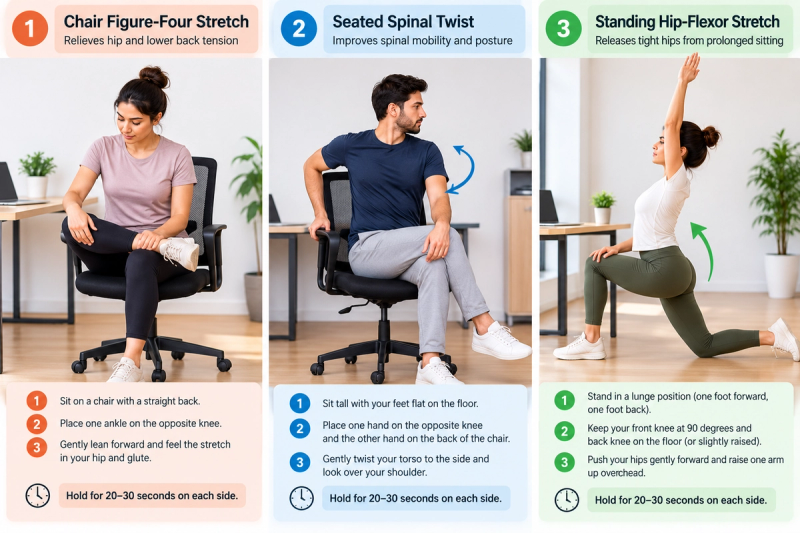
Seated spinal twist
Keep both feet on the floor. Place your left hand on the outside of your right thigh and your right hand on the chair. Sit tall, then rotate gently to the right. Move from your rib cage and upper back rather than forcing your neck to turn farther.
Repeat on the other side.
These movements are short enough to fit into a workday. Try pairing them with natural transition points: after a meeting, before lunch, or whenever you finish a long task.
Desk Yoga for Tight Hips, Hamstrings, and Lower Back
Your lower body can become surprisingly restricted after hours in a chair. The aim is not to “stretch out” every tight muscle aggressively. Instead, combine gentle mobility with standing movement.
Chair figure-four stretch
Sit near the edge of your chair and place your right ankle over your left thigh. Keep your right foot active and your chest long. If comfortable, hinge forward slightly from the hips.
You should feel the stretch around your outer right hip and glute. Do not push the knee downward.
Standing hip flexor stretch
Stand behind your chair and hold it lightly for balance. Step your right foot back. Bend your front knee slightly and gently tuck your pelvis so your lower back does not overarch.
Shift your weight forward only until you feel the front of the right hip open. Switch sides after several breaths.
Standing hamstring fold
Place one heel slightly forward with the toes pointing upward. Keep the standing knee soft. Hinge forward from your hips while maintaining a comfortable spine.
You do not need to reach your toes. A mild stretch is enough.
Supported squat
Stand with your feet approximately hip-width apart and hold the desk or chair for support. Bend your knees and lower only as far as feels comfortable, then return to standing.
This introduces movement into the ankles, knees, hips, and spine while also getting you out of the chair.
For people who experience recurring discomfort rather than simple stiffness, yoga should not replace professional assessment. Government guidance and evidence-based resources can be useful starting points; the Ministry of Ayush provides information on traditional systems including yoga.
A 10-Minute Yoga Routine After a Long Workday
You can turn the poses above into a short routine instead of treating each movement as an isolated stretch. The following sequence takes roughly ten minutes and requires very little space.
Start with one minute of standing breathing. Keep your feet comfortable, soften your shoulders, and take slow, natural breaths without forcing a particular breathing pattern.
Then move through:
- Shoulder rolls — 30 seconds
- Seated or standing neck movements — 1 minute
- Seated spinal twists — 1 minute
- Chair figure-four stretch — 1 minute per side
- Standing hip flexor stretch — 1 minute per side
- Standing hamstring fold — 1 minute
- Supported squat — 8–10 slow repetitions
- Gentle standing side stretch — 1 minute
Finish by standing quietly for another 30 seconds.
The routine works because it does more than stretch your back. You are changing your relationship with the chair: spine rotation replaces prolonged stillness, hip extension replaces constant hip flexion, and standing gives your legs a different mechanical demand.
You can also use a smaller “micro-break” version during work. Every 45–60 minutes, stand up, walk for a couple of minutes, roll your shoulders, and take a few comfortable breaths. The exact interval matters less than breaking up long periods of uninterrupted sitting.
If your workday is especially stressful, a short movement practice can also be paired with simple mindfulness or relaxation. For example, after movement, you could spend two minutes observing your breath rather than immediately returning to notifications.
How to Make Office Yoga Actually Work
The most effective office yoga routine is the one you will repeat. A complicated sequence that happens once a month is less useful than five minutes of movement that becomes part of your workday.
Use environmental cues. Keep your water bottle away from your desk so you have a reason to stand. Take phone calls while walking when appropriate. Put a short movement reminder beside your monitor. If you work from home, change rooms between tasks when possible.
Your workstation matters too. Keep your screen at a comfortable height, place your keyboard and mouse so your shoulders can stay relaxed, and make sure your feet can rest securely. Yoga cannot fully compensate for an uncomfortable workstation that you use for eight hours.
Pay attention to the difference between stiffness and pain. A gentle stretch can feel mild or unfamiliar, but sharp, burning, electric, or worsening pain is a reason to stop. If symptoms persist, radiate into an arm or leg, cause weakness or numbness, or interfere with normal activities, seek appropriate medical advice.
You also do not need to turn every break into a performance. Five calm movements performed with good control are enough. Your goal is regular movement, not achieving an impressive pose beside your laptop.
Why Rishikesh Matters for a Deeper Yoga Practice
A desk-worker routine is a practical starting point, but you may eventually want to understand why particular movements, breathing practices, meditation techniques, and sequencing choices work together.
Rishikesh offers an environment where you can step away from a highly screen-driven routine and spend more time studying yoga as a broader practice. The combination of dedicated practice time, teacher guidance, and a change of daily rhythm can be valuable if you want to move beyond occasional stretching.
You can also use your time in Rishikesh to explore Tapovan and build a more consistent personal practice rather than treating yoga as something you squeeze into spare minutes.
If you are considering a shorter reset, a structured retreat can make more sense than committing immediately to teacher training. A 5-day yoga retreat in Rishikesh can give you dedicated time for practice, rest, and reflection.
For a broader look at the local practice environment, you can also explore our guide to Tapovan Rishikesh yoga and how it can change your practice.
If desk stress is affecting your ability to switch off after work, our guide to yoga retreats for managing corporate burnout offers another perspective on using structured practice and time away from routine.
Build a Yoga Practice That Fits Your Working Life
If yoga has become more than a quick stretch for your shoulders, you may want to learn how to practice with better alignment, sequencing, breath awareness, and teaching fundamentals.
Our 100-hour yoga teacher training in Rishikesh is one option for going deeper without treating yoga as a collection of random poses. We also offer yoga therapy in Rishikesh for people interested in a more individualized approach to yoga and wellbeing.
A deeper practice does not mean abandoning your job or sitting on a mat for hours every day. It can mean learning how to make movement, recovery, awareness, and healthy routines fit realistically around your responsibilities.
If you are a corporate professional considering a bigger change, you may also find our guide on moving from a corporate career to becoming a yoga teacher useful before making that decision.

FAQs About Yoga for Desk Workers
Which yoga pose is best after sitting all day?
There is no single best pose. A combination of hip extension, spinal movement, shoulder mobility, and gentle strengthening is more useful than relying on one stretch. A standing hip flexor stretch, spinal twist, and supported squat make a practical combination.
How often should you do yoga if you sit at a desk all day?
Aim for frequent small movement breaks throughout the workday and a longer session when your schedule allows. Even five to ten minutes of deliberate movement can be easier to maintain than an ambitious routine that you rarely complete.
Can I do yoga at my desk without a yoga mat?
Yes. Neck movements, shoulder rolls, seated twists, chest openers, and chair figure-four stretches require little or no equipment. For standing poses, make sure you have enough clear floor space and stable support.
Can yoga fix poor posture from sitting?
Yoga can improve mobility, body awareness, strength, and your ability to change positions, but it is not a magic “posture fix.” Your workstation, activity level, sleep, stress, and daily movement habits also matter.
Should you stretch if sitting causes back pain?
If you have ordinary stiffness, gentle movement may feel helpful. If you have significant, persistent, or unusual pain, do not assume stretching is the answer. Stop movements that increase symptoms and seek professional guidance when needed.
Conclusion: Make Movement Part of Your Workday
Yoga for desk workers office poses are most useful when they become part of your routine rather than an emergency response to a stiff back at the end of the week. Use short office movements to wake up your shoulders and spine, add hip and hamstring mobility after long sitting, and stand or walk regularly throughout the day.
You do not need perfect posture or an advanced yoga practice. You need enough movement to interrupt prolonged stillness and enough consistency to make that movement normal.
If you want to take that practice further in Rishikesh, explore our 200-hour yoga teacher training in Rishikesh and learn yoga through a more complete framework of practice, philosophy, and teaching. Your next step does not have to be dramatic. Start with one movement break today, then build from there.