.jpg)

Explore yoga philosophy Patanjali sutras 200 hour TTC through practical lessons in mindfulness, discipline and teaching ethics in Rishikesh. Discover more.
Yoga Philosophy Patanjali Sutras 200 Hour TTC: Making Ancient Wisdom Practical
Introduction
What happens when you step onto your yoga mat feeling distracted, frustrated, or impatient, even though you have practised the same poses for years? The study of yoga philosophy Patanjali sutras 200 hour TTC connects situations like these with the deeper purpose of yoga: understanding your mind, developing self-awareness, and responding to life with greater clarity.
During a 200-hour yoga teacher training course, philosophy gives you a framework for understanding why you practise, beyond flexibility or physical strength. Patanjali's Yoga Sutras explore concentration, discipline, mental fluctuations, ethical conduct, and the relationship between awareness and experience.
You do not need to memorise every Sanskrit verse to benefit from this philosophy. What matters is learning how to interpret its principles responsibly and apply them to your daily habits, personal practice, and future teaching.
Whether you are an international student considering yoga training in India or an Indian practitioner deepening your understanding, this guide explains the essential concepts, their practical applications, and what you can expect when studying philosophy during a teacher training course in Rishikesh.
1. Yoga Philosophy Patanjali Sutras 200 Hour TTC: Understanding the Foundations
The study of yoga philosophy Patanjali sutras 200 hour TTC introduces you to the principles behind classical yoga, including concentration, disciplined practice, ethical behaviour, and awareness of the mind.
Patanjali's Yoga Sutras are traditionally organised into four chapters: Samadhi Pada, Sadhana Pada, Vibhuti Pada, and Kaivalya Pada. Together, they explore the challenges of mental fluctuations, the role of consistent practice, and the possibility of liberation.
One of the most recognised teachings appears in Yoga Sutra 1.2: Yogash chitta-vritti-nirodhah. It is commonly interpreted as the restraint or stilling of the fluctuations of the mind.
For example, imagine comparing your yoga posture with someone else's during class. That comparison may lead to frustration, even when your own practice is improving. Patanjali's philosophy encourages you to observe these mental reactions rather than automatically follow them.
Understanding the historical and philosophical context of yoga can deepen your learning. The Encyclopaedia Britannica website provides a starting point for exploring yoga's background and traditions.
Why does this philosophy matter during teacher training?
A 200-hour TTC should help you connect philosophical concepts with practical teaching decisions. You can explore how non-harming influences adjustments, how truthfulness supports honest communication, and how self-study helps you recognise your own biases.
The purpose is not simply to memorise Sanskrit verses. It is to understand their meaning, examine different interpretations, and apply relevant principles responsibly.
2. Yoga Philosophy Patanjali Sutras 200 Hour TTC: Applying the Eight Limbs
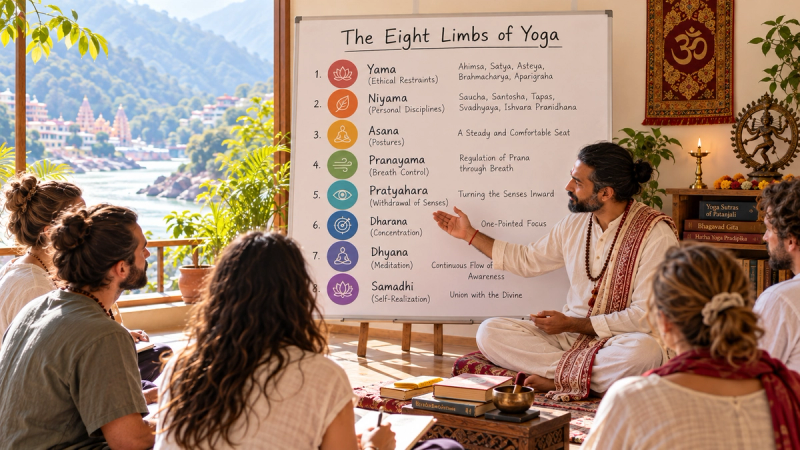
One of the most practical topics in a yoga teacher training course is Patanjali's eight-limbed framework, commonly known as Ashtanga Yoga. It offers a broader understanding of yoga than physical postures alone.
The eight limbs are yama, niyama, asana, pranayama, pratyahara, dharana, dhyana, and samadhi.
Yama concerns ethical relationships, while niyama focuses on personal observances. Asana relates to posture, and pranayama concerns the regulation of breath and vital energy. The remaining limbs explore sensory awareness, concentration, meditation, and deep absorption.
Turning philosophical concepts into everyday actions
You can apply ahimsa, or non-harming, by respecting your body's limits and avoiding unnecessary pressure on students. Satya, or truthfulness, encourages you to communicate honestly about your abilities and qualifications.
Svadhyaya, or self-study, invites you to reflect on your reactions and learning patterns. Santosha encourages contentment without eliminating the motivation to improve.
These ideas can also influence how you plan classes, offer modifications, and communicate with students from different backgrounds.
For additional scientific context about yoga and well-being, you can explore research through the PubMed research database. Remember that scientific studies investigate measurable outcomes, while classical yoga philosophy addresses broader questions about practice, awareness, and liberation. The two perspectives can inform your understanding, but they are not interchangeable.
3. Applying Patanjali's Teachings to Your Personal Practice
Philosophy becomes more meaningful when you can recognise its concepts in ordinary experiences. You do not have to retreat from everyday responsibilities to start exploring them.
Practise abhyasa and vairagya
Yoga Sutra 1.12 identifies abhyasa (practice) and vairagya (dispassion or non-attachment) as important approaches to working with mental fluctuations.
Abhyasa involves consistent effort over time. Vairagya concerns reducing your dependence on particular outcomes.
Suppose you are learning a difficult arm balance. Abhyasa encourages you to build strength, practise suitable progressions, and return to the skill consistently. Vairagya helps you avoid treating success or failure in a single session as a judgement of your worth.
Together, the concepts support commitment without excessive attachment to results.
Use svadhyaya for self-reflection
After practice, take two minutes to ask yourself three questions:
- Where did your attention repeatedly wander?
- How did you respond when something felt difficult?
- What could you approach differently next time?
Write down your observations without labelling yourself as a good or bad practitioner. The purpose is to notice patterns and make informed adjustments.
Connect philosophy with breath and attention
When your mind becomes restless during a breathing exercise, you can notice the distraction, return to a suitable breathing rhythm, and begin again.
This does not require you to suppress every thought. It involves practising the return of attention.
Avoid forcing your breath or attempting advanced retention without appropriate instruction. If a technique causes dizziness, discomfort, or breathlessness, stop and seek guidance from a qualified instructor.
For a balanced understanding of modern yoga and well-being, the PubMed research database provides access to scientific literature. Research on yoga varies in quality and scope, so distinguish clinical findings from philosophical teachings rather than treating them as interchangeable evidence.
4. Learning Yoga Philosophy as a Future Teacher
Understanding a concept personally is different from teaching it to a room of students. A 200-hour training programme gives you an opportunity to examine this distinction before taking responsibility for your own classes.
Translate Sanskrit concepts into accessible language
You may learn terms such as chitta, vritti, abhyasa, vairagya, and svadhyaya. Learning their meanings helps you engage with philosophical discussions, but memorising definitions is only a starting point.
For example, you could introduce svadhyaya by inviting students to observe how they respond when a pose becomes challenging. You do not need to deliver a long lecture or require students to adopt a particular spiritual belief.
Good teaching makes complex ideas understandable without pretending that every Sanskrit term has one universally accepted English equivalent.
For additional terminology, consult our guide to essential Sanskrit terms in yoga teacher training.
Connect ethical principles with professional conduct
Yoga teachers influence students through more than physical instructions. Your behaviour, communication, boundaries, and treatment of different students all contribute to the learning environment.
Ahimsa can encourage attention to student comfort and safety. Satya supports honest communication about your qualifications and limitations. Aparigraha can prompt reflection on competitiveness, recognition, and the temptation to overstate your expertise.
These principles do not replace professional safeguarding, informed consent, appropriate adjustments, or referral to qualified healthcare professionals when necessary.
A responsible teacher knows when a situation falls outside their competence.
Build a philosophy-based class plan
You can integrate one philosophical idea into a class without making the entire session theoretical.
For example, a class focused on santosha might invite students to notice their current range of movement without comparing themselves with others. A session exploring ahimsa could emphasise thoughtful transitions, suitable modifications, and respect for personal limits.
Keep the language inclusive. Students may approach yoga for physical, cultural, spiritual, or personal reasons, and you should not assume that everyone shares the same beliefs.
The goal is to make philosophy relevant while respecting the autonomy of the people you teach.
5. Why Study Yoga Philosophy in Rishikesh, India?
Rishikesh offers an environment in which you can encounter yoga through classes, teacher training, traditional discussions, meditation, and contact with a diverse community of practitioners.
Located in the Himalayan foothills beside the Ganga, the city has a long-standing association with spiritual learning and yoga. Areas such as Tapovan attract students from India and abroad, creating opportunities to exchange perspectives and ask questions beyond the yoga mat.
However, the location alone does not guarantee a high-quality education. Your learning depends on the curriculum, teachers, teaching methods, assessment, and willingness to practise what you study.
When comparing schools, ask whether philosophy sessions include explanations of the sutras, guided discussion, practical examples, and opportunities to relate ideas to teaching situations. Find out how much time is devoted to philosophy and whether Sanskrit terminology is explained in a way beginners can understand.
You should also examine accommodation, class schedules, course fees, and the school's approach to student welfare before committing to residential training.
A well-structured programme should help you understand both the value and the limitations of a philosophical framework. You should be encouraged to ask questions rather than accept every interpretation without examination.
If you are new to the region, our Tapovan Rishikesh yoga guide can help you explore the local context.
6. Explore Yoga Philosophy Training with Divine Yogpeeth
If you want to study philosophy alongside asana, pranayama, meditation, anatomy, and teaching methodology, compare the curriculum of a structured teacher training course before deciding where to enrol.
At Divine Yogpeeth, located in the Laxman Jhula–Tapovan area of Rishikesh, you can explore our 200-hour yoga teacher training course to learn more about the programme relevant to your goals.
Before enrolling, ask for the current syllabus, daily timetable, teaching hours, assessment requirements, accommodation details, and a complete fee breakdown. Confirm how philosophy is taught and whether the course gives you opportunities to connect theoretical learning with teaching practice.
A course should be a good fit for your experience, budget, learning preferences, and professional plans—not simply the programme with the most appealing promotional claims.
7. Frequently Asked Questions About Patanjali's Yoga Sutras in TTC
Do you need prior knowledge of Sanskrit to study Patanjali's Yoga Sutras?
No. Prior Sanskrit knowledge can be helpful, but you can begin by learning key terms, their context, and their practical meaning through guided explanations. Translation differences are normal, so focus on understanding concepts rather than memorising isolated words.
Are Patanjali's Yoga Sutras included in every 200-hour yoga teacher training course?
Not necessarily in the same depth or format. Many teacher training programmes include yoga philosophy, but the specific texts, teaching hours, and assessment methods vary. Request the syllabus before enrolling and confirm how the Yoga Sutras are covered.
How can you apply the eight limbs outside yoga class?
You can practise mindful communication, reflect on your habits, develop consistent routines, and observe how you respond to discomfort or distraction. These are possible applications of the framework, not a requirement to interpret every everyday action through a single philosophical system.
Is a 200-hour TTC enough to become an expert in yoga philosophy?
No. A 200-hour course provides an introduction to a broad field. Deeper study may involve reading different translations, examining traditional commentaries, learning Sanskrit, and studying relevant philosophical traditions over time.
Can international students study yoga philosophy in Rishikesh?
Yes, international students can explore teacher training programmes in Rishikesh. Before booking, verify the course's current language of instruction, entry requirements, accommodation arrangements, travel requirements, and any relevant certification details directly with the school.
Conclusion: Put Patanjali's Wisdom into Practice
Studying yoga philosophy through Patanjali's Yoga Sutras can help you understand the relationship between discipline, attention, ethical behaviour, and personal practice. The eight limbs provide a framework for looking beyond physical postures, while concepts such as abhyasa, vairagya, and svadhyaya encourage consistency, reflection, and a healthier relationship with outcomes.
You do not need to master every sutra before you begin. Start by exploring a few ideas carefully, testing how they relate to your experience, and learning how to communicate them respectfully to others.
If you are ready to deepen your understanding of yoga and develop your teaching skills in Rishikesh, explore our 200-hour yoga teacher training programme. Review the curriculum, ask questions about philosophy classes, and choose a programme that matches your goals and expectations.
Your study of yoga philosophy becomes meaningful when you move beyond memorising concepts and begin examining how you practise, teach, and relate to the world.