.jpg)

Divine Yogpeeth 100 hour course structure explained clearly. Discover exactly what you will learn week by week and find out how to prepare for your journey.
Divine Yogpeeth 100 Hour Course Structure: Your Complete Week-by-Week Guide
Understanding the exact Divine Yogpeeth 100 hour course structure is the single most important step before booking your ticket to India. Have you ever wondered what actually happens behind the doors of a traditional ashram during an intensive training program?
Many students arrive in India unsure of the daily physical demands or the depth of the theoretical studies awaiting them. Stepping into a rigorous schedule requires mental and physical preparation. You need to know exactly how your days will unfold to avoid overwhelming surprises.
This guide breaks down everything you will experience over your two-week immersion. You will discover the progression of physical postures, the exact philosophical texts you will study, and the anatomical principles that will keep your practice safe.
By knowing the curriculum inside and out, you can focus entirely on your personal growth upon arrival. Read on to explore the complete weekly breakdown and prepare yourself for an incredible physical and mental shift.
Week 1: Building the Foundation of Your Divine Yogpeeth 100 Hour Course Structure
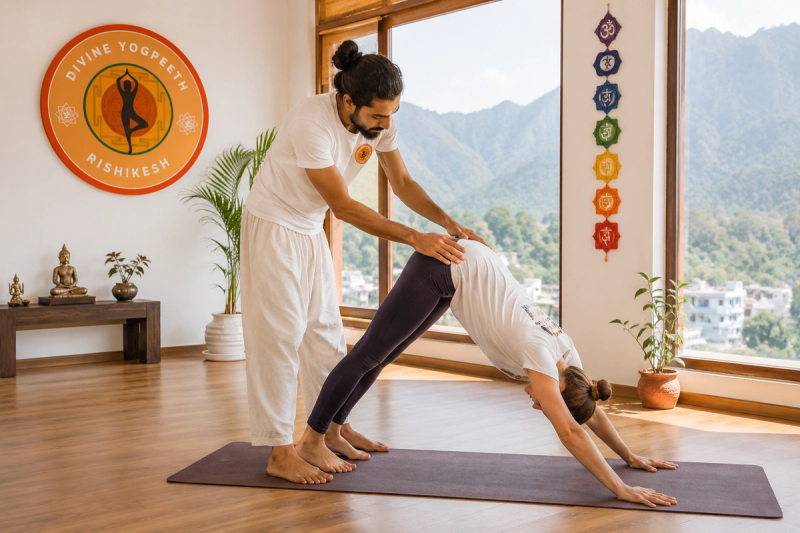
Your first week is entirely dedicated to establishing a rock-solid foundation. You will strip away any bad habits you have picked up in casual studio classes. The focus here is on fundamental alignment, basic breath awareness, and understanding your own bodily mechanics.
Mornings begin early with traditional Hatha yoga practices to awaken your nervous system. You will spend hours breaking down the mechanics of Surya Namaskar (Sun Salutations) to ensure every transition is flawlessly executed. Instructors will adjust your stance, correct your pelvic tilt, and help you find genuine stability.
Afternoons shift toward Ashtanga Vinyasa, introducing you to the primary series. This faster-paced practice builds internal heat and stamina. You will quickly realize that the standards set by organizations like Yoga Alliance require dedication and focus from day one.
You will also begin your foundational studies in Pranayama (breathwork). Learning to control your life force energy is crucial. If you want to prepare your body for these early morning breathing sessions, reviewing a 100 Hour YTT Daily Schedule: 5 Best Ways to Prepare will give you a massive advantage.
Week 2: Deepening the Practice and Gaining Confidence
As you move into the second week of your Divine Yogpeeth 100 hour course structure, the intensity noticeably increases. Your body has adapted to the early mornings, and your muscles are accustomed to the daily stretching and strengthening. Now, the focus shifts to refinement and inner awareness.
Hatha classes introduce longer holds and more complex variations of foundational poses. You will explore inversions, deep backbends, and arm balances with a strong emphasis on safety. Ashtanga sessions flow more smoothly as you memorize the sequence, allowing your breath to guide the movement rather than your thoughts.
This week also dives deeper into meditation techniques. You will practice various forms of stillness, from guided visualizations to silent Vipassana-style sitting. Maintaining focus becomes easier as your physical body grows stronger and your mind becomes less reactive.
For many students, this is the week where everything clicks. The physical exertion transforms into mental clarity. If you are starting this journey with zero background, do not worry; reading our 100 Hour YTT for Beginners No Experience: 1 Perfect Guide will show you why week two is when true breakthroughs happen.
Exploring Anatomy and Physiology Essentials
You cannot safely teach or practice without understanding the human body. The anatomy module of your training is practical, directly relating to the postures you perform on the mat. You will learn how muscles, bones, and joints interact during complex movements.
We cover the skeletal system, focusing on joint restrictions and skeletal variations. You will learn why a posture looks different on every single body. This knowledge prevents injuries and helps you understand your own physical limitations without judgment.
The curriculum also explores the respiratory and nervous systems. You will study the physiological effects of Pranayama and meditation on your brain waves and stress levels. Understanding the science behind the tradition is highly encouraged by institutions like the Ministry of Ayush to ensure holistic wellness.
By the end of this module, you will know exactly which muscles engage during a Chaturanga and how to protect your lower back in a backbend. You will also learn how holistic practices like Therapy can be integrated to support physical recovery and joint health.
Mastering Yoga Philosophy and Traditional Texts
The physical postures are only one small fraction of traditional training. The philosophy classes will completely reshape how you view your practice and your life. You will study the Yoga Sutras of Patanjali, diving into the Eight Limbs of Yoga.
Discussions will cover the Yamas and Niyamas—the ethical codes of a practitioner. You will explore how to take your practice off the mat and into your daily interactions. These sessions often provoke deep self-reflection and completely shift your perspective on modern living.
We also introduce the concept of the subtle body. You will learn about the Chakra system, Nadis (energy channels), and Prana (vital energy). This theoretical knowledge explains the emotional releases you often experience during deep hip openers or intensive breathwork.
Understanding philosophy gives your physical practice a profound purpose. Many students find these classroom hours to be the most impactful part of their journey. If you are curious about how this foundational knowledge compares to longer trainings, check out Why Choose 100 Hour Over 200 Hour YTT? 7 Best Proven Reasons.
Developing Alignment and Teaching Basics
Even if you only plan to deepen your personal practice, learning how to teach forces you to understand the mechanics of every posture perfectly. The teaching methodology sessions are highly interactive and practical.
You will learn the art of using your voice, giving clear cues, and commanding a room. We break down the absolute essentials of sequencing—how to safely warm up the body, peak a class, and cool down effectively. You will practice teaching small segments to your peers.
Adjustments and modifications are a huge focus. You will learn how to use props like blocks and straps to make postures accessible to all body types. Hands-on adjustment practice teaches you how to confidently and safely guide a student deeper into a pose.
Stepping into the role of a teacher, even briefly, builds massive self-confidence. You will learn to observe bodies rather than just perform poses. To see how these skills apply in the real world, explore Teaching Yoga After 100 Hour Certification: 5 Best Truths.
Expanding Your Skillset: Mantras and Sound
A truly holistic training program incorporates the power of sound. Mantra chanting is a daily practice that clears the mind and opens the throat chakra. You will learn the correct Sanskrit pronunciation for traditional opening and closing chants.
Chanting creates a powerful vibration in the body that instantly calms the nervous system. It acts as a bridge between your active physical practice and your seated meditation. You will quickly memorize these ancient sounds and feel their resonance long after the class ends.
We also introduce the fundamentals of sound therapy. You will experience the profound relaxation that comes from singing bowls and deep vibrational healing. This is a vital tool for stress reduction and deep cellular restoration.
If this specific modality calls to you, many students choose to return to further their education. You can dive entirely into this art form through a dedicated Sound Healing Training Course after your foundational training is complete.
Why Rishikesh? Why This Matters
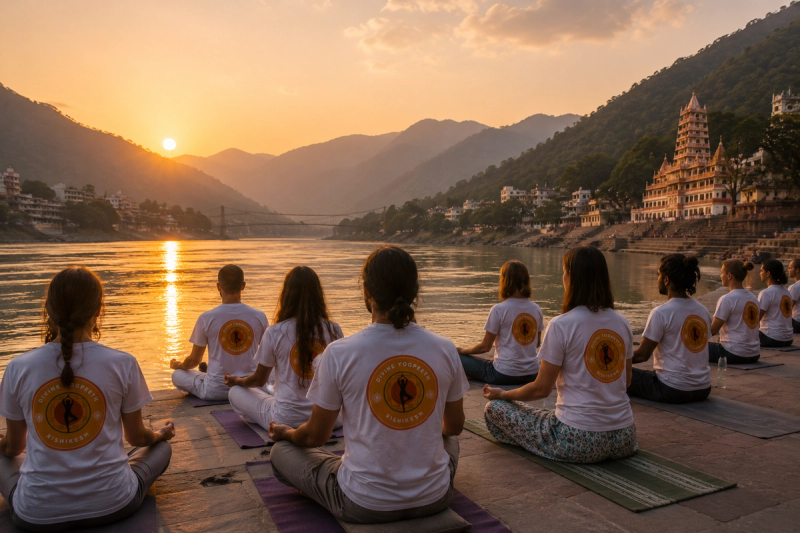
Rishikesh is not just a location; it is an active participant in your training. Situated on the banks of the sacred Ganga River and surrounded by the Himalayas, the environment here hums with spiritual energy. The air is thick with centuries of dedicated practice.
Practicing here removes you from the distractions of your daily life. You are immersed in a culture that honors the tradition you are studying. The vegetarian diet, the sounds of temple bells, and the community of like-minded seekers all accelerate your growth.
You will face challenges during your two weeks here. Your body will ache, and your mind will resist the early hours. However, the supportive environment of Rishikesh provides the exact container you need to push through those barriers.
Choosing to study at the source completely changes the depth of your education. You are not just learning physical fitness; you are absorbing a complete lifestyle. You can learn more about the ashram environment on our Home page.
Start Your Journey With Us
If you're considering training in Rishikesh, Divine Yogpeeth offers a supportive, highly structured environment to build your foundation. Our curriculum is designed to challenge you safely while providing deep traditional wisdom.
We limit our class sizes to ensure you receive the personalized attention necessary for real growth. Our teachers live and breathe this practice, guiding you with decades of combined experience.
You do not need to be an advanced gymnast to join us; you only need a genuine desire to learn and grow. We provide the tools, the space, and the knowledge. You provide the dedication.
Frequently Asked Questions
What physical level is required for the 100 hour course?
You do not need to be advanced. This course is designed for beginners and intermediate practitioners looking to solidify their foundation. A basic familiarity with common asanas is helpful, but dedication is far more important than flexibility.
Do I get a certificate after completing the 100 hours?
Yes. Upon successful completion, you receive a certificate of completion. While it does not allow you to register as an RYT-200 immediately, it counts as continuing education or the first half of a full 200-hour certification.
What is the daily schedule like?
Days begin around 6:00 AM with cleansing practices and Hatha yoga. The day is filled with philosophy, anatomy, and alignment classes, concluding with an evening Ashtanga session and meditation. You will typically finish around 7:00 PM.
Is food and accommodation included?
Yes. To ensure you can focus entirely on your training, we provide clean, comfortable accommodation and three nutritious, Sattvic (yogic vegetarian) meals per day. This diet actively supports your physical recovery and mental clarity.
Conclusion
Understanding the Divine Yogpeeth 100 hour course structure completely removes the anxiety of the unknown. You now know exactly how your weeks will unfold, from the intense morning asanas to the deep philosophical debates in the afternoon. This training is a rigorous, deeply rewarding immersion that builds unshakeable physical and mental foundations.
By committing to this structured curriculum, you are choosing to respect the ancient traditions while upgrading your own life. The discipline you learn here will reflect in everything you do back home. Ready to begin? Explore our 100-Hour Yoga Teacher Training and take the first step today.