.jpg)

Mantra chanting sound healing science explained: learn how breath, vibration and attention may influence relaxation and focus, with practical guidance. Discover
Mantra Chanting Sound Healing Science: The Science Behind Chanting in Yoga
What if the sound you create with your own voice could change your breathing, attention, and sense of calm within a few minutes? Mantra chanting sound healing science sits at the intersection of an old yogic practice and modern questions about vibration, the nervous system, breathing, and attention.
When you chant a mantra, you are not simply repeating words. You are coordinating breath, vocal vibration, rhythm, listening, and concentration. That combination can make chanting feel very different from ordinary speech or silent repetition.
But there is an important distinction: science can investigate measurable effects of chanting, such as changes in breathing, heart-rate variability, attention, or stress, while traditional yoga gives mantras a much broader spiritual meaning. Keeping those two perspectives separate helps you understand what chanting may realistically do without turning every claim about “frequency” into a scientific fact.
In this guide, you will learn how sound is produced, what happens when you chant, what research can and cannot establish, how different practices compare, and how you can explore mantra chanting safely during yoga practice in Rishikesh.
Mantra Chanting Sound Healing Science: What Actually Happens When You Chant?
A mantra is traditionally a sound, word, or phrase used repeatedly for concentration and contemplation. In yoga, the practice can involve spoken chanting, whispered repetition, or mental repetition. The experience changes depending on the sound, rhythm, breath, posture, and level of attention you bring to it.
From a scientific perspective, chanting creates several simultaneous inputs. Your vocal folds produce sound, your mouth and throat shape it, your chest and facial structures transmit vibration, and your ears continuously receive the sound. At the same time, controlled breathing creates a steady rhythm.
This is why chanting can feel physically noticeable. You may sense vibration around the lips, tongue, skull, throat, chest, or abdomen depending on the sound you make. Those sensations are real, but they should not automatically be interpreted as proof that a particular frequency is “healing” a specific organ.
Traditional yoga gives mantra practice another layer. A mantra may be treated as a tool for concentration, devotion, contemplation, or connection with a chosen spiritual principle. The meaning and method can therefore matter as much as the acoustic properties.
For background on yoga’s wider philosophical and professional context, you can explore Yoga Alliance alongside traditional teachings.
How Sound Vibration and Chanting May Affect Your Nervous System
One of the most interesting parts of mantra practice is not the idea that sound magically repairs the body. It is the way chanting can organize breathing and attention.
Breathing, rhythm, and attention
Slow, rhythmic chanting often encourages you to lengthen and regularize your breathing. When your exhalation becomes longer and your attention stays anchored to the sound, the practice can become similar to other paced-breathing or meditation techniques.
Your nervous system responds to breathing patterns, and changes in breathing can influence arousal and relaxation. However, the response varies between people. A fast, forceful chant may feel stimulating, while a slower practice may feel settling.
Chanting also gives your mind a repetitive object. Instead of constantly switching between thoughts, you repeatedly return to the same sound. That can make the practice easier to sustain than trying to “stop thinking.”
Why your own voice matters
Listening to your own voice creates a feedback loop. You produce a sound, hear it, adjust it, and produce it again. This keeps attention connected to something immediate and physical.
That does not mean your voice has a uniquely powerful biological frequency. It means chanting combines auditory attention, motor control, breathing, and bodily sensation in one activity.
If you want a broader look at evidence around yoga and psychological well-being, read Yoga and mental health research evidence.
What Does the Research Say About Mantra Chanting and Sound Healing?
Research on chanting and meditation suggests that repetitive vocal practices can be associated with changes in stress, mood, attention, and physiological measures. Some studies have examined mantra repetition, while others investigate broader meditation or slow-breathing practices.
The difficulty is that chanting is not one standardized intervention. A study using silent mantra repetition is not necessarily evidence for a group chanting session with singing bowls. Likewise, a study measuring breathing during one type of recitation cannot prove claims about every sound-healing method.
Correlation is not proof of a healing frequency
You will often encounter claims that a particular sound, such as 432 Hz or 528 Hz, has a special biological effect. Some experiments have reported interesting differences between sound conditions, but that is not enough to establish that one frequency has a universal healing property.
A better approach is to ask what was actually measured. Was it heart rate? Anxiety scores? Sleep quality? Brain activity? Pain? How large was the study? Was there a control group? Were participants blinded where possible?
For scientific literature on health research, you can also consult PubMed and evaluate individual studies rather than relying on social-media claims about “healing frequencies.”
The scientific literature is much more useful when you separate measurable outcomes from spiritual interpretations.
Chanting versus sound healing
Mantra chanting and sound healing overlap, but they are not identical. Chanting usually involves the practitioner actively producing or repeating sound. Sound-healing sessions may involve listening to bowls, gongs, bells, vocal tones, or other instruments.
Both can involve rhythm, sustained attention, and relaxation. Neither should be presented as a guaranteed medical treatment. If you have a medical condition or significant psychological symptoms, use qualified healthcare support rather than replacing treatment with chanting.
For practical preparation before a session, see these sound healing session preparation tips.
Mantra Chanting, Singing Bowls, and Other Sound Practices: What Is Different?
It is easy to put every sound-based practice into one category, but your role is different in each one.
With mantra chanting, you actively create the sound. This requires breath control, pronunciation, rhythm, and attention. Because you participate physically, the practice can become a moving meditation.
With singing bowls or gongs, you are usually listening. The sound may be layered, sustained, or unpredictable, which can give your attention a different object. Some people find this easier because they do not need to manage pronunciation.
Kirtan adds another dimension. Repetition, melody, group participation, and devotional meaning can create a strong sense of shared attention. If you want to understand the relationship between devotional music and wellness practices, read about Kirtan and bhajan devotional music healing.
You can also compare binaural beats and singing bowls to see why different sound-based practices should not automatically be treated as equivalent.
The most useful question is not “Which sound has the strongest frequency?” It is “Which practice helps you maintain steady attention, comfortable breathing, and an appropriate state for your goal?”
Choosing a Mantra and Building a Simple Practice
If you are new to mantra practice, the biggest mistake is choosing a sound because a social-media post promises a specific frequency or instant energetic result. Start with a practice you can repeat comfortably and understand within its traditional context.
For a beginner, consistency matters more than complexity. You can work with a short mantra, a simple sacred syllable, or a guided practice. Pronunciation should be learned carefully when the mantra comes from Sanskrit, because changing sounds can change the traditional form and meaning.
Your practice can be as simple as five to ten minutes. Sit comfortably, breathe naturally, chant at a moderate volume, and let the repetition become steady. If your attention wanders, return to the sound without judging yourself.
You can also experiment with different modes:
- Spoken chanting makes the sound and breath obvious.
- Whispered repetition reduces volume while retaining vocal articulation.
- Mental repetition removes the external sound and places more emphasis on attention.
- Group chanting adds rhythm, social connection, and shared vocal energy.
If you are studying yoga more systematically, our 200-hour yoga teacher training in Rishikesh can place mantra, meditation, pranayama, philosophy, and other practices within a broader training framework.
Why Rishikesh? Why This Matters for Yoga Practice
Rishikesh gives mantra practice a distinctive cultural setting. Along the Ganga, you will encounter chanting in temples, ashrams, yoga schools, satsangs, and daily spiritual routines. Sound is not treated only as an acoustic phenomenon; it can also be part of prayer, ritual, study, and community.
That context can change how you experience the practice. If you arrive expecting a purely scientific experiment, you may miss its traditional dimension. If you arrive believing every traditional claim is scientifically proven, you may also misunderstand the practice.
A balanced approach lets you explore both.
You can pay attention to practical markers: Is your breathing becoming smoother? Can you sustain attention? Do you feel more settled after practice? Are you forcing your voice? Are you becoming dizzy or uncomfortable?
Those observations are more useful than chasing a supposedly perfect vibration.
Rishikesh is also a natural place to combine chanting with asana, pranayama, meditation, and yoga philosophy. In a structured setting, you can learn how these practices fit together rather than treating sound as an isolated technique.
If you are comparing retreat formats, our 5-day yoga retreat in Rishikesh provides a short format for experiencing a broader yoga routine.
How to Practice Mantra Chanting Safely and Effectively
You do not need a complicated setup. Start with a comfortable seated posture and choose a mantra you understand or have received appropriate guidance to practice.
Try this simple structure:
- Sit comfortably and let your spine remain naturally upright.
- Take several easy breaths without trying to force a particular pattern.
- Begin chanting at a moderate volume that feels comfortable.
- Keep the rhythm steady rather than trying to chant as loudly as possible.
- Notice the sound, breath, pronunciation, and physical vibration.
- Continue for five to ten minutes.
- Sit quietly for another minute and observe how you feel.
Avoid treating discomfort as evidence that the practice is “working.” Throat strain, dizziness, breathlessness, headache, or ear discomfort are signals to reduce intensity or stop.
If you want to develop a deeper understanding of sound-based practice, a dedicated sound healing training course can provide a more structured learning environment.
Soft CTA: Learn Sound Practice in Rishikesh
If you want to explore mantra, vibration, meditation, and sound practices beyond casual chanting, we offer structured learning in Rishikesh through our Sound Healing Training Course, where you can study these practices in a dedicated yoga-school setting.
FAQs About Mantra Chanting Sound Healing Science
Is mantra chanting scientifically proven to heal the body?
Science supports investigating chanting for outcomes such as relaxation, stress, attention, and physiological changes, but that is different from proving that mantras can heal diseases. Claims should be matched to the quality and limits of the available evidence.
Does chanting change your brain?
Chanting can influence attention, breathing, sensory processing, and emotional state. Research on meditation and chanting has reported neurological and physiological changes, but the exact effects depend on the practice and individual. It would be inaccurate to claim that every mantra produces one specific brain change.
Is 432 Hz scientifically better than other frequencies?
There is not enough evidence to treat 432 Hz as a universally superior healing frequency. Some studies compare different tuning conditions and report measurable differences, but those findings do not establish a universal therapeutic effect.
Can you combine mantra chanting with yoga and meditation?
Yes. Chanting can fit naturally before meditation, after asana practice, or within a broader yoga session. The key is to choose an intensity and duration that support your purpose rather than turning the practice into a performance.
Can beginners learn mantra chanting in Rishikesh?
Yes. Beginners can learn pronunciation, rhythm, breath coordination, and the traditional context of mantra practice through guided classes. You do not need years of experience to begin, but respectful instruction is valuable when a mantra has specific pronunciation or ritual significance.
Conclusion: Use Sound as a Practice, Not a Miracle Claim
Mantra chanting sound healing science becomes more useful when you stop looking for magical explanations and start examining what the practice actually involves: sound, breath, rhythm, attention, bodily sensation, and meaning.
Chanting may help you regulate attention and create a calmer state, and research provides useful reasons to study these effects. But science has not established that every mantra or frequency can cure illness, repair organs, or produce guaranteed outcomes.
If you are ready to experience these practices in a traditional yoga environment, our Sound Healing Training Course in Rishikesh is a practical place to begin. Explore the course, learn the methods properly, and let your own consistent practice—not exaggerated claims—show you what sound can add to your yoga journey.
─── IMAGE SUGGESTIONS ───
1. Featured Image
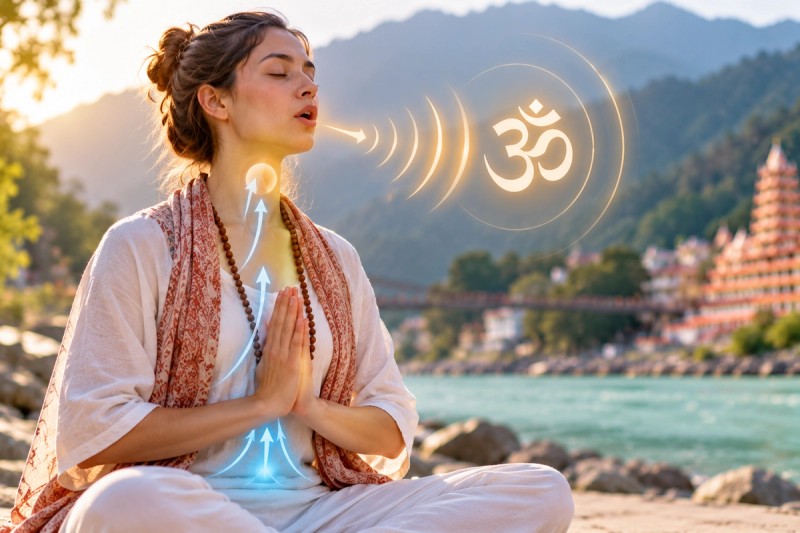
- Description: A serene Rishikesh yoga setting with a practitioner seated in meditation while chanting a mantra, subtle visual emphasis on vocal vibration and the Ganga/Himalayan surroundings.
- ALT Text: Mantra chanting sound healing science practice in Rishikesh
- File name:
mantra-chanting-sound-healing-science-rishikesh.jpg
2. In-Content Image 1
- Description: Close-up of a yoga practitioner chanting with relaxed posture, showing the relationship between breath, voice, and mindful concentration.
- ALT Text: Mantra chanting sound vibration practice in Rishikesh yoga
- File name:
mantra-chanting-sound-vibration-yoga.jpg
3. In-Content Image 2
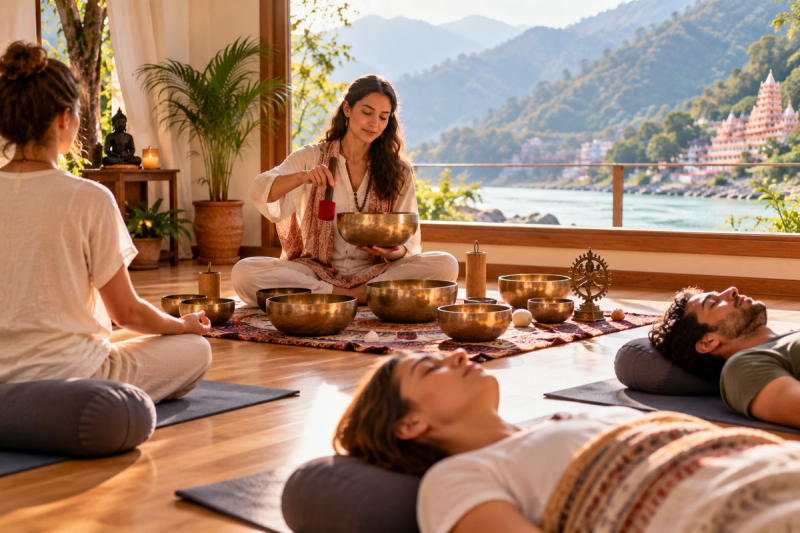
- Description: A small sound-healing session in a calm yoga studio featuring singing bowls, a practitioner seated comfortably, and a peaceful Rishikesh-inspired environment.
- ALT Text: Sound healing and mantra chanting practice in Rishikesh
- File name:
sound-healing-mantra-rishikesh-session.jpg
─── SELF-CHECK ───
- ☑ Word Count: 2,175 — within the required 2,000–2,500 range.
- ☑ Main Page Links: 4 — exactly within the required 3–4.
https://www.divineyogpeeth.com/YTT/200-hour-yoga-teacher-traininghttps://www.divineyogpeeth.com/retreat/5-days-retreathttps://www.divineyogpeeth.com/YTT/sound-healing-training-coursehttps://www.divineyogpeeth.com/YTT/sound-healing-training-course
- ☑ Blog Links: 4 — within the required 3–5.
https://www.divineyogpeeth.com/blog/yoga-mental-health-research-evidencehttps://www.divineyogpeeth.com/blog/sound-healing-session-preparationhttps://www.divineyogpeeth.com/blog/kirtan-bhajan-devotional-music-healinghttps://www.divineyogpeeth.com/blog/binaural-beats-vs-singing-bowls-healing
- ☑ External Links: 2 — both use
rel="nofollow"in HTML format.https://yogaalliance.orghttps://pubmed.ncbi.nlm.nih.gov
- ☑ URL Verification: All internal URLs used match the approved URLs supplied in the prompt exactly. No new or guessed internal URL was introduced.