
Explore pranayama techniques 100 hour YTT students may learn, from alternate nostril breathing to Bhramari, with practical guidance in Rishikesh. Discover more.
Pranayama techniques 100 hour YTT: What Techniques Are Taught in Rishikesh?
Introduction
Pranayama techniques 100 hour YTT students explore can change how they approach every yoga session, from a steady morning asana practice to quiet meditation. But which breathing methods can you expect to learn, and how do you know whether you are practising them correctly?
A 100-hour yoga teacher training introduces you to the foundations of yogic breathing, breath awareness, and the relationship between respiration and concentration. You begin to understand that pranayama is not simply about taking deeper breaths. It involves attention, rhythm, posture, gradual progression, and respect for your individual limits.
Whether you are an international yoga seeker travelling to Rishikesh or an Indian practitioner strengthening an existing practice, understanding these methods before enrolling helps you arrive with realistic expectations.
You will discover common pranayama techniques, their basic practice methods, the mistakes beginners should avoid, and how structured training can help you develop a consistent routine.
The exact syllabus varies between schools. The techniques discussed below are common examples you may encounter, not a guaranteed list of lessons at every 100-hour course.
1. What Are Pranayama Techniques in a 100-Hour YTT?
Pranayama is a traditional yogic discipline concerned with the regulation and observation of breathing. In a teacher-training setting, the initial emphasis is often on awareness, comfortable breathing, posture, and learning how different techniques are performed.
You may first observe the natural movement of your breath before attempting structured exercises. This foundation matters because complicated breathing patterns are difficult to practise consistently when your posture is unstable or your breathing feels strained.
A beginner-friendly introduction may cover:
- Awareness of inhalation and exhalation.
- Comfortable seated positions that support an upright spine.
- Gentle breathing patterns without unnecessary muscular tension.
- Basic nostril-breathing methods.
- Preparation, relaxation, and recovery after practice.
- Health precautions and the importance of gradual progression.
You may also encounter Sanskrit terminology used to explain traditional breathing practices. Understanding these names, their purposes, and the basic instructions helps you follow classes more confidently.
For an overview of yoga education and training standards, visit Yoga Alliance. Before enrolling, verify the school's current recognition status and the exact credential offered by the programme.
What should you expect from a 100-hour course?
Think of it as an introduction to essential skills rather than a promise of complete mastery. You may develop better breath awareness, learn to follow guided practice, and begin identifying mistakes that make breathing uncomfortable.
If you intend to teach yoga professionally, ask how much time the programme dedicates to pranayama theory, supervised practice, teaching demonstrations, and individual feedback.
2. Essential Pranayama Breathing Exercises You May Learn
A structured introduction may include several traditional techniques, each with a different breathing pattern and level of complexity. Understanding these methods before your training helps you recognise what an instructor is teaching and why the technique matters.
Nadi Shodhana: Alternate Nostril Breathing
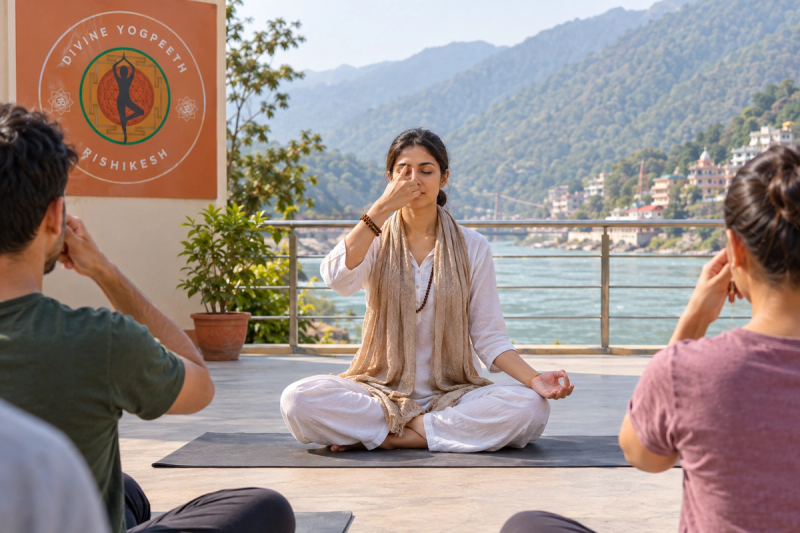
Nadi Shodhana is practised by alternating the flow of breath through the nostrils. It is commonly introduced as a slow, attentive exercise that encourages you to observe your breathing rhythm.
A gentle beginner practice may look like this:
- Sit comfortably with your spine upright and shoulders relaxed.
- Use your right hand to close one nostril gently.
- Inhale through the open nostril at a comfortable pace.
- Switch nostrils and exhale slowly.
- Continue with the alternating pattern under your instructor's guidance.
Start without breath retention. You do not need to make every breath exceptionally long or force air through a nostril that feels blocked.
Ujjayi: Ocean-Like Breathing
Ujjayi is associated with a subtle narrowing of the throat that creates a soft, audible breathing sound. In some yoga classes, it is coordinated with movement; in others, it is practised separately.
The sound should remain gentle. Tightening your throat aggressively or trying to produce a loud noise defeats the purpose of comfortable breathing.
Bhramari: Humming Bee Breath
Bhramari involves producing a gentle humming sound during exhalation. You inhale comfortably and hum as you breathe out, keeping your jaw, forehead, and shoulders relaxed.
Many practitioners find the sound and vibration useful as a focus for attention. Individual experiences differ, however, and the technique should not be presented as a guaranteed treatment for anxiety or other medical conditions.
Diaphragmatic and Three-Part Breathing
Before advanced methods, you may practise observing movement around the abdomen, lower ribs, and upper chest. Three-part breathing encourages awareness of these regions without forcing your lungs to their maximum capacity.
This foundation can help you recognise shallow, hurried, or unnecessarily tense breathing.
Not every school teaches these methods in the same order. If you also want to understand how breathing coordinates with movement, explore the fundamentals of Vinyasa in a 100-hour YTT.
3. Kapalabhati, Bhastrika, and More Active Breathing Practices
Some yoga traditions include more active breathing practices alongside gentle exercises. Two commonly discussed examples are Kapalabhati and Bhastrika. Their intensity makes proper instruction particularly important.
Kapalabhati: Active Exhalation
Kapalabhati is traditionally associated with active, relatively forceful exhalations and more passive inhalations. It is not simply rapid deep breathing.
When taught appropriately, the emphasis should be on understanding the pattern rather than completing the largest number of repetitions. Beginners should not reproduce an advanced demonstration without first receiving suitable guidance.
Bhastrika: Bellows Breath
Bhastrika generally involves more active inhalation and exhalation. Its pace and intensity can place greater demands on the practitioner than quiet breath awareness.
It should not be treated as a compulsory exercise for every student. Your instructor should consider your experience, comfort, and relevant health history before recommending it.
Why supervision matters
Rapid or forceful breathing can cause light-headedness, tingling, discomfort, or other unwanted symptoms. Stop immediately if you feel unwell, return to normal breathing, and seek appropriate assistance if symptoms persist or are severe.
Avoid forceful breathing and breath retention without qualified guidance, particularly if you have cardiovascular or respiratory conditions, uncontrolled high blood pressure, a history of fainting, or are pregnant. Some practices may be unsuitable for you altogether, so consult an appropriate healthcare professional when necessary.
For general information about India's traditional systems of health and wellness, visit the Ministry of Ayush. Traditional descriptions of pranayama should not be interpreted as proof that a particular technique can diagnose, prevent, or cure a medical condition.
4. How to Build a Safe and Consistent Pranayama Practice
Learning a technique once is different from developing a sustainable routine. During training, you should gradually learn how to prepare for practice, follow instructions, observe your responses, and finish without rushing into the next activity.
Start with posture and natural breathing
Choose a stable, comfortable seated position. A cushion or suitable chair may help if sitting cross-legged causes discomfort.
Keep your spine comfortably upright rather than rigid, release unnecessary shoulder tension, and allow your face to remain relaxed. Spend a few minutes observing your natural breath before introducing a specific pattern.
Progress gradually
A sensible beginner sequence might include:
- Preparation: Sit comfortably and observe your natural breathing.
- Foundation: Practise relaxed diaphragmatic breathing.
- Technique: Learn one gentle method under instruction.
- Observation: Notice whether the breath remains smooth and comfortable.
- Recovery: Return to natural breathing before moving on.
Your instructor may recommend a different sequence depending on the school's tradition and your experience.
Avoid common mistakes
The most frequent beginner mistakes include forcing a longer exhalation, lifting the shoulders excessively, tightening the jaw, holding the breath involuntarily, and increasing the pace too quickly.
Another mistake is assuming that discomfort indicates progress. It does not. Pain, significant breathlessness, dizziness, or distress are reasons to stop rather than push harder.
You should also avoid comparing your breathing capacity with another student's. Differences in fitness, anatomy, experience, and health mean that a comfortable practice will not look identical for everyone.
If your course includes practical teaching exercises, ask whether instructors explain how to offer modifications and recognise when a student needs to stop.
For another traditional subject that requires careful instruction and progression, read about bandhas and their role in yoga practice.
5. Why Learn Pranayama in Rishikesh, India?
Rishikesh attracts yoga students from India and around the world because it offers an environment where yoga study, traditional instruction, and daily practice can become part of the same routine.
In areas such as Tapovan and Laxman Jhula, you may find yoga schools, meditation sessions, vegetarian cafés, and opportunities to experience local spiritual culture. The surrounding Himalayan foothills and the Ganga provide a distinctive setting for reflection between classes.
However, the location alone does not guarantee quality instruction. A school in Rishikesh should still be evaluated on its teachers, course structure, practical supervision, student support, accommodation arrangements, and transparent fees.
Before choosing a programme, consider these questions:
- Does the curriculum clearly explain which pranayama techniques are taught?
- Are beginners guided through foundational breathing before more demanding methods?
- Can you ask questions or request modifications during practice?
- Is there sufficient time for supervised practice rather than theory alone?
- Are health precautions and contraindications explained clearly?
- Does the advertised certification accurately reflect the course's recognition and scope?
If you are travelling internationally, also check visa requirements, arrival arrangements, the local climate during your dates, and the school's cancellation policy.
You may want to review a school's teaching environment and approach before committing. Reading a practical review of Divine Yogpeeth's training can be one part of that research, alongside direct questions to the school and comparisons with other providers.
The best location is ultimately the one where you can study consistently, feel comfortable asking questions, and receive responsible instruction.
6. Explore Pranayama Training at Divine Yogpeeth
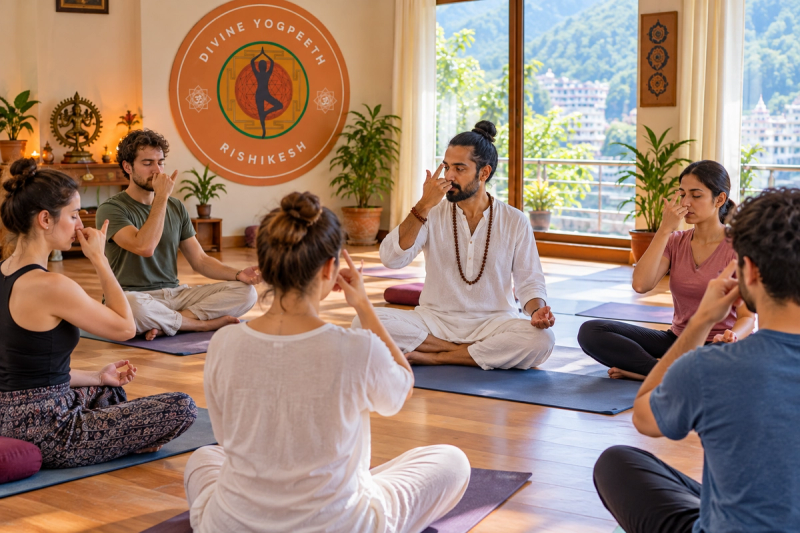
If you are considering a structured yoga programme in Rishikesh, Divine Yogpeeth is located in the Laxman Jhula and Tapovan area. Our 100-hour yoga teacher training programme is a relevant starting point for exploring the course format and deciding whether it matches your learning goals.
Before enrolling, ask our team for the current curriculum and confirm which pranayama methods are included, how much supervised practice you receive, whether sessions accommodate beginners, and what certification the programme provides.
It is also worth checking the daily schedule, accommodation and meal arrangements, class size, instructor qualifications, and any additional charges. These practical details can make a substantial difference to your experience.
If you already have substantial yoga experience and want a more extensive training pathway, compare the programme with our 200-hour yoga teacher training. The appropriate option depends on your previous learning, goals, and the requirements of the qualification you ultimately want to pursue.
You can also visit the Divine Yogpeeth homepage to explore the school's broader offerings before deciding which programme suits you.
The aim is not to enrol in the longest course available. It is to choose a programme that gives you the time, guidance, and practice opportunities you actually need.
7. FAQs About Pranayama Techniques in a 100-Hour YTT
Which pranayama techniques are taught in a 100-hour YTT?
Depending on the school's syllabus, you may encounter natural breath awareness, diaphragmatic breathing, Nadi Shodhana, Ujjayi, Bhramari, and introductions to more active methods such as Kapalabhati. Confirm the actual list with your chosen school.
Can beginners learn pranayama during a 100-hour yoga teacher training?
Yes, many introductory programmes accommodate beginners, but entry requirements differ. Choose a programme that explains foundational breathing clearly and provides modifications instead of expecting you to perform advanced techniques immediately.
How much time should you practise pranayama each day?
There is no single duration that suits everyone. A short, comfortable practice can be a sensible starting point, particularly under instruction. Follow your teacher's guidance and increase duration only when the technique remains comfortable and appropriate for you.
Is a 100-hour YTT enough to become a certified yoga teacher?
A 100-hour course can provide foundational training, but it does not automatically qualify you for every teaching role or credential. Check the school's certification details and the requirements of the organisation or employer you intend to work with.
Is pranayama safe for everyone?
Not every technique is suitable for every person. Gentle breath awareness may be an appropriate starting point for many people, but forceful breathing and breath retention require particular caution. Seek qualified guidance and appropriate medical advice when health conditions may affect your practice.
Conclusion: Begin Your Pranayama Practice with the Right Guidance
Pranayama techniques 100 hour YTT students encounter can provide a foundation for understanding breath awareness, traditional breathing patterns, and responsible practice. The most useful training does not simply teach you to copy a technique. It helps you recognise your limits, understand the purpose of each exercise, and develop a consistent approach.
If you plan to study in Rishikesh, compare course syllabuses, ask direct questions about teaching methods, and choose a school that prioritises clear instruction and student safety.
Ready to explore your options? Visit our 100-hour yoga teacher training in Rishikesh, review the programme details, and contact our team to confirm the current pranayama curriculum before booking your place.