.jpg)

Master yoga class sequencing principles teacher training basics to build safe, flowing routines. Discover how to structure your classes expertly. Learn more!
Yoga Class Sequencing Principles Teacher Training: Essential Rules for 200hr Graduates
Have you ever frozen at the front of the studio, suddenly unsure which asana should logically follow the last? Mastering yoga class sequencing principles teacher training is the exact difference between a clumsy, disjointed routine and a seamless, flowing experience. When you understand the biomechanics and energy behind every movement, your confidence as an instructor skyrockets.
Your students rely on you to guide them safely through their physical and mental barriers. A poorly structured class can lead to injuries, frustration, or a jarring energetic experience that leaves practitioners feeling unsettled. Conversely, an intelligently crafted sequence guides the body through a natural progression of opening, strengthening, and releasing.
This guide breaks down the core structural rules every new graduate needs to know. You will learn how to prepare the body for peak poses, balance the nervous system, and create routines that feel incredibly intuitive. Keep reading to master the art of designing sequences that will keep your students coming back to your mat time and time again.
Understanding Yoga Class Sequencing Principles Teacher Training Foundations
Every powerful sequence starts with a clear intention and a deep understanding of human anatomy. You cannot simply string your favorite poses together and hope the routine feels good for the entire room. The core of yoga class sequencing principles teacher training lies in the concept of Vinyasa Krama, which translates to taking steps in a specific, mindful direction.
You must prepare the joints and muscles systematically before asking them to perform complex or deep actions. International bodies like the Yoga Alliance emphasize safe structural progression as a cornerstone of their educational standards. Following these guidelines ensures you protect your students' physical health while optimizing their mental focus.
Your sequences should always follow a bell curve of energetic intensity. You begin low to the ground to center the mind, gradually build heat and complexity through standing postures, and then systematically cool the nervous system down. If you want a deeper dive into how this fits into your overall education, explore our Best 200 Hour YTT Curriculum Subjects guide.
The Core Yoga Class Sequencing Principles for Safe Movement
Protecting your students is your ultimate responsibility as an instructor. Every forward fold, backbend, and twist requires proper preparation and an appropriate counterpose to maintain spinal integrity. Never guide a class into an intense backbend like Urdhva Dhanurasana (Wheel Pose) without thoroughly opening the hip flexors, shoulders, and chest first.
Counterposes are non-negotiable elements of safe movement. After a deep backbend, you must neutralize the spine with a gentle twist or a mild forward fold to release the tension. Skipping these essential transitions can cause immediate discomfort or long-term lower back issues for your students.
You must also consider the varying skill levels within your room. Always offer modifications and utilize props like blocks and straps to make the sequence accessible to everyone. To refine your instructional techniques further, review these Yoga Teaching Methodology TTC strategies.
Warming Up the Major Muscle Groups
The initial ten to fifteen minutes of your class dictate the physical safety of the remaining hour. Use this time to lubricate the major joints—wrists, shoulders, hips, and spine. Sun Salutations (Surya Namaskar) are the traditional and most effective tool for generating internal heat and synchronizing breath with movement.
Transitioning Through Standing Postures
Standing poses build the foundational strength required for more advanced physical work. Sequence your standing postures so that the hip orientation remains logical. Moving repeatedly between open-hip poses (like Warrior II) and closed-hip poses (like Warrior I) within a single sequence can strain the sacroiliac joint.
The Art of Peak Pose Sequencing
Designing a class around a specific "peak pose" gives your routine a clear, targeted physical objective. This method requires you to deconstruct the most challenging posture of the class into its anatomical components. You then select warm-up and intermediate poses that specifically stretch and strengthen those exact muscle groups.
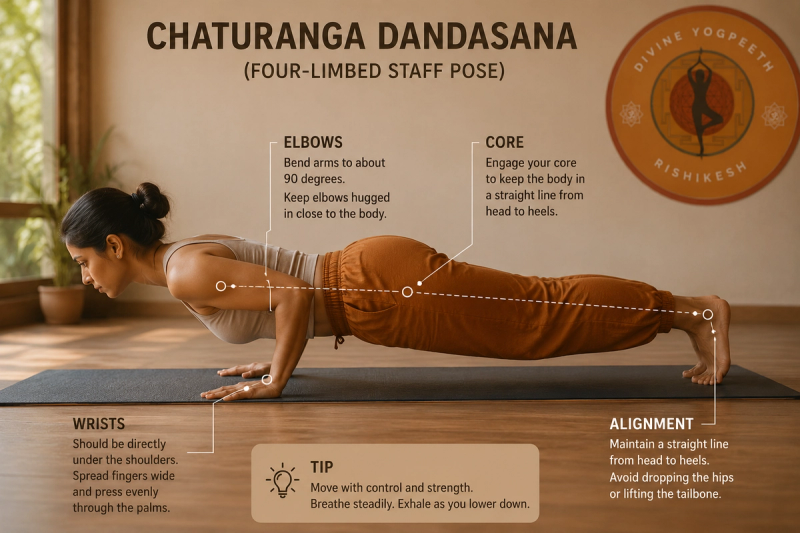
For example, if your peak pose is Bakasana (Crow Pose), your sequence must aggressively target core strength, wrist flexibility, and hip opening. You would naturally include poses like Plank, Chaturanga, and Malasana (Yogi Squat) early in the class to physically and mentally prepare the students.
This highly targeted approach builds confidence in your practitioners. By the time they reach the peak pose, their bodies physically understand the mechanics required to execute it safely. If you are debating which foundational style suits this method best, reading about Hatha vs Ashtanga Yoga can clarify the structural differences.
Sequencing the Cool Down
The descent from the peak pose must be gradual and deliberate. You cannot jump from an intense arm balance directly into Shavasana without shocking the nervous system. Use seated forward folds and supine twists to systematically lower the heart rate and calm the energetic body.
Integrating Breath and Energetic Alignment
A sequence is only as effective as the breath that carries it. Your cues must synchronize the inhalation with expansive, upward movements and the exhalation with contracting, downward, or twisting movements. This rhythmic breathing regulates the autonomic nervous system and keeps students grounded in the present moment.
Different sequences yield different energetic results, and you must design your class with the time of day in mind. Morning classes usually require stimulating, heat-building sequences, while evening classes should prioritize grounding and restorative postures. The Ministry of Ayush in India recognizes the profound impact these traditional rhythmic practices have on holistic well-being and stress reduction.
Do not overlook the subtle body—the chakras and nadis—when designing your class theme. Focusing on grounding postures like Tree Pose (Vrksasana) activates the Root Chakra, providing stability for anxious students. If you want to integrate more healing elements into your flows, exploring Therapy techniques can add immense value to your teaching toolkit.
Common Mistakes New Instructors Make in Sequencing
New teachers often feel pressured to reinvent the wheel, leading to overly complicated and awkward sequences. Complexity does not equal effectiveness. Your students will benefit far more from a simple, well-cued routine than a confusing choreography that leaves them tangled and breathless.
Another frequent error is neglecting to balance the left and right sides of the body evenly. If you hold a challenging pose for five breaths on the right side, you must ensure the left side receives the exact same attention and duration. Failing to do so creates muscular imbalances and leaves the practitioner feeling physically skewed.
Finally, rushing through Shavasana is a cardinal sin in yoga instruction. The final resting pose is where the body integrates the physical work and the nervous system completely resets. Always protect at least five to seven minutes for an undisturbed, deeply relaxing Shavasana at the end of your sequence.
Building Sequences Around Anatomical Themes
Anatomical themes provide a fantastic framework for your weekly class planning. Instead of a general flow, you might dedicate an entire session specifically to "Opening the Hips" or "Releasing Shoulder Tension." This allows you to dive deeply into a specific bodily region and provide targeted relief for your students.
When planning an anatomically themed class, you must still maintain the overall arc of the sequence. A hip-opening class still requires a proper spinal warm-up and a balanced cool-down. The theme simply dictates the flavor of the standing and seated postures you select for the middle portion of the routine.
This focused approach helps your students understand their own bodies better. They learn which poses alleviate specific aches and pains, empowering them to build their own home practices. Mastering this thematic structuring is a core component of any comprehensive 100 Hour Yoga Teacher Training.
Why Rishikesh Elevates Your Sequencing Skills
There is a profound difference between learning yoga in a western studio and studying it at the source. Rishikesh offers an immersive environment where the philosophy of yoga informs every physical movement you make. You absorb the traditional reasoning behind why certain poses are grouped together, moving beyond mere physical exercise.
Practicing on the banks of the Ganga River grounds your energetic body, allowing you to focus entirely on your educational journey. You are surrounded by masters who have dedicated their lives to understanding the subtle nuances of Vinyasa Krama. This environment accelerates your learning and deepens your personal practice immensely.
The spiritual atmosphere of the Himalayas naturally encourages deep introspection and focus. You learn to sequence classes that heal not just the muscles, but the mind and spirit as well. Discover how this sacred location can refine your teaching by reading about Tapovan Rishikesh Yoga.
Your Next Steps in Teaching Mastery
Becoming a confident yoga teacher requires consistent practice, expert guidance, and a supportive community. If you're considering training in Rishikesh, Divine Yogpeeth offers an authentic, traditional environment to master your instructional skills. We focus heavily on practical teaching methodology so you leave fully prepared to lead a room.
Our curriculum is designed to bridge the gap between ancient wisdom and modern anatomical understanding. You will practice sequencing daily, receiving constructive, personalized feedback from our experienced Indian masters.
We ensure you understand not just how to move, but why every movement matters. Whether you are beginning your journey or refining your existing skills, exploring our 200 Hour Yoga Teacher Training program can give you the structural knowledge you need to succeed.
Frequently Asked Questions (FAQs)
What is the most important rule in yoga sequencing?
The most critical rule is maintaining anatomical safety through proper warm-ups and necessary counterposes. You must prepare the body before pushing it into deep stretches or challenging balances to prevent injuries.
How long should a warm-up be in a 60-minute class?
A standard warm-up should last between 10 to 15 minutes. This allows sufficient time to center the breath, lubricate the major joints, and build the initial internal heat required for safe movement.
Do I have to use a peak pose in every class?
No, peak pose sequencing is just one methodology. You can also design classes around anatomical themes, energetic goals (like grounding or energizing), or simply offer a balanced, full-body Vinyasa flow.
How do I remember my sequences while teaching?
Practice teaching your sequence out loud at home multiple times before bringing it to the studio. Writing a brief outline on a small card and keeping it near your mat is also a perfectly acceptable tool for new teachers.
Conclusion: Lead with Confidence and Purpose
Understanding yoga class sequencing principles teacher training is what transforms a practitioner into a true guide. When you know how to safely and intelligently structure a flow, your classes become a sanctuary for your students. They will feel the difference in their bodies and trust your leadership entirely.
Never stop studying the body and experimenting with your flows on your own mat. The best sequences come from a place of deep personal practice and authentic understanding. Take your time, focus on the breath, and build your routines with clear, loving intention.
Ready to begin? Explore our 200 Hour Yoga Teacher Training in Rishikesh and take the first step toward teaching mastery today.