.jpg)

Trauma-informed yoga teacher training basics can help you teach with choice, consent, and safer boundaries. Learn why they matter in 100-hour courses. Discover.
Trauma-Informed Yoga Teacher Training Basics: Why It Matters Even in 100-Hour Courses
Imagine joining a yoga class expecting to learn alignment, sequencing, and teaching skills, only to discover that a perfectly ordinary instruction can feel uncomfortable for someone in the room. That is why trauma-informed yoga teacher training basics matter, even when your course is only 100 hours. You do not need to become a therapist to teach with greater awareness; you do need to understand how choice, language, boundaries, and classroom structure can affect a student's sense of safety.
A short teacher-training course cannot cover every aspect of trauma studies or clinical care. It can, however, introduce practical principles that make your teaching more respectful and adaptable. You can learn why consent matters, how to offer options without singling people out, when hands-on adjustments may be inappropriate, and why your role has clear limits.
This guide explains what you can reasonably expect from trauma-aware education in a 100-hour yoga course, how it can influence your teaching, why Rishikesh is a useful setting for this conversation, and what to look for when comparing teacher-training programs.

Trauma-Informed Yoga Teacher Training Basics: What Does It Actually Mean?
Trauma-informed yoga begins with a simple shift in perspective: you teach the person in front of you, not just the posture on your lesson plan. A trauma-aware teacher recognizes that students can arrive with different histories, stress responses, boundaries, and relationships with their bodies.
The goal is not to identify who has experienced trauma. You are not there to diagnose students, ask for personal stories, or interpret emotional reactions. Instead, you create conditions in which students have meaningful choices and can participate without unnecessary pressure.
That can change ordinary teaching details. Instead of saying, “This is the only correct way to do the pose,” you might demonstrate a range of options and explain what each option is intended to develop. Instead of physically moving a student's body without warning, you can ask permission first and accept a no without making it awkward.
You may also become more careful with language. Commands that imply failure, shame, or forced endurance can be replaced with neutral cues such as noticing sensation, reducing intensity, changing the shape, or resting.
This approach does not mean making every class extremely gentle. A strong vinyasa, balancing practice, or disciplined asana session can still be trauma-aware. The difference is that intensity is not confused with pressure, and challenge is not treated as a test of obedience.
For broader professional context, you can also review the role of standards and teacher education through Yoga Alliance.
Why 100-Hour Courses Introduce Trauma-Aware Teaching
A 100-hour program is often an entry point for people who want a concentrated introduction to yoga teaching. Because you may begin working with different bodies, ages, cultures, abilities, and comfort levels after training, basic trauma awareness can be useful before you teach independently.
The important word is basics. A 100-hour course should not present a few classroom tips as equivalent to specialist trauma therapy education. If a program claims that a short module makes you qualified to treat post-traumatic stress, severe mental-health conditions, or complex trauma, you should be skeptical.
Instead, introductory training can help you develop safer habits from day one.
Choice Is a Teaching Skill
A student may benefit from being offered choices such as keeping the eyes open or softly lowering the gaze, taking child's pose or resting on the back, using a wall for balance, or reducing the range of motion. You can give these options to everyone rather than making assumptions about one person's history.
Choice also protects dignity. If you say, “If this variation does not feel right today, you can choose another,” the student can adapt without having to explain why.
Consent Is More Than Asking Once
Consent should be specific, informed, and easy to withdraw. If you use hands-on adjustments, you need a clear system for communicating whether students want them. A student's silence should not be treated as automatic permission.
You also need to understand that consent can change from one class to another. Someone who welcomed an adjustment yesterday may not want one today. A professional teacher respects that without taking it personally.
Predictability Can Reduce Unnecessary Stress
Clear class structure can help students know what to expect. You can explain how the session will flow, demonstrate unfamiliar movements, and give students time to transition rather than constantly surprising them with abrupt instructions.
These practices are not complicated. They are simply more intentional ways of teaching.
What You May Learn in a Trauma-Informed Module
The strongest introductory modules usually connect principles with actual teaching decisions. You should leave with practical tools rather than a collection of dramatic stories or medical claims.
Language, Cueing, and Classroom Tone
Your words can influence how students relate to their bodies. Trauma-aware cueing generally favors invitations and observations over coercive language.
For example, instead of “Push through the pain,” you can say, “Explore the range that feels sustainable today.” Instead of “Don't be lazy; hold it longer,” you can say, “If the posture feels too intense, reduce the effort or rest.”
That does not mean every sentence needs to sound cautious or vague. Good teaching can be direct while still preserving autonomy.
Boundaries and Teacher Responsibilities
You should understand where yoga teaching ends and clinical care begins. A teacher can guide breath, movement, relaxation, and attention, but should not diagnose a student's condition or promise to resolve trauma through asana.
If a student discloses a serious personal problem, the appropriate response is not to investigate. You can listen respectfully, maintain boundaries, and encourage appropriate professional support when needed.
Modifying Practice Without Labeling Students
You can learn to modify posture, pace, props, transitions, and participation. For example, a seated practice can include a chair option, a balance sequence can include wall support, and a relaxation practice can allow a student to remain seated rather than lying down.
The point is not to create a special “trauma class” every time. It is to make ordinary teaching flexible enough that students can make reasonable choices.
This connects with broader discussions about yoga and mental wellbeing, but you should keep evidence and scope in perspective. You can review research on yoga and mental health while remembering that evidence for a specific outcome depends on the population, practice, and study design. Yoga may support wellbeing for some people, yet it should not be presented as a replacement for appropriate medical or mental-health care.
For medical and health-policy context, you can also consult the Ministry of Ayush.
How Trauma-Aware Principles Change Your Teaching
The real value of these basics becomes clearer when you imagine teaching your first class. You may notice that trauma awareness affects the entire teaching environment, not just the final relaxation.
Before class, you can make expectations clear. Tell students what the session will involve and where they can ask for modifications. During class, avoid hovering over students who choose alternatives. If everyone knows that variations are normal, no one has to feel publicly identified.
During demonstrations, you can show rather than physically position students. When an adjustment is useful, ask first and explain what you intend to do. If the answer is no, move on naturally.
During breathwork or meditation, you can also avoid presenting one response as universally correct. Some students may find closed-eye practices uncomfortable, so an eyes-open option can be offered without turning it into a major event.
A Practical Classroom Checklist
You can ask yourself:
- Have you explained the structure of the session?
- Have you normalized modifications and rest?
- Are your cues clear without being threatening or shaming?
- Can students decline touch without embarrassment?
- Have you avoided asking students to disclose personal trauma?
- Are you staying within your role as a yoga teacher?
- Do students know they can change or stop an exercise?
- Have you left enough time for transitions?
These questions are simple, but they can expose habits that otherwise go unnoticed.
For a related look at professional boundaries and teaching conduct, you can explore our guide to yoga teacher ethics training in a 100-hour course.
Trauma-Informed Yoga in Rishikesh: Why This Matters
Rishikesh attracts students from many countries, backgrounds, and yoga traditions. That diversity can make teacher awareness especially important. You may teach someone who has practiced for years alongside someone attending their first structured yoga course.
The same instruction will not necessarily land the same way for everyone. Cultural expectations around touch, authority, eye contact, personal space, gender, and communication can differ. A good teacher does not need to know every cultural rule; you do need enough humility to avoid assuming that your preferred teaching style works for everyone.
The setting itself can also create a powerful learning environment. In Rishikesh, you may study yoga close to the Ganga, practice in Tapovan, and experience an atmosphere where traditional philosophy sits alongside modern approaches to wellness.
That does not automatically make a course trauma-informed. The location is not the credential. What matters is the curriculum, instructor experience, teaching methodology, boundaries, and opportunities for supervised practice.
If you are comparing the structure of shorter and longer programs, our 100-hour yoga teacher training in Rishikesh can help you examine what an intensive foundational format looks like, while our 200-hour yoga teacher training in Rishikesh is more suitable if you want a deeper teacher-training pathway.
You can also explore Tapovan Rishikesh yoga and its learning environment if the location itself is part of your decision.
How to Choose a 100-Hour Course That Teaches Trauma Awareness Responsibly
Not every course that uses the words “trauma-informed” offers the same depth. Before you pay a deposit, ask what the module actually covers.
A responsible program should explain the limits of its training. Look for curriculum language around consent, choice, inclusive cueing, boundaries, nervous-system awareness, modifications, and referral to qualified professionals. Ask who teaches the module and what their relevant experience is.
Be cautious when you see sweeping promises such as “heal trauma in one session” or “become a trauma therapist through yoga training.” Those claims blur important professional boundaries.
You should also ask how the principles are practiced, not just discussed. If a school teaches autonomy but pressures students to perform every posture exactly as demonstrated, there is a mismatch between the marketing and the classroom.
Another useful sign is whether teachers normalize different ways of participating. You can also compare the practical expectations of a shorter program with a weekend yoga workshop before deciding what level of training fits your goal.
A student who uses a prop, takes rest, keeps their eyes open, or chooses a simpler variation should not be treated as less committed.
For international students, consider practical details too: teaching language, accommodation, class schedule, certificate information, and how the school communicates expectations before arrival.
The best choice is not necessarily the course with the longest list of topics. It is the one that clearly defines what you will learn, what you will not be qualified to do, and how those principles show up in real teaching.
A Gentle Introduction Through Divine Yogpeeth
If you want to study foundational yoga teaching in Rishikesh with attention to practical classroom skills, Divine Yogpeeth is one option to consider.
Our approach should be evaluated by the curriculum, teaching style, and learning experience rather than by promises alone. For you as a student, that means asking questions about what is included, how teaching practice is supervised, and how the program handles individual needs.
A trauma-aware foundation can complement asana, pranayama, meditation, anatomy, philosophy, and teaching methodology. It should not dominate the entire course or be marketed as clinical treatment.
FAQs About Trauma-Informed Yoga Teacher Training Basics
Is Trauma-Informed Yoga Therapy?
No. Trauma-informed yoga is an approach to teaching that emphasizes safety, choice, consent, and awareness of individual responses. It does not automatically make you a therapist or qualify you to treat trauma-related disorders.
Is 100 Hours Enough to Become a Trauma-Informed Yoga Teacher?
It can provide a useful foundation, but the answer depends on the curriculum and your intended role. A 100-hour course may introduce trauma-aware principles and teaching practices. It should not be treated as equivalent to advanced specialist training.
Do Trauma-Informed Yoga Classes Have to Be Gentle?
No. Trauma-aware teaching is about how you offer practice, not a fixed intensity level. A vigorous class can still include choice, clear expectations, respectful cueing, consent, and permission to modify or rest.
Should a Yoga Teacher Ask Students About Their Trauma?
Generally, no. You do not need a student's personal history to offer respectful teaching. Asking for sensitive details can cross boundaries and may place unnecessary pressure on the student.
Why Study These Basics in Rishikesh?
Rishikesh gives you access to a diverse international yoga-learning environment where traditional practices and modern teaching approaches often meet. The location can enrich your study, but the quality of the curriculum and instructors matters more than the destination itself.
Conclusion: Build Safer Teaching Habits From the Start
Trauma-informed yoga teacher training basics are worth introducing even in a 100-hour course because they influence the way you communicate, demonstrate, adjust, modify, and respect student autonomy. You do not need to diagnose trauma, act as a therapist, or turn every yoga class into a clinical intervention.
You do need to understand that students bring different experiences into the room. When your teaching gives people reasonable choices, clear boundaries, and permission to participate at their own pace, you create a more respectful learning environment.
If you are ready to develop your foundation in Rishikesh, explore our 100-hour yoga teacher training and see whether its format matches your goals. If you want a more comprehensive path toward teaching, consider our 200-hour yoga teacher training. Your next step should be based on the depth of training you actually need—not simply the number printed on the certificate.
─── IMAGE SUGGESTIONS ───
1. Featured Image
Description: Realistic professional yoga teacher-training classroom in Tapovan, Rishikesh, with an instructor calmly offering multiple posture variations while international and Indian students independently choose comfortable options. The scene should communicate autonomy, consent, inclusive teaching, and respectful instruction.
ALT Text: Trauma-informed yoga teacher training basics in Rishikesh classroom
File name: trauma-informed-yoga-teacher-training-rishikesh.jpg
2. In-Content Image 1
Description: Realistic yoga class in Rishikesh showing a teacher demonstrating a standing posture while students use different modifications, props, and levels of intensity. No forced physical adjustments; emphasize choice and individual participation.
ALT Text: Trauma-informed yoga teaching with student choice in Rishikesh
File name: trauma-aware-yoga-teaching-student-choice-rishikesh.jpg
3. In-Content Image 2
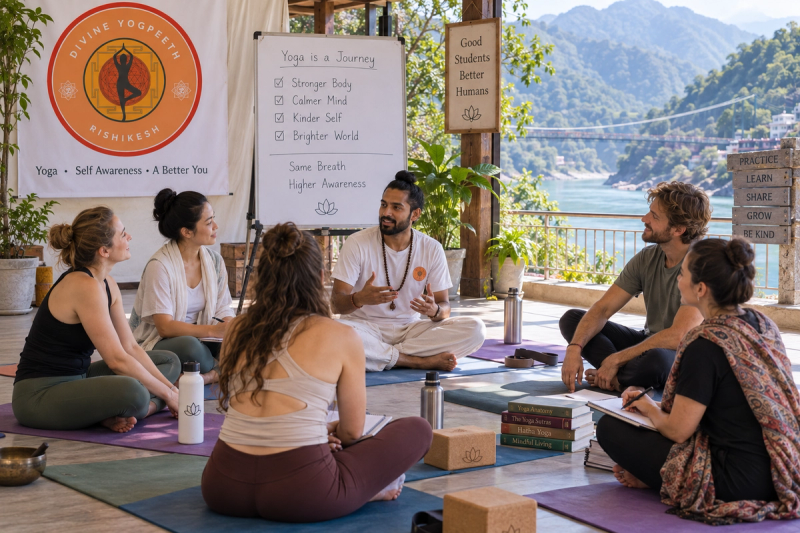
Description: Calm professional yoga teacher-training environment near the Ganga in Rishikesh, showing a teacher speaking with students after practice. Students appear engaged and comfortable, with mats and natural Himalayan surroundings subtly visible.
ALT Text: Yoga teacher training with trauma-aware teaching principles in Rishikesh
File name: yoga-teacher-training-trauma-aware-rishikesh-ganga.jpg
─── SELF-CHECK ───
- ☑ Word Count: 2,377 — within the required 2,000–2,500 range.
- ☑ Main Page Links: 3 — requirement met.
- ☑ Blog Links: 4 — requirement met.
- ☑ External Links: 2 — exactly two, both with
rel="nofollow". - ☑ URL Verification: All internal URLs used match the approved URL lists exactly. No mismatches found.