.jpg)

Yin yoga vs vinyasa yoga comparison for beginners: compare pace, flexibility, strength, breath, and class style, then choose a practice that fits you. Discover.
Yin Yoga vs Vinyasa Yoga Comparison: Complete Comparison for Beginners
Yin yoga vs vinyasa yoga comparison becomes much easier when you stop asking which style is “better” and ask what your body and mind need from practice. Do you want to slow down, stay with a posture, and explore stillness, or do you want to move continuously, build heat, and coordinate breath with transitions?
The two styles can look almost opposite, yet both can become valuable parts of your practice. Your choice can affect the pace of class, the physical sensations you experience, the kind of concentration you develop, and how easily the practice fits your current goals.
In this guide, you’ll compare Yin and Vinyasa yoga by pace, postures, breath, physical demands, flexibility, strength, recovery, and beginner suitability. You’ll also see how Rishikesh can support a deeper yoga practice and what to consider if you eventually want formal teacher training.
Yin Yoga vs Vinyasa Yoga: What Is the Main Difference?
The simplest way to understand the difference is through movement and time. Yin yoga is generally slow and passive, with poses held for several minutes. Vinyasa is a more dynamic style in which you move through sequences while coordinating movement with breathing.
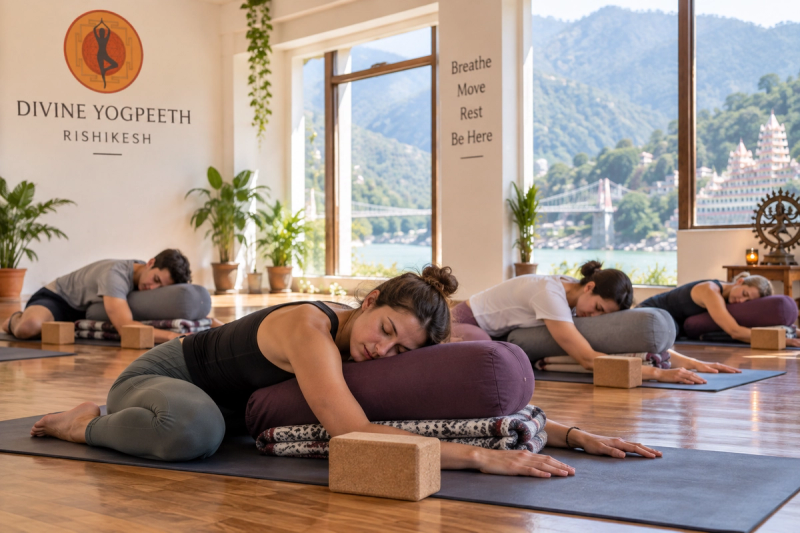
In Yin, you may settle into a shape and remain there long enough to observe changing sensations. The aim is not to force a deeper stretch. Instead, you use an appropriate edge, relax unnecessary muscular effort, and stay attentive.
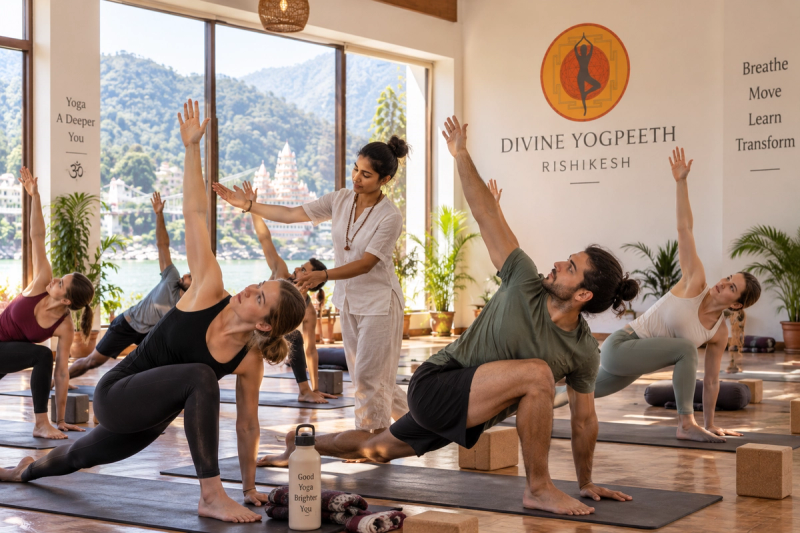
Vinyasa usually asks for more active muscular engagement. A class may connect poses through transitions such as plank, chaturanga, upward-facing or cobra variations, downward-facing dog, lunges, standing poses, and balancing postures. The exact sequence can vary considerably because Vinyasa does not have one fixed routine.
Yin yoga at a glance
You may prefer Yin if you want:
- Longer-held floor-based postures
- A quieter pace and more time for observation
- Practice that emphasizes mobility and tolerance of stillness
- A complementary practice for days when you do not want a high movement load
Yin is not simply “easy stretching.” Long holds can feel intense, especially around the hips, hamstrings, inner thighs, and connective tissues. Your experience also depends on anatomy, props, range of motion, and how a teacher structures the class.
Vinyasa yoga at a glance
You may prefer Vinyasa if you want:
- Continuous movement linked with breath
- More active muscular work
- Variety from class to class
- A practice that can challenge coordination, balance, strength, and cardiovascular effort
For a broader introduction to yoga as a discipline and tradition, you can also explore the resources of <a href="https://britannica.com" rel="nofollow">Britannica</a>.
Neither style automatically suits every person or every day. Your best starting point depends on your current mobility, energy, goals, experience, and willingness to work at a particular intensity.
Yin Yoga vs Vinyasa Yoga for Flexibility, Strength, and Mobility
If you are comparing Yin and Vinyasa because you want a physical result, look beyond the name of the style. What matters is how the class is taught and what you consistently practice.
Yin commonly gives you more time to explore passive ranges of motion. Because you stay in a posture longer, you can notice where you are resisting, where you can relax, and how sensations change over time. That does not mean you should push into pain. A useful Yin practice teaches you to distinguish productive sensation from a warning signal.
Vinyasa can develop active mobility. When you repeatedly move into and out of positions, you learn to control your range rather than simply access it passively. Lunges, standing poses, balances, and transitions can also demand strength around the hips, legs, shoulders, and core.
Which style supports strength?
Vinyasa generally creates more opportunities for active muscular loading. Repeated transitions, plank variations, arm-support work, standing sequences, and balances can make a class physically demanding.
Yin can still be physically challenging, but the challenge is different. The longer holds may test your patience, positional awareness, and ability to stay relaxed while experiencing sustained sensation.
If your main goal is building a dynamic movement practice, Vinyasa may give you more direct opportunities to train active strength. If your priority is exploring stillness and passive mobility, Yin may feel more relevant.
Your anatomy matters too. A posture that looks identical on two people may create very different sensations because of skeletal structure, proportions, previous movement habits, and mobility.
Yin and Vinyasa Yoga: How the Class Experience Changes
The biggest practical difference may be what your attention has to do during class.
In Yin, the slower pace can expose your habits around impatience. You may have several minutes with little external stimulation, which gives you time to notice breathing, tension, discomfort, distraction, and the urge to change position.
Vinyasa asks for a different kind of concentration. You may need to remember a sequence, respond to verbal cues, coordinate breath and movement, shift weight, stabilize joints, and prepare for the next posture. The practice can feel meditative precisely because your attention has to stay with the moving body.
Breath and pacing
Yin does not require you to breathe in one single universal pattern. A teacher may encourage slow, comfortable breathing and relaxed observation. The important point is that breathing should not become a struggle.
Vinyasa often uses the breath as a timing tool. You may inhale during one movement and exhale during another, depending on the teacher and sequence. This coordination can create a steady rhythm.
Neither approach means you must force your breath. If you feel dizzy, strained, or unable to breathe comfortably, the intensity or technique needs adjustment.
What happens after class?
After Yin, you may notice a sense of spaciousness or quiet attention, although sensations can also continue to evolve after a long-held posture. After Vinyasa, you may feel physically energized, warm, worked, or pleasantly tired.
Your response can change from day to day. Sleep, stress, hydration, training history, and the intensity of the specific class all matter.
Which Yoga Style Is Better for Beginners?
For a beginner, the question is less about choosing a permanent style and more about choosing a safe entry point.
Yin can be approachable because you have time to understand a posture instead of constantly moving to the next one. However, long holds can surprise beginners who assume slow automatically means gentle. You still need clear instruction about props, joint positioning, and when to back off.
Vinyasa can be exciting because you learn how poses connect. The challenge is that a faster class may leave you trying to copy the person beside you rather than learning your own alignment and breathing pattern.
If you are new to yoga, look for a class described as beginner-friendly and tell the teacher that you are new. You should not feel pressured to match another student’s depth or pace.
A simple decision guide can help:
- Choose Yin when you want slower practice, sustained postures, and more time for inward attention.
- Choose Vinyasa when you want movement, active strength, coordination, and a stronger physical rhythm.
- Try both if you are unsure. A week that includes one or two sessions of each can show you how your body responds.
- Use props freely. Blocks, bolsters, blankets, and straps are tools for adapting practice, not signs that you are doing less.
If your interest grows beyond attending classes and you want to understand sequencing, anatomy, philosophy, and teaching methodology, structured yoga education can add another layer to your practice. You can also review <a href="https://yogaalliance.org" rel="nofollow">Yoga Alliance</a> when researching teacher-training standards and credential terminology.
You can read about our 100-hour yoga teacher training in Rishikesh when you are ready to explore a shorter teacher-training format.
How to Combine Yin and Vinyasa in One Practice Routine
You do not have to choose one style and reject the other. In fact, combining them can make your weekly practice more adaptable.
You might use Vinyasa on days when you have energy for active movement and Yin on days when you want a slower practice. Some practitioners also place a short Yin session after a dynamic practice, while others prefer to keep the two sessions separate.
The key is not to assume that more is always better. A long Yin class after a very demanding physical session may not be what your body needs. Likewise, adding an intense Vinyasa session every day can leave you with insufficient recovery.
A simple weekly structure could look like this:
- Two Vinyasa sessions for active movement and skill development
- One or two Yin sessions for slower mobility and awareness
- One lighter day for walking, breathing practice, meditation, or complete rest
You can adjust this according to your experience and schedule. If you are recovering from an injury or have a medical concern, get appropriate professional guidance rather than using a general yoga schedule as a treatment plan.
For a deeper look at how yoga practice can be structured around the body, our guide to yoga anatomy, muscles, joints, and alignment can help you think more carefully about movement and positioning.
If you want to explore restorative approaches alongside slower practices, you may also find our article on restorative yoga in a 200-hour TTC curriculum useful.
A Practical Yin Yoga vs Vinyasa Yoga Comparison for Your Goals
Your decision becomes easier when you start with the outcome you want from a class.
If you want to develop movement vocabulary and active coordination, Vinyasa gives you repeated opportunities to link postures and transitions. You can gradually become more comfortable with weight shifting, balance, breath timing, and active range of motion.
If you want to practice staying with sensation without constantly changing positions, Yin gives you a very different training environment. You can learn to observe rather than immediately react.
If you want both, alternating styles may be more useful than trying to find one “perfect” practice.
For formal teacher training, the curriculum matters even more. Look for education that covers anatomy, sequencing, teaching practice, philosophy, and safe instruction rather than focusing only on performing advanced poses. You can review our 200-hour yoga teacher training in Rishikesh if you want to explore a more comprehensive path.
Why Rishikesh Matters When You Want to Deepen Your Yoga Practice
Rishikesh can change the context in which you practice. Instead of squeezing one class between work and errands, you can spend several days paying attention to yoga, study, rest, and the environment around you.
Tapovan, where you can find many yoga schools and practitioners, gives you access to a strong yoga-focused community. The presence of the Ganga and the Himalayan setting can also create a quieter rhythm between classes.
If you are planning a retreat rather than a long training, comparing different formats can help. Our 5-day yoga retreat in Rishikesh can be a practical option if you want several days of guided practice without committing to a full teacher-training program.
If your goal is to become a teacher, a longer residential program can give you more time to develop consistency and teaching skills. If your goal is simply to experience a focused retreat, a shorter program may make more sense.
A Gentle Next Step With Divine Yogpeeth
If you want to experience yoga in Rishikesh rather than only read about different styles, we offer programs that let you choose a shorter retreat or a more structured training path. Our Divine Yogpeeth yoga programs in Rishikesh include options for different levels of commitment.
The right choice depends on whether you want a few focused days, deeper study, or teacher training. Start with the format that matches your actual goal rather than choosing a course simply because it sounds more advanced.
You can also explore our other yoga and wellness resources before deciding. For example, if sound-based practices interest you, our guide to preparing for a sound healing session explains what you can expect before attending.
FAQs About Yin Yoga vs Vinyasa Yoga
Is Yin yoga easier than Vinyasa yoga?
Not necessarily. Yin is slower and usually involves less continuous movement, but long-held postures can create strong sensations and require patience. Vinyasa may feel more demanding because it includes continuous movement and active muscular work. Difficulty depends on the class, your body, and your experience.
Can you do Yin and Vinyasa yoga on the same day?
Yes, many people can combine them, but the order and intensity matter. If you are already fatigued, adding another demanding session may not be useful. Keep the practice appropriate to your experience and recovery. You do not need to combine both styles every day to benefit from them.
Which is better for flexibility: Yin or Vinyasa?
Yin provides more time in passive positions, while Vinyasa can develop active mobility through controlled movement. Flexibility is not only about how far you can move; control, strength, joint structure, and technique also matter. A balanced practice can include both approaches.
Is Vinyasa good for beginners?
It can be, especially when the class is explicitly beginner-friendly and the teacher explains transitions clearly. A very fast or advanced class may be frustrating for someone who is still learning basic postures. Start with an appropriate level and prioritize breathing and control over keeping up.
Can Yin yoga help you prepare for yoga teacher training?
Yin can help you become more familiar with sustained postures, observation, and body awareness, but teacher training requires a much broader skill set. You will also need anatomy, sequencing, teaching practice, philosophy, communication, and an understanding of how to adapt practices for different students.
Conclusion: Choose the Practice That Matches Your Purpose
Yin yoga vs vinyasa yoga comparison does not need to end with one universal winner. Yin gives you a slower environment for sustained postures, observation, and passive mobility, while Vinyasa gives you more continuous movement, active engagement, coordination, and sequencing.
Your smartest starting point is to identify what you need today and what you want to develop over time. You can practice one style, alternate between both, or eventually study them as part of a broader yoga education.
If Rishikesh is part of your plan, you can take that exploration further through a structured retreat or teacher-training program. Ready to deepen your practice? Explore our 200-hour yoga teacher training in Rishikesh and choose a learning path that fits your goals.