.jpg)

Use this yoga class plan template new teacher guide to structure sequences, timing, cues, and modifications with confidence. Learn practical tips and discover.
Yoga Class Plan Template New Teacher: How to Build a Confident Class
A yoga class plan template new teacher can use is often the difference between a class that feels calm and purposeful and one that feels improvised. You may know plenty of poses, yet still struggle when ten students are waiting for your next instruction.
The good news is that planning a class does not mean writing a rigid script. A useful plan gives you a clear intention, sensible progression, teaching cues, timing, and enough flexibility to respond to the people in front of you.
Whether you are preparing your first community class, teaching after a teacher-training course, or trying to make your sequences more consistent, you can build a reliable plan with a simple framework. You will learn how to choose a theme, structure a sequence, estimate timing, write useful cues, include modifications, and review your class afterward. You will also see a practical template you can reuse for different levels and styles.
Yoga Class Plan Template New Teacher: Start With the Class Intention
Before choosing a single asana, decide what you want your students to experience by the end of the class. This sounds simple, but it prevents one of the most common new-teacher mistakes: collecting attractive poses first and trying to connect them later.
Your intention can be physical, energetic, educational, or a combination. For example, you might plan a gentle morning class that gradually wakes the spine, a beginner class focused on stable standing postures, or a Vinyasa class that explores a particular movement pattern.
Keep the intention narrow enough to guide your choices. “Make everyone feel amazing” is too vague. “Build steady standing balance while teaching students how to shift weight safely” gives you a useful direction.
If you are teaching a public class, consider these questions before you write the sequence:
- Who is likely to attend, and what experience level can you reasonably expect?
- How much time do you have for practice, explanation, and rest?
- What physical focus makes sense for this group?
- Which poses are essential to the class, and which are optional?
- Where might students need a simpler variation or prop?
You should also understand the professional context in which you are teaching. If you are pursuing formal yoga-teacher credentials, review the current standards and guidance available from Yoga Alliance rather than relying on assumptions from another teacher or school.
A strong plan is not a list of twenty impressive poses. It is a logical answer to one question: “Why is this pose here, and why is it here now?”
How to Build a Yoga Class Plan From Beginning to End
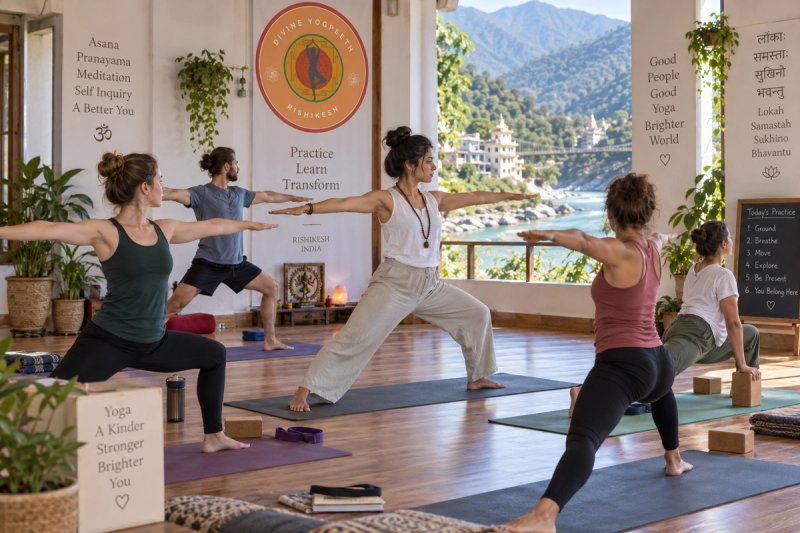
Once your intention is clear, create the class as a progression. Think of it as preparing the body and attention for increasingly demanding movements, then gradually bringing everything back down.
A 60-minute general class might look like this:
- Arrival and centering — 5 minutes
- Breath awareness or pranayama — 5 minutes
- Gentle warm-up — 10 minutes
- Main sequence — 20 minutes
- Peak posture or focused work — 10 minutes
- Cool-down — 5 minutes
- Savasana and closing — 5 minutes
The exact distribution will change with your style. A restorative class may spend much longer in supported shapes, while a strong Vinyasa class may devote more time to the central sequence.
The reusable planning template
You can write each class on one page using the following structure:
Class goal:
Choose one clear physical or experiential objective.
Level:
Beginner, mixed-level, intermediate, or another clearly defined group.
Duration:
Write the total class time and leave a small buffer for transitions.
Opening:
Note your centering position, opening message, and initial breath practice.
Warm-up:
List movements that prepare the joints, spine, breath, and attention for the main work.
Main sequence:
Arrange postures from accessible to more demanding. Include transitions, not just pose names.
Peak or focus:
Choose one main posture, movement skill, or teaching concept.
Counterposes and cool-down:
Select movements that reduce intensity and help students settle.
Savasana:
Decide how much quiet time you want and what final instruction you will give.
Closing:
Keep your final words short and relevant to the class intention.
Teacher notes:
Write only the cues, reminders, modifications, or timing points you are most likely to forget.
This template gives you structure without forcing you to read from a page while teaching. Your written plan should support your presence, not replace it.
Sequence Your Yoga Class Plan Around Preparation, Peak, and Release
A sequence becomes easier to teach when every section prepares for the next one. Instead of asking, “What pose should I teach next?”, ask, “What does the student need before this movement?”
Suppose your focus is Warrior III. You might first explore standing stability, hip mobility, hamstring length, core engagement, and controlled weight transfer. That could lead through standing balance drills, Warrior I or II, a supported balance variation, and finally Warrior III.
This approach makes the peak posture feel earned rather than random.
You should also plan transitions. New teachers often spend considerable time choosing poses and almost none deciding how students will move between them. Yet transitions are where confusion, rushed movement, and unnecessary strain often appear.
For each demanding transition, write a short cue such as:
- “Step the right foot forward, then pause before lifting the back leg.”
- “Use a block under the hand if reaching the floor changes your breathing.”
- “Move slowly enough that you can keep the standing foot stable.”
Build options into the sequence
A mixed-level class needs more than one version of a difficult shape. You do not have to create a separate sequence for every student. Instead, prepare a base version and one or two meaningful options.
For example, in a balance posture, you might offer a wall for support, keep the lifted foot lower, or reduce the duration. In a forward fold, you might suggest bent knees or blocks rather than telling everyone to reach the floor.
Avoid presenting modifications as failures. A variation is simply another route toward the same learning objective.
This is also where your anatomy knowledge matters. You do not need to turn class into a lecture, but you should understand the basic movement demands of the poses you teach. For a useful foundation, see this related guide on yoga anatomy, muscles, joints, and safe alignment.
Write Teaching Cues That Students Can Actually Use
A beautiful sequence can still produce a poor class if your instructions are unclear. New teachers often try to say everything they know. The result is a stream of anatomical details that students cannot process while moving.
Your cue should answer a practical question: what should the student do, feel, notice, or avoid?
Instead of saying, “Externally rotate the femur while maintaining neutral pelvic alignment,” you might say, “Keep your knee tracking in the same direction as your toes.” The second cue is easier to act on immediately.
Use a mix of action, breath, and awareness cues.
Action cue:
“Press through the outer edge of the back foot.”
Breath cue:
“Inhale as you lengthen; exhale as you fold.”
Awareness cue:
“Notice whether you can keep your jaw and shoulders relaxed.”
You should also avoid cue overload. Give the most important instruction first, allow students time to respond, then add another cue if needed.
Use a teacher's timing sheet
A simple timing sheet can keep you from spending fifteen minutes on the warm-up and rushing Savasana.
SectionPlanned timeKey teaching pointCentering5 minArrive and establish breathWarm-up10 minMobilize and prepareMain flow20 minBuild toward focusPeak work10 minExplore the main skillCool-down5 minLower intensitySavasana5 minIntegrate and restClosing5 minFinish clearly
Treat these numbers as targets, not laws. If a student needs more explanation, you can adjust. But having a target prevents the class from drifting.
If you want more help creating sequences after certification, this guide to creating a yoga sequence after teacher training can help you think beyond memorized class scripts.
Why Rishikesh Matters When You Are Learning to Teach Yoga
Rishikesh can be a particularly useful environment for learning how to teach because yoga is not separated from daily life here. You encounter different teaching styles, students from different countries, traditional practices, modern sequencing, and conversations about yoga beyond the physical postures.
That variety can expose a weakness in your planning: a sequence that works beautifully for one group may not work for another.
If you train in Rishikesh, pay attention not only to the poses but also to how experienced teachers manage a room. Notice how they demonstrate without over-demonstrating, how they change their language for beginners, and how they recover when timing changes.
You can also compare different approaches to practice. A teacher-training class may emphasize anatomy and sequencing, while a retreat may give you more space for reflection, meditation, or breathwork.
The location itself should not become an excuse for romanticizing your teaching. Being in Rishikesh does not automatically make someone a good teacher. What matters is whether you develop observation, communication, ethical awareness, technical understanding, and the ability to adapt.
If you are exploring teacher training in the area, you can learn more about Tapovan Rishikesh yoga and the local practice environment.
For a more immersive introduction to the environment, you can also explore a 5-day yoga retreat in Rishikesh before deciding whether a longer training experience suits your goals.
A Practical Yoga Class Plan Template You Can Copy
Here is a compact version you can copy into your notes before teaching:
Class title:
Duration:
Level:
Main intention:
Opening — ___ minutes
- Starting posture:
- Breath practice:
- Opening instruction:
Warm-up — ___ minutes
- Movement 1:
- Movement 2:
- Movement 3:
- Preparation for main focus:
Main sequence — ___ minutes
- Sequence A:
- Transition:
- Sequence B:
- Transition:
- Sequence C:
Peak/focus — ___ minutes
- Main posture or skill:
- Beginner option:
- Prop/support option:
- Key safety cue:
Cool-down — ___ minutes
- Counterpose 1:
- Gentle movement:
- Final release:
Savasana — ___ minutes
- Setup:
- Closing cue:
Teacher reminders:
- Watch timing:
- Offer modification:
- Avoid over-cueing:
- Leave enough quiet:
After class, write three quick notes: what worked, what felt rushed, and what you would change next time. That short review is one of the fastest ways to improve.
If you are preparing for formal training rather than simply teaching informally, structured education can make this process much stronger. Divine Yogpeeth's 200-Hour Yoga Teacher Training in Rishikesh is one option to explore if you want deeper study of teaching, practice, and yoga-related subjects.
When Your Class Plan Should Be Flexible
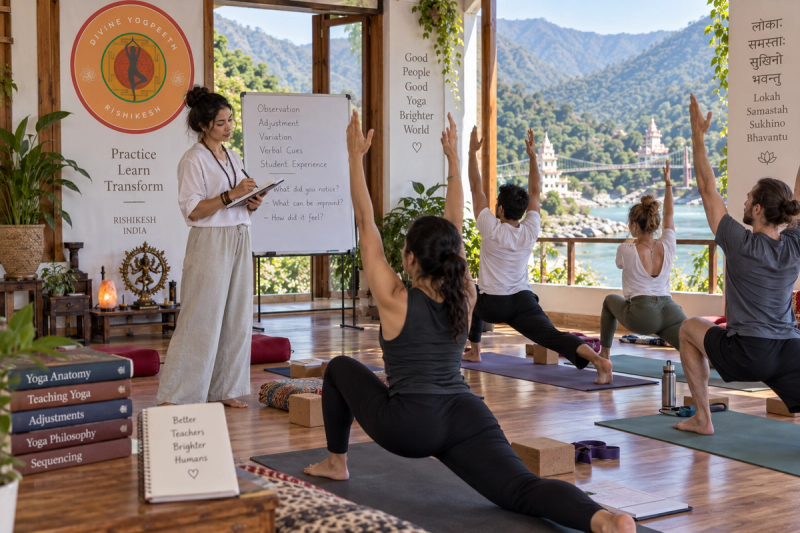
A plan is useful only if you are willing to change it.
Imagine that you planned a strong standing sequence, but several students arrive with limited mobility or are clearly fatigued. Following your sheet exactly may satisfy your plan while failing the people you are responsible for teaching.
Before class, prepare a simple decision tree:
If the group is less experienced than expected:
Slow down, demonstrate more, and reduce complexity.
If the group is more experienced:
Offer optional variations rather than making the entire class harder.
If time is running short:
Remove a repeated transition or accessory posture, not the final rest.
If students look confused:
Stop adding information and clarify the current action.
If a posture is not working:
Return to the preparation that came before it or choose a simpler variation.
You should also avoid turning every class into a performance. Students do not need a new peak pose every week. Repeating a sequence can be valuable when repetition helps them notice alignment, breath, balance, or concentration more clearly.
Good teaching is responsive. Your plan is the map; the room tells you whether you need to take another route.
Soft CTA: Build Your Teaching Skills in Rishikesh
If you want to move from planning practice sessions to confidently teaching real students, we offer structured yoga teacher training in Rishikesh through our 100-Hour Yoga Teacher Training course, where you can develop practical teaching skills alongside your yoga studies.
For shorter immersion before committing to a longer course, a focused 3-day yoga retreat in Rishikesh can also give you time to experience the practice environment and reflect on what kind of learning suits you.
FAQs
How long should a yoga class plan be for a new teacher?
Keep your written plan simple enough to scan while teaching. For a 60-minute class, one page is often enough. Record the sequence, timing, major transitions, key cues, and modifications rather than writing a complete speech.
Should a new yoga teacher memorize the whole class?
No. Memorizing every sentence can make you less responsive. Learn the sequence and intention well enough that you can teach without constantly looking at notes, but keep a small timing and cue sheet nearby until planning becomes second nature.
How many poses should you include in a yoga class?
There is no correct number. A beginner class may use fewer postures with more explanation, while a Vinyasa class may move through more shapes. Quality of progression matters more than the number of poses.
What should you do if you finish the sequence early?
Do not invent complicated poses just to fill time. Slow down, repeat a useful movement with better awareness, extend a gentle cool-down, or allow more time for Savasana. Leaving students rushed at the end is usually worse than having a calm, slightly longer closing.
Can you use the same yoga class plan more than once?
Yes. Reusing a plan is sensible if you evaluate it and adapt it to the group. Repetition can improve your teaching because you can focus less on remembering the order and more on observing students and refining your cues.
Conclusion + Strong CTA
A reliable yoga class plan template for a new teacher should make your teaching clearer, safer, and more adaptable—not more rigid. Start with one intention, build a logical progression toward it, plan transitions and modifications, keep your cues practical, and review the class afterward.
As your teaching develops, you will need less detail on the page because your sequencing decisions become easier to make in real time. That is the goal: not to depend on a perfect script, but to understand why each part of your class belongs there.
If you are ready to develop those skills through structured study, explore our 200-Hour Yoga Teacher Training in Rishikesh and take the next step toward teaching with greater clarity and confidence.