.jpg)

Yoga teacher training group dynamics shape learning and teaching skills. Discover ways to build trust, handle conflict, and thrive in Rishikesh. Learn more.
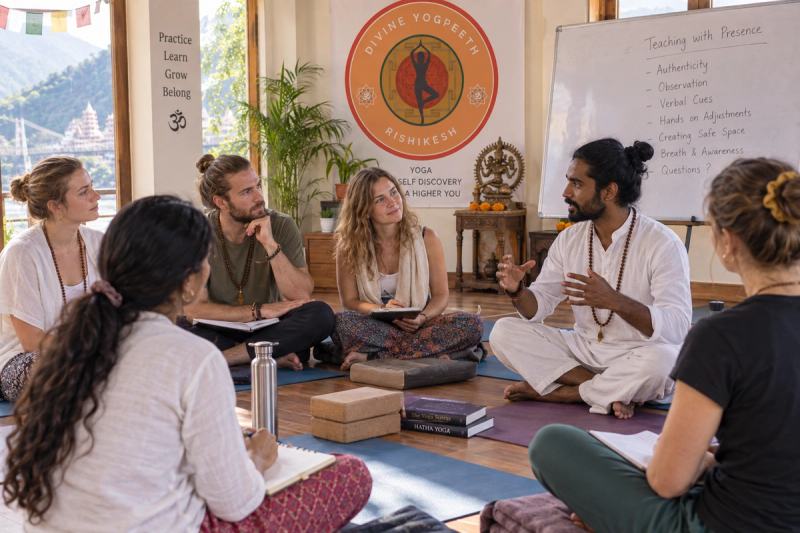
Group Dynamics in Yoga Teacher Training: How to Thrive in Community
Group dynamics in yoga teacher training can shape your experience just as much as the syllabus, teachers, or daily practice. What happens when you share a room with twenty people from different countries, backgrounds, personalities, and levels of experience?
You may arrive expecting to learn asana, anatomy, teaching skills, and philosophy. Yet the people around you can become an equally important part of your education. You learn how to communicate, listen without judging, receive feedback, handle differences, and support someone who is struggling. Those skills matter when you eventually guide your own students.
A strong YTT community does not mean everyone becomes close friends. Healthy group dynamics give you enough trust to participate honestly while leaving room for boundaries, individuality, and disagreement. This guide explains how to build that balance, what common group challenges look like, and how your community can deepen your learning in Rishikesh.
Yoga Teacher Training Group Dynamics: What Community Really Teaches You
A yoga teacher training group is a small social ecosystem. You practice together, eat together, study together, and often spend long days in the same learning environment. That intensity can reveal habits that are easy to miss in ordinary yoga classes.
You might notice that you speak quickly when nervous, avoid asking questions, become defensive when corrected, or compare your practice with someone else's. None of these reactions makes you a bad practitioner. They simply give you useful information about how you relate to people.
Community also teaches skills that are difficult to learn from a textbook:
- Listening to different interpretations of yoga philosophy
- Giving and receiving constructive feedback
- Speaking clearly during group discussions
- Respecting cultural and personal differences
- Sharing space without dominating it
- Asking for help before frustration builds
- Offering support without trying to fix everyone
If your course follows a recognized teacher-training framework, it is also useful to understand what certification means and what it does not guarantee. You can explore the standards and credentialing information provided by Yoga Alliance while remembering that the quality of a school depends on its teachers, curriculum, teaching practice, student support, and learning environment—not a label alone.
The biggest lesson is simple: community is not a distraction from training. It is part of the training. Every conversation, partner exercise, teaching practice, and disagreement can become an opportunity to develop the interpersonal awareness a responsible yoga teacher needs.
Building Healthy YTT Community and Group Dynamics
Healthy community rarely appears automatically. It is built through small behaviors repeated every day.
Start by learning names and making room for people who seem quieter. You do not need to become socially outgoing. A simple greeting, a genuine question after class, or an invitation to join a study session can make a new student feel less isolated.
At the same time, avoid turning friendliness into pressure. Some students need silence before morning practice. Others may be processing homesickness, language barriers, or a demanding physical schedule. Respecting that space is part of practicing ahimsa in a practical, everyday way.
Practice curiosity before judgment
You may encounter a classmate whose approach to yoga feels completely different from yours. Perhaps they are highly devotional while you are more analytical. Perhaps they ask many questions while you prefer to observe.
Instead of deciding that one style is superior, ask what you can learn from the difference. Curiosity keeps disagreement from becoming personal.
Create a culture of useful feedback
Feedback works best when it is specific and connected to an observable action. “Your teaching was bad” creates defensiveness. “Your instructions became difficult to follow when you changed poses quickly” gives you something you can actually improve.
When receiving feedback, pause before defending yourself. You can ask, “Can you give me an example?” or “What would make that clearer?” You do not have to accept every opinion, but you can examine it honestly.
A healthy group also knows how to disagree without humiliating anyone. If tension appears, address the behavior rather than attacking the person's character. That distinction protects trust.
Common Challenges in Yoga Teacher Training Group Dynamics
Even a respectful group will have difficult moments. Intensive training can expose differences in expectations, communication styles, energy levels, and personal boundaries.
One common challenge is comparison. You may see another student demonstrate a deep posture, deliver a confident teaching practice, or memorize Sanskrit terminology quickly. It is tempting to treat their progress as evidence that you are falling behind.
That comparison is usually unhelpful. A YTT is not a competition for the most flexible body or the most impressive demonstration. Your goal is to become more capable of practicing and teaching with awareness, clarity, and responsibility.
Another challenge is uneven participation. One person may dominate discussions while another rarely speaks. If you notice yourself taking too much space, practice stepping back. If you are consistently silent, challenge yourself to contribute at least one thoughtful observation or question.
When personalities clash
You may simply not like everyone in your group. That is normal.
You do not need to manufacture friendship. Aim for respect, reliability, and workable communication. Keep conversations focused on the shared learning environment when necessary.
If someone's behavior repeatedly disrupts your learning—such as disrespectful comments, boundary violations, or persistent hostility—do not assume you must solve it alone. Speak with an appropriate teacher or course coordinator and describe specific incidents calmly.
Cultural differences and communication
International groups can be especially valuable because you encounter different assumptions about personal space, eye contact, punctuality, discussion, touch, and communication.
Avoid treating one cultural habit as the universal standard. Ask questions when something is unclear, and explain your own preferences without assuming bad intentions.
For international students, basic cultural awareness can make the adjustment to Rishikesh smoother. You can also prepare more deliberately by learning about practical considerations before joining a retreat or training program.
How to Thrive in a Yoga Training Community Without Losing Yourself
Community does not require you to surrender your boundaries. In fact, healthy boundaries make community stronger.
You may need time alone after a long practice, prefer not to discuss personal matters, or want to maintain a particular sleep routine. You can communicate these needs respectfully.
Try using direct, low-drama language: “I need some quiet time this evening,” “I'd rather not discuss that,” or “Please ask before adjusting me physically.” Clear boundaries reduce guesswork and prevent resentment.
Your daily routine can also protect your ability to participate well. Sleep, hydration, food, recovery, and realistic expectations matter. When you are exhausted, even a minor disagreement can feel much bigger than it is.
Another useful habit is choosing your social circle consciously. Connect with people who encourage learning rather than constant comparison. Study together, practice teaching together, explore Rishikesh together, and still allow each other independent time.
If your training includes philosophy, use it as a practical lens rather than just an exam topic. Ideas such as ahimsa, svadhyaya, and aparigraha can help you examine how you communicate, how you react to criticism, and how tightly you hold onto being right. For broader context on yoga and its philosophical tradition, a balanced reference such as Britannica can provide useful background.
Why Rishikesh Makes Community Especially Meaningful
Rishikesh brings together students who may have travelled thousands of kilometres to study yoga. That creates an unusual mix of backgrounds and expectations.
You might practice beside someone visiting India for the first time, an Indian practitioner deepening an existing practice, or a future teacher who has already studied in another country. The diversity can challenge assumptions you did not know you had.
The physical setting also changes the rhythm of learning. Time near the Ganga, early morning practice, shared meals, walks through Tapovan, and conversations after class can create natural opportunities to connect outside formal lessons.
But do not romanticize the experience. Rishikesh does not automatically make every group harmonious. Travel fatigue, cultural adjustment, different dietary habits, weather, intensive schedules, and close living arrangements can create friction.
That is precisely why group skills matter. You learn to stay grounded when conditions are imperfect.
If you are comparing training options, look beyond photographs and course-hour totals. Consider teaching practice, class size, daily schedule, student support, accommodation arrangements, philosophy and anatomy teaching, and how the school handles questions or concerns.
A structured course such as a 200-hour yoga teacher training program in Rishikesh can give you an environment where these community skills develop alongside the technical foundations of teaching.
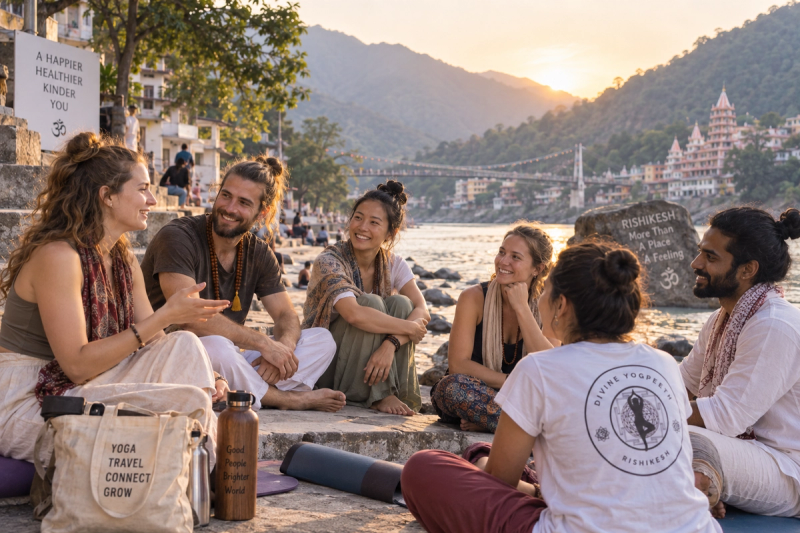
A Supportive Place to Develop as a Teacher
The right training environment should challenge you without making you feel that you have to perform a personality to belong. You should be able to ask basic questions, make mistakes during teaching practice, and receive honest guidance.
If you are considering training in Rishikesh, Divine Yogpeeth's yoga school in Laxman Jhula, Rishikesh offers teacher training where learning, practice, and community are part of the overall experience.
You can also explore the 100-hour yoga teacher training option if you want a shorter training format before committing to a longer program.
For a broader understanding of what daily student life can feel like, see our student life and weekly schedule during 200-hour YTT. And if your long-term goal is certification and teaching, our guide to becoming a certified yoga teacher in India can help you think through the bigger path.
Small Habits That Strengthen the YTT Community
You can improve a group without becoming its unofficial leader. The most useful contributions are often small and consistent.
Arrive on time, keep shared spaces reasonably clean, listen when someone else is teaching, and avoid side conversations during explanations. These habits sound ordinary, but they reduce friction in an intensive course.
During partner work, do not assume you know what another person needs. Ask before giving hands-on adjustments, demonstrations, or personal advice. If you are unsure whether feedback is welcome, ask first.
You can also become a better community member by noticing who gets overlooked. Invite a quieter classmate into a study conversation. If someone struggles with a concept you understand, explain it without making them feel behind. If you are the person struggling, accept help without turning it into a judgment about your ability.
Keep group conversations constructive. Constant complaining can spread quickly in a residential training environment, especially when everyone is tired. If you have a legitimate concern, take it to the right person and focus on what could improve rather than repeatedly discussing it with classmates.
Finally, protect the confidentiality of personal stories shared in the group. A classmate may disclose something vulnerable during a philosophy discussion, meditation exercise, or informal conversation. Treat that trust carefully.
These habits prepare you for real teaching. Your future students will have different personalities, beliefs, bodies, communication styles, and expectations. Learning to create a respectful room starts with learning how to participate respectfully in one.
FAQs About Yoga Teacher Training Group Dynamics
What if I do not connect with my YTT group?
You do not need to become close friends with everyone. Focus on respectful communication, participation, and maintaining healthy boundaries. Usually, a few meaningful connections are enough to make a group feel supportive.
How can I handle conflict with another student?
Speak privately and address the specific behavior rather than the person's character. Listen to their perspective, state what you need, and look for a practical solution. If the issue involves repeated disrespect or boundary problems, involve a teacher or coordinator.
Should I speak up during group discussions?
Yes, especially when you have a genuine question or useful observation. You do not need to speak constantly. A good balance is to contribute thoughtfully while also making room for other voices.
Can group dynamics affect my development as a yoga teacher?
Absolutely. Teaching yoga requires more than demonstrating postures. You need to communicate clearly, read a room, receive feedback, adapt to different students, and maintain appropriate boundaries. Group training gives you repeated opportunities to practice these skills.
What should I look for in a supportive yoga teacher training community?
Look for respectful teachers, clear expectations, opportunities for teaching practice, constructive feedback, manageable class sizes, transparent schedules, and a culture where students can raise concerns without being dismissed.
Conclusion: Let Community Become Part of Your Training
Yoga teacher training group dynamics can become one of the most valuable parts of your education when you approach community with curiosity, humility, and clear boundaries. You are not there to impress everyone or become friends with every classmate.
You are there to learn—and other people can help you learn how you listen, communicate, respond to feedback, handle disagreement, and teach with greater awareness.
If you are ready to develop those skills alongside a structured yoga curriculum, explore our 200-hour Yoga Teacher Training in Rishikesh and see whether the program fits your goals. Your strongest teacher-training experience may not be the one where everything feels easy; it may be the one where the community helps you become more thoughtful, capable, and grounded.