.jpg)

100 hour YTT part time yoga teaching career starts with the right training. Learn what you can teach, its limits, and when 200 hours make sense. Discover.
100 hour YTT part time yoga teaching career: Is 100-Hour YTT Enough to Start a Part-Time Yoga Teaching Career?
If you are wondering whether a 100 hour YTT part time yoga teaching career is realistic, the honest answer is: sometimes—but the certificate alone does not make you ready to teach every kind of class. A focused 100-hour course can give you a useful foundation, especially if you want to teach a few beginner sessions alongside another job, studies, or your own practice.
The bigger question is what you want to teach, where you want to teach, and how much responsibility you plan to take on. Your anatomy knowledge, sequencing skills, communication, ethics, supervised practice, and ability to stay within your scope all matter.
This guide breaks down what a 100-hour training can realistically prepare you for, where its limits are, when a 200-hour qualification makes more sense, and how you can build a part-time teaching path without rushing into responsibilities you are not trained for.
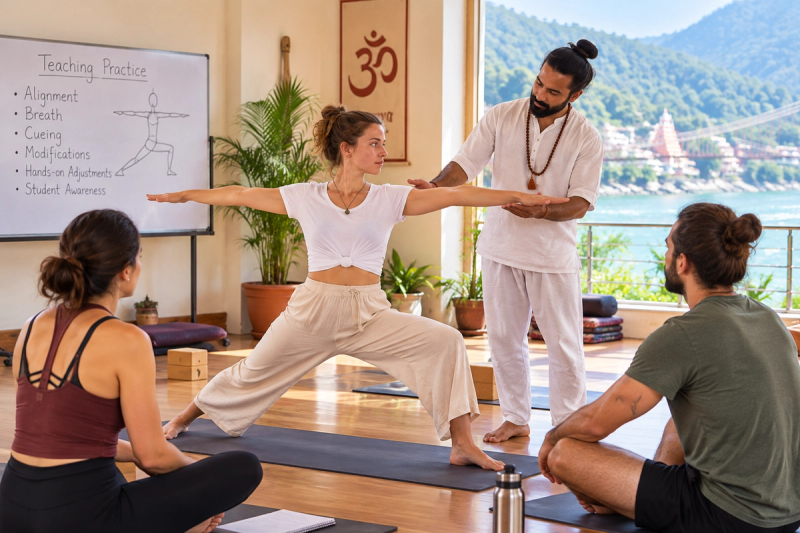
Can a 100-hour YTT start a part-time yoga teaching career?
A 100-hour YTT can be a practical starting point if your goal is modest and clearly defined. You may be able to begin with beginner-friendly group sessions, private introductory classes, community classes, or online sessions, depending on your training, local requirements, insurance, and the expectations of the studio or platform where you want to teach.
However, “100 hours” describes the amount of training, not a universal guarantee of professional scope. Different schools structure their 100-hour programs differently. One may emphasize asana, pranayama, meditation, and teaching practice, while another may focus heavily on philosophy or a particular style.
Before enrolling, check exactly what your course covers. You want meaningful practice in:
- Teaching methodology and class sequencing
- Alignment, modifications, and safe use of props
- Basic anatomy and movement awareness
- Pranayama and meditation instruction
- Communication, demonstration, observation, and feedback
- Yoga philosophy and professional ethics
- Practice teaching under supervision
You can review the role and standards of Yoga Alliance before making assumptions about what a specific credential permits you to call yourself or teach.
A sensible way to think about a 100-hour course is as focused teacher preparation, not a universal license. Your actual teaching opportunities will depend on your training content, experience, local rules, employer requirements, and the type of students you serve.
100 hour YTT part-time teaching: what can you realistically teach?
If you want a 100 hour YTT part time yoga teaching career, start with the simplest environment that matches your preparation. Your first classes should give you room to observe students, communicate clearly, adjust your pacing, and learn from feedback.
Beginner classes are often the logical starting point
A beginner class may involve basic standing postures, simple transitions, accessible seated work, breath awareness, relaxation, and a clear warm-up and cool-down. You can keep the sequence predictable and offer options rather than trying to impress students with advanced shapes.
Your teaching should not depend on being able to perform difficult poses yourself. A good beginner teacher needs to notice when a student is struggling, explain an alternative, and maintain a coherent class rhythm.
Private and online teaching require extra responsibility
Private sessions can look attractive because you can tailor the class to one person. The trade-off is that students may expect more personalization. If someone arrives with an injury, pregnancy, significant medical condition, or complex movement limitation, you need to know when your training is insufficient and when referral to an appropriate healthcare professional is necessary.
Online teaching adds another limitation: you cannot observe the student's body as closely as you can in person. Clear verbal instructions, conservative sequencing, and reminders for students to stop if something feels wrong become even more important.
If online teaching interests you, you can also explore practical guidance on teaching online yoga classes after certification.
What should you learn before teaching your first paid class?
A certificate is useful, but your ability to teach comes from repeated practice. Before accepting money from students, you should be able to plan a class from beginning to end without relying on a script for every sentence.
Your preparation should cover four areas.
1. Sequencing
You should understand why one posture follows another. A basic class might progress from centering and breath awareness to warm-up movements, standing postures, a main sequence, gentle floor work, and final relaxation.
You do not need a complicated sequence. You need one that has a clear purpose, manageable transitions, and realistic timing.
2. Observation and modification
Learn to offer variations without making students feel that a modification is a failure. A block, chair, bent knee, smaller range of motion, or slower transition can make a practice more accessible.
Your teaching should also leave room for individual differences. Two people can receive the same instruction and need completely different options.
3. Communication
Give one instruction at a time when the movement is unfamiliar. Avoid excessive technical language unless you explain it. Demonstrate when useful, but do not spend the entire class facing away from your students.
You should also learn to ask useful questions after class: What felt clear? Where did you feel confused? Was the pace manageable? Those answers can improve your next session.
4. Ethics and boundaries
Part-time teaching is still professional teaching. Respect privacy, avoid making medical claims, maintain appropriate teacher-student boundaries, and be honest about your qualifications.
You can deepen this area with yoga teacher ethics training for a 100-hour course, especially if you are moving from being a practitioner into a teaching role.
For an India-based learning path, you may also review the Ministry of AYUSH at AYUSH for government information related to yoga and traditional systems. This is useful context, but it should not be treated as a substitute for checking the specific legal or professional requirements that apply to your teaching situation.
When is a 200-hour YTT the better choice?
A 100-hour course may suit a narrow goal, but a 200-hour YTT becomes more relevant when you want a broader teaching foundation or plan to build a serious teaching career.
Think about the difference in terms of depth rather than simply certificate size. More training time can give you more opportunities to practice teaching, study anatomy and philosophy, receive feedback, refine sequencing, and work through different class styles.
A 200-hour program may be worth considering if you want to:
- Teach more regularly at studios or wellness centers
- Develop a broader class repertoire
- Work with mixed-level groups
- Build a long-term yoga teaching profession
- Strengthen your confidence through more supervised practice
- Continue toward additional specialist training later
That does not mean every 200-hour graduate is automatically a better teacher than every 100-hour graduate. Teaching quality depends on the training itself, your practice, preparation, communication, and continued learning.
If your target is a more comprehensive foundation, compare the curriculum and teaching approach of a 200-hour Yoga Teacher Training in Rishikesh with the shorter course you are considering.
Why Rishikesh matters for a part-time teaching path
Rishikesh can be valuable because you are surrounded by a large yoga-learning ecosystem rather than studying yoga only through isolated online lessons. You can encounter different teaching styles, expectations, and approaches to practice.
For a new teacher, the environment can also provide useful exposure to real classes. You can observe how experienced teachers structure a session, communicate with mixed-level students, manage time, and create a focused classroom.
But do not confuse being in Rishikesh with being qualified to teach everything. The location cannot replace curriculum, supervised practice, anatomy knowledge, or professional judgment.
Your advantage comes from using the environment deliberately. Attend classes as a student. Take notes on sequencing. Notice how teachers explain modifications. Practice teaching classmates. Ask for specific feedback rather than general praise.
You can also explore the wider learning environment through Tapovan Rishikesh yoga practices and experiences, particularly if you plan to combine training with time in the local yoga community. If you want a shorter immersion before committing to teacher training, the 5-day yoga retreat in Rishikesh can help you experience the environment first. You can also learn more about the school and training environment on the Divine Yogpeeth home page.

A realistic roadmap from 100-hour YTT to part-time yoga teaching
If your goal is to start slowly, you do not need to turn your life upside down after receiving your certificate. A staged approach can help you build competence before increasing your workload.
Stage 1: Build your foundation.
Complete the training seriously. Practice the techniques yourself and understand the reasoning behind the sequence, not just the names of poses.
Stage 2: Teach practice classes.
Start with friends, classmates, or peers when appropriate. Ask for honest feedback about your instructions, pacing, clarity, and confidence.
Stage 3: Create two or three repeatable class plans.
For example, prepare a 45-minute beginner class, a gentle mobility-focused class, and a basic relaxation-oriented session. Keep your plans simple enough to teach naturally.
Stage 4: Start with a small schedule.
One or two classes a week can be enough initially. This lets you learn how preparation time, travel, communication, cancellations, and student expectations affect your actual workload.
Stage 5: Review every class.
Write down what worked, what confused students, where you rushed, and which transitions felt awkward. Then revise the plan.
Stage 6: Expand only when your skills justify it.
Once you are comfortable with beginner teaching, you can consider additional styles or specialist training. Do not add advanced populations or therapeutic claims simply because students ask for them.
This process can turn a certificate into actual teaching competence.
How to choose a 100-hour YTT for career use
Not all 100-hour programs will give you the same preparation. If your purpose is teaching rather than simply collecting a certificate, compare the curriculum before comparing photographs, accommodation, or marketing claims.
Ask these questions before enrolling:
- How many hours are devoted to actual teaching methodology?
- How much supervised teaching practice is included?
- Does the course cover anatomy and safe modifications?
- Are sequencing and class planning taught practically?
- Do students receive individual feedback?
- How are ethics and professional boundaries addressed?
- What styles of yoga are included?
- What does the certificate actually represent?
- Is the program suitable for your intended teaching environment?
- What support, if any, is available after the course?
Also look carefully at the schedule. A course can contain 100 instructional hours but still feel very different depending on how those hours are distributed.
If your aim is to teach part-time, prioritize practical teaching exposure over impressive-sounding extras. A course that gives you repeated opportunities to stand in front of students, teach a sequence, receive feedback, and try again can be far more relevant to your goal than a curriculum packed with topics you never practice.
A practical part-time yoga teaching career plan
Once you have the right training, treat your first months as a learning period rather than an immediate business launch.
Start by choosing a clear audience. Beginner adults are easier to plan for than “everyone.” Decide whether you want to teach in person, online, privately, through a studio, or through a community group.
Then define a simple offer. For example, you might teach a 45-minute beginner class once a week. Keep the description accurate and avoid promising medical or therapeutic outcomes beyond your training.
Your pricing should also account for more than teaching time. Preparation, travel, venue costs, platform fees, payment processing, cancellations, and follow-up communication can all affect what you actually earn.
Keep records of your classes and feedback. Over time, you will see which formats you can teach confidently and which areas need more education.
If you discover that you enjoy teaching and want to increase your professional options, that is the point to evaluate further training. A 200-hour program or a specialist course may make more sense than immediately adding more classes.
Soft CTA: Start your training in Rishikesh
If you are considering a focused teacher-training foundation in Rishikesh, our 100-hour Yoga Teacher Training program is designed for practitioners who want structured learning without automatically committing to a longer 200-hour program.
FAQs
Is a 100-hour YTT enough to teach yoga professionally?
It can be enough for some limited teaching roles, but there is no universal answer. Your opportunities depend on the course curriculum, your competence, local requirements, the employer or platform, and the type of students you teach. For a broader professional foundation, additional training may be appropriate.
Can you teach yoga part-time after a 100-hour YTT?
Yes, part-time teaching can be a realistic goal when your training includes teaching practice and you begin with classes appropriate to your preparation. Start conservatively, gather feedback, and expand your responsibilities as your competence grows.
Is a 100-hour YTT better than a weekend workshop for teaching?
They serve different purposes. A 100-hour program normally provides substantially more time for structured study and practice, while a weekend workshop is usually much shorter and more focused. If teaching is your goal, compare actual curriculum and supervised practice rather than judging only by the title.
For a deeper comparison, see 100-hour YTT versus a weekend yoga workshop.
Should you choose a 200-hour YTT instead?
If you already know that you want to build a long-term teaching career, a 200-hour program may fit your goal better because it allows more time for broad foundational study and teaching practice. If you only want to teach a small number of beginner classes alongside another commitment, a well-designed 100-hour course may be a more proportionate starting point.
What should you do after a 100-hour YTT?
Practice teaching, collect feedback, refine your class plans, keep studying, and stay within your scope. You can then decide whether to continue with more teaching experience, a 200-hour qualification, or specialist education based on the students and settings you want to serve.
Conclusion: Is a 100 hour YTT enough for your part-time teaching goal?
A 100 hour YTT part time yoga teaching career can be realistic when you define the goal carefully. The certificate is a starting point, not proof that you are prepared for every student, style, or teaching situation.
If you want to teach a few beginner-friendly classes alongside work or studies, a well-structured 100-hour course can provide a useful foundation. Your next step should be supervised practice, honest feedback, careful class planning, and continued learning.
If you already know that teaching will become a serious long-term career, consider whether a broader 200-hour pathway better matches your ambitions.
Ready to begin? Explore our 100-hour Yoga Teacher Training in Rishikesh and take the next step toward developing practical teaching skills in a dedicated yoga environment.