.jpg)

100 hour YTT vs weekend workshop comparison: see the real differences in depth, cost, practice, and outcomes before choosing your yoga path. Discover.
100 hour YTT vs weekend workshop comparison: Which Fits Your Goals?
A 100 hour YTT vs weekend workshop comparison can change how you spend your money, time, and energy on yoga education. If you have ever wondered whether one intensive weekend is enough or whether you need a structured teacher-training program, the real answer depends on what you want to be able to do afterward.
A weekend workshop can give you a focused introduction to one subject, a new technique, or a short reset from your normal routine. A 100-hour training asks for something different: sustained study, practice, reflection, and usually a broader foundation.
The important part is not choosing the option that sounds more impressive. You need to match the depth of the program with your goal. In this comparison, you will look at training hours, curriculum depth, teaching practice, cost and time commitment, learning outcomes, and the Rishikesh factor. You will also see when a weekend workshop makes more sense and when a 100-hour program is the more practical investment.
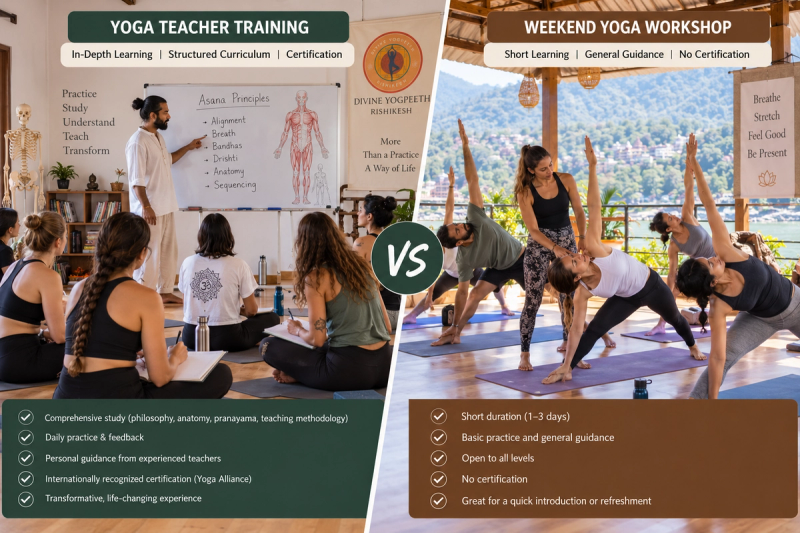
100 hour YTT vs weekend workshop: the biggest difference is depth
The clearest difference is simple: a weekend workshop is usually designed around a narrow topic, while a 100-hour YTT is designed as a more sustained educational experience.
A weekend program might run for one or two days and concentrate on areas such as Yin yoga, sequencing, meditation, anatomy, pranayama, sound, or a particular movement method. You can learn useful material quickly, but the format naturally limits how much repetition and supervised practice you can fit in.
A 100-hour YTT gives you substantially more contact time. That does not automatically make every 100-hour course better than every workshop. Curriculum quality still matters. However, more structured hours create room for concepts to be introduced, practiced, corrected, revisited, and connected.
For example, if you are learning basic sequencing during a weekend, you may understand the principles and create a short sequence. In a longer training, you can build several sequences, teach portions of them, receive feedback, and refine your choices.
You should also check what the certificate actually represents. A course certificate and a Yoga Alliance credential are not interchangeable terms. If a program makes claims about Yoga Alliance registration or standards, verify the current information directly through Yoga Alliance rather than relying only on a brochure.
A useful rule is this: choose a workshop when you want targeted learning; consider a longer YTT when you want a structured foundation that you can continue developing after the course ends.
What you actually learn in a 100-hour YTT compared with a weekend course
The curriculum is where the difference becomes practical. You are not simply buying hours; you are buying the amount of guided learning those hours can support.
A focused weekend workshop often has one central outcome. You might leave knowing how to use a particular meditation method, understand a specific anatomy concept, or practice a new style of yoga. That focused approach can be excellent when you already have a foundation and want to deepen one area.
A 100-hour YTT can spread your learning across several connected areas. Depending on the school and curriculum, you may encounter asana practice, pranayama, meditation, anatomy, yoga philosophy, teaching methodology, sequencing, adjustments, communication, and basic professional considerations.
The advantage is integration. You start seeing how a breathing technique can affect a class, how anatomy can influence alignment cues, or how philosophy can shape the way you teach rather than remaining an isolated theory topic.
Practice and feedback matter more than a certificate
One of the biggest differences is what happens between instruction and understanding. You can read about teaching yoga for hours and still feel uncertain when another person is actually in front of you.
A longer training gives you more opportunities to practice explaining poses, demonstrating techniques, observing students, managing transitions, and responding to common questions. Feedback is particularly valuable because you may not notice your own unclear instructions or rushed pacing.
That does not mean every 100-hour YTT provides extensive teaching practice. You should ask before enrolling: How many supervised teaching sessions are included? Is feedback individual? Are lesson plans assessed? What does a typical training day look like?
For broader background on what a yoga teaching pathway can involve, you can also explore our guide to becoming a certified yoga teacher in India.
If you are especially interested in Vinyasa, a focused guide to Vinyasa fundamentals in a 100-hour YTT can help you see why repeated practice matters when you move from understanding a sequence to teaching it.
A weekend workshop can still include hands-on practice, and a good one should. The difference is that the limited schedule makes it harder to build a repeated feedback loop.
100 hour YTT vs weekend workshop: time, cost, and commitment
The cheaper option is not automatically the better value. You need to compare what you are trying to achieve with what each format can realistically deliver.
A weekend workshop normally requires less leave from work, less travel planning, and less accommodation. If you live near the venue, your total expense may be relatively modest. It can be a sensible way to test a subject before committing to a longer program.
A 100-hour YTT usually requires a larger block of time and a bigger overall budget. If you travel to Rishikesh, your real cost includes more than tuition: transport, accommodation, food, insurance, and the opportunity cost of taking time away from work or other responsibilities.
But a longer course may offer better value if your goal is substantial skill development. You are paying for repeated instruction and practice rather than only an introduction.
Before comparing prices, write down your intended outcome. If your goal is simply to experience a new style, paying for a 100-hour program may be unnecessary. If your goal is to build a foundation for teaching, choosing a short workshop solely because it costs less can become false economy.
Also compare what is included. Ask whether course materials, assessments, practical teaching, accommodation, meals, or additional sessions are included. Two programs with similar headline prices can have very different total costs.
Your decision becomes clearer when you compare total commitment rather than tuition alone.
Which option is better for your yoga goals?
Your personal goal should drive the decision more than the course label.
A weekend workshop may be the better choice if you:
- Want to explore a specialized topic before making a larger commitment.
- Have limited time because of work, university, family, or travel.
- Already have strong yoga experience and want focused continuing education.
- Want a short learning experience rather than teacher-training preparation.
- Prefer testing a school or teaching style before enrolling in a longer program.
A 100-hour YTT may make more sense if you:
- Want a broader foundation in yoga practice and teaching.
- Expect to teach beginners or support small groups after further preparation.
- Learn better through repetition, supervised practice, and feedback.
- Want dedicated time away from daily distractions to study.
- Are considering a longer teacher-training pathway and want a substantial starting point.
You should also be realistic about what 100 hours means. Completing 100 hours does not magically make you an expert teacher. Teaching skill develops through continued practice, observation, study, and experience. A 100-hour program can provide a foundation; it cannot replace years of learning.
If you already know that you want a full foundational teacher-training pathway, compare the curriculum of a 200-Hour Yoga Teacher Training in Rishikesh as well. A longer program may be more appropriate if your end goal requires broader preparation than a 100-hour format offers.
For a useful example of how structured practice can extend beyond physical postures, you can also read about yoga philosophy and its role in modern practice.
Why Rishikesh matters when you choose a longer training
Location does not guarantee teaching quality, but it can influence your learning environment. Rishikesh is especially relevant if you want your training to happen in a place where yoga is a visible part of everyday life.
In Rishikesh, your study is not limited to the classroom. You can experience early-morning practice, time near the Ganga, walks through Tapovan and Laxman Jhula, and the rhythm of a city where many visitors arrive specifically for yoga and spiritual study.
That environment can make a longer course feel more immersive. It also gives you opportunities to notice how different teachers approach asana, meditation, philosophy, and discipline.
At the same time, do not romanticize the location. Rishikesh can be busy, hot, noisy, crowded, and highly commercial in popular areas. The right school matters more than the postcard image. You should investigate the daily schedule, class size, accommodation, teacher experience, curriculum, assessment method, and what support is available when you struggle with a concept.
If you are travelling internationally, practical preparation matters too. Review visa requirements, travel insurance, local conditions, accommodation details, and the school's attendance expectations before paying.
If you are comparing a training course with a retreat, remember that the objectives are different. A 5-day yoga retreat in Rishikesh may be a better fit when your priority is rest, practice, and immersion without the academic commitment of teacher training.
A practical way to choose your next step
If you are still undecided, stop comparing course names and compare outcomes.
Ask yourself five questions:
- What do you want to be able to do after the program?
- How much uninterrupted time can you realistically give to study?
- Do you need a broad foundation or one specialized skill?
- How much supervised practice and feedback does the program provide?
- Will the certificate or training structure support your next planned step?
Then look at the curriculum line by line. A serious comparison should cover teaching methodology, anatomy, philosophy, practical sessions, assessment, daily schedule, and instructor involvement rather than focusing only on photographs, accommodation, or promotional language.
You should also ask what happens after the course. Can you continue studying? Is there an alumni network? Can you ask teachers questions later? Are there opportunities to practice teaching?
If your decision includes studying yoga in India, you can also consult the official Ministry of Ayush website for broader information about India's yoga and traditional wellness context.
For some practitioners, the best path is not either-or. You can attend a weekend workshop first, discover what genuinely interests you, and later choose a longer YTT. Alternatively, if you already know that teaching is your goal, starting with a structured 100-hour program may save you from collecting disconnected short certificates without building a coherent foundation.
If your interests are moving toward complementary practices, you might also compare yoga training with a focused sound healing training course in Rishikesh. That is a different educational route, so the question is whether it supports your actual goals rather than whether it sounds attractive.
Why Divine Yogpeeth can be a practical option in Rishikesh
If you are considering a longer program in Rishikesh, we offer a 100-hour Yoga Teacher Training program for learners who want more depth than a short workshop can realistically provide.
The best reason to choose a school, however, is not its marketing. Before you enroll, compare its curriculum, schedule, practical teaching components, instructor background, accommodation details, and student support with other programs you are considering.
You should feel clear about what you will study and what you will be expected to do each day. That clarity is more useful than a long list of promises.
FAQs
Is a 100-hour YTT better than a weekend yoga workshop?
Not automatically. A 100-hour YTT is generally better suited to structured, broader learning, while a weekend workshop can be better for a focused topic or a low-commitment introduction. Your goal should determine the format.
Can a weekend yoga workshop qualify you to teach yoga?
That depends on the workshop and the credential it provides, but you should not assume that attending a weekend workshop makes you ready to teach safely and confidently. Ask about curriculum, assessment, supervised teaching, and the recognition of the certificate.
Is 100 hours enough to become a yoga teacher?
It can provide a meaningful foundation, but hours alone do not determine teaching competence. You need practice, feedback, continued education, and real teaching experience. If you want a more comprehensive initial teacher-training route, compare the curriculum and requirements of longer programs too.
Should beginners choose a 100-hour YTT or a weekend workshop?
If you are completely new to yoga, a weekend workshop can be a useful way to test whether you enjoy structured study. However, if you already know you want serious foundational education, a well-designed 100-hour program can give you more time to build understanding and practice.
Can you combine a YTT with a yoga retreat in Rishikesh?
Yes, but the experience is different. Teacher training has an educational workload, while a retreat usually emphasizes practice, rest, reflection, and immersion. Combining them can work if your schedule, budget, and energy allow enough recovery time.
Conclusion: choose the depth that matches your goal
A good 100 hour YTT vs weekend workshop comparison does not produce one universal winner. It helps you see what each format is designed to accomplish.
Choose a weekend workshop when you need focused learning, limited commitment, or a chance to explore a subject. Choose a 100-hour YTT when you want structured study, repeated practice, broader foundations, and time to develop skills under guidance.
If you already know that you want to take yoga education seriously, do not choose a program only because it is cheaper or shorter. Compare the curriculum, teaching practice, instructor involvement, assessment, schedule, and total cost.
Ready to take the next step in Rishikesh? Explore our 100-hour Yoga Teacher Training and compare it carefully with the alternatives before you enroll. The right course is the one that matches the teacher, practitioner, and learner you are trying to become.