
How to become sound healing practitioner India? Explore training, singing bowl techniques, certification, career opportunities and practical steps. Learn more.
How to Become Sound Healing Practitioner India: A Complete Guide to Training, Skills and Career Opportunities
Introduction
How to become sound healing practitioner India is a question worth exploring if you feel drawn to therapeutic sound, meditation, and holistic wellness. But becoming a practitioner involves more than purchasing a Tibetan singing bowl and learning to strike it.
You need to understand sound instruments, develop practical skills, learn how to conduct sessions, and recognise the responsibilities involved when working with other people.
India offers several opportunities to explore this field, particularly in traditional wellness destinations such as Rishikesh. Here, you can experience Himalayan singing bowls, mantra chanting, meditation, and other sound-based practices in an environment connected with yoga and spiritual learning.
Whether you are a yoga teacher, wellness enthusiast, meditation practitioner, or someone considering a career change, this guide explains the practical steps involved.
You will discover which instruments to learn, what a quality training programme should include, how certification works, what career opportunities exist, and how to choose suitable training in India.
1. How to Become a Sound Healing Practitioner in India: Understanding the Profession
Before enrolling in a course, understand what a sound healing practitioner actually does.
A sound healing practitioner facilitates experiences using instruments and sound-based techniques to support relaxation, meditation, mindfulness, and personal wellbeing.
Unlike a musician performing for an audience, your responsibility is to create a comfortable environment in which participants can experience sound without feeling pressured to respond in a particular way.
Common instruments include:
- Tibetan singing bowls
- Crystal singing bowls
- Gong
- Tuning forks
- Koshi chimes
- Bells and other resonant instruments
- Voice and traditional mantra chanting
Each instrument produces a different combination of tones, vibrations, and resonance.
For example, singing bowls produce layered tones that can become a focal point during meditation. Gongs create broad sound textures, while tuning forks are commonly used for more targeted sound applications.
Is sound healing a recognised medical profession?
This distinction is important.
Sound healing is generally considered a complementary wellness practice, not a replacement for medical treatment or psychotherapy.
Although research has explored the effects of music and sound-based interventions on relaxation, stress, and wellbeing, the scientific evidence does not establish that singing bowls cure diseases, remove physical blockages, or reliably balance specific organs and chakras.
As a practitioner, you should communicate honestly about what your sessions offer.
Your work may support relaxation and meditative experiences, but you should never promise medical outcomes or advise participants to discontinue prescribed treatment.
For a broader understanding of traditional Indian wellness systems, you can explore the official Ministry of AYUSH website.
2. Sound Healing Practitioner Training in India: Which Instruments Should You Learn?
Your training should introduce you to the instruments you intend to use professionally.
You do not need to master every instrument immediately. Starting with a smaller collection and understanding its practical applications is usually more useful than purchasing expensive equipment without proper training.
Himalayan singing bowls
Singing bowls are among the most recognisable instruments used in sound meditation.
They produce resonant tones through striking or rubbing their rims with appropriate mallets.
During training, you should learn:
- Different techniques for striking and playing bowls.
- How to produce consistent, clear tones.
- How bowl size and construction affect sound.
- How to combine multiple bowls without creating overwhelming sound.
- How to position instruments safely around participants.
You should also learn that not every singing bowl produces the same sound. Two bowls of similar size may have noticeably different tonal characteristics.
Crystal singing bowls
Crystal bowls are commonly made from quartz and produce sustained, prominent tones.
They are frequently used in group sound baths and meditation sessions.
Their volume and resonance require careful handling, particularly when participants are resting nearby.
Gong and other sound instruments
Gong playing requires practice because intensity, striking technique, and timing can dramatically change the sound experience.
You can gradually expand your instrument knowledge to include:
- Gong techniques and sound layering.
- Tuning fork applications.
- Chimes and bells.
- Mantra-based sound practices.
- Voice-led relaxation exercises.
The objective is not to collect the largest number of instruments. It is to understand how to use each instrument appropriately.
A useful starting point is to become confident with singing bowls before expanding into more specialised techniques.
3. How to Choose a Sound Healing Certification Course in India
Choosing the right training programme can influence your practical ability and professional confidence.
However, you should not assume that every programme advertising a certificate offers the same quality of education.
Sound healing training in India varies considerably in duration, curriculum, teaching approach, and assessment.
What should a good course include?
Before paying your fees, examine the curriculum carefully.
A comprehensive beginner-level programme should ideally cover:
Training area
What you should learn
Sound fundamentals
Frequency, resonance, vibration and sound characteristics
Instrument knowledge
Types, selection and maintenance
Singing bowl techniques
Striking, rim playing and sound combinations
Gong practice
Basic playing techniques and sound control
Session planning
Structure, timing and transitions
Meditation
Guided relaxation and mindful listening
Practical experience
Conducting supervised practice sessions
Professional ethics
Consent, boundaries and participant safety
Practical sessions deserve particular attention.
A course that consists mainly of theoretical lectures may give you terminology without developing the confidence required to facilitate an actual session.
You should have opportunities to practise with different instruments, receive feedback, and understand how to respond when participants find certain sounds uncomfortable.
Does a sound healing certificate guarantee professional recognition?
No.
There is an important difference between receiving a training certificate and holding a government-recognised professional qualification.
Do not assume that a private sound healing certificate is equivalent to a medical licence, regulated healthcare qualification, or Yoga Alliance credential.
For yoga-related professional education, you can explore the official Yoga Alliance website. Its registration framework relates to yoga teachers and schools; it should not be confused with universal accreditation of sound healing practitioners.
Before enrolling, ask the provider:
- Who issues the certificate?
- hat are the course completion requirements?
- How many practical hours are included?
- Are supervised sessions part of the programme?
- Does the certificate describe the actual training completed?
- What support is available after graduation?
These questions help you evaluate the education rather than simply choosing the course with the most attractive certificate.
How long does sound healing training take?
There is no single standard duration.
Introductory workshops may last a few days, while more comprehensive programmes can involve several weeks of instruction and practice.
Your choice should depend on your previous experience, learning objectives, and the depth of practical training offered.
If you are completely new, prioritise a structured beginner programme instead of immediately enrolling in advanced training.
4. Practical Steps to Become a Professional Sound Healing Practitioner
Understanding instruments is only one part of the profession. You also need to develop the ability to facilitate sessions, communicate with participants, and manage a wellness environment responsibly.
Here is a practical progression you can follow.
Step 1: Develop a personal sound meditation practice
Start by experiencing sound meditation yourself.
Attend group sound baths, practise mindful listening, and become familiar with different instruments.
Notice how volume, rhythm, silence, and transitions influence your experience.
This personal practice helps you understand the participant's perspective rather than approaching every session purely as a technical exercise.
Step 2: Enroll in structured practitioner training
Find a programme that combines theoretical learning with supervised instrument practice.
Look for instructors who can demonstrate their techniques, explain the limitations of sound-based practices, and provide individual feedback.
Avoid choosing a programme exclusively because it promises a certificate within a very short period.
Step 3: Learn session facilitation
A practitioner must understand how to guide people through a complete session.
A basic group session may include:
- Welcoming participants and explaining what to expect.
- Asking about relevant sensitivities and accessibility requirements.
- Providing comfortable seating or resting arrangements.
- Beginning with gentle sounds and mindful breathing.
- Gradually introducing singing bowls or other instruments.
- Allowing periods of silence.
- Ending with a gradual return to normal awareness.
- Offering participants time to share feedback.
The ability to manage transitions and create a comfortable atmosphere is just as important as playing the instruments.
Step 4: Practise with different participants
After learning the fundamentals, practise under appropriate supervision.
Start with small groups of friends or fellow practitioners who understand that you are developing your skills.
Ask for specific feedback about sound intensity, session duration, comfort, and the overall experience.
Do not present yourself as an experienced professional immediately after completing a short introductory workshop.
Step 5: Develop your professional identity
Once you have sufficient training and practice, decide how you want to work.
You could specialise in:
- Group sound bath sessions.
- Individual sound meditation experiences.
- Singing bowl relaxation sessions.
- Yoga and sound meditation combinations.
- Retreat-based wellness programmes.
- Corporate relaxation workshops.
A clear specialisation makes it easier to communicate your services and identify the audience you want to serve.
Step 6: Build a portfolio and gain experience
Document your training, instruments, supervised practice, and participant feedback with appropriate permission.
Create a professional profile explaining your qualifications and the type of sessions you facilitate.
You can also collaborate with yoga studios, meditation centres, retreat organisers, and wellness professionals.
Your reputation will depend more on the quality and consistency of your sessions than on how many certificates you display.
5. Why Rishikesh Is a Popular Place to Learn Sound Healing
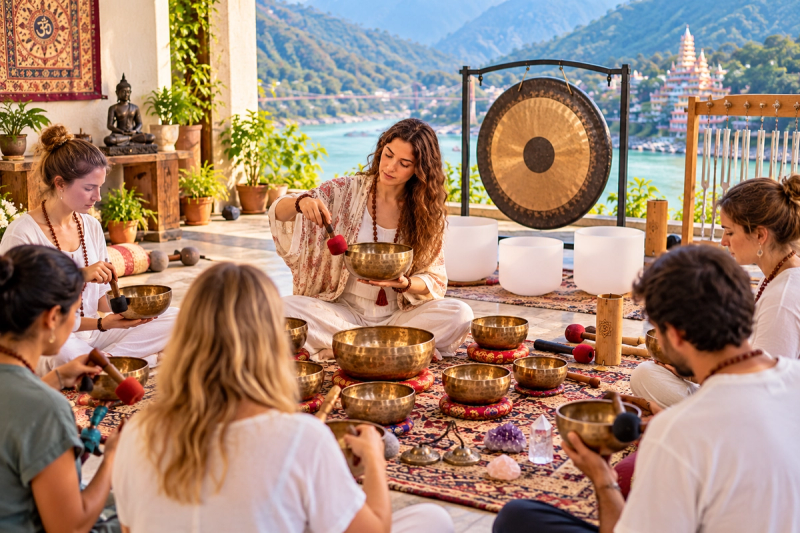
Rishikesh attracts yoga students, meditation practitioners, and wellness travellers from across the world.
Its connection with yoga education, Himalayan traditions, and spiritual practices makes it an interesting destination for learning sound-based relaxation techniques.
For someone planning to become a practitioner, the environment offers opportunities to experience different approaches to meditation and wellness.
Exposure to different wellness traditions
You can encounter singing bowl meditation, mantra chanting, pranayama, yoga, and other contemplative practices.
Experiencing these approaches together can help you understand how sound meditation may complement a broader wellness routine.
For example, a practitioner might begin a session with gentle breathing exercises and introduce singing bowls during the relaxation phase.
However, combining different practices requires appropriate training. More techniques do not automatically produce better results.
Learning in an international environment
Rishikesh receives visitors from different countries and cultural backgrounds.
This exposure can help you develop communication skills and understand how people with different expectations experience group meditation.
If you eventually plan to work with international wellness travellers, this can be valuable practical exposure.
You can also explore the local yoga environment through our guide to yoga practice in Tapovan, Rishikesh.
A setting that supports focused learning
The Ganga River and Himalayan surroundings provide an environment where you can step away from some everyday distractions.
A residential learning experience can also give you more opportunities to practise, interact with instructors, and experience meditation outside scheduled classes.
However, location alone does not guarantee educational quality. Always assess the instructor's experience, course curriculum, practical hours, and student feedback before making a decision.
6. Career Opportunities After Sound Healing Practitioner Training
Completing a training programme is the beginning of professional development, not a guarantee of employment.
The sound healing industry includes independent practitioners, yoga studios, retreat centres, wellness businesses, and complementary wellness services.
Your opportunities will depend on practical ability, professional networking, location, communication skills, and the demand for your services.
Work as an independent practitioner
You can start by offering individual or small-group sound meditation sessions.
This approach provides flexibility because you can decide your schedule, session format, and pricing.
However, you will also be responsible for finding clients, arranging instruments, managing bookings, and handling business expenses.
Collaborate with yoga studios and wellness centres
Yoga studios may offer sound baths as additional experiences alongside their regular classes.
You can approach established studios with a clear introduction, details of your training, and a proposal for a small demonstration session.
Developing relationships with existing wellness businesses may be easier than immediately renting your own space.
Work with retreat centres
Retreat organisers sometimes include sound meditation as part of their wellness schedules.
If you have suitable practical experience, you can approach retreat centres and yoga schools about collaborations.
Your ability to work with groups, follow schedules, and communicate professionally will matter.
Offer online sound meditation sessions
Online sessions can help you reach participants outside your immediate location.
However, there are limitations.
The sound quality of a remote session depends on microphones, speakers, internet connections, and the participant's equipment.
Therefore, online delivery should be designed differently from an in-person experience.
What is the earning potential?
There is no reliable universal salary for sound healing practitioners in India.
Income varies according to experience, city, client base, session format, and whether you work independently or for an organisation.
Consider the following income models rather than treating them as guaranteed earnings:
Professional model
Possible income source
Independent practitioner
Individual session fees
Group facilitator
Per-participant or group booking fees
Yoga studio collaborator
Fixed fee or revenue sharing
Retreat facilitator
Session-based or programme-based payment
Wellness entrepreneur
Multiple services and workshops
Initially, building a regular client base may take time. You should not depend on sound healing as your only income source immediately after completing training.
A sensible approach is to develop your practice alongside another professional skill or existing wellness career until demand becomes consistent.
7. Essential Skills and Safety Responsibilities of a Sound Healing Practitioner
Being a practitioner involves working with people who may have different physical, emotional, and sensory needs.
Your technical ability matters, but responsible facilitation is equally important.
Communication and active listening
You should be able to explain the session before it begins.
Participants need to understand what instruments will be used, how long the experience will last, and whether they can change their position or leave whenever they feel uncomfortable.
Never assume that everyone enjoys the same volume or type of sound.
Understanding sound sensitivity
Some participants may experience discomfort with loud or sudden sounds.
People with tinnitus, hyperacusis, migraine, sensory sensitivities, or certain medical conditions may need additional consideration.
Ask participants about relevant sensitivities beforehand. Offer a quieter position, reduced intensity, or the option to opt out.
Avoid placing instruments close to someone's ears or body without explicit consent.
Professional boundaries and ethics
A sound healing practitioner should never claim to diagnose or cure medical conditions.
Keep your sessions within the scope of your training.
You should also:
- Respect participant privacy.
- Obtain permission before physical contact.
- Avoid making guaranteed healing claims.
- Explain any limitations of your services.
- Maintain clean instruments and comfortable surroundings.
- Refer participants to qualified healthcare professionals when medical concerns arise.
Building knowledge beyond your certificate
Continue exploring sound, meditation, music, anatomy, and relaxation techniques.
You may also find it useful to understand the relationship between mantra chanting and meditation. Our article on the benefits and science of mantra chanting explores another important aspect of sound-based practices.
For further reading about sound-based relaxation, you can also explore our guide to gong bath meditation and its potential benefits.
8. How to Start Your Sound Healing Practice Without Overspending
You do not need to purchase an expensive collection of instruments before you begin.
In fact, spending heavily before understanding the fundamentals is one of the easiest mistakes a beginner can make.
Start with a realistic budget and expand your equipment as your practical experience grows.
Choose your first instruments carefully
A beginner may start with one or two good-quality singing bowls and suitable playing mallets.
When selecting bowls, pay attention to:
- Sound quality and resonance.
- Construction and overall condition.
- Comfort when handling the instrument.
- Availability of suitable accessories.
- Whether you can test the sound before purchasing.
Avoid buying instruments solely because a seller describes them as having special healing frequencies.
A high price does not automatically indicate superior quality or therapeutic effectiveness.
Practise in an affordable environment
You can initially practise in a quiet room at home.
A comfortable mat, basic seating arrangements, clean instruments, and a peaceful environment are sufficient for learning basic facilitation.
You do not need to rent a commercial studio before you have established demand.
If you want ideas for creating a suitable practice environment, explore our guide to setting up a sound healing space at home.
Develop a realistic business plan
Before investing in a professional setup, calculate your likely expenses.
Consider equipment, training, travel, accommodation, marketing, venue rental, and ongoing maintenance.
Start with small sessions and evaluate actual demand.
You should also research local competition and understand what potential clients expect from a professional wellness experience.
A sustainable practice develops through consistent service quality, transparent pricing, and genuine client relationships.
9. Begin Your Sound Healing Training in Rishikesh with Divine Yogpeeth
Choosing a suitable learning environment is an important decision when you are preparing to enter the sound healing field.
If you are considering training in Rishikesh, Divine Yogpeeth offers a dedicated Sound Healing Training Course in Rishikesh for those interested in learning sound-based wellness practices.
Our location in the Tapovan and Laxman Jhula area provides access to Rishikesh's wider yoga and meditation environment.
You can explore our main yoga and wellness programmes to understand the broader learning environment.
Before enrolling, review the specific sound healing curriculum, practical training hours, course duration, instructor details, certification arrangements, and current fees.
If you already have a yoga background, combining your knowledge of meditation and mindful movement with sound-based practices may also help you develop a more varied wellness offering.
The important thing is to choose training that develops your actual skills rather than focusing only on the certificate you receive.
10. Frequently Asked Questions About Becoming a Sound Healing Practitioner in India
How can I become a sound healing practitioner in India?
Start by learning the fundamentals of sound meditation and common instruments such as Himalayan singing bowls and gongs.
Enrol in a structured training programme with practical sessions, learn ethical facilitation, and gain supervised experience before offering professional sessions independently.
Do I need a yoga certification to learn sound healing?
No. A yoga certification is not generally a prerequisite for learning basic sound healing techniques.
However, previous experience with yoga, meditation, music, or wellness practices can provide useful background knowledge.
Check the eligibility requirements of your chosen training provider.
How much does sound healing training cost in India?
Course fees vary according to duration, instruments, practical hours, accommodation, and instructor experience.
Some programmes offer short introductory workshops, while more comprehensive training involves additional instruction and practice.
Always request a complete fee breakdown before paying.
Can I earn money after completing a sound healing course?
Yes, you can explore independent sessions, group sound baths, yoga studio collaborations, retreats, and online experiences.
However, completing a course does not guarantee clients or employment. Building a sustainable practice requires experience, networking, professional communication, and consistent service quality.
Can beginners learn sound healing in Rishikesh?
Yes. Beginners can explore introductory training programmes in Rishikesh.
You should select a course that starts with the fundamentals, provides sufficient instrument practice, and explains participant safety and professional boundaries.
Conclusion: Take Your First Step Towards Becoming a Sound Healing Practitioner in India
Learning how to become sound healing practitioner India requires more than an interest in singing bowls or meditation.
You need structured education, practical instrument skills, responsible session facilitation, and a realistic understanding of the professional opportunities available.
Start with the fundamentals. Practise consistently, understand your limitations, and build experience before presenting yourself as an established practitioner.
If Rishikesh is your preferred learning destination, Divine Yogpeeth invites you to explore our Sound Healing Training Course in Rishikesh.
Review the programme details, understand what your training includes, and take the next step towards developing your sound healing practice.
Your professional foundation should begin with knowledge, practice, and responsibility.