
Discover chanting Om benefits, effects and science, from relaxation and focused attention to mindful breathing. Explore the practice and its roots in Rishikesh. Learn more.
Chanting Om benefits effects science: Why This Simple Sound Has Such Profound Effects
Introduction: What Happens When You Chant Om?
What if a single sound could help you slow your breathing, settle your attention and create a quieter moment in a busy mind? Understanding chanting Om benefits effects science reveals how a simple vocal practice can become a practical tool for mindfulness without requiring expensive equipment or complicated techniques.
Om, also written as Aum, holds a central place in several Indian spiritual traditions. You may hear it at the beginning of a yoga class, during meditation, or as part of a traditional mantra practice. For some practitioners, it expresses a profound spiritual principle; for others, it offers a structured way to focus on breath, sound and bodily sensation.
The experience can feel surprisingly different from ordinary breathing exercises. You produce a sound, feel its vibration and listen as it gradually fades into silence. That combination gives your attention something concrete to follow.
But what does science actually support? Can Om chanting influence stress, attention or the nervous system? Which benefits are plausible, and which claims go beyond the available evidence?
You will explore the traditional meaning of Om, the physiological mechanisms researchers are investigating, practical instructions for chanting safely, and why Rishikesh provides a meaningful setting for learning this practice.
1. Chanting Om Benefits and Effects: Understanding the Meaning
Om is more than a syllable repeated during meditation. In Indian philosophical traditions, it represents a profound relationship between consciousness, existence and the experience of reality.
The Mandukya Upanishad, a short but influential philosophical text, explores Om through its relationship with waking, dreaming, deep sleep and a state described as turiya, often interpreted as a fourth aspect of consciousness. These ideas belong to a spiritual and philosophical framework rather than a claim established by modern laboratory science.
You may also encounter Om represented as A-U-M. In some traditional explanations, these sounds symbolically correspond to different aspects of experience, while the silence following the chant represents that which cannot be adequately expressed through sound.
The precise interpretation varies between philosophical schools, teachers and lineages. You do not need to accept a particular metaphysical explanation to practise attentively.
Why the sound matters
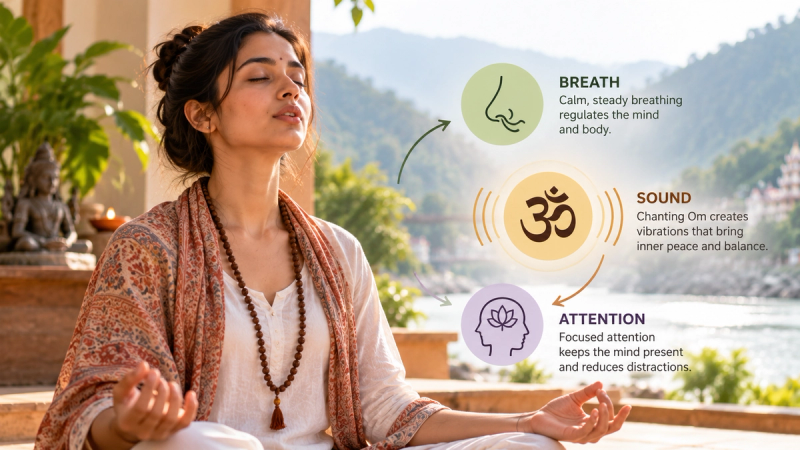
When you chant Om, three elements become especially noticeable:
- Vocalisation: You produce a sustained sound instead of speaking ordinary words.
- Breath: You coordinate the sound with a controlled, comfortable exhalation.
- Attention: You listen to the changing tone and notice when your mind wanders.
Together, these elements create a simple meditation structure. Rather than attempting to eliminate thoughts, you repeatedly return your attention to a sound you can hear and feel.
For a beginner, that can be easier than sitting in silence with no specific point of focus.
The practice also has a cultural dimension. If you learn Om chanting in a traditional yoga environment, you can explore its pronunciation, philosophical context and appropriate use rather than treating it as a generic relaxation sound.
For a broader introduction to traditional terminology, explore this guide to essential Sanskrit terms used in yoga teacher training.
2. The Science Behind Om Chanting: Breath, Vibration and the Nervous System
The scientific interest in Om chanting centres on several possible mechanisms: vocal breathing, sustained attention, auditory stimulation and the physiological effects associated with slower respiration.
It is important to distinguish between evidence for these mechanisms generally and evidence specifically demonstrating that Om produces a unique effect.
Slower breathing and relaxation
When you sustain a comfortable chant, your exhalation may naturally become longer than it would during ordinary conversation. Slower, controlled breathing can influence respiratory patterns and heart-rate variability, a measure of variation in the intervals between heartbeats.
Breathing at an appropriate pace can also influence the interaction between respiratory activity and cardiovascular regulation. These responses are associated with autonomic processes involved in adapting to stress and relaxation.
However, the result depends on how you breathe. Forcing a long chant, taking excessively deep breaths or repeatedly inhaling too much air may cause dizziness or discomfort.
The goal is not to achieve the longest possible exhalation. It is to find a rhythm that feels natural and sustainable.
Vocal vibration and sensory attention
During chanting, your vocal folds generate sound, while vibration can be felt around the throat, mouth and face. You may notice different sensations as the sound changes from an open vowel to a humming-like ending.
These sensations provide immediate sensory feedback. Instead of mentally rehearsing a problem or planning your next task, you have a specific physical experience to observe.
This does not mean the vibration automatically heals organs or removes disease. It means that sound and bodily sensation can serve as useful anchors for attention.
What does research suggest?
A small body of research has investigated Om chanting and related practices. Some studies have reported changes in physiological measurements or brain activity during chanting, but study designs, participant numbers and methods vary.
A frequently discussed example is research on the neurohemodynamic correlates of Om chanting, published in the International Journal of Yoga. The literature is interesting, but it is not sufficient to establish that Om chanting reliably treats anxiety disorders or produces the same response in everyone.
You can explore biomedical research through PubMed, the US National Library of Medicine's research database. Search for Om chanting, mantra meditation and related breathing practices, and pay attention to the actual methods and limitations of each study.
The sensible conclusion is that Om chanting offers a plausible combination of breathing regulation and attentional practice. Its specific effects require further rigorous research.
3. Seven Potential Benefits of Om Chanting for Mind and Body
The experience of chanting can differ depending on your breathing, expectations, familiarity with meditation and surrounding environment. These seven potential benefits explain why practitioners often include it in a regular yoga routine.
1. A practical way to settle your attention
Following the beginning, middle and end of each chant gives your mind a repeatable task. Whenever you notice distraction, you can return to listening.
This is particularly useful if silent meditation feels difficult. You are not expected to stop thinking; you are practising the skill of noticing distraction and redirecting attention.
2. Support for stress management
A quiet chanting session can provide a deliberate pause between demanding activities. Comfortable breathing, repetitive sound and reduced external stimulation may help you feel calmer.
That experience is not a guarantee of reduced clinical anxiety. Treat chanting as one possible stress-management tool, not a replacement for professional support when symptoms interfere with daily life.
3. Greater awareness of breathing
Because the sound depends on your exhalation, you become more aware of your breathing rhythm. You may notice unnecessary tension in your shoulders, jaw or throat and learn to soften it.
This awareness can also carry into asana practice, where coordinated breathing often helps you move with greater control.
4. An accessible introduction to meditation
You do not need to memorise a long mantra or master a complicated posture. A comfortable seat and a few minutes of practice are enough to begin.
This simplicity makes Om chanting approachable for people who are new to meditation or who prefer a structured alternative to silent sitting.
5. A mindful transition between activities
Chanting before work, after a commute or at the end of a yoga session can create a consistent transition. Over time, the ritual may remind you to pause before moving into another demanding task.
The benefit comes from the repeated practice and your attention to it, rather than from an assumption that a sound has a guaranteed biological effect.
6. A deeper connection with yoga philosophy
For practitioners interested in traditional yoga, Om provides a starting point for studying mantra, contemplative practice and Indian philosophical thought.
Understanding its context can make chanting feel more meaningful than simply copying a sound heard in class.
7. A shared experience in group practice
When a group chants together, participants coordinate around a common rhythm. Some people find this supportive and grounding.
However, group chanting is not essential. You can practise alone, chant softly or listen without vocalising if that better suits your comfort and circumstances.
Image placement: Insert In-Content Image 1 after this section, showing a relaxed practitioner during mantra meditation.
What about claims of healing?
You may encounter claims that Om chanting balances hormones, repairs organs, activates every chakra or cures disease. These statements require stronger evidence than is currently available.
If you find the relationship between traditional sound practices and contemporary research interesting, this article on mantra chanting and sound healing science offers a related topic to explore.
4. How to Practise Om Chanting: A Simple Beginner's Method
You can begin with five minutes. Consistency and comfort matter more than volume, duration or the number of repetitions.
Step 1: Find a comfortable position
Sit on a cushion, folded blanket or chair. Keep your spine comfortably upright without stiffening your back, and let your shoulders relax.
You do not need to sit in a full lotus posture. Choose a position that allows you to breathe without strain.
Step 2: Notice your natural breathing
Spend about one minute observing your normal inhalation and exhalation. Do not deliberately increase the depth of your breaths.
Notice whether your jaw, forehead and shoulders are relaxed. Make small adjustments if you are holding unnecessary tension.
Step 3: Chant slowly and comfortably
Take an easy breath in. As you exhale, produce a gentle A-U-M sound, allowing it to change naturally toward a soft humming quality.
You might experiment with an open beginning and a humming ending, but there is no need to divide every chant into mathematically equal parts. Keep the sound within a comfortable vocal range.
Step 4: Listen until the sound fades
Pay attention to the sound as it becomes quieter. Notice the brief silence before your next breath.
That silence is part of the experience, but do not hold your breath to make it longer.
Step 5: Repeat without forcing the rhythm
Continue for three to five minutes. If your voice becomes strained or your breathing feels uncomfortable, reduce the volume, shorten the chant or stop.
When you finish, remain seated briefly and observe how you feel. You do not have to experience a dramatic change for the practice to be worthwhile.
A simple daily routine
- Morning: Chant for three to five minutes before beginning your usual activities.
- Before meditation: Use a few repetitions as a transition into quieter observation.
- After yoga: Finish your practice with gentle chanting if it feels appropriate.
- Evening: Choose a quiet, comfortable volume and avoid turning the session into another performance target.
If you have respiratory difficulties, significant vocal discomfort or a condition affected by breath-control exercises, seek appropriate professional guidance before experimenting with prolonged chanting. You can also meditate by listening to a recording or observing your natural breathing.
5. Why Rishikesh Matters for Learning Om Chanting
Rishikesh has a long-standing association with yoga, meditation, pilgrimage and spiritual study. Its ashrams, yoga schools and riverside settings attract both Indian practitioners and international visitors interested in contemplative traditions.
The location can provide useful conditions for learning: dedicated practice time, instruction from experienced teachers and opportunities to study yoga philosophy alongside physical postures and breathing techniques.
In Tapovan and the wider Laxman Jhula area, you may encounter classes that incorporate mantra chanting into a broader routine of asana, pranayama and meditation.
The setting itself does not guarantee a particular mental or physiological response. Crowds, traffic, travel fatigue and unfamiliar surroundings can also affect your experience. What matters is finding an environment where you can practise comfortably and receive clear guidance.
Choosing a suitable learning experience
If you plan to study in Rishikesh, consider the format that fits your goals:
- A short retreat: Useful when you want dedicated time for yoga and meditation without committing to an extended course.
- A structured teacher-training programme: Appropriate if you want a broader foundation in yoga practice, teaching methodology and philosophy.
- Sound-focused training: Worth exploring if your main interest is mantra, sound-based meditation and related practices.
If you are travelling from abroad, review the schedule, accommodation arrangements, course inclusions and teaching approach before booking. You can also explore this guide to yoga retreats in Rishikesh for international visitors to help you prepare.
A good learning environment should encourage questions and informed practice rather than promising miraculous outcomes.
6. Explore Yoga and Sound Practices with Divine Yogpeeth
If you want to explore Om chanting within a wider yoga practice, the learning environment matters as much as the technique itself.
At Divine Yogpeeth, located in the Laxman Jhula, Tapovan area of Rishikesh, you can explore yoga learning options that complement an interest in meditation, philosophy and sound-based practices.
Our sound healing training course is a relevant option to investigate if you want to study sound practices more systematically. Review the curriculum and course details to establish whether the programme matches your experience level and learning objectives.
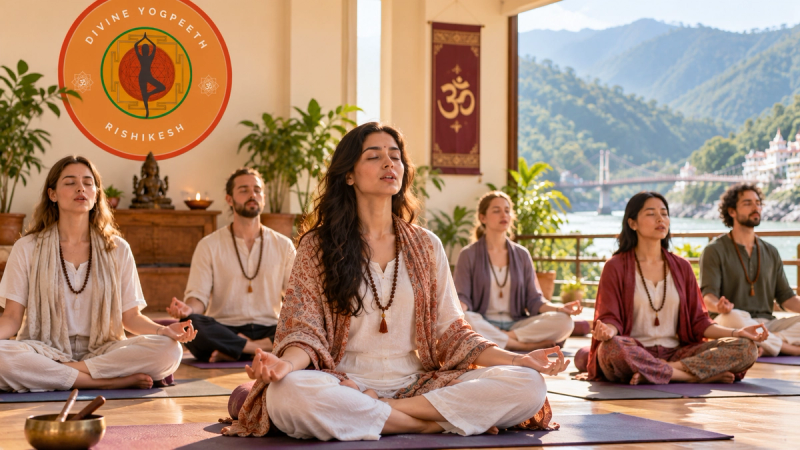
Image placement: Insert In-Content Image 2 here, showing a small group practising meditation in a calm yoga classroom in Rishikesh.
The right choice depends on what you want from your practice. You may prefer a short introduction to meditation, or you may want a structured programme that places chanting within a larger study of yoga.
7. FAQs About Om Chanting, Benefits and Science
Is there scientific evidence for Om chanting?
Some small studies have investigated Om chanting and related physiological or brain-activity measurements. The findings are preliminary and do not establish universal benefits or prove that chanting treats medical conditions.
How long should you chant Om each day?
Start with three to five comfortable minutes. You can gradually increase the duration if it feels helpful, but there is no scientifically established ideal length that guarantees better results.
Is Om chanting suitable for beginners?
Yes, many beginners can try gentle chanting without special equipment. Sit comfortably, use a natural breathing rhythm and stop if you experience dizziness, breathlessness or vocal strain.
Is Om chanting different from ordinary meditation?
Om chanting is one form of meditation. It gives you an audible and physical point of focus, while other meditation methods may use natural breathing, bodily sensations or silent observation.
Can Om chanting replace medical treatment?
No. Although chanting may complement general wellbeing practices, it should not replace prescribed treatment or professional assessment for persistent physical or psychological symptoms.
Conclusion: Make Om Chanting a Meaningful Daily Practice
Understanding chanting Om benefits effects science means recognising both the potential and the limitations of this simple practice. Gentle vocalisation, attentive listening and comfortable breathing can create a useful structure for meditation, while research continues to investigate the specific physiological effects of Om chanting.
You do not need to chase extraordinary experiences. Begin with a few minutes, keep your breathing natural and observe what changes in your attention and comfort over time.
If you want to develop your practice in a dedicated yoga setting, explore our 200-hour yoga teacher training in Rishikesh and review whether its curriculum fits your goals. Take the next step towards a more informed, consistent yoga practice in Rishikesh.