.jpg)

Divine Yogpeeth teachers faculty selection explained: discover how yoga educators are evaluated for expertise, teaching ability, safety, and student needs. Discover
Divine Yogpeeth Teachers Faculty Selection: How Our Yoga Faculty Is Chosen
Introduction
Divine Yogpeeth teachers faculty selection can make a bigger difference to your yoga teacher training than a beautifully designed brochure ever will. A knowledgeable teacher can deepen your understanding; the wrong teaching approach can leave even a well-designed syllabus feeling confusing.
Choosing a yoga teacher training is not only about the syllabus, schedule, or certificate. The person standing in front of you can shape how you understand alignment, philosophy, breathwork, teaching ethics, and even your relationship with your own practice.
A strong faculty should bring more than impressive credentials. You need teachers who can explain clearly, adapt to different bodies and experience levels, respect traditional knowledge, and create a learning environment where questions are welcome.
You also need practical teaching ability. Knowing something and knowing how to teach it are different skills.
This guide explains the qualities you should examine when evaluating yoga faculty, how a responsible school can assess teachers, and what those choices mean for your training experience. You will also see why Rishikesh adds a particular context to teacher education and how to evaluate a school before paying a course fee.
What Divine Yogpeeth Teachers Faculty Selection Should Look Like
When you research a yoga teacher training, it is easy to focus on the teacher's years of experience or the number of certificates listed in a profile. Those details can help, but they do not tell you whether a teacher can actually teach you well.
A useful faculty-selection process should look at several dimensions together. You should expect a school to consider subject knowledge, teaching experience, communication, professionalism, respect for students, and alignment with the school's educational standards.
For example, an anatomy teacher needs to understand movement and basic anatomy, but you also benefit when that teacher can translate technical ideas into practical cues.
A philosophy teacher should know the subject, but should also be able to connect concepts to contemporary practice without presenting personal opinions as ancient doctrine.
You can use the same framework when researching a school yourself:
- Relevant training and subject expertise
- Demonstrated teaching experience
- Clear, understandable communication
- Ability to work with mixed experience levels
- Respectful and professional conduct
- Practical understanding of classroom safety
- Willingness to answer questions and explain alternatives
- Consistency with the school's curriculum and teaching standards
Credentials still matter. If a school claims a particular registration or certification, check the organization directly rather than relying only on a promotional page. You can learn about yoga teacher education and credentialing through Yoga Alliance.
The key point is simple: a certificate can show that someone completed training, while effective teaching requires the ability to turn knowledge into a useful learning experience.
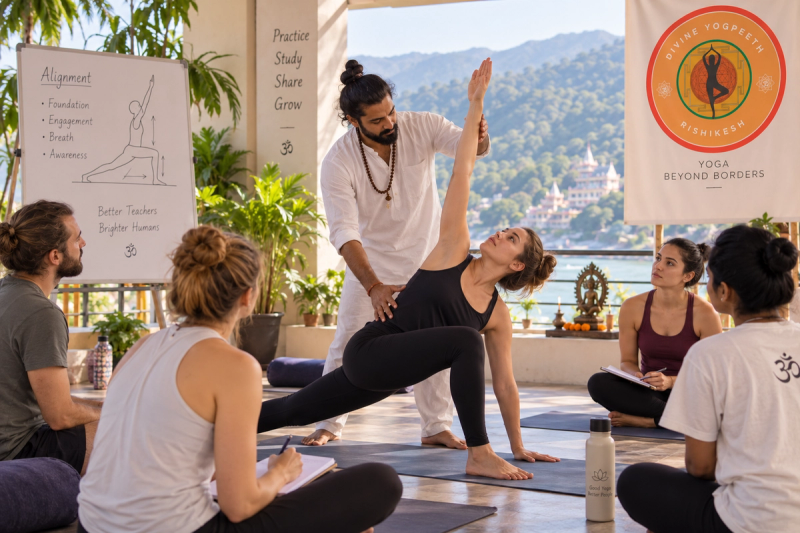
How Yoga Teacher Faculty Selection Goes Beyond Certificates
A good faculty profile should answer a practical question: what will this teacher help you learn, and how will they help you learn it?
Subject expertise is the first layer. Depending on the program, you may encounter teachers responsible for asana practice, anatomy and physiology, pranayama, meditation, philosophy, Sanskrit, teaching methodology, or specialized practices such as sound healing.
Each subject calls for a somewhat different teaching approach.
Teaching experience is another layer. An experienced practitioner is not automatically an experienced educator.
Teaching requires pacing a class, noticing confusion, adjusting explanations, responding to questions, and keeping students engaged without turning the session into a performance.
Communication matters just as much. Imagine two teachers explaining the same alignment principle.
One uses technical terminology for twenty minutes. The other explains the concept, demonstrates it, gives you a simple cue, and then observes how you apply it. The second approach may make the material easier to retain.
What you should expect from a strong teacher
You should be able to ask why a practice is taught a certain way. You should receive explanations rather than vague appeals to authority.
You should also see room for individual differences. A teacher training group may include an experienced practitioner, a complete beginner, and someone returning to practice after years away.
A rigid one-size-fits-all approach can leave some students behind.
The best way to evaluate faculty is therefore not to ask only, “How many years have they practiced?”
Ask, “Can this teacher help me understand, practice, and eventually teach this material responsibly?”
For additional preparation, you can explore this guide to yoga teacher ethics training, especially if ethical teaching and professional boundaries are important to your decision.
What We Look for in Yoga Teachers and Faculty
Inside a responsible school, faculty selection should begin with the curriculum rather than personality. Once you know what students need to learn, you can determine what kind of teacher is suitable for each subject.
For practical yoga classes, teaching observation is valuable. A school can assess whether a prospective teacher gives clear instructions, demonstrates safely, manages time, and responds appropriately when students struggle.
For theory subjects, the emphasis can shift toward depth of knowledge and the ability to make complex material understandable.
A teacher discussing philosophy should distinguish between classical concepts, modern interpretations, and personal viewpoints.
Teaching ability and student awareness
Student awareness is particularly important in a teacher training environment.
You are not simply attending a public drop-in class. You are learning how to observe bodies, communicate instructions, sequence practices, and eventually take responsibility for other students.
That means faculty should model the behaviors you are expected to develop. You should see patience, appropriate language, respect for boundaries, and attention to safety.
A useful faculty team also benefits from complementary strengths. One teacher may be particularly strong at anatomy, another at meditation, and another at sequencing or practical teaching.
You do not need every instructor to teach every subject.
This matters because a teacher training course is an ecosystem. Your learning is shaped by the consistency between subjects.
Anatomy should inform alignment discussions. Philosophy can give context to practice. Teaching methodology should help you communicate what you have learned.
You can explore how to create a yoga sequence after teacher training to see why teaching skills extend beyond knowing individual postures.
Professionalism is part of teaching quality
Professional conduct can be less visible than a teacher's asana skills, but it affects your experience every day.
Punctuality, preparation, clear expectations, respectful interaction, and appropriate handling of feedback all matter.
When you compare schools, look for evidence that faculty are treated as educators rather than simply as names used to market a course.
A clear curriculum, defined teaching roles, and transparent course information can tell you more than a long list of impressive adjectives.
Why Faculty Quality Matters During Teacher Training
Your teacher training may be intense because you are learning and practicing at the same time.
You are absorbing information in class, testing it on your own body, discussing it with peers, and gradually learning to communicate it.
That is where faculty quality becomes tangible.
A teacher who explains anatomy clearly can help you understand why a cue may be useful in one context but unsuitable in another.
A strong teaching-methodology instructor can help you move from “I know this posture” to “I can teach this posture.”
A thoughtful philosophy teacher can help you engage with ideas without reducing them to slogans.
The learning environment matters too. You should feel comfortable asking basic questions.
If you are afraid of looking inexperienced, you may hide confusion rather than resolve it.
A strong faculty culture can encourage curiosity while still maintaining discipline.
Yoga teacher training should not become an informal retreat where every opinion is treated as equally authoritative. Nor should it become a rigid classroom where questioning is discouraged.
You can also examine Yoga Teacher Training Group Dynamics if you want to understand how the people around you can affect your learning.
Teaching safety and responsible adaptation
Safety deserves particular attention.
A teacher should understand that bodies differ and that a posture can require modification. You should be taught to observe rather than force a predetermined shape.
This principle becomes even more important when you eventually teach others.
Your future students will have different mobility, experience, goals, and limitations. Faculty should therefore model adaptable instruction rather than rewarding students for pushing through discomfort.
A course can teach you a large number of postures, but the deeper skill is learning how to make sound teaching decisions.
Why Rishikesh Matters When Choosing Yoga Faculty
Rishikesh is widely associated with yoga education, ashrams, retreats, and teacher training.
That creates an unusual advantage for a learner: you can encounter many approaches in one place.
It also creates a challenge. The sheer number of schools and teachers means you cannot assume that every course offers the same educational quality.
Your location should therefore be part of your research, not a substitute for it.
Tapovan and the Laxman Jhula area provide an environment where yoga practice, spiritual traditions, international travel, and modern wellness culture meet.
If you are coming from another country, that setting can make the training feel very different from practicing yoga at home.
But the location does not automatically tell you whether a faculty team is right for you.
Look at the curriculum, teacher backgrounds, course duration, daily schedule, student feedback, accommodation information, and what is actually included in the fee.
If you are comparing the local setting with your expectations, Tapovan Rishikesh yoga can give you additional context about practicing and studying in this part of Rishikesh.
For international students, practical details matter as much as the atmosphere.
Think about arrival logistics, food preferences, room arrangements, class intensity, free time, and whether you will have enough opportunity to recover between sessions.
How to Evaluate Divine Yogpeeth Teachers Faculty Selection Before Enrolling
If you are considering a course, do not stop at a teacher's biography. Build a small checklist and look for evidence.
Start with the curriculum. Does it clearly explain what you will study and practice?
Then examine faculty responsibilities. Can you identify who teaches the major components, rather than seeing only generic references to “expert instructors”?
Next, look for consistency. The teaching philosophy described by a school should make sense alongside its course structure.
If the school emphasizes responsible teaching, you should see attention to anatomy, methodology, ethics, and student safety.
You should also consider whether the program matches your current level.
A 100-hour program and a 200-hour teacher training can serve different learning needs. If you want a more comprehensive foundation, examine the 200-hour Yoga Teacher Training in Rishikesh.
If you need a shorter training format, review the 100-hour Yoga Teacher Training program.
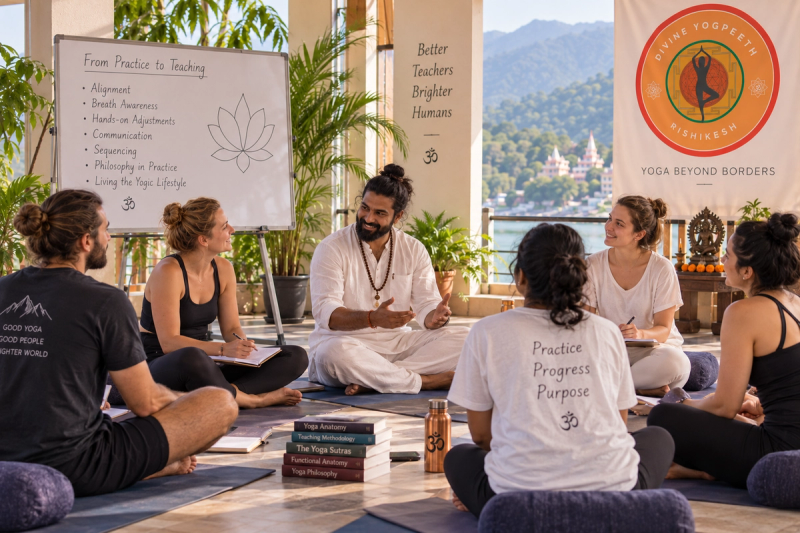
Questions worth asking before you pay
Before enrolling, you can ask:
- Which teachers handle the core subjects?
- What qualifications and teaching experience do they have?
- How much practical teaching practice is included?
- How are students assessed?
- What happens if you need a modification?
- How large is the typical training group?
- What is included in the course fee?
- What support is available if you have questions during training?
You do not need a school to promise perfection.
You need enough transparent information to make an informed choice.
If sound-based practices are part of your interest, you can also compare the school's dedicated sound healing training course with your goals before choosing a broader teacher training.
A closer look at faculty and course structure can save you from choosing a program simply because its photographs look appealing.
Why Our Faculty Approach Matters to Your Learning
If you're considering yoga teacher training in Rishikesh, we at Divine Yogpeeth focus on connecting the learning experience with practical teaching skills, subject knowledge, and the needs of students from different backgrounds; you can explore our yoga school and programs to see the broader training options.
The important question is not whether a school can describe its faculty with impressive language.
It is whether your daily experience gives you useful explanations, opportunities to practice, constructive feedback, and a respectful learning environment.
When you evaluate a school, pay attention to those details. They are much harder to fake than polished marketing copy.
FAQs
How should you evaluate yoga teacher faculty before joining a course?
Look at subject expertise, teaching experience, curriculum responsibilities, communication style, student feedback, safety practices, and the amount of practical teaching included.
A long biography alone is not enough.
Does a teacher's certification guarantee good teaching?
No. Certification can establish that a person completed a particular training or meets an organization's requirements, but effective teaching also depends on communication, observation, adaptability, preparation, and professional conduct.
Why is faculty selection important for a 200-hour YTT?
A 200-hour course covers multiple areas, so you benefit from instructors with appropriate expertise across practice, anatomy, philosophy, pranayama, meditation, and teaching methodology.
The consistency between those subjects is also important.
Should beginners choose a different faculty than experienced practitioners?
Not necessarily.
A mixed group can work well when teachers can adapt explanations and offer appropriate modifications. The more important question is whether the teaching approach accommodates different levels without compromising the core curriculum.
What should international students check before enrolling in Rishikesh?
Check the curriculum, faculty, course duration, accommodation, meals, schedule, inclusions, location, payment terms, and practical arrival information.
You should also understand the school's expectations around attendance and participation.
Conclusion: Choose the Teacher, Not Just the Certificate
The quality of your teacher training is shaped by what happens between the timetable lines.
Faculty expertise, teaching ability, safety awareness, communication, and professional conduct can determine whether you simply complete a course or genuinely develop the skills to teach.
That is why Divine Yogpeeth teachers faculty selection deserves careful attention when you compare programs in Rishikesh.
Look beyond photographs and certificate claims. Ask who teaches you, what they teach, how they teach it, and whether the curriculum gives you enough practice to apply the knowledge.
If you are ready to build a stronger foundation, explore our 200-Hour Yoga Teacher Training in Rishikesh and review the curriculum before you enroll.
Your next step should be based on the education you want—not simply the destination you want to visit.