.jpg)

Teaching beginner yoga class after 100 hour YTT? Learn practical sequencing, safe modifications, cueing, and confidence-building tips for new teachers. Discover more.
Teaching beginner yoga class after 100 hour YTT: Practical Tips That Actually Work
Your first class can feel very different from your teacher training practice. Teaching beginner yoga class after 100 hour YTT requires more than remembering asanas: you need to explain movements clearly, adapt to different bodies, manage your timing, and help students feel comfortable.
You might know how to perform a sequence yourself, yet struggle to explain it to someone who has never tried downward-facing dog. That is normal. The real skill develops when you learn to see the practice from your students' perspective.
The good news is that you do not need a complicated sequence or perfect Sanskrit pronunciation to lead a useful class. You need a clear plan, safe instructions, realistic expectations, and the willingness to learn from each session.
This guide explains how to plan your first beginner class, choose appropriate poses, communicate confidently, make sensible modifications, and recognise when you need additional training. Whether you plan to teach in your home country, lead small community sessions, or gain experience in Rishikesh, these practical strategies will help you approach teaching with greater clarity.
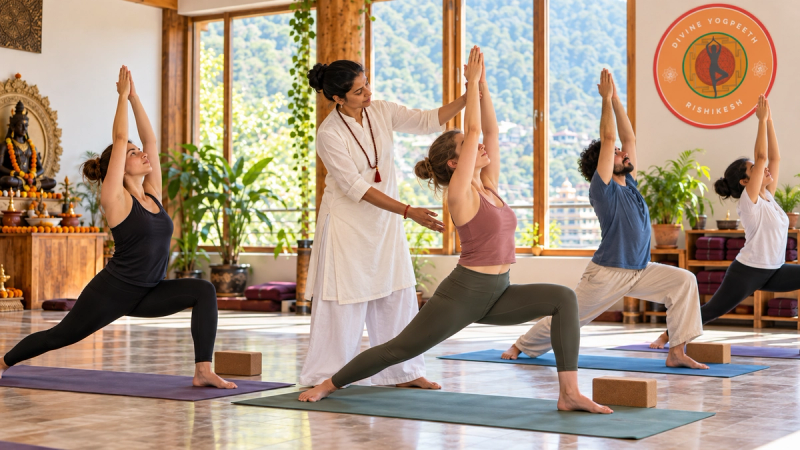
1. What Teaching Beginner Yoga Class After 100 Hour YTT Really Requires
A 100-hour yoga teacher training can introduce you to asana practice, alignment, breathing techniques, philosophy, and teaching methodology. However, completing a course does not automatically mean you are prepared for every teaching situation.
Your next step is to translate what you have learned into instructions that beginners can understand and follow.
Understand your students before planning the class
A beginner might be completely new to yoga, returning after an injury, unfamiliar with English yoga terminology, or uncomfortable practising in front of others. Two students in the same room can have very different needs.
Before class, ask about previous experience, current discomfort, relevant limitations, and any movements they have been advised to avoid. Do not diagnose medical conditions or promise therapeutic results. If a student has a significant injury or medical concern, encourage appropriate professional guidance.
Keep these priorities in mind:
- Explain the purpose of each movement in simple language.
- Offer a comfortable alternative rather than insisting on one shape.
- Allow students to rest without feeling that they have failed.
- Avoid comparing flexibility, strength, balance, or progress.
- Give students permission to stop if something feels painful or unsafe.
You should also understand the scope of your training. A short certification may provide a foundation, but your competence depends on the curriculum, supervised practice, feedback, and experience you gain.
For professional expectations and continuing education, consult Yoga Alliance. Check the current requirements that apply to your qualification rather than assuming every 100-hour course independently qualifies you for the same teaching credentials.
2. How to Plan Your First Beginner Yoga Class
Your first class should be simple enough to teach confidently and structured enough to give students a satisfying experience. Avoid trying to demonstrate everything you learned during training.
A beginner usually benefits more from understanding five basic movements than from rushing through twenty unfamiliar poses.
Use a predictable class structure
For a 45-minute introductory session, you can begin with this framework:
Class stageTimeMain purposeArrival and check-in5 minutesEstablish comfort and explain optionsBreath awareness5 minutesSettle attention without forcing the breathGentle warm-up8 minutesPrepare joints and introduce movementStanding and floor poses15 minutesPractise a small number of foundational posturesRelaxation7 minutesAllow the body to settleClosing5 minutesEnd calmly and invite questions
This is a flexible example, not a universal prescription. Adjust the timing to your students' needs, the style you teach, and the actual duration of the session.
Write down the sequence before class. Include the pose order, key cues, transitions, easier alternatives, and estimated duration. Rehearse the transitions aloud so you know what you will say while students move.
A useful resource is this yoga class plan template for new teachers. Use a written plan as a support, not a script you must follow regardless of what happens in the room.
Choose consistency over complexity
For your first few classes, repeat familiar movements across sessions. Students become more comfortable when they recognise the sequence, and you get more opportunities to improve your explanations.
For example, you might introduce mountain pose, a gentle standing forward fold, a supported lunge, cat-cow, child's pose, and a comfortable seated breathing practice. Select only the movements appropriate for your students and provide alternatives whenever needed.
Do not include advanced arm balances, deep backbends, or demanding transitions simply to make the class look impressive. Your responsibility is to guide the students in front of you, not to display your own practice.
3. Teach Foundational Poses With Clear, Safe Instructions
Beginners often struggle less with the pose itself than with understanding what to do, where to place their weight, and how to move between positions.
Your verbal instructions should be brief, specific, and delivered in the order students need them.
Replace complicated explanations with practical cues
Instead of saying, “Activate the entire posterior kinetic chain while maintaining spinal neutrality,” you could say, “Keep your knees soft, lengthen your back, and let your hands rest on your thighs.”
The second instruction is easier to understand and act on.
Consider these examples:
Mountain pose: Ask students to stand comfortably with their feet grounded, knees relaxed, and shoulders easy. Avoid insisting that every student stand with identical foot spacing.
Cat-cow: Explain the movement slowly, coordinating comfortable spinal motion with natural breathing. Students with wrist discomfort may need a different hand position or an alternative movement.
Downward-facing dog: Offer bent knees and lifted heels as options. A chair-supported variation may be more appropriate for some students. Do not insist that everyone's heels reach the floor.
Warrior II: Encourage a stable stance, comfortable knee alignment, and a range of motion that suits the student. Avoid forcing a deep bend or a fixed stance width.
Child's pose: Offer support under the forehead or knees, or suggest another resting position if the posture causes discomfort.
These are teaching examples, not individual medical advice. Pain, numbness, dizziness, or unusual shortness of breath should not be treated as something a student must push through.
Demonstrate, explain, then observe
A useful teaching cycle is to demonstrate a movement briefly, give one or two clear instructions, and allow students to practise while you observe.
Do not spend so long demonstrating that students are left waiting. Equally, do not talk continuously through every second of the practice. Quiet moments give students time to notice their breathing and sensations.
For further preparation, review vinyasa fundamentals for 100-hour YTT to strengthen your understanding of transitions and movement flow.
For additional anatomical background, you can explore the Encyclopaedia Britannica homepage as a general reference starting point, then consult reputable anatomy and movement resources for specific questions. Do not use a general reference as a substitute for qualified anatomy instruction or clinical guidance.
4. Build Confidence Through Cueing, Observation, and Adaptation
Confidence does not come from memorising a perfect speech. It comes from knowing your plan, communicating clearly, and responding sensibly when students need something different.
Your early classes may include awkward pauses, forgotten cues, or timing problems. These are manageable when you prepare and reflect instead of trying to hide every mistake.
Use three types of teaching cues
Action cues tell students what to do. For example, “Place your hands on the mat” or “Shift your weight gently towards your front foot.”
Awareness cues help students notice their experience. For example, “Notice whether your shoulders feel tense” or “Observe how your breathing feels without changing it.”
Transition cues prepare students for the next movement. For example, “Bring your hands back beneath your shoulders before slowly returning to a seated position.”
Give students time to process each instruction. If you introduce several actions in one sentence, some people will miss the first step while trying to understand the last.
Manage the room without constant correction
Position yourself where you can observe most students without making anyone feel watched. Scan the room, notice obvious instability or discomfort, and offer general alternatives when appropriate.
Ask before using hands-on adjustments. A student's consent should be informed, voluntary, and respected throughout the class. If you are unsure about an adjustment, use verbal guidance or demonstrate an alternative instead.
Never assume that a pose looks correct simply because it resembles your own. Differences in mobility, body proportions, balance, and previous experience mean that a useful posture may look different from person to person.
If you lose your place, pause, check your notes, and continue calmly. Students generally need clear guidance far more than they need a teacher who never hesitates.
5. Why Rishikesh Matters for Developing Your Teaching Skills
Rishikesh attracts yoga practitioners from India and around the world, creating opportunities to encounter different teaching styles, learning preferences, and approaches to yoga philosophy.
Practising and studying in this environment can expose you to traditional Hatha yoga, Vinyasa, pranayama, meditation, and discussions about how yoga principles apply beyond the mat. However, the location alone does not guarantee high-quality teaching. The quality of instruction, supervised practice, feedback, and curriculum matters more than the destination's reputation.
If you are teaching international students, practise giving instructions in accessible English. Avoid assuming that everyone understands Sanskrit terms or shares the same cultural background. Explain the purpose of a practice without requiring students to accept a particular belief.
Indian beginners may also have different expectations based on previous exposure to yoga, school physical education, family practices, or online classes. Ask questions instead of relying on stereotypes.
Choose training that addresses the actual gap
If you need help with sequencing, alignment, and foundational postures, look for training that gives you opportunities to practise teaching and receive individual feedback. If your existing 100-hour course has not provided enough supervised teaching, more practical instruction may be more valuable than simply collecting another certificate.
Before enrolling, ask about the curriculum, teacher qualifications, class size, supervised teaching hours, assessment, and total fees.
You can also read this guide to yoga teacher ethics training for a 100-hour course to consider boundaries, consent, and responsible conduct in the classroom.
6. How to Keep Improving After Your First Few Classes
The first class is a starting point, not a final test of your ability. Improvement becomes easier when you collect specific feedback instead of judging every session as either a success or a failure.
After each class, spend five minutes answering these questions:
- Which instructions did students understand quickly?
- Where did people appear confused or lose balance?
- Did the class finish on time?
- Were the alternatives practical and easy to explain?
- Did anyone report discomfort or need additional support?
- What is one change worth testing next time?
Change one or two elements at a time. If you rewrite the entire sequence after every session, you may never learn which adjustments actually helped.
With students' informed permission, you can occasionally record a practice-teaching session for self-review, taking care to protect privacy and avoid recording anyone who has not consented. A mentor's observations can reveal habits you may not notice yourself, such as giving instructions too quickly, facing away from the group, or overusing technical language.
Know when a longer training is appropriate
A 100-hour course can be useful for building a foundation or exploring a particular approach. It should not be treated as automatic proof that you are ready to teach every population, style, or situation independently.
If your goal is to develop a broader teaching foundation, compare the syllabus and practical teaching requirements of a 200-hour yoga teacher training course in Rishikesh. Check the actual programme details and relevant credential requirements before making a decision.
You can also gain experience gradually by assisting a qualified teacher, practising with willing peers, or leading short introductory sessions within your competence. Be transparent about your training and do not advertise specialist expertise you have not developed.
7. Prepare for Your First Class With This Practical Checklist
A checklist reduces avoidable mistakes and gives you more attention to devote to your students.
Before class
- Prepare a realistic sequence and rehearse the transitions.
- Check the room, mats, props, ventilation, and available space.
- Ask about relevant limitations and explain that students can opt out of movements.
- Prepare easier alternatives for balance, flexibility, and floor-based poses.
- Decide how you will manage timing and communicate basic safety guidance.
During class
- Introduce yourself and explain the class format.
- Use short, understandable instructions.
- Demonstrate unfamiliar movements when helpful.
- Offer alternatives without singling out students unnecessarily.
- Encourage rest and never pressure anyone to continue through pain.
- Leave enough time for relaxation and a calm closing.
After class
- Invite questions without pressuring students to share personal information.
- Ask for feedback on the pace, clarity, and comfort of the session.
- Make a short note of what worked and what needs improvement.
- Seek mentorship if you repeatedly encounter situations outside your training.
Keep this checklist accessible until the main parts of teaching become familiar. You can gradually rely less on your notes as your experience grows.
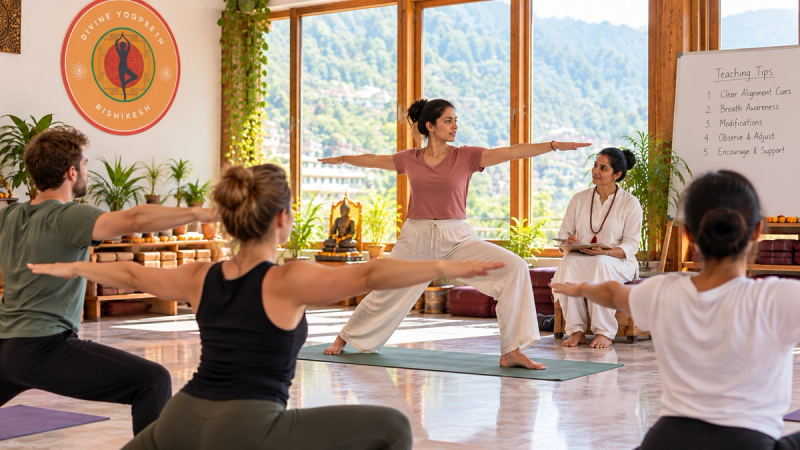
8. Frequently Asked Questions
Can you teach yoga after a 100-hour YTT?
Possibly, depending on your actual training, competence, the type of class, and any applicable professional or local requirements. A 100-hour certificate is not automatically equivalent to every 200-hour qualification or professional registration pathway. Check the scope of your training before accepting teaching responsibilities.
What should your first beginner yoga class include?
A simple class can include a check-in, gentle breathing awareness, a warm-up, a few foundational poses, rest, and a calm closing. The precise sequence should reflect your students' abilities and the class duration.
How do you handle a student who cannot perform a pose?
Offer an easier variation, a prop, a supported version, or a different movement. Ask whether the alternative feels comfortable, and make it clear that resting is acceptable. Never force a posture or treat pain as a necessary part of progress.
How can you overcome nervousness before teaching?
Rehearse your opening, write a clear sequence, practise the instructions aloud, and arrive early to prepare the room. Start with a small group if possible. Afterward, review specific feedback rather than expecting yourself to be flawless.
Is a 200-hour YTT necessary after a 100-hour course?
That depends on your goals and the credential you want to pursue. A 200-hour programme may offer broader study and more opportunities for supervised practice, but you should compare actual syllabuses, teaching hours, assessment, recognition, and cost before enrolling.
Conclusion: Teach Your First Beginner Yoga Class With a Clear Plan
Teaching beginner yoga class after 100 hour YTT becomes more manageable when you focus on clear communication, thoughtful sequencing, appropriate modifications, and honest awareness of your limitations.
Start with a simple class. Give students enough time to understand each movement. Observe rather than constantly correct, invite questions, and review every session for practical improvements.
You do not need to impress beginners with advanced poses. You need to help them practise safely, understand the instructions, and feel comfortable making choices about their own bodies.
If you want to strengthen your foundation before taking on more teaching responsibility, explore our 100-hour yoga teacher training in Rishikesh and review the curriculum to see whether it matches your learning needs. Choose a programme that supports real teaching practice, constructive feedback, and responsible instruction.
Your next step is simple: prepare one realistic beginner class, practise teaching it aloud, and refine it before leading your students.