.jpg)

The yoga teacher training flexibility required myth stops many from starting. Learn why you don't need to be bendy to teach yoga and uncover the truth today.
Yoga Teacher Training Flexibility Required Myth Shattered
The yoga teacher training flexibility required myth is the single biggest barrier holding passionate practitioners back from fulfilling their dreams. You likely scroll through social media, see instructors folded perfectly in half, and assume your stiff hamstrings disqualify you from teaching. That assumption could not be further from the truth. Your physical ability to perform advanced gymnastics has absolutely zero correlation with your capacity to become an exceptional, life-changing yoga instructor.
You are not alone in feeling this hesitation. Every year, thousands of students hesitate to enroll in certification programs because they believe they are not physically "ready" yet. They spend years trying to stretch their way to a perceived baseline, missing out on the deeper education waiting for them.
This guide dismantles those fears entirely. We will explore exactly why your current physical capabilities are more than enough to begin your journey. You will understand the real anatomy behind movement, the true skills required to teach, and why being stiff might actually be your greatest asset in a classroom.
Where the Yoga Teacher Training Flexibility Required Myth Originated
To understand how we got here, you have to look at the commercialization of wellness over the past two decades. As the practice moved West, the visual representation shifted dramatically from seated meditation to acrobatic physical feats. Magazines and fitness apparel brands needed eye-catching imagery to sell products. Slowly, the image of the ultra-flexible gymnast became synonymous with the ideal practitioner.
This visual bias created an unspoken standard that was never part of the original tradition. Organizations like Yoga Alliance establish rigorous global standards for certification. If you review their curriculum requirements, you will notice a massive emphasis on anatomy, philosophy, and teaching methodology. There is no physical fitness test required to become registered.
You do not need to prove you can do the splits to earn your certificate. You only need to demonstrate a willingness to learn, a dedication to the practice, and the ability to keep your future students safe. Understanding this distinction is the first step toward overcoming the hesitation holding you back. If you still have doubts about starting, reviewing the Yoga Teacher Training Beginners FAQ: 10 Proven Answers can clear up those lingering worries.
The Reality of the Yoga Teacher Training Flexibility Required Myth
When you actually step inside a yoga shala, the reality looks vastly different from your Instagram feed. A typical classroom is filled with people of all ages, body types, and physical backgrounds. Some students come from dance backgrounds, while others have spent forty years sitting at a desk. A good teacher must cater to all of them.
If you are hyper-mobile, you might actually face more challenges during your education. Highly flexible people often struggle with joint stability and have a harder time engaging the correct muscles. They rely on their loose ligaments to fall into poses, which can lead to severe injuries over time.
Being stiff forces you to practice with incredible mindfulness. You have to engage your muscles actively to support your joints. You naturally develop a deep understanding of alignment because you physically cannot cheat your way into a posture. This mindful struggle builds the exact type of internal awareness you need to guide others safely through their own physical limitations.
Anatomy Over Aesthetics: Tension vs. Compression
To truly move past this mental block, you must understand the difference between muscular tension and skeletal compression. Many people believe they just need to stretch more to achieve a certain pose. However, medical research indexed in databases like PubMed reveals that human anatomy is incredibly diverse.
Tension happens when a muscle is tight and restricts movement. With consistent, safe practice, tension can slowly release over time. Compression, on the other hand, happens when bone hits bone. If your femur is shaped a certain way, or your hip socket is positioned at a specific angle, you will never achieve the full expression of certain poses. No amount of stretching will change your skeletal structure.
A quality certification program teaches you to recognize these anatomical realities. You learn that a pose looking "perfect" on the outside might actually be structurally harmful on the inside. You stop trying to force your unique body into a standardized shape. Instead, you learn how to adapt the shape to serve your specific body, which is the exact skill you will eventually pass on to your own students.
The True Skills of an Exceptional Yoga Instructor
Think about the best teachers you have ever practiced with. Did you return to their classes because they could hold a perfect handstand? Or did you return because of how they made you feel? The most successful instructors excel in areas that have absolutely nothing to do with physical bendiness.
Your voice, pacing, and emotional intelligence dictate the energy of the room. You must learn how to read a room, adjusting your sequence on the fly when you notice the energy dropping. You must master the art of clear, concise verbal cueing so students can navigate the practice with their eyes closed. These pedagogical skills are the core focus when studying Teaching Methodology 200 Hour YTT: 7 Best Real Insights.
Furthermore, holding space for others is a profound responsibility. Students often release deep emotional trauma during physical movement. An exceptional teacher remains grounded, offering a safe, non-judgmental environment for that release. Your empathy, not your hamstrings, is what will ultimately change your students' lives.
Why Your Stiffness is Your Greatest Teaching Asset
Imagine a student walks into their very first class. They are nervous, their hips are incredibly tight, and they feel entirely out of place. Now, imagine they look at the front of the room and see a teacher effortlessly dropping into the splits. The student immediately feels intimidated and disconnected.
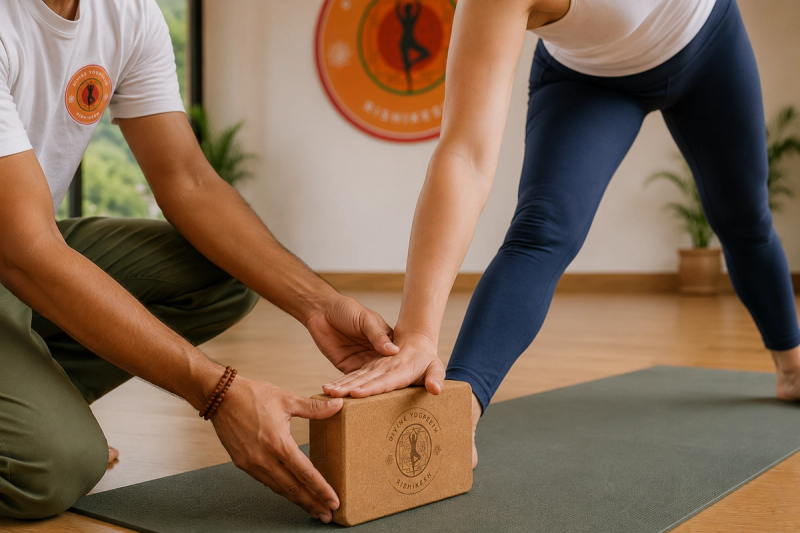
Now imagine that same student seeing a teacher who uses two blocks for a forward fold. Suddenly, the practice feels accessible. When you struggle with tight shoulders or stiff hamstrings, you develop a massive toolkit of modifications. You know exactly where to place a strap. You know precisely how to adjust a block to bring the floor closer to your hands.
Your personal physical challenges give you direct, lived experience with the modifications your students will desperately need. You will not have to guess how a tight hip feels because you live in one. This relatability builds instant trust and rapport with your class, making you a far more effective and popular instructor than someone who has never struggled a day in their life.
Expanding Your Practice Beyond Physical Postures
The physical postures, or asanas, are merely one small fraction of a much larger, ancient system. If you read the foundational texts of this tradition, you will quickly realize that physical movement was primarily designed to prepare the body for prolonged seated meditation. The ultimate goal has always been mental liberation, not physical acrobatics.
When you enroll in a comprehensive program, you dive deep into breathwork (pranayama), meditation, and ancient philosophy. You study the ethical guidelines that dictate how to live a meaningful, compassionate life off the mat. Mastering these non-physical elements transforms you from a fitness instructor into a true spiritual guide.
If you want to understand the breadth of what you will actually be learning, exploring the Eight Limbs of Yoga Philosophy: 8 Ultimate Steps to Peace offers a massive perspective shift. You will see clearly that physical capability is just the tip of the iceberg in this vast, life-changing education.
Embracing Alternative Modalities Like Sound Healing
The world of wellness is expanding rapidly, and teaching physical postures is no longer the only path to a successful career. Many practitioners realize that their true calling lies in guiding others through deep relaxation and energetic healing. These modalities require zero physical flexibility, yet offer profound therapeutic benefits to your clients.
Sound healing, for instance, uses the frequencies of Tibetan singing bowls, gongs, and tuning forks to induce deep states of meditation. As a practitioner, your job is to understand acoustics, energy centers, and how to hold a deeply therapeutic space. Your physical bendiness is entirely irrelevant to your ability to facilitate this profound healing.
Many students choose to specialize in these areas, either as a standalone career or as a powerful addition to their standard classes. Exploring a Sound Healing Training Course opens entirely new doors for your practice, proving once again that your tight hamstrings do not dictate your future success in this industry.
Overcoming Imposter Syndrome Before Your Journey
Even after understanding the anatomy and the philosophy, you might still battle the voice in your head telling you that you are not good enough. Imposter syndrome runs rampant among new practitioners. You look around the room, compare your chapter one to someone else's chapter twenty, and feel entirely inadequate.
The key to overcoming this mental block is shifting your perspective from "performer" to "student." You are attending a training to learn, not to prove you already know everything. The curriculum is designed to break you down and build you back up. Your instructors expect you to stumble, ask questions, and rely heavily on props.
Every single master was once a struggling beginner. Acknowledging your limitations openly is a sign of profound maturity. If you are struggling with these mental barriers, reading about New yoga teacher confidence after training: 7 Best Tips can provide immense relief and practical strategies for silencing your inner critic.
Preparing Your Body and Mind for the Experience
While you do not need to be a gymnast, a certification course is still physically and mentally demanding. You will likely be practicing physical movement for several hours a day, alongside intense academic study. The best way to prepare is to build consistency, not extreme flexibility.
Focus on building a daily habit. Even twenty minutes of mindful movement and breathwork every morning will prepare your nervous system for the intensive schedule ahead. Start familiarizing yourself with the basic names of common poses, and practice listening to your body's signals of fatigue.
Most importantly, arrive with an empty cup. Leave your ego, your expectations, and your competitive nature at home. The students who struggle the most during training are usually the ones who refuse to let go of their preconceived notions about what a "perfect" practice should look like. Come ready to learn, and the process will take care of the rest.
Why Rishikesh? / Why This Matters
Choosing where to study heavily influences how you perceive the physical demands of the practice. If you study in a hyper-competitive, fitness-focused Western studio, the pressure to perform physically will be immense. The environment dictates the curriculum.
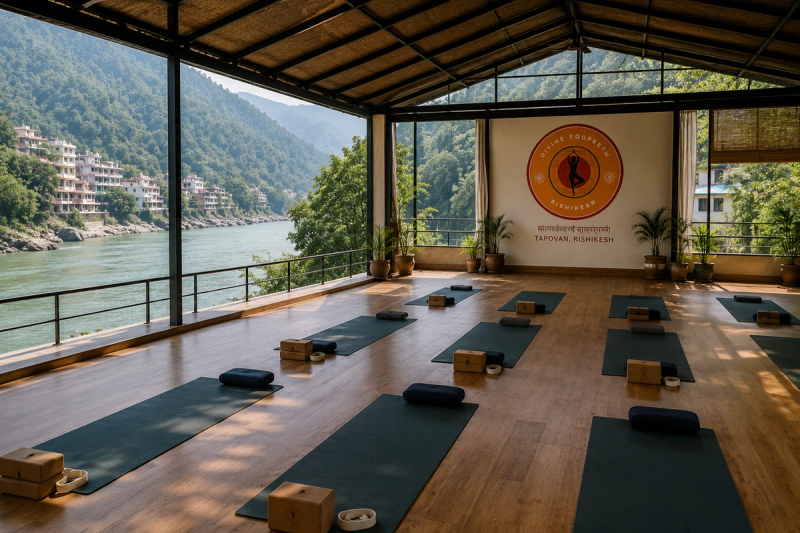
Rishikesh is the undisputed yoga capital of the world. Here, the practice remains deeply rooted in its spiritual origins. The focus naturally shifts away from how a pose looks and moves toward how a pose feels. The energy of the Ganges River, the surrounding Himalayas, and the deeply spiritual culture strip away the superficial layers of modern fitness culture.
When you study in India, you are immersed in a lifestyle, not just a workout routine. The pressure to look perfect instantly vanishes, replaced by a profound sense of inner exploration. You learn to honor your body exactly as it is today, which is the most valuable lesson you can ever take back to your future students.
Your Safe Space to Learn and Grow
If you are considering starting your journey in Rishikesh, Divine Yogpeeth provides an authentic, deeply supportive environment. We focus heavily on accessible anatomy, ensuring you understand how to teach real bodies with real limitations.
You can explore our foundational teachings by visiting the Divine Yogpeeth Home. It is the perfect place to see how traditional knowledge blends with modern safety standards, ensuring you feel completely supported regardless of your current physical abilities.
FAQs
Do I need to demonstrate advanced poses to graduate?
Absolutely not. You are evaluated on your ability to sequence safely, cue clearly, and understand the anatomical purpose of the postures. Your personal ability to perform advanced acrobatics is never a graduation requirement.
What if I cannot physically perform a pose I need to teach?
You will learn the art of verbal cueing and demonstration using students. Many incredible teachers guide advanced workshops without ever demonstrating the peak poses themselves. You learn to talk students into the shape seamlessly.
Are props allowed during the practical exams?
Props are highly encouraged. Using blocks, straps, and bolsters demonstrates a deep understanding of anatomy and accessibility. The best instructors use props daily to modify and deepen their own practice.
Will other students judge me if I am stiff?
A reputable training environment strips away competition entirely. You will quickly find that everyone struggles with something different—some with flexibility, some with strength, and others with the academic philosophy. You will support each other through all of it.
Conclusion
It is time to permanently discard the yoga teacher training flexibility required myth. Your tight hips, stiff shoulders, and physical limitations are not roadblocks; they are the exact tools you will use to connect with your future students. Teaching is an act of service, empathy, and deep internal awareness, none of which require you to touch your toes.
Ready to begin? Explore our 200-Hour Yoga Teacher Training and take the first confident step toward your new teaching career today.