.jpg)

Yoga vs stretching difference benefits are clear when you move beyond basic flexibility. Discover how intentional practice transforms your mind and body today.
Yoga vs Stretching Difference Benefits: What You Get Wrong
yoga vs stretching difference benefits are often misunderstood by beginners stepping onto the mat for the first time. You might easily touch your toes and assume you are practicing yoga, but true practice goes far deeper than simply lengthening a hamstring.
You are about to discover the profound layers that separate a basic physical warm-up from a complete mind-body transformation. Understanding these nuances completely changes how you approach your daily routine and protects your body from unnecessary strain.
This guide walks you through the biomechanics, mental shifts, and energetic principles that define each practice. You will learn exactly how to align your physical movements with your deeper wellness goals to achieve genuine results. By the end of this read, you will have a clear roadmap for your personal and physical progression.
Understanding Yoga vs Stretching Difference Benefits
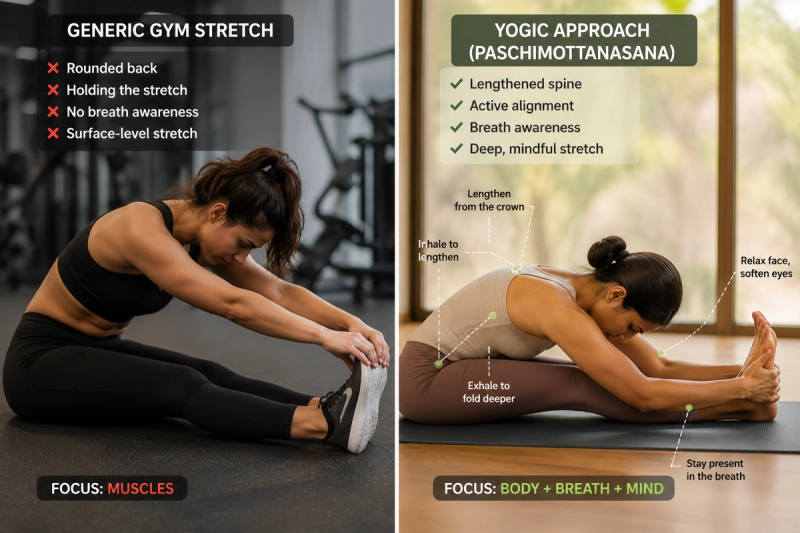
When you stretch, your primary goal is to elongate specific muscle fibers to improve a joint's range of motion. You hold a position for a set time, release, and move on with your day. It is purely mechanical, focusing entirely on the physical tissue and its elasticity.
Yoga demands something entirely different from your nervous system and your awareness. You are not just pulling on muscles; you are integrating your breath, your focused gaze, and your energetic alignment into every single posture.
Organizations like Yoga Alliance emphasize that true yoga is a comprehensive system of holistic health, not just a fitness routine. You practice to unite the mind and body, using physical shapes as a tool to access deeper states of awareness.
Stretching isolates a body part, asking it to perform a localized function. Yoga integrates the entire body, asking how your grounded foot connects to the crown of your head. This fundamental shift in intention dictates the entirely different results you will experience over time.
The Physical Impact: Yoga vs Stretching Difference Benefits Explained
You cannot fully grasp the depth of these practices without looking at what happens beneath your skin. Your body reacts very differently to mindful integration compared to isolated tension.
Muscular Engagement and Fascia
Standard stretching often targets isolated muscles in a passive state, attempting to pull them longer. While this is great for a post-run cool-down, it ignores the complex web of fascia holding your entire skeletal structure together.
Yoga asanas require active engagement, meaning you are building strength and mobility simultaneously. You engage opposing muscle groups to support the joints while you lengthen them, creating structural integrity. This prevents the hypermobility and joint destabilization that can sometimes occur from aggressive, passive stretching routines.
Breath-Syncing (Pranayama)
If you are holding your breath while touching your toes, you are simply stretching under stress. Yoga requires you to link every single micro-movement with an inhale or an exhale.
This conscious breathing signals your nervous system that you are safe, allowing the muscles to release tension organically rather than forcing them. To understand how powerful this breath connection truly is, you can explore the Pranayama Types Benefits Practice: 7 Proven Breathing Truths to refine your technique.
Mental and Spiritual Transformation
You will never find spiritual liberation at the bottom of a calf stretch. The mental landscape you cultivate during practice is the most critical differentiator.
Mindfulness over Mechanics
Stretching allows your mind to wander; you can plan your groceries or watch a video while lengthening your quads. Yoga demands your absolute, unwavering presence in the current moment.
You are tracking physical sensations, monitoring your breath quality, and observing your mental fluctuations without judgment. This rigorous mental discipline trains your brain to handle real-world stress with the same calm focus you use during a difficult balancing pose.
Nervous System Regulation
Because yoga integrates breath and deep focus, it actively shifts your body from a sympathetic (fight-or-flight) state into a parasympathetic (rest-and-digest) state.
Studies indexed by the National Library of Medicine show that mindful movement significantly lowers cortisol levels compared to standard physical exercise. You are literally rewiring your brain's response to stress, which is a core component of the Eight Limbs of Yoga Philosophy: 8 Ultimate Steps to Peace.
Exploring the Core Goals of Each Practice
Your intention dictates your outcome. When you engage in a stretching routine, your goal is usually tied to fitness: recovering from a workout, preparing for a sport, or fixing a stiff neck.
These are incredibly valid goals, and stretching is the perfect tool for mechanical body maintenance. However, when you step onto a yoga mat, the physical benefits are merely a byproduct of a much larger objective.
Yoga aims for self-realization, inner peace, and the balancing of your internal energy centers. You are using the physical body as a gateway to access and clear emotional blockages. If you are curious about how different physical styles achieve these deeper goals, exploring Hatha vs Ashtanga Yoga: 5 Best Ways to Avoid Confusion provides excellent clarity.
The Science Behind the Movements
Biomechanically, stretching often relies on the stretch reflex—a neurological mechanism that actually tightens a muscle when it is pulled too quickly. If you force a stretch, your body fights back.
Yoga bypasses this reflex through slow, deliberate movement and breath control, allowing the muscle spindles to relax safely. You are building active mobility, which is the ability to control your body through its full range of motion.
Passive stretching gives you flexibility, but without strength, that flexibility is useless and potentially injurious. Yoga builds the necessary muscular armor around your newly opened joints, ensuring your body remains resilient and functional.
How to Choose What Your Body Needs
You do not have to choose one over the other permanently; you simply need to know when to apply each tool. If you just finished a heavy lifting session and need to release lactic acid, a basic stretching routine is ideal.
If you are feeling mentally scattered, emotionally drained, and physically stiff, a yoga sequence is what your system craves. Listen to your body's subtle signals to determine whether you need a quick mechanical fix or a deep, integrated reset.
For those looking to commit to a structured routine, understanding a 100 Hour YTT Daily Schedule: 5 Best Ways to Prepare can help you see how seamlessly yoga fits into a balanced lifestyle.
Why Rishikesh? / Why This Matters
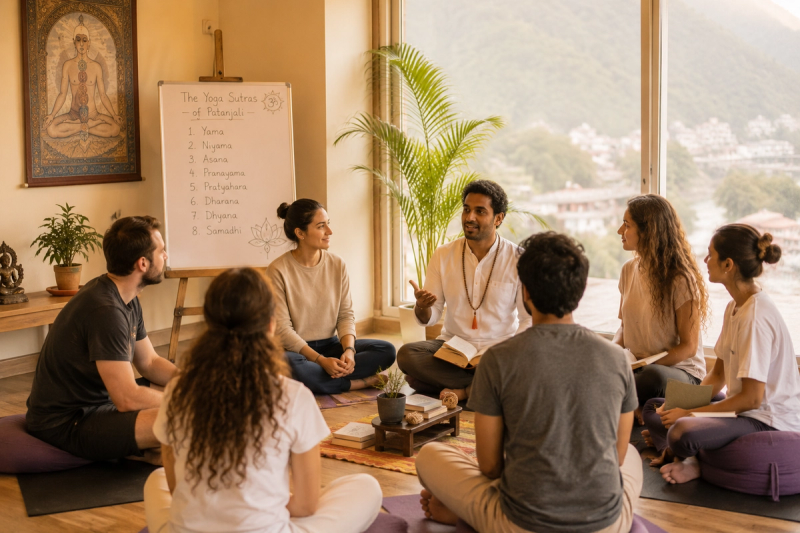
Practicing yoga in a gym studio is wonderful, but practicing at the source elevates your understanding completely. Rishikesh carries an energetic frequency that has supported spiritual seekers for thousands of years.
When you practice on the banks of the Ganges, surrounded by the Himalayas, the philosophy of yoga stops being an abstract concept and becomes a lived reality. You are removed from your daily distractions, allowing you to fully immerse in the mindful aspects of the practice.
The environment naturally forces you to slow down, breath deeper, and connect with the profound stillness that true yoga promises.
Soft CTA Section
If you are considering training in Rishikesh, we offer authentic guidance deeply rooted in traditional wisdom. You can explore our home page to get a feel for our community and our teaching style.
For those wanting a focused introduction to these life-changing practices, our 100-Hour Yoga Teacher Training provides the perfect foundation to deepen your personal practice safely.
FAQs
Can I do yoga if I am not flexible enough to stretch?
Absolutely. Yoga is not about touching your toes; it is about what you learn on the way down. Flexibility is a result of consistent practice, not a prerequisite for starting it.
Is standard stretching bad for my joints?
Not inherently, but passive over-stretching without building supporting muscle strength can lead to joint instability. This is why yoga's emphasis on active muscular engagement is crucial for long-term joint health.
How often should I practice to see the difference?
You will feel the mental benefits of breath-syncing immediately after your first session. For physical changes in mobility and strength, practicing three to four times a week yields excellent, sustainable results.
Conclusion + Strong CTA
The yoga vs stretching difference benefits ultimately come down to your intention, your breath, and your level of presence. Stretching maintains your physical vehicle, while yoga transforms the driver entirely. You now have the knowledge to step onto your mat with purpose, moving beyond simple flexibility into genuine holistic wellness.
Ready to begin your true journey? Explore our 200-Hour Yoga Teacher Training to master these practices, or join our immersive 5 Days Yoga Retreat to experience the magic of Rishikesh for yourself today.