.jpg)

Hatha yoga fundamentals 100 hour TTC explained: see what you practice in Rishikesh, from asana and pranayama to meditation and anatomy. Discover more today.
Hatha Yoga Fundamentals 100 Hour TTC: What You Actually Practice
Hatha yoga fundamentals 100 hour TTC training can look simple from the outside: postures, breathing, meditation, and a few hours of theory. But what you actually practice is more detailed. You learn how to work with alignment, breath, steadiness, concentration, and the relationship between effort and relaxation.
If you are considering a 100-hour course in Rishikesh, this guide will show you what Hatha practice can look like inside training rather than giving you another generic list of yoga benefits. You will learn which physical practices matter, how pranayama fits into the day, why bandhas and meditation are introduced, how anatomy and philosophy support practice, and what you should realistically expect from a 100-hour format.
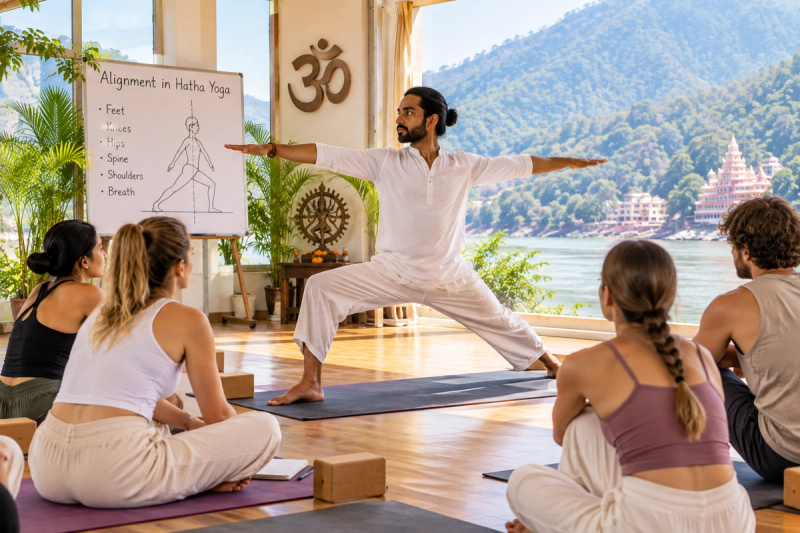
Hatha Yoga Fundamentals in 100-Hour TTC: The Foundation of Your Practice
A strong Hatha foundation is less about collecting difficult poses and more about learning how to practice with attention. In a 100-hour TTC, you may spend considerable time refining familiar postures instead of constantly adding advanced ones.
Your practice typically develops around several connected areas:
- Asana: learning stable, sustainable postures and transitions.
- Pranayama: coordinating breath, awareness, and controlled breathing techniques.
- Meditation: developing concentration and observing mental activity.
- Alignment and anatomy: understanding how joints, muscles, and movement patterns affect your practice.
- Yogic principles: connecting physical practice with broader ideas such as discipline, awareness, and balance.
The physical side can include standing, seated, forward-bending, twisting, balancing, and restorative postures. The emphasis is usually on how you enter, hold, breathe through, and release a posture rather than simply reaching its final shape.
A useful reference point for understanding teacher-training standards is Yoga Alliance, although a school's actual curriculum, schedule, teaching style, and contact hours can differ.
You should also expect repetition. That is not wasted time. Repeating a posture gives you a chance to notice whether your breathing changes, where you create unnecessary tension, and whether your alignment remains stable as you stay longer.
Hatha Yoga Practice in a 100-Hour TTC: What Happens on the Mat
The most obvious part of training is asana practice, but the real learning happens in the details.
You may begin with preparatory movements to mobilize the spine, shoulders, hips, ankles, and other major joints. From there, the session can progress into standing poses, seated work, balances, twists, backbends, or relaxation depending on the day's objective.
Alignment Is More Than Looking Correct
When you practice Hatha yoga in a teacher-training environment, you are not simply trying to copy the instructor's shape. You are learning to understand why a posture is organized in a particular way.
For example, in a standing posture, you may pay attention to the relationship between your feet, knees, pelvis, spine, shoulders, and breath. Small changes can alter where you feel effort.
This is where basic yoga anatomy becomes useful. You do not need to become a medical professional, but you should understand enough to recognize common movement limitations and avoid treating every body as if it needs the same alignment.
For a deeper look at movement and joint awareness, you can explore this related guide on yoga anatomy, muscles, joints, and safe alignment.
Holding, Breathing, and Releasing
Hatha practice often gives you time to stay with a posture. That creates a different experience from a fast sequence where you move before you have time to notice what is happening.
You may observe three things at once: physical effort, breathing quality, and mental response. If the breath becomes strained, you may need to reduce intensity. If the body is stable but the mind becomes restless, maintaining attention becomes part of the practice.
The goal is not to force yourself deeper. It is to develop enough awareness to distinguish productive effort from unnecessary strain.
Hatha Yoga Fundamentals in 100-Hour TTC: The Internal Side of Hatha Training
A 100-hour Hatha course should not feel like a posture-only workshop. Breath and attention are central because they change how you experience the physical practice.
Pranayama introduces controlled breathing methods and the discipline of observing how breathing affects your state. Depending on the curriculum and your level, you may encounter practices such as basic breath awareness, alternate-nostril breathing, or other traditional techniques taught progressively.
You should not judge pranayama by how dramatic a technique feels. Good instruction emphasizes preparation, appropriate technique, and knowing when a practice is unsuitable for you.
Bandhas can be another important part of the training. They are traditionally taught as energetic locks or engagements, but beginners also need practical instruction on how these concepts relate to awareness and muscular control. You may encounter practices involving the pelvic floor, abdominal region, or throat area, depending on the school's approach.
For a more focused explanation of this subject, see bandhas, yoga types, and how to practice them.
Meditation then shifts the emphasis from managing the body to observing the mind. You may practice breath awareness, concentration, mantra-based methods, or guided meditation. The important lesson is consistency: concentration develops through repeated practice, not through one unusually peaceful session.
These internal practices also help explain why Hatha yoga can feel demanding even when you are not doing advanced postures. Sitting still and maintaining attention can require as much discipline as holding a physically challenging pose.
Hatha Yoga Fundamentals in 100-Hour TTC: Anatomy, Philosophy, and Teaching Awareness
A useful teacher-training curriculum connects practice with understanding. You should know what you are doing, why you are doing it, and how to communicate it responsibly.
Anatomy gives you a framework for understanding movement. You may study basic skeletal structure, major muscle groups, joint actions, posture, and common alignment considerations. This knowledge helps you avoid simplistic statements such as one alignment rule being perfect for every student.
Yoga philosophy adds another layer. Concepts from traditional yoga texts can help you examine discipline, concentration, self-observation, and the purpose of practice. Philosophy should not feel detached from the mat. A useful class should give you opportunities to connect an idea with an actual experience.
Teaching awareness also starts developing even if the course is not a full 200-hour qualification. You may observe how an instructor gives demonstrations, uses verbal cues, manages transitions, and creates a safe learning environment.
You can also compare a structured 100-hour course with a shorter workshop by reading 100-hour YTT vs weekend yoga workshop. The difference is not only the number of hours. A longer format gives you more time for repetition, feedback, and integration.
For broader background on yoga as a traditional Indian system, Britannica's overview of yoga can provide useful historical and cultural context. Your teacher-training curriculum, however, should remain the primary source for what you will actually practice in class.
Why Rishikesh Matters for a Hatha Yoga Teacher Training
Rishikesh changes the context in which you practice. You are not simply attending a fitness class between other commitments. The city has a long association with yoga education, ashram traditions, spiritual study, and teacher training.
For you, the practical advantage can be immersion. A concentrated training schedule makes it easier to establish a daily rhythm: waking earlier, practicing, studying, eating more mindfully, resting, and returning to practice.
Location also matters because your environment can affect how consistently you engage with the course. In Tapovan and the wider Rishikesh area, you can find a mixture of yoga schools, retreats, cafes, wellness services, and quieter spaces for reflection.
That does not mean Rishikesh automatically makes a course better. The quality of your experience still depends on the teachers, curriculum, class size, accommodation, schedule, safety practices, and how well the course matches your goals.
If you want to understand the local setting before booking, this guide to Tapovan Rishikesh yoga and how the environment shapes practice can help you think about the location as part of your training decision. You can also review the school's official home page before comparing course details.
Choosing a 100-Hour Hatha Course: What You Should Check
Before paying a deposit, look beyond attractive photographs and broad promises about transformation.
Check what is actually included in the timetable. A serious course should make it reasonably clear how much time is devoted to asana, pranayama, meditation, anatomy, philosophy, teaching methodology, and other subjects.
You should also ask practical questions:
- How many teaching hours are included each day?
- Who teaches the core Hatha sessions?
- What is the expected experience level?
- How large are the practice groups?
- What accommodation and meals are included?
- How are injuries or physical limitations handled?
- Is the course designed mainly for personal practice, teaching development, or both?
- What certificate is awarded, and what does it actually represent?
If you are specifically comparing programs in Rishikesh, an honest review of a 100-hour YTT in Rishikesh can give you another perspective on what to consider before enrolling.
Most importantly, do not choose a course solely because it promises advanced poses quickly. A strong foundation should make your practice more intelligent, not simply more impressive. If you want broader teacher preparation, you can compare course structure with our 200-Hour Yoga Teacher Training in Rishikesh.

A Soft Introduction to Divine Yogpeeth
If you want to study these foundations in Rishikesh, our 100-Hour Yoga Teacher Training Course is designed for focused study of yoga practice, theory, breathwork, meditation, and related foundations in a structured setting.
The course can be relevant if you want a concentrated period of practice without immediately committing to a longer 200-hour program.
What You May Notice After Several Days of Hatha Practice
One of the clearest differences between reading about Hatha yoga and practicing it daily is that you start noticing patterns that are easy to miss in occasional classes.
You may become more aware of how you breathe when a posture becomes difficult, how quickly you rush through transitions, or how much tension you hold in areas that do not need to work. Those observations are useful because they give you something concrete to refine.
You may also notice that progress is not always measured by flexibility. Better balance, steadier breathing, improved body awareness, and the ability to stay attentive can be meaningful signs of progress.
A concentrated 100-hour format gives you repeated opportunities to observe these changes. You practice, receive instruction, rest, and return to the same principles from a different angle. Over time, the pieces begin to connect.
That is especially valuable if your goal is to continue into more advanced training. Instead of rushing toward complexity, you build habits that can support stronger practice later.
FAQs About Hatha Yoga Fundamentals in a 100-Hour TTC
Is a 100-hour Hatha TTC suitable for beginners?
It can be, depending on the school's entry requirements and teaching approach. You do not necessarily need advanced flexibility, but you should be prepared for regular physical practice, study, and a structured daily schedule.
Will I practice advanced Hatha yoga poses?
Not necessarily. A good foundation course should prioritize safe technique, awareness, breathing, and progressive learning. Advanced poses may be introduced only when appropriate for the group.
Is pranayama part of Hatha yoga teacher training?
Pranayama is commonly included in Hatha-oriented training, but the exact techniques and depth vary between schools. Ask for the actual syllabus rather than assuming every 100-hour course teaches the same methods.
Can a 100-hour TTC make me a yoga teacher?
A 100-hour course may provide valuable training and a certificate, but you should not automatically assume it carries the same qualification or registration pathway as a 200-hour teacher-training program. Check the school's certification details and the requirements relevant to where you intend to teach.
How physically demanding is Hatha training?
It depends on the schedule, teachers, and your current conditioning. Some sessions can be physically challenging, while others emphasize breath, mobility, meditation, or restorative work. Recovery, hydration, sleep, and communicating limitations to your teacher matter.
Conclusion: Build Your Hatha Foundation Before Chasing Complexity
Hatha yoga fundamentals in a 100-hour TTC are ultimately about learning how to practice with greater precision. You work with posture, breath, concentration, anatomy, philosophy, and self-observation so that your practice becomes more informed rather than simply more difficult.
Rishikesh can provide an immersive environment for that study, but the school and curriculum you choose still matter. Look for clear teaching hours, experienced instructors, realistic expectations, appropriate safety guidance, and a syllabus that matches your goals.
If you are ready to study these foundations in Rishikesh, explore our 100-Hour Yoga Teacher Training in Rishikesh and review the curriculum, schedule, and course details before making your decision. A strong practice starts with understanding what you are actually practicing.