.jpg)

Yin yoga teacher training 200 hour course explained: learn what Yin covers, how deep the training goes, and when extra study may help. Discover more today.
Yin Yoga Teacher Training 200 Hour Course: Is Yin Covered?
A yin yoga teacher training 200 hour course can introduce you to Yin Yoga, but it does not automatically mean you will graduate as a Yin Yoga specialist. The real question is not simply whether Yin appears in the syllabus—it is how much time you spend learning its principles, sequencing, anatomy, teaching methods, and modifications.
If you are considering a 200-hour course in Rishikesh, understanding this distinction can save you from choosing a program that sounds broad but does not match your goals. In this guide, you will learn what Yin Yoga usually means within foundational teacher training, what a 200-hour curriculum can realistically cover, how Yin differs from restorative practice, and when you may need additional specialist training.
Yin Yoga Teacher Training in a 200-Hour Course: What Can You Expect?
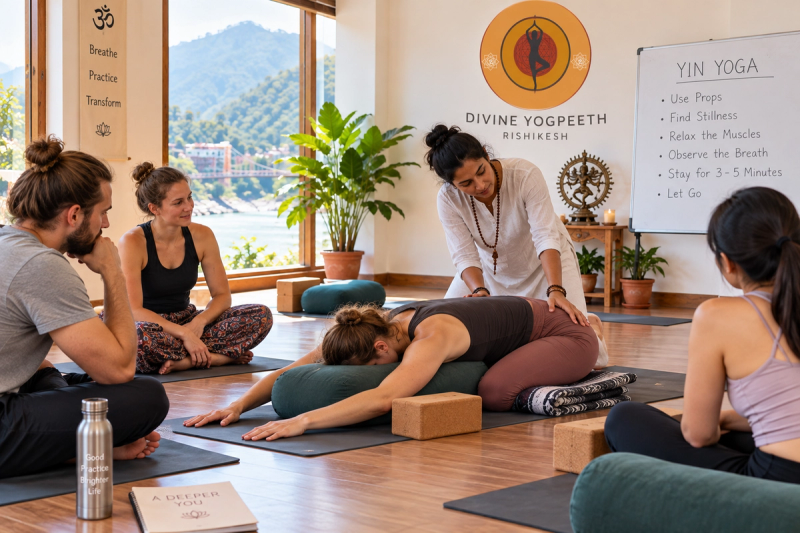
Yin Yoga is generally slower and more passive than styles built around continuous movement. You may stay in a posture for several minutes, using gravity, props, and relaxed muscular effort to explore areas around the hips, pelvis, spine, and legs.
That does not make Yin Yoga simply “easy yoga.” Teaching it well requires judgment. You need to understand range of motion, individual anatomy, comfortable sensation, appropriate use of props, and the difference between useful intensity and pain.
A broad 200-hour teacher training may introduce Yin concepts as part of its wider curriculum. Depending on the school, you might encounter:
- Foundations of Yin principles and terminology
- Longer-held seated, supine, or prone postures
- Basic sequencing and class planning
- Prop use and accessible variations
- Introductory functional anatomy
- Observation and teaching practice
- Differences between active and passive approaches
The depth varies significantly from one school to another. A 200-hour certification is usually designed to establish broad teaching foundations rather than make every participant an expert in every yoga method.
If you want to understand what a recognized yoga credential represents, you can review the Yoga Alliance website directly. You should still read the individual school's curriculum rather than assuming that a registration or certification label guarantees a particular amount of Yin instruction.
How Deeply Does a 200-Hour Yin Yoga Teacher Training Course Cover Yin?
The most useful way to judge Yin coverage is to look beyond the course title and examine the curriculum.
A strong foundation can give you enough exposure to understand how Yin differs from dynamic practices and how to teach simple sequences safely. You may learn why a posture is held longer, how to offer prop variations, and how to create a quieter class arc.
However, a broad course has limited hours. Those hours may also need to cover asana, pranayama, meditation, yoga philosophy, anatomy, teaching methodology, ethics, sequencing, and supervised practice. That means Yin may occupy only one component of the overall training.
What “covered” should mean
Before enrolling, check whether Yin is actually named in the syllabus. Then ask practical questions:
- How many contact hours are dedicated to Yin?
- Is Yin taught as theory, practice, or both?
- Do trainees teach Yin sequences under supervision?
- Does the anatomy section address prolonged passive positions?
- Are modifications and contraindications discussed?
- Is assessment based partly on teaching Yin?
These questions tell you much more than a generic phrase such as “multiple yoga styles included.”
If Yin is central to your professional goal, compare the syllabus with the teaching outcomes you want. You may find that a comprehensive 200-hour program gives you an excellent foundation, while a separate Yin-focused module is needed for deeper specialization.
Yin Yoga vs Restorative Yoga: Why the Difference Matters
Yin Yoga and restorative yoga can look similar from outside: both may involve props, fewer transitions, longer holds, and a calm atmosphere. But you should not treat them as interchangeable.
In Yin, you may intentionally explore a sustained sensation in a target area while allowing the body to settle into a posture. The emphasis is often on functional range and the experience of connective-tissue loading rather than muscular strengthening.
Restorative yoga generally aims to support deep relaxation with the body arranged and supported so that unnecessary effort is minimized. Props can be used extensively to make a position comfortable and sustainable.
That distinction matters when you teach. A student who expects restorative relaxation may interpret a strong Yin sensation differently from a student who understands the purpose of a longer-held Yin posture.
For a broader look at how a slower practice can fit into teacher training, you can also explore our guide to restorative yoga in a 200-hour TTC curriculum.
Your 200-hour training should help you recognize these differences rather than simply putting both styles under the label “gentle yoga.”
How anatomy changes your teaching
Anatomy becomes especially useful when you stop asking whether a student is performing a pose “correctly” and start asking what their body is experiencing.
Two people can look completely different in the same Yin posture because skeletal proportions, joint structure, flexibility, previous activity, and individual mobility vary. A useful teacher therefore needs options rather than one ideal shape.
You can also review our practical resource on yoga anatomy, muscles, joints, and alignment to build that broader perspective.
The Ministry of Ayush is another useful official source for broader information about India's traditional systems and yoga-related initiatives. It can provide context, but it should not replace your teacher-training curriculum or professional instruction.
What Should You Learn Before Teaching Yin Yoga?
If you plan to teach Yin after a 200-hour course, focus on skills rather than collecting style names.
First, you need observation skills. A Yin class can become unsafe when a teacher assumes that a deeper shape is automatically better. You should be able to notice discomfort, instability, breath restriction, or a student forcing a range that does not suit them.
Second, you need sequencing skills. A class should have a coherent progression rather than a random collection of long-held postures. The order, transitions, counterposes, and amount of stillness all affect the experience.
Third, you need communication skills. Longer holds give you more time to teach, but too much talking can work against the quiet quality of the practice. Clear instructions at the beginning of a posture can be more useful than constant correction.
Fourth, you need modifications. Props, alternative positions, and reduced range can make a posture more appropriate for different bodies.
You also need to know your limits. A foundational teacher training can prepare you to teach within your education, but it should not encourage you to diagnose injuries or replace medical care.
If you are building confidence as a new teacher, our guide on teaching your first yoga class can help you think through practical teaching situations.
Why Rishikesh Matters for Your Yoga Teacher Training
Rishikesh gives you an environment where yoga is not confined to a studio timetable. You may encounter different approaches through teacher trainings, workshops, ashrams, retreats, and conversations with practitioners from different countries.
That variety can be useful when you are deciding what kind of teacher you want to become. You can experience the difference between dynamic practice and slower work instead of learning every concept only from a textbook.
The location also matters because teacher training is immersive. When you spend several weeks practicing, studying, teaching, observing, and discussing yoga with the same group, you get repeated feedback. That is particularly valuable for learning how to sequence and communicate.
For international students, practical planning matters too. Before booking, check accommodation, food, course schedule, local transport, and what is included. Our Rishikesh yoga retreat guide for foreigners covers practical considerations that can also help you prepare for a longer stay.
Rishikesh should not be treated as a guarantee of teaching quality. The school, faculty, syllabus, supervised practice, and learning environment still deserve careful evaluation.
Choosing a 200-Hour Yin Yoga Teacher Training Course If Yin Is Your Main Goal
If Yin is your main reason for entering teacher training, compare programs using a simple checklist.
Curriculum depth: Look for specific Yin topics rather than a vague promise that “all styles” are covered.
Teaching practice: Reading about Yin is not enough. You need opportunities to teach, receive feedback, and adjust your instructions.
Anatomy: Ask whether the program treats anatomy as memorization or connects it to actual teaching decisions.
Faculty: Check who teaches the Yin component and what experience they have with slower practices.
Course scope: Remember that a 200-hour program has to cover many foundations. If the Yin portion is small, decide whether that is acceptable for your goal.
Next-step education: Find out whether the school offers additional modules, workshops, or specialist training that can deepen your knowledge later.
For a broad foundational route, you can review our 200-hour Yoga Teacher Training in Rishikesh and compare its curriculum with your own Yin-specific learning objectives.
If you are not ready for a full 200-hour commitment, a shorter 100-hour Yoga Teacher Training program may also be worth comparing, depending on your experience and intended teaching path.
A Practical Path from 200-Hour Foundation to Yin Specialization
You do not have to make your entire career about one style on day one.
A practical route is to use your 200-hour training to develop strong fundamentals: anatomy, sequencing, teaching language, observation, pranayama, meditation, ethics, and regular personal practice. During that training, pay close attention to the Yin sessions and keep notes on what interests you.
After certification, teach only within the scope of your education and continue studying. A Yin-focused workshop or specialist course can then deepen areas that a general 200-hour curriculum could only introduce.
You can also explore adjacent skills. For example, learning how sound-based practices are structured can broaden your understanding of relaxation-focused sessions; our Sound Healing Training Course is one option you can review if that direction interests you.
The important point is sequencing your education sensibly. A broad foundation first, followed by targeted specialization, can be more realistic than expecting one certification to make you an expert in every style.
Train in Rishikesh with a Clear Yin Learning Goal
If you are comparing teacher trainings in Rishikesh, our Divine Yogpeeth yoga school in Rishikesh is one option to explore. We encourage you to compare the curriculum, teaching hours, faculty, accommodation, and practical components against what you specifically want from your training.
A useful question to ask before enrolling is simple: “After these 200 hours, what will I actually be able to teach confidently?” That question keeps your decision focused on skills rather than marketing language.
FAQs About Yin Yoga Teacher Training and 200-Hour Courses
Is Yin Yoga included in every 200-hour yoga teacher training?
No. Curricula differ between schools, and even when Yin is included, the number of hours and depth can vary. Always check the published syllabus and ask the school how much Yin theory, practice, sequencing, and teaching assessment are included.
Can you teach Yin Yoga after completing a 200-hour course?
You can teach what you are properly trained and competent to teach, but a general 200-hour qualification does not automatically make you a Yin specialist. If Yin is your primary teaching focus, additional education and supervised practice can help you develop greater depth.
Is Yin Yoga difficult to learn?
The physical practice may look simple because postures are often held for longer and there are fewer transitions. Teaching it well is more nuanced. You need to understand individual differences, appropriate intensity, props, communication, sequencing, and when to modify or stop.
Should you choose a Yin-focused course instead of a 200-hour YTT?
That depends on your goal. If you want broad teacher foundations and Yin is one area of interest, a 200-hour course may make sense. If your main professional goal is specifically Yin teaching, compare specialist programs and check whether the 200-hour course gives enough Yin depth for what you want.
Can you learn Yin Yoga in Rishikesh?
Yes, you can encounter Yin and other yoga approaches in Rishikesh, but the quality and depth depend on the individual school or teacher. Evaluate the curriculum, faculty experience, teaching practice, and course structure rather than choosing a program based on location alone.
Conclusion: Is a 200-Hour Course Enough for Yin Yoga?
A yin yoga teacher training 200 hour course can be a strong starting point for Yin Yoga, but “included” and “specialized” are not the same thing. Your best indicator is the actual curriculum: how much Yin you practice, how deeply you study anatomy and sequencing, and how much supervised teaching you receive.
If your goal is to become a well-rounded teacher with Yin as one part of your toolkit, a broad 200-hour course can give you useful foundations. If you want Yin to become your primary specialty, plan for continued study after the foundational certification.
Ready to build that foundation in Rishikesh? Explore our 200-Hour Yoga Teacher Training and compare the curriculum with your Yin-specific goals before you enroll.